Page 2 of 3

Day 15: Dishpan Cookies

“Oh, taste and see that the Lord is good!” Psalm 34:8

One of my husband’s fondest memories of his childhood centered around Christmas and baking.  In the first weeks of December, his mother would spend her days baking delectable cookies and bars, storing them in the freezer till Christmas.  Terry would spend the month counting down the days till Christmas break, because only then would his mother bring out the cookie treasures to share with her boys.  Then, for the next two weeks, they could indulge in chocolate and sugar, while playing games as a family.  For a young boy with a sweet tooth, this was as good as anything found under the tree!

This cookie recipe has been in Terry’s family cookie repertoire since he was about 8 years old.  The original recipe made so many cookies that you needed a dishpan to mix the dough, hence its name!  This year as I was composing my cookie list, I thought about changing the name of the cookie to make it sound more appealing.  My daughter protested, saying that, although the name is not regal, it makes the cookie even more astounding.  Honestly, when it is placed on the tray of all the other cookies I make, the simplicity of the cookie gets lost in the chocolate, butter, candy, and nut explosions.  Yet, I have had people dare to take a bite and declare this cookie, a gooey concoction of oats and Corn Flakes, is one of their favorites!

*A few notes on the recipe below.  This cookie doesn’t freeze well, so I typically make it within a few days of consumption.  It’s a great cookie to have with coffee.  Also, splurging on Kellogg’s brand Corn Flakes is a must!  I have tried the cheaper corn flakes before, and the cookie does not taste quite right.  Finally, the dough is definitely worth snitching.

Collins’ Dishpan Cookie

2 c. sugar                                                                             2 c. brown sugar

2 c. canola oil                                                                     4 eggs

2 t. vanilla                                                                            2 t. baking soda

1 t. salt                                                                                 1 ½ c. quick oats

4 c. flour                                                                              4 c. Corn Flakes, crushed by hand

Combine both sugars, eggs, oil, vanilla, salt, and baking soda.  Mix well and then add remaining ingredients, one at a time.  Bake at 325⁰ for 8-10 minutes.  Cookies are done when lightly browned around the edges.  It is normal for them to flatten out when cooled.

Day 14: You’re a Mean One, King Herod

“Now the God of hope fill you with all joy and peace in believing, that ye may abound in hope, through the power of the Holy Ghost.”

Romans 15:13

The sickly green Grinch and his sly, wicked plans of stealing Christmas from the innocent Who'”s has captivated our home since our children were little.  As Christmas traditionalists, we prefer the 1966 animated version, as opposed to the recent attempts to modernize this Christmas fairy tale!  I still gasp when the mean Grinch steals the roast beast and the last can of Who Hash!  (By the way, what is roast beast?)  I, too, lean into the screen and listen intently with the Grinch to see if his efforts to steal Christmas have succeeded.  As soon as the first notes of music are heard from Whoville, my heart also swells three sizes bigger as the Grinch realizes that the true meaning of Christmas does not come from packages, boxes, or bags!

Like the Grinch, King Herod, a political figurehead set up by the Roman government, tried to stop Christmas from coming.  With the arrival of the wise men in Jerusalem looking for the birth of a king, Herod consulted the chief priests and scribes, learning about the messianic prophecy.  Recognizing that these prophecies threatened his status and power, he struck a deal with the wise men, hiding his true purposes.  His plan failed when the wise men and Joseph were warned in dreams to avoid Herod.  Yet, Herod was determined to stop the Messiah, killing any baby boy born in the Bethlehem vicinity that was two years and younger!  His killing spree ended the lives of many children and the hopes of many parents.  However, despite his diabolical efforts, Herod could not stop Christmas from coming!  Today, COVID-19, death, controversial elections, family difficulties, job losses and heartache may be making attempts to keep Christmas from coming, taking our joy and hope with it!  But like the first Christmas, Jesus lives, and his life not only provided hope for those parents whose lives were directly impacted by Herod, but for us today as well!

Day 13: Family Tree

“The book of the generation of Jesus Christ, the son of David, the son of Abraham.” Matthew 1:1

In the last few years, my husband has been doing research on his ancestry.  He has been able to trace one line of his family back to English nobility and has been able to view the ruins of a castle in which they once lived.  As surprising as this information was, he later found, in a different family line, a member of his family who ended up in prison for murder in the 1800’s.  His family tree is reflective of all our family trees.  We might have some great ancestors who have accomplished amazing feats, while, at the same time, we might have some branches we wish we could cut from the tree!

One of the most interesting accounts of the birth of Jesus is recorded by Matthew.  It doesn’t start with angelic visits or the manger scene, instead it carefully lays out the lineage of Jesus beginning with Abraham, the first person to enter into a covenant relationship with God, through King David, a man after God’s own heart, and ending with Joseph, Jesus’ earthly father.  What is revolutionary about this family tree is that Matthew records four different women as part of Jesus’ ancestry.  Remember, at the time Matthew wrote this, women were not considered important or significant.  Yet, not only did Matthew record four women in the lineage, but these were scandalous women involved in adultery, murder, deceit, prostitution, and discrimination!  Most of these women were not terrible people, but victims in a society that treated them as less than human, broken by situations that were, often, were not of their own creation!  Matthew chose not even to name one of the women, referring to her as the wife of Uriah, the man that was killed due to her act of adultery.  She was so insignificant that, generations later, her very name remained shunned!

But isn’t this lineage representative of who Jesus came to save: those of us who are shattered and broken by sin?  While we are complicit in some sins, other sins are perpetrated upon us, leaving us marred by its effects!  He came to save those whom society has deemed insignificant!  He came to redeem those whose reputations have been destroyed!  So when I read the names of Tamar, Rahab, Ruth, and Bathsheba (the wife of Uriah), I am reminded that, “after you have suffered a little while, the God of all grace, who has called you to his eternal glory in Christ, will himself restore, confirm, strengthen and establish you.” (1 Peter 5:10)!

Day 12: The Most Wonderful Time of the Year

“For unto us a child is born, unto us a son is given: and the government shall be upon his shoulder: and his name shall be called Wonderful, Counsellor, The mighty God, The everlasting Father, The Prince of Peace.” Isaiah 9:6

While I was pregnant with my first born, I fully expected the baby to emerge with red hair like my husband’s.  After my son was born, I was surprised to see he had dark hair and that his complexion was like mine.  During my second pregnancy, we knew we were having a little girl, and I expected her to favor her older brother.  Again, I was surprised when my beautiful blond-haired, blue-eyed daughter was placed in my arms.  Although my predictions were wrong, my beautiful babies far exceeded any expectations I had!

Unlike my own flawed track record, Isaiah was 100% accurate in his prophecies relating to the Messiah as recorded in the Bible.  Some of these prophecies included details like “Behold, a virgin shall conceive” and he would be “heir to King David’s throne.”  Isaiah’s prophecies were astonishingly accurate considering that they were written seven hundred years prior to the birth of Jesus!  In Isaiah 9:6, he also expounded on the nature of the baby by proclaiming attributes or titles that the future Messiah would possess, including that he would be “Wonderful”.  Wonderful, in Hebrew, is “pele”, defined as wonder, marvel, extraordinary, or hard to understand.  Jesus’ birth was amazing, not only because of all the prophecies it fulfilled, but also for what it signified.  And Advent is a time for us to embrace this knowledge.  In The Greatest Gift, Ann Voskamp says, “The message of Christmas is that this world’s a mess and we can never save ourselves from ourselves and we need a Messiah.”  Over two thousand years later, our need for that precious baby, whose birth fulfilled all of Isaiah’s Messianic prophecies, still holds true.  And I believe, if Isaiah could have seen the results of Jesus’ life, He would have declared this “the most wonderful time of the year!”

Day 11: The Christmas Pickle

“Seek the Lord and his strength; seek his presence continually!”

Psalm 105:4

We have a pickle on our tree.  No, it is not a juicy kosher pickle you find in Jewish deli, but rather a blown glass pickle I believed was derived from an old German legend.  According to the legend, parents in Germany would decorate the tree on Christmas Eve and hide a pickle among the branches.  The next morning, the observant child who found the pickle would get another gift from St. Nicholas.  Unfortunately, this legend has turned out to be an urban myth.  There is a possible link to John Lower, a Bavarian immigrant, who was imprisoned during the Civil War, surviving on pickles during his imprisonment.  He later decorated his tree every year with a pickle in honor of the food that had sustained him.  Later, some merchants capitalized on this idea by asking some famous German glass blowers to create a pickle ornament.  No matter where the legend came from, this little pickle has captured the attention of every child who has entered my home, providing a perfect game of hide and seek during the holidays.   One year, the game got so competitive, we didn’t find the pickle until weeks later when we took our tree down!

Just like children who search for the pickle on the tree, many of the characters in the scripture were searching for the Messiah, including the shepherds, wise men, and Simeon.  Only the shepherds were given a clear direction, while the wise men followed a star for hundreds of miles and Simeon was told by the Holy Spirit that within in his lifetime, he would meet the Messiah.  Their searching is a reminder that I need to spend time seeking God.  Scripture declares that seeking God will not only open my understanding of His character, but also that it will result in leaving me fulfilled.  This Advent, I want to spend some time not just reflecting on the birth of Jesus, but truly seeking Him, and growing in my knowledge and faith.  And, unlike the pickle, my searching will always result in finding God.

Day 10: Fear and Linus’ Blanket

And the angel said to them. “Fear not, for behold, I bring you good news of great joy that will be for all the people.” Luke 2:10

As a child, the TV guide was a highlight of my Christmas season.  Unlike today, children of the 70s and 80s had one shot at watching Rudolph, Frosty or Charlie Brown.  The TV guide was your only path to walking in a winter wonderland of cartoons!  Although I have outgrown Rudolph, A Charlie Brown Christmas remains one of my favorites.  Charlie Brown’s dilapidated tree choice and his attempt to produce a Christmas pageant has enchanted the airwaves since 1965.  Besides the simplicity of the animations, Linus’ inspirational recital of Luke chapter two, the most popular portion of Christmas scripture, seems contrary to today’s secularization of cartoons.  Yet, even in 1965, the producers of the cartoon were hesitant to air the special because of its spiritual message.  Charles Schulz, the creator of the Peanuts strip, was adamant about including the true meaning of Christmas, responding to the producer’s concerns by saying, “If we don’t do it, who will?”  Schulz’s convictions proved to be right, earning the special a Peabody Award along with Emmy and Grammy nominations!

Recently, it was brought to my attention that Charles Schulz arranged for Linus to have a significant moment during the special!  For those of who you are unfamiliar with Charlie Brown, his friend, Linus, carries a blanket wherever he goes.  Even when his peers make fun of his security blanket, Linus clasps his blanket in defense, sometimes using it as a prop or a tool.   During the Christmas special, Charlie Brown desperately asks his peers if anyone knows what Christmas really means.  Clutching his blanket, Linus declares he knows, takes center stage, and begins quoting the Bible.  When Linus gets to the portion where the angel tells the shepherds to “Fear not”, Linus drops his precious blanket and continues his recitation.  This symbolic act of Linus reminds the audience that they have nothing to fear when Jesus is present!

Copyrighted image by ABC

This past week, I talked to four different women facing some intense challenges including job loss, family struggles, working in the medical field during a pandemic, and health issues.  All of them were struggling with feeling anxious and overwhelmed by their situations, with undercurrents of fear.  I can empathize with these women because their feelings are normal in this fallen world.  But, like Linus, we can each let go of our “security blanket”, whether it is eating, shopping, or whatever else we use to self-soothe during these fearful moments.  Instead, like the shepherds who went to see the newborn baby, we can spend time in the Bible getting to know Jesus more intimately than before.  And, as we read, the angel’s message echoes across the centuries that, “I bring to you good tidings of great joy!”

Day 9: The Revolutionary Magnificat

And Mary said. “My soul magnifies the Lord, and my spirit rejoices in God my Savior” Luke 1:46-47

I would venture to say all major art museums of the world have at least one painting that depicts Mary, the mother of Jesus.  Whether it is a halo around her head, or her calmly holding a baby, Christians are fascinated with this woman portrayed in scripture, with some denominations raising her to the status of sainthood.  Yet, when looking at the scriptural accounts of Mary, she was just an ordinary teenage girl, preparing for her future marriage, when the Angel announced to her about miracle that she was about to birth.

I am spending some time this Advent season studying Mary’s song recorded in Luke 1:46-55, historically referred as the “Magnificat”.  This was recorded after she had had some time to adjust to the idea of being pregnant and the potential scandal it would create.  It is also likely she had told Joseph and, although the timeline is not clear, she may not have known how he was going to respond to her situation.  Yet, as Mary sang this praise, she appears to be confident in God saying, “My soul glorifies the Lord, and my spirit rejoices in God my Savior.”  This does not sound like a girl who was terrified of her future, but rather a girl with a deeper understanding that what was growing in her body was about to revolutionize the world!  She continues later in her song to say, “for the Mighty One has done great things for me, holy is his name.  His mercy extends to those who fear him, from generation to generation.”  The song continues to revolutionize how society views leadership by saying, “He has brought down rulers from their thrones but has lifted up the humble.  He has filled the hungry with good things but has sent the rich away empty”.

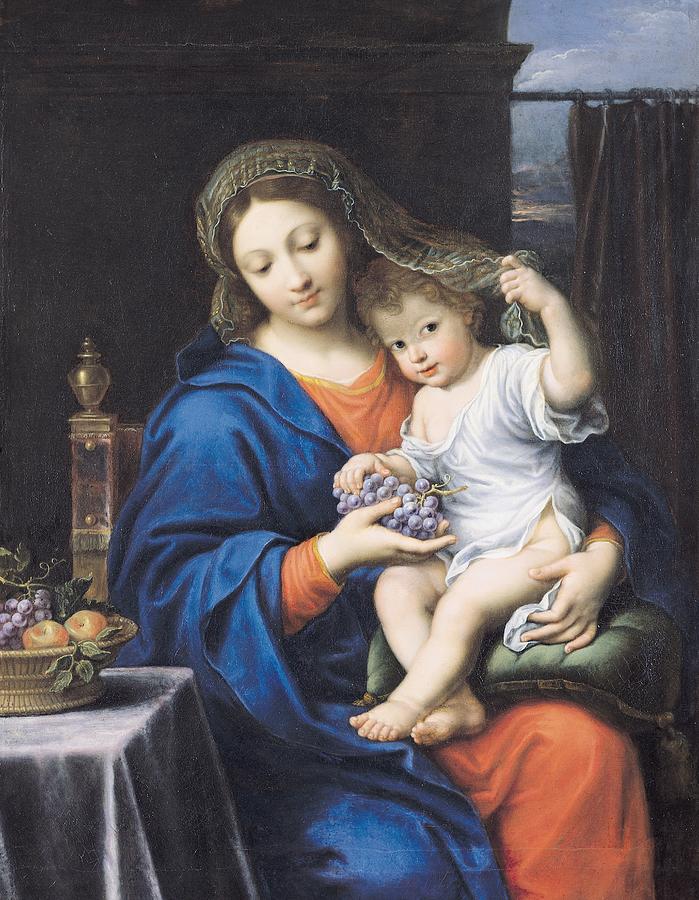
Painting done by Pierre Mignard, titled “Virgin of the Grapes”, found in the Louvre, Paris.

Remember, this was being sung by a teenage girl who had no status in her society and was considered property.  This piece of scripture was so transformative that it is often used by oppressed groups and banned by totalitarian governments!  Dietrich Bonhoeffer, a German theologian executed by the Nazis, called the Magnificat “the most passionate, the wildest, one might even say the most revolutionary hymn ever sung.”  Today, Christianity is often viewed as an ancient way of thinking or even worse, oppressive.  But just like Mary sang, I too sing how Jesus transforms the most unlikely lives and sets free those who are captive.  And, like Mary, I recognize that the birth of Jesus has revolutionized our world!

Day 8: Christmas Playlist

“My lips will shout for joy, when I sing praises to you; my soul also, which you have redeemed. ” Psalms 71:23

Our family loves Christmas music!  In fact, we often break out the tunes mid-November and continue non-stop throughout Christmas, much to the dismay of the Scrooges around us.  As a family, we have some strong opinions.  I know some of you might find that shocking!  Some of us are strictly traditional and would prefer Bing, Frank and Dean to croon all of our favorites, while others enjoy newer favorites like Amy Grant, Pentatonix, Michael Buble’ and Seth McFarland.  We have even been known to debate who has the best rendition of some classics like “O Holy Night” and cover our ears to those who have failed miserably!

Photo credit to Margaret Collins

In my research about Advent, I found it interesting that our traditional Christmas hymns like “Joy to the World” and “Hark the Herald Angels Sing” were not sung in churches until Christmas day!  Instead, the traditional music of Advent focused on anticipating His coming with songs like “O Come O Come Emmanuel”.  I also learned that Christmas music drastically changed in the 1940’s and 1950’s, when most new music written focused on the secular nature of Christmas.  Now, I love Bing’s famous rendition of “White Christmas” and I am not opposed to singing “Deck the Halls”, but this research made me a little more conscientious about my music choices during Christmas.  I am choosing to be more intentional about my playlist, pausing a few moments to worship during some of the beautiful Christmas hymns and paying more attention to the lyrics.  I have also spent time listening to some modern Christmas hymns, like First Call’s “Heaven’s Coming Down” and Amy Grant’s “Emmanuel”.  This intentional playlist has kept me focused on Advent!  Yes, if you peeked in my windows, you might still see me bopping around to “Rocking Around the Christmas Tree”, but you might also see me worshiping to “Silent Night”!

For a little Christmas fun: my daughter took the following five pictures of Christmas songs, displaying her creativity. Share these pictures with your family and see if you can guess the songs. Feel free to make your guesses in the comments of the blog. I will share the answers in a few days!!!

Day 7: The Lamb in Bethlehem

“The next day he saw Jesus coming toward him, and said “Behold, the Lamb of God, who takes away the sin of the world!” John 1:29

Before I deck the halls with my tree and ornaments, the first Christmas decoration I like to put out is my nativity set.  Although it in no way represents the scene accurately, its’ simplicity and the message it depicts set the stage for the rest of the house.  I do not have an elaborate mantle on which to place my nativity, instead it sits on a simple yellow table in the dining area of my kitchen.  It’s just a simple piece of furniture, but it has a special significance for me.  I purchased it from my first pastor, Rev. Louis Wasmundt, who has since passed away.  Both the table and nativity scene remind me of my roots in the Christian faith.

It’s ironic that most of us try to find the most prominent place in our homes for our nativity, yet Jesus was born in one of the most insignificant places, an animal stable.  Unlike the smooth, polished wood of my nativity, this stable was a straw-filled cave.  Yet, this “insignificant” place had much more history behind it than what first appears in scripture.  In the last few years, I have heard messages from two different ministers that researched the place of Jesus’s birth.  They both concluded that this was not likely an ordinary stable, but the stable where spotless lambs were separated and kept to later be offered as sacrifices in the temple in Jerusalem.  Jesus, the ultimate sacrifice, was born in a place where innocent lambs were being prepared for sacrifice.  In no way is this a coincidence, it has the fingerprints of God all over it!  About thirty years later, John the Baptist also recognized the significance of Jesus by announcing to the crowd in John 1:29, “Look, the Lamb of God, who takes away the sin of the world.”  In essence, His birth was the preparation for the final atonement for all sin, including mine!

Photo credit by Margaret Collins

Whether your nativity sits prominently on your mantle, or in a humble corner of your kitchen, what it represents is far more significant than any craftsmanship can display.  It’s not a symbol of a simple children’s Bible story, but an epic full of details that only God could arrange so perfectly!

If you want to here more about this significant birth, I have linked Raymond Woodward’s messages about the birth of Jesus here.

Day 6: Let it Go

“a time to seek, and a time to lose, a time to keep, and a time to cast away” Ecclesiastes 3:6

My husband and I started a family tradition the first year we were married.  We bought each other a special ornament to place on our tree.  As we added to our family, we also added ornaments to our tree.  Sometimes, the ornaments represented what we were interested in at the time, like my son’s billiard ball and my daughter’s kayak.  Other times, the ornaments were picked because they sparked joy in our lives, like my husband’s globe and my blue Volkswagen with a wreath on top!  Every year, as we unpack our ornaments, we are delighted to place our treasures on the tree.  After my son was married, I gently packed up Ethan’s ornaments, and gave them for him to put on his own tree.  Teary eyed, I handed a piece of his childhood over to him, knowing that he would be creating his own traditions with his family.  I could not hang onto the past, I had to let go.

Sometimes, the Christmas season can seem overwhelming with its demands and obligations.  Years ago, I stressed myself and my family by trying to participate in every wonderful experience Christmas had to offer.  After some tears of frustration on my part, I realize that this speed was not good for our family dynamic, especially when you have two strong introverts, so I decided to let go!  We would not read every favorite Christmas book, or watch every Christmas movie, or participate in every Christmas activity.  Instead, we did what we could and let go of the rest.  Some years, we fit more into the season, other seasons we did less.  It made Christmas manageable.

Photo credit to Margaret Collins

This Christmas, my schedule is already a lot more open than usual due to the pandemic.  But rather than letting go of activities, I am choosing to let go of disappointments.  I am focusing more on letting go of frustrations and sadness about situations the pandemic has forced upon me.  Not only does my schedule need to be manageable, but my heart needs to be peaceful during this season.  Ask yourself if there is anything you need to let go of this season.