
 by
by “Strive for peace with everyone, and for the holiness without which no one will see the Lord.” Hebrews 12:14
It’s October, one of my favorite months. The bright sun magnifies the red, orange, and yellow leaves, painting the warm hues across the landscape. The days may be warm, but the temperatures drop in the evenings, making cozy sweatshirts, bonfires, and hot apple cider perfect ways to end the day. It seems the perfect time to read an Edgar Allen Poe story with a plush throw puddled in your lap. Pumpkins of all sizes, shapes, and colors accent doors and porches, while pumpkin spice infiltrates coffee, pies, and pancakes. October quotes abound including a new favorite of mine by writer John Nichols, “October is a hallelujah! Reverberating in my body year-round.”
But while some celebrate, there are also the naysayers who hate October or some elements of what the month signifies. Though many embrace pumpkin spice and everything nice, there is a large contingent of people who hate that flavor and share memes expressing their disgust. There are others who see Fall as a sign of the world dying and get either depressed or angry as the days get shorter. And probably the most contentious symbol of fall is the sugary confection, candy corn.
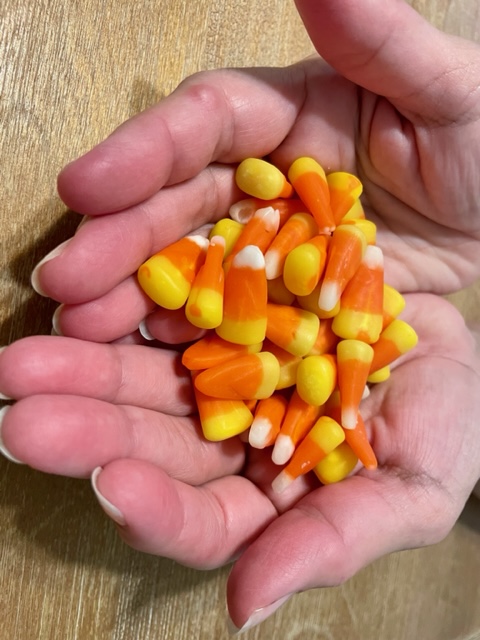
I love candy corn! I am not going to try to sell you on its flavor as it has little beyond the sweetness of candied sugar with a touch of vanilla and a hint of marshmallow. But this kernel-shaped candy lures me in every year. It is nostalgic for me, a candy that appeared in teacher’s bowls or parties during the month of October. And I am particularly partial to the corn shape, always rejecting the exact same candy in the shape of pumpkins. Despite its abundance on store shelves, many people despise it. But I am not alone; 35 million pounds of candy corn are sold every year, making me not as much of an outlier as one might think.
After some internet research, I found some interesting facts about candy corn. Along with Hershey, Peeps, and Reese’s, candy corn was first created in Pennsylvania where I live. In the 1880’s, farmers made up half of the American workforce. Candy companies decided to form candy in the shape of turnips, pumpkins, and corn to appeal to farmer’s children. Corn was not a vegetable many Americans ate, instead it was considered chicken feed. But the iconic tri-color candy caught on and became known as “chicken feed candy.” Before automation, it required people to work together to pour the syrup into the molds. And, until it was heavily marketed for Halloween in the 1950s, children snacked on it all year round.
Another candy that gets a lot of love during the month of October is Reese’s Peanut Butter Cups. In the shape of ghosts or pumpkins, shelves are filled with this iconic American candy waiting to be handed out at doors to trick-or-treaters. Despite serious peanut allergies, it still finds itself in the number one or two spot in sales. It’s often considered everyone’s favorite, except for me. I am not allergic to peanut butter, and often will eat peanut butter and jelly sandwiches for my lunch. Granted, I upscale it with all-natural peanut butter and my own homemade freezer jam. I am not opposed to all chocolate and peanut butter combinations, loving energy bites and the occasional chocolate ice cream sundae with peanut butter topping. But I have never liked Reese’s Peanut Butter Cups. Based on the famous commercials, as a child I was enticed to take a Hershey bar and dip it into peanut butter, hoping to have a look of ecstasy cross my face like I had seen on TV. Instead, I found the combination lackluster. When I mention my dislike of Reese’s, gasps follow along with questions about my taste buds and my sanity. I just shrug and think this may not be the wisest time to mention my love for candy corn.
I recently saw a tea towel that made me laugh. The tea towel has nine pieces of candy corn with a word written on most of them. The words combine to form the sentence “You don’t have to be everyone’s favorite.” At first, I thought, I no longer need to convince everyone that candy corn is good, nor do I have to defend my choice to buy a bag of candy corn. But the more I thought about the statement, the deeper this simple truth resonated with me.
Like candy corn, I don’t have to be everyone’s favorite. And more importantly, I don’t have to compromise my boundaries or beliefs to stay in everyone’s good graces. For many years, I found myself trying to appease others and “fix” situations so that I would not be seen as offensive or difficult. In other words, I spent a lot of time pleasing others. I didn’t know how to express anger well or set healthy boundaries that protected me. And often I found myself becoming smaller, spending more energy pressing myself into a mold that I did not fit.
In the last two years, I have been learning to set healthier boundaries. I am learning that saying “no” is okay. I am learning to address times when I feel I have been treated unfairly or unkindly. I am learning to express anger in a healthy manner and am choosing not to grab the extinguisher every time a fire flares up in a relationship. And the weight of trying to manage other people’s emotions so they would like me has been lifted, giving me a sense of freedom I have never felt before.
A few months ago, I woke up to a series of texts alerting me to a post someone made on my social media. The post sarcastically maligned my character. This resulted in some drama, with those who love me standing up for me. My instinct was to ignore the incident, recognizing that hurt people try to hurt others. Instead, I opened a conversation with the person, who responded with an unwillingness to talk and more accusations. At this point, I would have cowered and made every effort to appease and apologize for something that I hadn’t even done. In the past, I was desperate to stay in their good graces by taking responsibility for something that wasn’t my fault. But three other people who love me well reminded me that I didn’t deserve to be treated like this. And that I should stand up for myself. I closed the conversation and moved on. I pray that, someday, we can come to some sort of closure. But this problem isn’t mine to fix.
I don’t have to convince everyone to like candy corn, or why my dislike of peanut butter cups is valid. I also don’t have to convince everyone to like me by changing who I am or taking responsibility for things that I don’t need to own. But this requires me to sit in a space where things can be uncomfortable, where I don’t respond to every text, and where I don’t have to fix everything. It requires me to pause, pray, and ask for God’s guidance. It’s finding the balance of being a Christian with pursing peace, long-suffering, and kindness in conjunction with the recognition not everyone is going to like me. And while it’s hard, it is also okay to not be everyone’s favorite.
 By Sherry Collins
Leave a comment