 by
by “Remember the Sabbath day, to keep it holy.” Exodus 20:8
As I was beginning my parenting journey, I ran across a recommended book, The Plug-In Drug, written by Marie Winn. The book, although dated, proposed that television disrupted family life and hindered the imagination of children. It suggested that children’s developing brains became addicted to television and had a hard time transitioning into other activities. She mentioned that some children started to gaze dazedly, becoming slack jawed when watching a screen.
While reading the book, I observed both my children, with glazed eyes, watching a video that I deemed educational. Although I limited the kinds of media they watched, along with the amount they watched, I realized that even within my limits, my children, ages 2 and 3, were on their way to being addicted to a screen. With the support of my husband, I did a radical intervention. I took a piece of butcher block paper, taped it to the television with the words “No TV October.”
The first week was challenging, some for the children, but far more for me. Yes, they whined a little bit, but I redirected them to a different activity, and they quickly moved on. I found the time while I was prepping dinner the most difficult, where they both wanted my constant attention or needed my intervention. In the past, I plopped them down in front of a television as a “babysitter” while I made dinner. Without my babysitter, I had to help them develop ways of entertaining themselves while I chopped onions or grated cheese. And this training took time and patience on my end.
After the month-long challenge, the paper came down, but the television stayed off. Our family had developed new rhythms, and we didn’t need the television. Instead, we spent time as a family playing games, putting together puzzles, and reading. We still watched movies, but this was an outlier instead of a regular occurrence.
I am not judging anyone for their family’s decisions on how to handle screens. My approach was right for me and my family at that point in time. I didn’t handle all screens with the same diligence as I had with the television screen. I was ignorant about the internet and some of the dangers it posed to my children, therefore, was not as careful. And finally, children and screen use are not the point of my post, because I am writing about my own screen addiction. Yes, I am addicted to my screen.
Years ago, I stated unequivocally that I was never going to go on Facebook or have a smart phone. I saw Facebook as a place for people to air their dirty laundry and a smart phone as an unneeded expense. Just like most Luddites, I eventually caved, drawn to connecting with friends and family that live far away. And my smart phone has in many ways made my life easier. It’s where I shop for groceries, discover new places, and see photos of my grandchildren.
But that little device is always with me. I pounce on it as Terry and I discuss something, googling the answer in a few seconds. Although I have curated my Instagram, I still find myself endlessly scrolling artists, chefs, and writers. I have even downloaded a word game that I play when “I need a break”. And if I wake up in the middle of the night from menopausal insomnia, I pick up my phone.
Terry and I lead busy lives. I could go into the details, but most of us understand busyness and could fill in the blanks with different responsibilities that take up our time. At the end of last year, we found ourselves approaching burnout. We love the different activities we are involved in and find them fulfilling. But at the same time, we needed to find some ways to reclaim some space in our lives free of distractions. We decided that in 2024 we would observe Sabbath from Friday at dusk to Saturday evening. Sabbath was originally set aside as a day of rest for God’s people. God recognized that setting aside one day from constant “producing” would help His people see that all their needs were ultimately met by God. And this day of rest was for worship and rejuvenation.
We already set aside Sunday as our day of worship. And as much as we often find aspects of the day inspiring and life-giving, we also end the day tired, and not rejuvenated. We have chosen to use some of our giftings to serve in our church and have no desire to change that. It just means we often come to church with a list of things we need to do to be present during the service. And in some ways, our volunteering falls under the “producing” mode, even if God is inspiring our efforts.
We are still unpacking what observing the sabbath means for us. But we did decide to be screen free for twenty-four hours every week. This means no mindless scrolling, listening to podcasts, playing games, and responding to texts. This frees us to be present with one another and choose other ways to spend our time. And with only three weekends in, I have not done so well. I find myself forgetting and automatically picking up my phone. I feel a bit agitated while I wander around the house in silence, preferring the distraction of podcasts with ear buds planted in my ears. And I find it difficult to leave questions unanswered, hoping I’ll remember the question at the end of the sabbath.
I wonder, if my children looked at me today, would they see my eyes glazed and my mouth slack jawed? I know they would see me hunched over staring at a screen far more than I want to admit. And the Apple weekly screen updates don’t lie. They tell me exactly how much time I spend on my screen. Additionally, have I missed the whole point of the Sabbath with my endless desires to go to my phone? Theologian Timothy Keller stated, “The purpose of Sabbath is to enjoy your God, life in general, what you have accomplished in the world through his help, and freedom you have in the gospel-freedom from slavery to any material object or human expectation.” Have I become a slave to a material object?
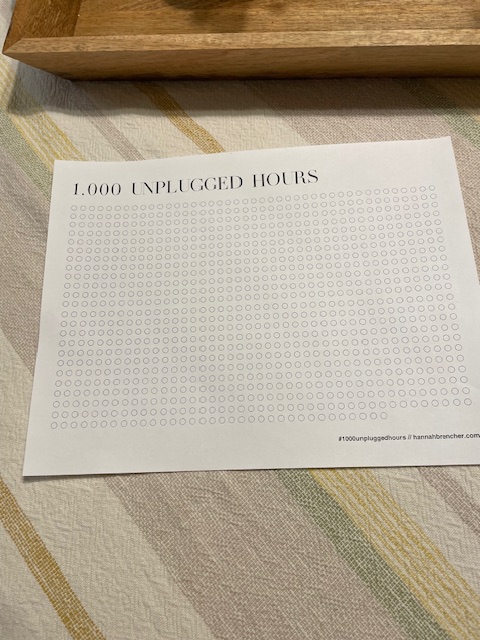
Hannah Brencher, author and podcaster, has created the 1,000 Hours Unplugged challenge with a downloadable tracker. On her website, she reports some startling statistics. According to Pew Research, on average, people will spend five years and four months of their lifetimes on social media. Trendhunter claims that 66% of people show signs of nomophobia, the fear of being without their phone. Additionally, it wouldn’t take much time to google how the algorithms on social media are designed to hit you with dopamine so you will continue to scroll. Hannah challenged herself because, during the pandemic, she found the phone to be what she called her “mini savior.” After hitting the 1,000 hours unplugged mark on her tracker, she found that “It wasn’t just a call to be unplugged. It was a call to be relentlessly present in my life and the lives of others. It was a call to create, rather than just consume. It was a call to see the blessing in the mundane of daily life.” And isn’t this the whole point of Sabbath?
For me, if I truly want to engage in Sabbath, I need to stop my addiction. I am starting late in January on this challenge. If I break it down, it means I must choose to be unplugged for an average of almost four hours each day. I want to be called to something else instead of being chained to my phone. I want to be present, rest in my curiosity without needing to find an answer on Google, and see the blessing in mundane chores in my home.
And finally, I want to create, not just consume, And not in a productive mode, where I am perfecting my writing craft, or working on skits for Vacation Bible School. This is creating for the sake of creating, dabbling in things that bring joy and satisfaction. It may be spending the weekend making morning buns with laminated dough. It may be repotting some plants. And it may involve the watercolor paints and book sitting on my dresser since Christmas. I don’t know where you are with your devices, but if you are curious, feel free to download your own tracker. I will update you throughout the year on how being unplugged is transforming me.
 By Sherry Collins
Leave a comment