
 by
by “But whoever hates his brother is in the darkness and walks in the darkness, and does not know where he is going, because the darkness has blinded his eyes.” 1 John 2:11
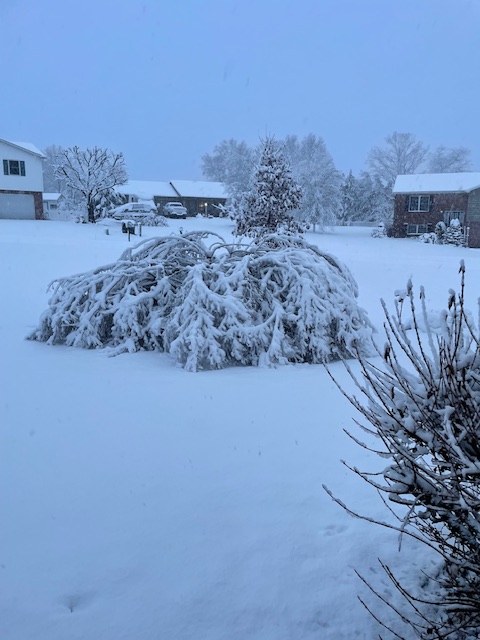
Last Tuesday, I awoke to a winter wonderland. Heavy snow blanketed all the trees and bushes in our yard. One bush laden with snow created an umbrella sanctuary for all creatures, both real and imaginary (the fairies I wish existed). I snapped a few pictures and sent it to my family remarking on the beauty God had landscaped. Throughout the day, I gazed out the windows, soaking in the views. The world felt magical, fresh, and peaceful.
Five weeks ago, this same scene didn’t evoke any feelings of beauty and serenity. I awoke to my alarm at 5:00 am, bundled up, and started the herculean task of shoveling my driveway. Later, my husband joined me, and after shoveling for over an hour, I walked into my house as he headed off to work. After pouring myself a cup of coffee, I turned on a podcast, and dozed off in our recliner. An hour later, still half asleep, I answered the phone to my ordinarily calm husband’s panicked voice, “Honey, I had a car accident! I’m not hurt but I’m waiting for the police to come.” He quickly described how he hit some slush on the interstate, and ended up spinning around three times, staying in his own lane. He knocked into a concrete embankment several times during his spin-out. This interstate is normally filled with tractor-trailers and other vehicles. But due to the conditions, and the size of our car, Terry managed not to hit anyone else. We both believe this was a miracle.
Hazy and shaken, I called my children to let them know about the accident. Maggie promptly took charge, calling her dad for more details. Within twenty minutes, she and Will were on their way to pick up Terry and bring him home. For the next two hours, I paced around my home, staring out into my yard at the treacherous snow. Tears fell as I imagined the “what if’s”. And when Terry walked in and I hugged him tight, so thankful that he was alive and well.
Snow, like many things in life, can be beautiful or deadly. Last Tuesday, my son and his family played in the snow and created a snowman that Joel called “Frosty”. Others may have chosen to go sledding or ride the trails with a snowmobile. This winter wonderland turned into a playground for many delighting in winter. But this same day, I am sure there were more severe accidents than the one my husband had had five weeks earlier. And the results could be lifelong injuries or the loss of a family member. And with this tragedy, these family members may never look at a snowstorm the same as before.
Even if the advent of snow doesn’t result in a life-changing accident, the very fact of snow can illicit different responses. Although I have no desire to live in Anchorage where they have received 101.9 inches of snow, I still love the accumulation of etched snowflakes. Like a child, I look forward to snowy days. I conjure feelings of Hygge and can’t wait to curl up on my couch with a cozy blanket and a book. I light candles, dim the lights, and drink coffee, alternating it with hot chocolate. It’s a day when my extroverted nature is pushed aside, and I embrace the solitude that a snow day brings. I don’t even mind shoveling and love the sound of the snowplow going through my neighborhood.
Prior to the accident, my husband didn’t share my sentiments. He finds snow to be cold, messy, and stressful, especially with his hour-long commute. And although he found the snow fall last Tuesday beautiful, long term snow piles make him feel claustrophobic. Yes, he likes curling up with a good book, wrapping up in a throw, and drinking coffee. But he doesn’t need snow to add to the ambiance of Hygge. He concedes that one snowfall on Christmas Eve is all he needs, and then he’s ready to move on and embrace spring. And with the accident, his lackluster attitude towards snow has diminished even more.
It’s Black History month, and as someone who identifies as a white American, I have my view of the world. But those who are African American have a different view of the same world. And although God gives salvation to all of us freely, we live in a fallen world where others are not treated the same nor given the same freedoms. And although God sees us as equals, too often our world has treated others less than equally.
Just like my husband sees snow differently than I do, it doesn’t mean his perspective is wrong. This is based on his experience of having to navigate icy roads on a regular basis. I rarely drive in snow and can relax in the comfort of my home while watching the snow fall. But until his accident, I hadn’t acknowledged how dangerous snow can be. And for that day, I walked in his shoes and saw how my magical snow could be treacherous.
I haven’t experienced the blatant racism African Americans face along with the microaggressions they deal with on a regular basis. I may understand trauma on a personal level, but I haven’t experienced the trauma of slavery, Jim Crow laws, lynchings, and police brutality that has been passed on for generations. Their experience has created a sense of hopelessness, lack of agency, and anger towards any expression of racism, blatant or not. But this lack of experience doesn’t give me a pass on expressing empathy and understanding. As a Christian, I am called to love as Jesus loved, unconditionally, regardless of gender, race, or ethnicity.
I just finished my book this week but am a long way from publishing it. We have lots of editing, a cover to design, and formats to be decided. I hope to publish it by the end of summer. This as-yet-untitled memoir is about God’s restoration from a childhood fraught with sexual abuse. My daughter suggested that I make it clear who my intended audience is. I believe the book is for everyone. I am inviting readers into my suffering so that they have a better understanding of how sexual abuse affects a person throughout their life. I hope it dismantles some of the myths of sexual assault and the ludicrous idea that a person just needs to “forgive and move on.” I hope that the reader comes to the book with an open mind and is changed by my story.
For me, reading is a gateway into understanding different viewpoints. Last year, I read a few books about the black experience in prison, George Floyd’s life, and Tyler Merritt’s experience as an African American. These books helped me walk in their shoes for a little while, seeing the reality of their struggles and challenges. This year, I am planning on reading two of Esau McCaulley’s works. As a professor and theologian, his Reading While Black: African American Biblical Interpretation as an Exercise in Hope and How Far to the Promise Land will help me reform some of my ideas of race within the context of Christianity. McCaulley challenges, “If the church is going to be on the side of peace in the United States, there has to be an honest accounting of what this country has done and continues to do to Black and Brown people.”
In addition to reading, I listen to podcasts and follow Instagram accounts of other thinkers in the Christian world who offer a more nuanced perspective on race. Jasmine L. Holmes’ Instagram feed is full of myths with scholarly research combating some of those ideas that have plagued Christian circles, particularly the homeschooling circuit, for years. These include the idea that the Civil War was not about slavery, but mostly about states’ rights, and most slaves were treated like family and given the gospel. The daughter of a major speaker at home education conferences, Holmes has insight into some of the racist material that was being marketed to home educators. In her book Mother to a Son: Letters to a Black Boy on Identity and Hope, she writes “The truth of the gospel is not threatened by the truth we learn elsewhere, but highlighted by it.”
It’s been almost four years since George Floyd’s death, and I don’t believe we have resolved the racial tensions in the United States. White supremacy groups continue to flourish, and hate is marketed. I am not called to justify my position before Christ, but to present myself as a person who needs sanctification. And this sanctification looks like being honest about my own privilege and inviting myself into the sufferings of others through their stories. And if I hope that my own memoir moves the dial in being more empathetic towards rape victims, I need to do the same about race. Black History month might look very different for everyone. Take the opportunity and be open to changing your view, maybe through a podcast, an Instagram feed, or even a book. And like both McCaulley and Holmes state, we must reckon with both the history and current treatment of Black and Brown people and how it illuminates the gospel and our response to it.
 By Sherry Collins
Leave a comment