Dogs and Dippy Eggs

“There is no fear in love; but perfect love casts out fear, because fear involves torment. But he who fears has not been made perfect in love.” 1 John 4:18

It is a sultry summer day, and I am playing in my yard, my thick, dark hair messy and loose. Everything is filtered through that 1970s yellow haze, and I am barefoot, wearing a striped terrycloth shirt and shorts. Out of the corner of my eye, I see a coyote-sized dog growling from the edge of yard. I smell fear, like sulfuric rotten eggs, smothering me. I vacillate between two different choices: stay still and hope that the dog thinks I am a tree or run to the trailer for safety. My choice is made when the dog crouches low, ready to run and pounce on me. I ran faster than I ever thought possible and banged on the metal framed screen door for my father to let me in. I hear the clinking of beer bottles, see the wafts of cigarette smoke, and even see my parents and grandparents talking. My cries are ignored, and soon the dog is at my ankles growling and snarling. I turn around see his mouth open with his sharp canine teeth ready to tear my flesh and…I wake up. Panting with fear, breathing heavily, I realize this is just a dream. I try to slow down my breathing and begin to drift off to sleep again.

For about forty years, I had this recurring nightmare. It wasn’t based on the memory of a real event. I recently had a conversation with my mom about it. According to her, the setting of the nightmare took place in a mobile home where we actually lived after she married my stepfather, putting me at two years old. We didn’t have a dog at that time, and she doesn’t remember any dog trying to maul me. But this vivid nightmare has impacted my relationships with animals, especially dogs, for my entire life.

We grew up with dogs, and I say that with a plural for a reason. It wasn’t that we had a lot of dogs at once, we just seemed to have a different dog on a semi-regular basis. Our first dog, Willy, a curly, gray peakapoo, arrived in our home when I was in second grade. Like most little dogs, he scurried around our house, was a bit nippy, and jumped endlessly. I have no idea how long we had him, I just know that one day he ran across our road and was hit by a car. We then had a German Shepherd that my father thought would be a good guard dog. My mom recognized his viciousness and, for our safety, kept him chained up in an outside kennel. She used a rake to push his food bowl to him and insisted that the dog had to go, fearful that he would get loose and maul us. We then had Tippy, possibly a dog named Tuffy, and Budweiser (yes, we had a dog named after a beer). I believe most of the dogs met their demise in the same way that Willy did. We lived in the country, didn’t leash our dogs, and had no underground electrical fencing. With all the chaos going on in our home, we probably should not have added any animals into the mix.

For all the times we had a dog, I don’t remember actively interacting with any of them. I avoided them, rarely petted them, and kept my door closed at night afraid they would crawl into my bed. This may sound heartless, but I don’t even remember shedding tears when any of them died. The only dog I remember being sad over was a tiny cocker-spaniel puppy I named Rose, that was accidentally run over by my stepfather the day after we got her. Even with Rose, I didn’t bond with her enough to shed actual tears, I just felt a little disappointed.

This fear of dogs carried over to cats, goats, rabbits, basically anything that crawls, runs, jumps, or pounces. I have never held a kitten, don’t know how to carry a puppy, and the idea of goat yoga is far from relaxing. Even for the short time we had cats when my children were younger, I would allow Zoe, the timid one, to sit next to me, but I never picked her up.

An amateur Freudian analysis of my dream has led me to two possible conclusions: either my father silenced me with the threat of a dog attack, or I transferred my fear of my father to animals. I’ll likely never know for sure, but for about fifty years, my fear has controlled me, hindered me, and caused me shame. The shame developed from well-meaning people who are shocked by my fear of animals. They don’t intend to make me feel bad, but comments like “it’s just a little puppy” or “how could you not love this face” always made me feel there was something wrong with me. Additionally, many of my friends post the memes “I don’t trust the human who doesn’t like dogs or cats”, solidifying the fear that I am somehow abnormal.

I have worked hard to overcome the fears, triggers, and dislikes caused by my childhood experiences. Some were as simple as using pepper on my food, associating that with my father. I can now hear someone walking in cowboy boots without feeling my skin crawl. And I even have a recliner in my home, now, which I also associated with my father. But there are a few things that have stuck with me since childhood: dogs and dippy eggs.

I do find puppies adorable. And I have seriously thought about getting a dog to help me overcome my fear, plus it will give me more excuses for walking. However, Terry and I have concluded we are too busy and like our freedom to do long day trips or weekends away without having a pet to consider. And there is still my fear.

A few years ago, we changed the place where we worship. Along with the change came new friends with dogs, lots of them. My one friend had a small pack of six dogs, who barked loudly to welcome me when I arrived. Other friends have one or two dogs. But it didn’t matter whose house I went to, a four-footed, furry friend was there.

This exposure to dogs has slowly eroded my fear. I can walk confidently into my friend’s house with the pack of dogs, with no racing heart. Our friends the Kempers, had a dog named Kona, who I not only played catch with but took him on a walk. My other friends, the Hornes, have a mini Bernedoodle, Barkley, who is still a wild puppy, but I have managed to get his leash on him to let him outside. My other friends, the Eplers, have Tucker who I haven’t interacted with much, but I follow his antics on Instagram.

And then there is Winston, a Bernedoodle and part of the McCory family, who has captured both my heart and Terry’s. This sweet fluffy dog looks like a giant bear. He is calm and has the sweetest disposition. He probably sensed my fear, but was determined to win me over, by sitting next to me on the couch and putting his head in my lap. His dark eyes looked so forlorn as if to say, “Please, just pet me, I want to be your friend.” I couldn’t resist him, and soon he and I became pals.

Fears and dislikes rooted in trauma are hard to overcome. They don’t always make sense and can seem unreasonable. I can’t say that I am at the place where I could become a pet owner as our busy lifestyle would make it challenging. I still think if I would pick up a pet, it would appear as awkward as it would feel. And I have no desire to try goat yoga. But I think this fear is slowly diminishing, and I thank all my furry friends and their owners for helping me.

And now, dippy eggs…I can’t even deal with this one, right now!
Heroes of Hospitality

“Do not neglect to show hospitality to strangers, for thereby some have entertained angels unawares.” Hebrews 13:2

A few weeks ago, I binged several episodes of a podcast that featured various teen icons from my high school days. Some of them were part of the 80’s Brat Pack and others were in the music industry. All of them, at some point or another, had their pictures torn out of a Tiger Beat magazine and taped on my bedroom walls. I relived their highlighted moments, remembering the songs and movies of my teen years. I also heard about the darker side of fame: insecurity, jealousy amongst each other, addictions, and broken relationships. Although they may have been smiling on the red carpet, behind the scenes they were dealing with a lot of angst.

It’s common for teenagers to put a certain musician, athlete, or movie star on a pedestal. Today’s generations are looking at Taylor Swift, Timothée Chalamet, and others whose names I don’t even recognize. God admonishes us not to have idols, but the idea of having a hero can be valuable because they can inspire us to be something greater than we are. According to the Britannica Dictionary, a hero is a person who is admired for great or brave acts or fine qualities. Some dictionaries substitute the concepts of fine qualities for noble characteristics. And as a Christian, loving God and loving others are the finest qualities any person can possess.

It was 1994, and I had just moved to Aurora, Illinois, having just taken my first job after college. Coming from a small church, I walked into the doors of a much larger church, where generations of families worshipped together. I quickly learned there were some pillars in the church and made mental notes of the family trees. Two of those families were the Bryants and the Wideners. Despite their large families, they welcomed me in and incorporated me into their church family. Coming from a dysfunctional home, seeing their connections with one another and amongst their children and grandchildren was beautiful. It gave me a picture of what a God-centered family could be.

One of my fondest memories of that time was attending their annual Independence Day picnic. It was an all-day affair, where people gathered laughing, singing, and enjoying homemade ice cream. I had no history with these families, yet I still felt included and accepted. Although my time in Aurora was short-lived, it was filled with many memorable moments like this. And these two families impacted my life far beyond those two years.

My husband, too, had attended that same church, only fifteen years earlier than I did. His time in Aurora was also short. Despite being a shy teenager at the time, he too was impacted by the lives of these two families. Some of them were his youth leaders, helping him to grow in his relationship with God. And although he didn’t attend any of their parties, their kindness was never forgotten.

When Terry and I decided to get married, we spent some time discussing the kind of house we wanted and the trips we wanted to take. But most of the time we dreamed about what kind of family we wanted to create. We both came from dysfunctional homes, with patterns of behavior that we had no desire to repeat. I was still attending church in Aurora at the time and loved the examples the older generations in that church had created with their families, particularly the Bryants and Wideners. They had a strong family identity with traditions, and they laughed a lot, but what I loved the most, is that family was not just limited to DNA. They enlarged their families by including others amongst them. And this gift of hospitality and love was a blueprint for me in creating my own family.

We got married, and eventually moved to Wisconsin, where we started a family. These couples eventually retired and moved to Tennessee, along with some of their children, grandchildren, and now great-grandchildren. But with the advent of social media, I have been able to stay in contact, albeit from a distance.

A month ago, Raymond Bryant, one husband of the two couples, passed away at age 87. It was amazing to see how many visitors came to see him and support the family in his last days. On one day, it was noted that over 50 people had come to his hospital room, some singing old hymns, others praying, and everyone sharing stories. And it was heartbreaking to read the posts about his death and how much he would be missed. A week later, hundreds came to celebrate his life, causing the funeral to be delayed for over half an hour due to the amount of people still waiting in line to pay their respects.

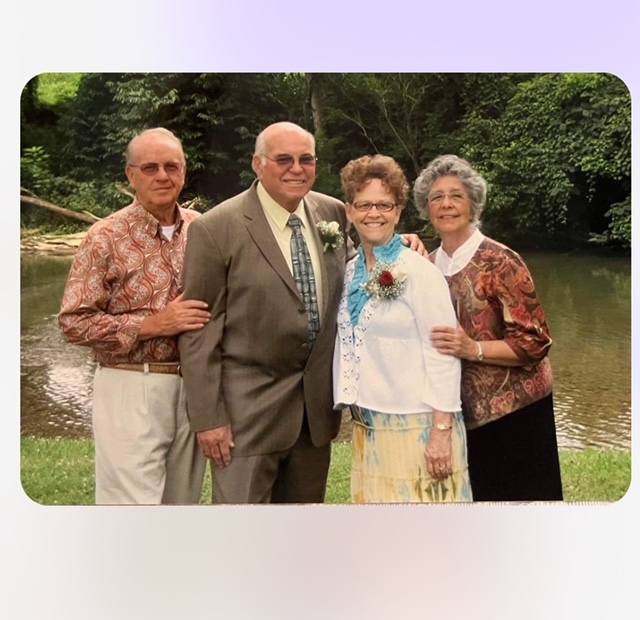
Raymond and Faye Bryant, along with Gordon and Joan Widener, were never ordained into the ministry. They never wrote a book, were never on the cover of a magazine, nor to my knowledge were they ever featured on a podcast. But these four people’s pictures hang on the walls of those who love them, and more importantly, their impact is more far reaching than just pictures on a wall. They served faithfully in whatever churches they belonged to. They loved their children well, doted on their grandchildren, and cherished their great-grandchildren. Throughout their lives, they opened their homes and welcomed countless people. This kindness and hospitality impacted generations of people that they may or may not be aware of, and to me, this is the true definition of a hero.

I met these families almost thirty years ago, and I am now approaching the same age as they were when I met them. At that time, they could have easily been caught up with their own families, pouring all their energy and attention into the numerous grandchildren they had. But they took a little time out for a young single woman from Wisconsin that has paid dividends in my life. And I have no doubt, as they retired and moved to Tennessee, they have continued to impact other people. They did not set out to be heroes, as Joan Widener shared with me in a recent conversation, it was just “part of their fiber.” They embodied the gospel of Jesus by loving others well.

For me, being heroic is not measured by the clicking of cameras while walking the red carpet. It’s not measured by rehashing the story of your fame on a podcast. Being heroic is measured by the lives you have positively impacted within and outside of your family. And it’s not based on your individual temperament either. Joan Widener readily acknowledged that the Bryants had a gift of hospitality and inclusion based on their personalities. Her husband was a little more reserved, and their style of hospitality looked different than that of the Bryants. The Wideners still chose to love others well, thus impacting others in a style that suited them.

Too often, we reach a certain stage in life, where we make our circles smaller and focus on the people in our immediate family. But what if we, like the Bryants and the Wideners, enlarge our circles by including others? What if we invite someone over for a holiday? What if we connect with singles in our church? What if we decide that ministry is not limited to a title or a position?

I’m not setting out to be a hero at this stage of my life. And I have no illusions or desire to walk the red carpet. But I do hope that I love others well and this love is demonstrated in how I live my life.  And I am forever grateful for the examples of the Bryants and Wideners; they continue to inspire me!

Sourdough MESSages

“And do not be conformed to this world, but be ye transformed by the renewing of your mind, that you may prove what is that good and acceptable and perfect will of God.” Romans 12:2

I am done! A few Saturdays ago, I came home to find my sourdough starter exploding all over my counter. It bubbled over, looking like a cave-dwelling ogre hugging the outside of the glass jar. I sighed with disgust as I scrubbed the dried sourdough cement off my counter. Despite its reviews and the Amazon algorithms, the thin, well-shaped glass was not designed for sourdough. At least once a week, my sourdough feasted, causing it to overflow, resulting in a mess for me to clean up. I was tired of trying to fit my dough in a glass that didn’t work. It was time to change jars!

Just like my sourdough fiasco, I have spent a lifetime trying to fit into places that didn’t fit me. I tried to be demure to compensate for when my extroverted nature was seen as offensive. I stifled my opinions and ideas, knowing they wouldn’t be welcomed. I curbed my passions when they would be seen as “too much”. And I ignored the voice of God because I thought others were more in tune than I was. Now, in my early fifties, I declare, “I AM DONE!”

This doesn’t give me a pass to be overbearing or prideful. But it does change the amount of energy and attention I put towards trying to fit in. I need to look for places where I am loved and valued for who I am. I need to trust my gut and my ability to discern the voice of God. But even in this declaration, I know I am battling lifelong patterns of minimizing and judging myself.

I find these same patterns developing in a group of young tween girls that I love, with the age-old messages most women wrestle with; messages like “I am too fat”, “I am not smart enough”, or “I don’t fit in.” Generation after generation, these comments corrode a young girl’s sense of worth like acid. They create well-trod paths in her brain leading to self-doubt and lack of confidence. These paths prevent her from recognizing who she is in God and from moving forward.

Despite the explosions, when the sourdough is feeding and growing well, I have made some delicious, crusty loaves of bread. I have also made delicious, flaky sourdough piecrust to cover individual turkey pot pies. My grandchildren have indulged in the sourdough discard crackers my daughter-in-love has baked. And, although I haven’t yet tried them, I have pinned recipes for sourdough cookies, cakes, and pancakes. This dough, when in the right jar, has endless possibilities. But that Saturday afternoon, I just saw a mess.

I see the “mess” created by the messages that young girls receive about themselves, along with the messages I have received about myself. And before I choose a different jar, I need to clean up my mess. This starts by examining how I live my life and the messages I believe about myself. What I say can and will influence those younger women in my circle, including my nieces and granddaughters. And even more importantly, I need to evaluate the messages I convey to younger girls and how those messages may reinforce the negative views they have of themselves.

Honestly, I struggle with how much or how little we should comment to a young girl on her appearance. Being the young girl who rarely received comments on how pretty she was, I felt that void in a big way. This slight becomes glaringly obvious when your peers are praised for their beauty, and you are mostly ignored except for the occasional “You have a pretty face.” Comments that would have made me feel beautiful and feminine and would have been a balm for my broken soul were withheld. It took me twenty-five years into my marriage to a committed husband to really believe he found me attractive.

On the flipside, these comments can make a young girl feel like her appearance is the only valuable thing she has to offer. It objectifies her as something to be put on display and viewed. It ignores her talents, strengths, character traits, and intelligence. And when we don’t praise those traits in young women, they will also feel the void.

And this puts us back to where we started. How can I help future generations stop trying to fit into places that don’t fit them? How can they work on changing those destructive messages in their teens and early twenties? And how can we prevent those destructive messages from even being contemplated?

Along with cleaning up my own mess, I need to understand how I define beauty and how my definition contrasts with God’s definition. Do I see beauty as being a certain size, hair style, or type of dress? Do I recognize that God made everyone in His image, and His image is not limited by height, weight, or bone structure? The closer I get to God’s definition, the more inclusive and encouraging I will become.

Next, I don’t think eliminating all affirmations about appearance is the answer. Instead, it’s making the jar large enough to encompass all the beautiful traits that make each woman valuable. This means an honest evaluation of the type of compliments I give. Besides complimenting a young girl on her appearance, am I pointing out times she is kind, courageous, and demonstrating perseverance? When she is sweaty and playing hard, am I cheering her on while she is engaging in habits that promote wellness? Most importantly, when she is modeling Jesus, am I encouraging her with praise? These simple acts of affirmation can help her see that she is beautiful both inwardly and outwardly.

The more I deal with my own mess, align my concept of beauty with God’s, and take an honest evaluation of how I am complimenting young women, the more I believe I can make a dent in this mess that we have created in our society. And I think the more women who join me, the more we can impact future generations with the idea that anything is possible.

It’s Women’s History Month. We should look back and honor the women who have made an impact on our lives historically. But it’s also a time we can pave the way for younger women to make a future impact in our society. So, let’s look at our jars!