
 by
by “Do not neglect to show hospitality to strangers, for thereby some have entertained angels unawares.” Hebrews 13:2
A few weeks ago, I binged several episodes of a podcast that featured various teen icons from my high school days. Some of them were part of the 80’s Brat Pack and others were in the music industry. All of them, at some point or another, had their pictures torn out of a Tiger Beat magazine and taped on my bedroom walls. I relived their highlighted moments, remembering the songs and movies of my teen years. I also heard about the darker side of fame: insecurity, jealousy amongst each other, addictions, and broken relationships. Although they may have been smiling on the red carpet, behind the scenes they were dealing with a lot of angst.
It’s common for teenagers to put a certain musician, athlete, or movie star on a pedestal. Today’s generations are looking at Taylor Swift, Timothée Chalamet, and others whose names I don’t even recognize. God admonishes us not to have idols, but the idea of having a hero can be valuable because they can inspire us to be something greater than we are. According to the Britannica Dictionary, a hero is a person who is admired for great or brave acts or fine qualities. Some dictionaries substitute the concepts of fine qualities for noble characteristics. And as a Christian, loving God and loving others are the finest qualities any person can possess.
It was 1994, and I had just moved to Aurora, Illinois, having just taken my first job after college. Coming from a small church, I walked into the doors of a much larger church, where generations of families worshipped together. I quickly learned there were some pillars in the church and made mental notes of the family trees. Two of those families were the Bryants and the Wideners. Despite their large families, they welcomed me in and incorporated me into their church family. Coming from a dysfunctional home, seeing their connections with one another and amongst their children and grandchildren was beautiful. It gave me a picture of what a God-centered family could be.
One of my fondest memories of that time was attending their annual Independence Day picnic. It was an all-day affair, where people gathered laughing, singing, and enjoying homemade ice cream. I had no history with these families, yet I still felt included and accepted. Although my time in Aurora was short-lived, it was filled with many memorable moments like this. And these two families impacted my life far beyond those two years.
My husband, too, had attended that same church, only fifteen years earlier than I did. His time in Aurora was also short. Despite being a shy teenager at the time, he too was impacted by the lives of these two families. Some of them were his youth leaders, helping him to grow in his relationship with God. And although he didn’t attend any of their parties, their kindness was never forgotten.
When Terry and I decided to get married, we spent some time discussing the kind of house we wanted and the trips we wanted to take. But most of the time we dreamed about what kind of family we wanted to create. We both came from dysfunctional homes, with patterns of behavior that we had no desire to repeat. I was still attending church in Aurora at the time and loved the examples the older generations in that church had created with their families, particularly the Bryants and Wideners. They had a strong family identity with traditions, and they laughed a lot, but what I loved the most, is that family was not just limited to DNA. They enlarged their families by including others amongst them. And this gift of hospitality and love was a blueprint for me in creating my own family.
We got married, and eventually moved to Wisconsin, where we started a family. These couples eventually retired and moved to Tennessee, along with some of their children, grandchildren, and now great-grandchildren. But with the advent of social media, I have been able to stay in contact, albeit from a distance.
A month ago, Raymond Bryant, one husband of the two couples, passed away at age 87. It was amazing to see how many visitors came to see him and support the family in his last days. On one day, it was noted that over 50 people had come to his hospital room, some singing old hymns, others praying, and everyone sharing stories. And it was heartbreaking to read the posts about his death and how much he would be missed. A week later, hundreds came to celebrate his life, causing the funeral to be delayed for over half an hour due to the amount of people still waiting in line to pay their respects.
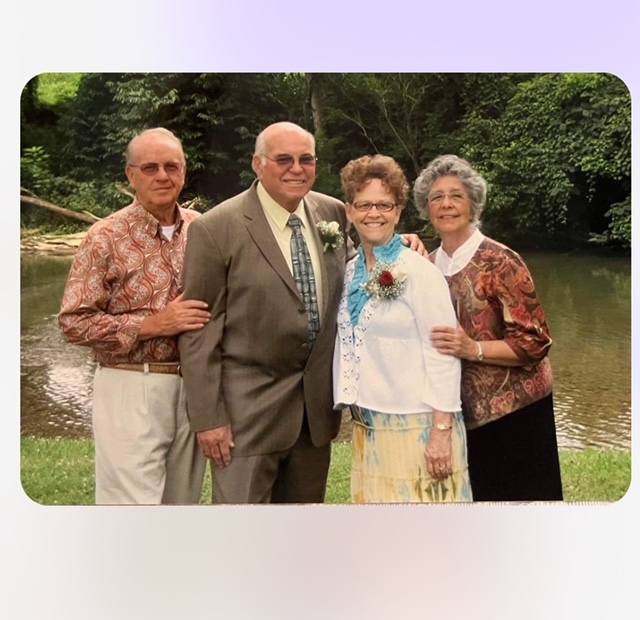
Raymond and Faye Bryant, along with Gordon and Joan Widener, were never ordained into the ministry. They never wrote a book, were never on the cover of a magazine, nor to my knowledge were they ever featured on a podcast. But these four people’s pictures hang on the walls of those who love them, and more importantly, their impact is more far reaching than just pictures on a wall. They served faithfully in whatever churches they belonged to. They loved their children well, doted on their grandchildren, and cherished their great-grandchildren. Throughout their lives, they opened their homes and welcomed countless people. This kindness and hospitality impacted generations of people that they may or may not be aware of, and to me, this is the true definition of a hero.
I met these families almost thirty years ago, and I am now approaching the same age as they were when I met them. At that time, they could have easily been caught up with their own families, pouring all their energy and attention into the numerous grandchildren they had. But they took a little time out for a young single woman from Wisconsin that has paid dividends in my life. And I have no doubt, as they retired and moved to Tennessee, they have continued to impact other people. They did not set out to be heroes, as Joan Widener shared with me in a recent conversation, it was just “part of their fiber.” They embodied the gospel of Jesus by loving others well.
For me, being heroic is not measured by the clicking of cameras while walking the red carpet. It’s not measured by rehashing the story of your fame on a podcast. Being heroic is measured by the lives you have positively impacted within and outside of your family. And it’s not based on your individual temperament either. Joan Widener readily acknowledged that the Bryants had a gift of hospitality and inclusion based on their personalities. Her husband was a little more reserved, and their style of hospitality looked different than that of the Bryants. The Wideners still chose to love others well, thus impacting others in a style that suited them.
Too often, we reach a certain stage in life, where we make our circles smaller and focus on the people in our immediate family. But what if we, like the Bryants and the Wideners, enlarge our circles by including others? What if we invite someone over for a holiday? What if we connect with singles in our church? What if we decide that ministry is not limited to a title or a position?
I’m not setting out to be a hero at this stage of my life. And I have no illusions or desire to walk the red carpet. But I do hope that I love others well and this love is demonstrated in how I live my life. And I am forever grateful for the examples of the Bryants and Wideners; they continue to inspire me!
 By Sherry Collins
Leave a comment