
Chili Crisp and Jackson Pollock
“He has made everything beautiful in its time. Also, He has put eternity in their hearts, except that no one can find out the work that God does from beginning to end.” Ecclesiastes 3:11 NKJV
Despite being a resident of Pennsylvania for the last 13 years, I still identify as a Wisconsinite, and more specifically, a Sheboyganite. My hometown is famous for its picturesque lakeshore, championship golf courses, award winning bratwursts, and hard rolls. The city and its greater community are also home to some world-renowned businesses, including Kohler Company, Sargento Cheese, Johnsonville Sausage, and Acuity Insurance. Sheboygan is no stranger to pop culture, including references in the movies Some Like It Hot and Home Alone, reinforcing the popularity of polka! Even in Fall River, Massachusetts, a nurse shared with my son her own familiarity of Sheboygan. On the day my grandson was born, the nurse chuckled when my son reported that he was born in Sheboygan. As a child, her mom had threatened that someone would take her to Sheboygan if she misbehaved.
Like all areas, Sheboygan has its own folklore, idiosyncrasies, and even its own dialect. When we go to bakeries, we also eat bakery, aka donuts and pastries. We are super polite at four-way stops where everyone waves to everyone else to go first, even if everyone sits there for a minute or two. We don’t grill out, we fry out, and brat frys are the major fundraisers for local charities. We eat brats on a hard roll, which are not in the shape of a hot dog bun, but rather a hamburger bun. We also call the drinking water fountains bubblers after a local company that made them.
Like bubblers, certain products are identified by brand name. We no longer mop our floors, we swiffer them. I call tissues Kleenex, although I only buy Puffs. I never refer to my phone as my cell phone, but instead my I-Phone. Some brands elicit a strong feeling of loyalty. I once tried to use generic toasted corn flakes in place of Kellog’s Corn Flakes in one of our family’s favorite Christmas cookies. My husband’s discerning taste buds recognized the difference immediately, and since then, we only use the name brand.
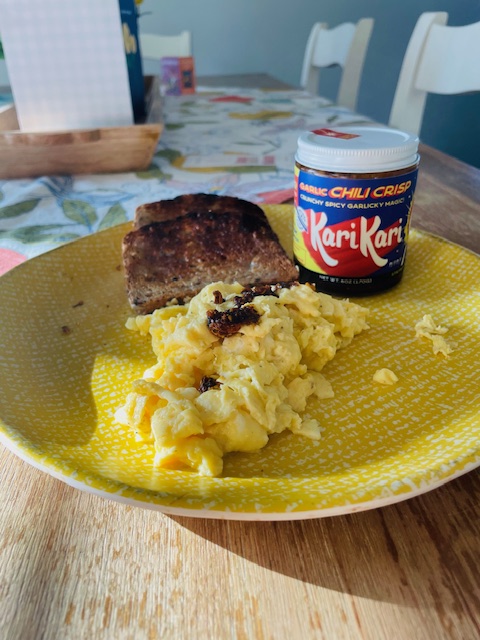
Companies protect the names of their product by submitting a trademark with the United States Patent and Trademark office. A trademark is a type of intellectual property consisting of a recognizable sign, design, or expression. The application itself is straightforward, but the process of getting something trademarked can take time. Trademarks can’t be used on something general, like ice cream or ketchup or tissues. But it can be used on specific brands, like Ben & Jerry’s Chunky Monkey, Heinz Ketchup and even the swish on Nike athletic shoes. Once something is trademarked, that intellectual property belongs to an individual or company and can’t be used by any other person or company.
Recently, the food world was in uproar over a company’s trademark on chili crunch, otherwise known as chili crisp. This popular condiment adds a finishing touch over dumplings, noodles, eggs, and avocado toast. The crunchy, oily, spicy condiment is made of dried chili flakes, crispy fried garlic, or shallots, and sometimes sesame seeds. Some cookbooks and websites are dedicated to finding more ways to use the condiment, including as an ice cream topping. Self-proclaimed foodies have multiple jars of different chili crisps in their refrigerators. Terry and I discovered the joy of chili crisp, adding it to stir fries and spaghetti.
The controversy came when Momofuku, a company started by celebrity chef David Chang, decided to trademark his brand of the condiment with the name “chili crunch.” Soon small businesses who used chili crunch in their product name were sent cease-and-desist letters by Momofuku’s legal representation. These small companies, many of whom are using family recipes, had ninety days to rebrand their products. Many food writers and chefs opposed Momofuku’s right to trademark the name “chili crunch”, arguing that the term was ubiquitous for a cultural product.
As a Christian, I have acted like Momofuku, thinking that Christians owned the trademark on truth, love, beauty, and righteousness. As a home educator, I surrounded myself with history books from Christian educators. If a musical artist was not explicitly Christian, I concluded that the music didn’t glorify God. If an artist or writer had any moral failures in their life, I wrote off their painting or book as not important. I thought only Christian organizations were doing important and worthwhile charitable work. I also thought that Christians hit the mark on righteousness and held themselves above reproach.
I have realized my thinking set Christians, me included, above others. Only God has the trademark on truth, love, beauty, and righteousness. All truth, love, beauty, and righteousness reflect the glory of God, no matter the source. This shift in perspective has opened me to more empathy and humility. As a Christian, it helps me validate the importance of the work others are contributing to science, history, medicine, art, music, and writing. I can read Robin Wall Kimmerer’s Braiding Sweetgrass, a book built on her indigenous spiritual worldview, and find some principles, like honorable harvest, rooted in the Bible. I can listen to a Taylor Swift song and see in her music her longing for a lasting love, a desire in all of us only fulfilled by Christ. I can follow Jasmine L. Holme’s Instagram page and find resources that explain how Southern confederate biases influenced some of the homeschooling material I used. I can read poetry by Mary Oliver that speaks beauty into my life.
This trademark belief was also evident when Christian apologists believed that abstract art reflected a post-modern world. I held on to that view for many years, denigrating modern art. Like all my self-righteous thinking, my views on modern art began to change. It started when my sister brought a modern art piece for her kitchen, and it surprised me how much I was drawn to this piece. It added a touch of color to her kitchen, anchoring it with a sense of calmness and warmth. After discovering that I liked that piece, I started looking at more modern art, finding some pieces that inspired joy in me.

Later, I discovered Makoto Fujimura, an abstract artist who is a leader in the slow art movement. He uses a Japanese technique called Nihonga. This style involves the artist grinding colored minerals in a fine powder and layering them onto his art piece. Each layer takes time to dry, and some of his pieces have sixty layers. His Walking on Water series started off as an elegy to the victims of the 2011 Tsunami, and has evolved to pieces addressing climate change. At the end of his book Art + Faith: A Theology of Making, Fujimura writes a Benediction for Makers: “May we steward well what the Creator King has given us and accept God’s invitation to sanctify our imagination and creativity, even as we labor hard on this side of eternity.”
Based on his writings, Fujimura makes a difference between being an artist who is a Christian and being a Christian artist. He warns that art should not be a tool to evangelize and disciple others, instead it should glorify God. By glorifying God, we open the door for conversations with others. Even artists who are not Christians can glorify God in their works by reflecting the beauty of the created world. None of this is more evident than artist Jackson Pollock. Like Ian Falconer’s children’s book character Olivia, I believed I could splatter paint like Jackson Pollock and call it art. How naive and prideful I was, again believing I knew and understood the trademark of beauty.
Jackson Pollock painted his famous artwork by using a “drip” technique. He involved his whole body to paint and used force to cover the whole canvas, almost like dancing. For some, his pieces looked unpredictable and shocking. But again and again, people were drawn to his art. In 1999, physicist and artist Richard Taylor became interested in Pollock’s work in relation to fractals. Fractals are the repeating patterns found in nature starting at a large scale moving to the smallest scale. Imagine a tree, and it starts to fork out into big branches, and then eventually into smaller branches, and this same pattern is repeated down to the veining in a leaf. This pattern is a fractal, and research demonstrates that we find these fractals reassuring and harmonious. Using computer analysis, Taylor discovered that what others had determined to be random drip marks were actually fractals. Pollock referred to his painting style as “I am nature”, but his artwork tapped into God’s creative design in nature. This same computer analysis was used to determine that some recently discovered works thought to be Pollock’s were fakes, later confirmed by paint analysis. I am looking forward to my next visit to MOMA and viewing Pollock’s work with new eyes.
Because of the backlash, Momofuku has dropped the trademark disputes. It’s not clear if they are going to exercise their legal trademark rights in the future, but right now, they seem to have taken a break from owning “chili crunch” as intellectual property. I am a Christian, but I no longer believe that I hold the trademark on truth, love, beauty, and righteousness. I need to keep my eyes on God, who holds all truth, reflects all love and beauty, and is truly righteous. I can also look at both my fellow believers and those who don’t believe and discover how the image of God is reflected in their lives. This curiosity for discovery can help bridge the gap in a divided world.
Reclaimed & Restored
“I will seek the lost, and I will bring back the strayed, and I will bind up the injured, and I will strengthen the weak, and the fat and the strong I will destroy. I will feed them in justice.” Ezekiel 34:16
Eleven years ago, my children gave me a lilac bush for Mother’s Day. Lilacs remind me of my own childhood when three lilac bushes framed the living room picture window. Despite all the dark things happening within our home, every spring those bushes would drip with white, lavender, and deep purple blooms. The heady, sweet scent was always a welcome relief from the odor of cigarettes and alcohol. This annual display of beauty gave little Sherry some hope.
My Mother’s Day bush has grown and filled out. Each spring, it seems to be covered with more and more blooms. For a week or two, the scent of lilacs transports me back to a few bright moments in my childhood where hope and beauty collided with despair and darkness. This spring, the lilac bush reminds me again of beauty despite brokenness.
A heavy, late winter snow fell this year, covering the dead brown earth with a fresh white blanket. I sat in my house, enjoying a cup of coffee, marveling as the intricate snowflakes drifted to the ground. Everything looked beautiful and dreamy. The snow coated the branches of every tree and bush in our yard. My privet bushes bowed to the ground with the weight of the snow, while my lilac bush remained sturdy, despite piles of snow coating the branches. Later the temperatures rose, and the snow turned into icy rain. By night, the tree branches glistened with icicles and my whole yard glittered. I went to bed, dreaming of my magical snow globe world.
I was a little worried about the privet bushes. They were so bowed down that I wondered if they would survive the weight of the ice and snow. But when I came downstairs the next morning, they had perked back up, lifting their branches to the bright sun. I went into the kitchen and opened my patio blinds. The sun reflected my snow-covered yard, blinding me for a few seconds when something caught my eye. I noticed two main branches of the lilac bush lying down on the snow. They looked forlorn, and upon closer inspection, I realized they had partially snapped off from the base of the bush. My beautiful snow globe world had cracked, breaking something that was beautiful.
Three weeks ago, I posted on Facebook that I had finished my book. This book has been a labor of love and grace. I had always dreamed of writing a book, perhaps to tell my own story. But I never imagined the journey that it would take for me to get to that place. It started with a series of events that left me wondering who I was, and who I wanted to be. Some of these events were ordinary life transitions like dealing with an empty nest while others were unexpected losses and crises. But through all of it, I felt God was inviting me into a deeper healing process not only from what was going on in my life then, but what had gone on in the past as well.
Instead of jumping to get a job after my children left home, I invested the time to do some internal work. And for this first time in my life, this extrovert craved space and solitude! I wasn’t totally alone; I spent hours communing with God through His word and in prayer. I also spent a lot of time reading and listening to any material that offered me perspective, care, and support such as blogs, books, and podcasts. Finally, I found community, in my Life Groups at church, friends, family, and mostly my husband. These safe places allowed me to share some of the ugly, crushing, shame-filled experiences, as well as the beauty I was now discovering.
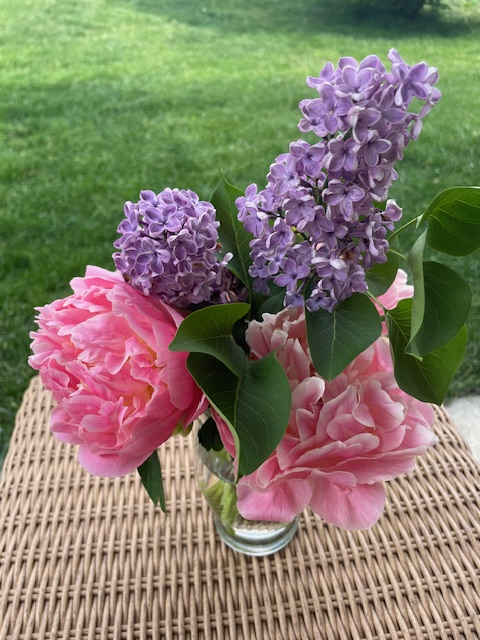
We forgot about the bush this past spring in the midst of editing and finishing my book. Before we knew it, the broken branches were budding with both leaves and blooms. We decided to wait before severing it from the rest of the bush. Why not let it bloom once more before we cut it down? And bloom it did. Soon the branch was saturated with purple flowers, filling vases throughout my home. But something else happened unexpectedly, my peony bush also bloomed at the same time. And it too was covered with vibrant pink flowers. Wanting to capture this moment, I filled the house with vases of lilacs and peonies.
I discovered peonies later in life. They seem more sophisticated than my lilacs. When they first bloom, they open as soon as the sun peaks over the horizon, and close as dusk falls. At the height of their short life, they flash their vivid pink petals for the world to see, displaying delicate yellow stamens and pistils. In the short five years since I planted them, another Mother’s Day gift, my peony bushes now also drip with blooms. These little bushes, if cared for, will continue to bloom throughout my life and beyond. Peonies have been known to bloom for up to 100 years.
These flowering bushes represent my lifelong need for beauty. Even what they symbolize illustrates my past and present. Both the white and lavender lilacs of my childhood embody innocence and spirituality. It should have been a time in my life where childhood innocence was celebrated, and my spiritual formation developed. Peonies represent compassion, healing, and renewal. Since planting my peonies, I have begun learning self-compassion and healing.
The fact that the two different flowers bloomed simultaneously is not lost on me. I had just sent out my book to friends I trust to offer valuable feedback. I want this book to be the best version of itself, so I’m inviting others to critique it before I publish it. Yet, the book had no title. People have offered some great suggestions, but nothing seemed to connect with me. For a while, I had thought about titling it My Ugly House Restored. But for too long, the ugly of my life held sway over the beauty I desired. It defined my living nightmares as a child, the names I was called, and how I saw myself even as an adult. The book has some ugly moments in it, but I am not defined by the ugliness that was perpetrated on me.
My friend Michele sent me another suggestion for the title, the word “Reclaimed”. I looked up the definition of that word along with restored, and although the words are often used synonymously, they have different meanings and applications. I felt my book was both, and that’s when the title hit me. Reclaimed & Restored will be released in October of this year. God reclaimed my life from fourteen years of sexual abuse and has lovingly led me on a thirty-five-years-and-counting restoration journey. After settling on that title, both my lilacs and peonies bloomed together. I can place the lilac blooms from my broken branch into the same vase as the peonies to create a beautiful centerpiece on my table; a centerpiece that integrates my past and present into something beautiful.
Yesterday, Terry cut off the broken branches of the lilac bush. And in a week or two, my peony bush will be devoid of blooms. But right now, I will bask in the goodness of God as their blooms fill my home. And I know that next spring they will bloom again. I have no illusions that I will make the New York Times Best Seller List with my little book. I am self-publishing, so I don’t have a PR team hyping my book. But I do know I have faithfully embarked on a healing journey with God from my days of seeing lilac bushes in the yard to discovering peonies as an adult. If my words impact just one reader, I have done what God has called me to do. And as disturbing as the sexual abuse was, my deepest desire is that the readers will see the beauty God has given me, time and time again!
Stewarding the Earth: Echo Chambers and Climate Change
“but in your hearts honor Christ the Lord as holy, always prepared to make a defense to anyone who asks you for the reason for the hope that is in you; yet do it in gentleness and respect.” 1 Peter 3:15 ESV
Four and half years ago, I titled my blog Graceful Transitions and started writing about my midlife journey. I wanted it to be a space where I could share things I was wrestling with, such as creating more intimacy in my marriage, being transparent about my journey to better health, and moving from parenting to blessing my adult children. Just as I agonized over the names of my children, I picked the name for my blog carefully. I wanted this to be a place that exuded gracefulness. In years past, I had been bold and harsh with my opinions, often alienating those around me. But life has a way of humbling you, and I wanted to operate in that space. My writings could still be bold and confident, but I didn’t want to come off as an expert. Instead, I wanted to share my thoughts in a gentle manner that dignified both God and the reader. The word “transitions” was also carefully thought out. I didn’t want to portray myself as someone who has arrived. Instead, I wanted to be curious, eager to learn and grow in my relationship with Christ. These traits would move me from one place to another with fluidity.
We often walk in a local park that has a tunnel underneath a busy road. Anytime we have children with us, we stop in the tunnel for a few minutes. They sometimes yell each other’s names or just make a loud noise and listen to it reverberate. There is something about hearing an echo that is delightful. Your voice becomes an instrument that can drown out any other sound. And it’s contagious. Once one child makes a sound, other children quickly start doing the same. And soon, the tunnel becomes a cacophony of noise.
Initially, I had no intentions of pontificating on any hot button issues in my blog. Current event noise fills our screens with rants and raves, polarizing our society. But as I continued to write, I found God gracefully transitioning me out of the self-imposed echo chamber I had been in for the last thirty years. This echo chamber informed my political views, how I looked at the world, and what causes I believed in. Like the tunnel, the echo chamber noise of the 2020 election became deafening. And as the world dealt with the pandemic, racism, and immigration issues, I found myself looking for other perspectives.

This led to a spiritual crisis. For so many years, I espoused the idea that you could only vote one way to be a good Christian. I even challenged others on this principle, boldly declaring that God only accepted the votes of one political party. But again and again, I kept reading in scripture how God cared for the poor, the widow, the fatherless, and the sojourner (another word for immigrant). Did my votes support what God truly cares about? Can Christians think differently about issues?
God always has a way of helping you wrestle well these concepts. As I read scripture, God directed me to other Christians who had a different perspective from those on talk radio and certain news outlets. These thinkers researched carefully, believed all people were created in the image of God, and still held fast to scripture. They didn’t water down the gospel, but instead looked at scripture wholly and completely.
All this reading, listening, and thinking led me to this series on Stewarding the Earth. For years, the far right has labeled environmental supporters “wackos and pagan worshippers”. As a follower of Christ, I am troubled by the name calling I used to support. Is name calling helpful in moving the conversation forward and declaring the gospel to those who care about the earth? I now believe you can be a Christian environmentalist. John Muir, one of the biggest environmental supporters had Christian roots. Founder of the Sierra Club and considered the father of the National Parks, Muir believed in God. He was known to share his faith with others on the University of Wisconsin campus. Some scholars acknowledge that Muir struggled with orthodox Christianity later in life, but he did recognize God’s hand in creation throughout his book My First Summer in the Sierra. Today, one of the leading climate change scientists, Katherine Hayhoe, is a Christian. She has been awarded Champion of the Earth, the United Nation’s highest environmental honor. In her bio on her website, she says, “I don’t accept global warming on faith; I crunch the data, I analyze the models. I help engineers and city managers and ecologists quantify the impacts.” There are also some faith based environmental advocacy groups, like A Rocha International and the Evangelical Environmental Network.
I have heard two consistent arguments from fellow Christians against environmental policies. First, they believe that environmentalists worship creation more than the creator. There may be some truth to this in some cases. But scripture supports the fact that when people express awe in creation, it points them to the creator. David says in Psalms 8:3, “When I look at your heavens, the work of your finger, the moon and the stars, which you have set in place.” This sense of awe was reaffirmed by Paul in Romans 1:20, where he says, “For the invisible attributes, namely his eternal power and divine nature, have been clearly perceived, ever since the creation of the world, in the things that have been made.” Psychologist Dacher Keltner, who has studied awe, finds that experiencing awe makes people more curious and less judgmental. It also makes people more humble, generous, and altruistic. If we Christians keep the earth as awe inspiring as we can by reducing our impact on the climate, can we point others to Christ? If we value the created earth, because it points to an awesome creator, can we have conversations with non-believers when they are curious and open to ideas about how God frames our world? These conversations can only happen if we, too, are inspired by awe. This will help us to express curiosity and be less judgmental.
The next argument I hear often is that we were given dominion over the earth from the beginning of time. Again, there is truth in that. Genesis 1:28 says, “Be fruitful and multiply and fill the earth and subdue it and have dominion over the fish of the sea and over the birds of the heavens and over every living thing that moves on the earth.” But the Bible goes on to say in Genesis 2:15, “The Lord God took the man and put him in the garden of Eden to work it and keep it.” The Hebrew word for work is “abad” which also means to serve, and the Hebrew word for keep is “samar” which means to guard and keep watch, protect, and save. When you put the two verses together, it changes our view on the word dominion. We are to operate on God’s behalf, and we are called to rule over the earth by protecting and serving it. By doing this well, we are ensuring that the earth will provide us with the means to survive: a healthy climate where animals and vegetation are thriving, and clean water flows freely. God didn’t give us the authority to destroy and plunder the earth!
There are some great theologians and philosophers who advocate for a more theologically sound view of the environment. C. S. Lewis, great Christian apologist, warned in The Abolition of Man that “Man’s conquest of Nature turns out, in the moment of its consummation, to be Nature’s conquest of man.” Francis Schafer, a leading Christian philosopher, challenged believers in Pollution and the Death of Man, “Christians, of all people, should not be the destroyers. We should treat nature with an overwhelming respect.” Wendell Berry, poet and naturalist, writes in The Art of the Commonplace: The Agrarian Essays, “…the care of the earth is our most ancient and most worthy and, after all, our most pleasing responsibility. To cherish what remains of it, and to foster its renewal, is our only legitimate hope.” These Christians contemplate the word of God and carefully choose words to respond to concerns they have about the environment. I wonder how often the voices that oppose environmental policies contemplate scripture and man’s responsibility towards the earth.
As a follower of Christ, I am expected to shine His light in a dark world. This is more than just sharing my testimony; it should be embodied in how I act and treat others and the earth around me. How I live my life impacts the climate. My carbon footprint increases drought and flood conditions and changes water supplies. It also makes winters warmer, allowing bugs and pests to increase. Their increase can lead to the destruction of forests and other vegetation. Food supply chains are being affected and the sea level is also changing. All this change directly impacts my neighbor, from the person next door to those in Mozambique who contribute little to the carbon footprint. Katherine Hayhoe’s website is full of information about how climate change is affecting our world. She uses scientific research to support her arguments and to counter the opposition.
I have written about noise pollution, our obsessive use of plastics, and how to Leave No Trace. Some of these ideas will help reduce our carbon footprint. Although I don’t personally own a hybrid or electric vehicle, I can argue the benefits of encouraging research and development in making these vehicles more viable. I can also talk about how shopping locally, both for produce and meat, is another way you can reduce your carbon footprint. But the biggest way for me to make an impact is to acknowledge climate change is real and to be educated before I enter the voting booth, both on a national and a local level. Supporting policies that reduce climate change can be one of the most important ways I steward the earth well as a follower of Christ.
This is the end of my series on Stewarding the Earth. Readers, I hope you enjoyed it. Feel free to comment on any of the posts I have made. I will continue the conversation in the future with some interviews with fellow Christians who model these principles well. Additionally, I will likely write about other issues where God has been opening my eyes to a wider and fuller view of scripture. These still fit into the ethos of Graceful Transitions, because I want my words to dignify God and you, my readers. Thank you for all your support.
 By Sherry Collins