
 by
by “He has made everything beautiful in its time. Also, He has put eternity in their hearts, except that no one can find out the work that God does from beginning to end.” Ecclesiastes 3:11 NKJV
Despite being a resident of Pennsylvania for the last 13 years, I still identify as a Wisconsinite, and more specifically, a Sheboyganite. My hometown is famous for its picturesque lakeshore, championship golf courses, award winning bratwursts, and hard rolls. The city and its greater community are also home to some world-renowned businesses, including Kohler Company, Sargento Cheese, Johnsonville Sausage, and Acuity Insurance. Sheboygan is no stranger to pop culture, including references in the movies Some Like It Hot and Home Alone, reinforcing the popularity of polka! Even in Fall River, Massachusetts, a nurse shared with my son her own familiarity of Sheboygan. On the day my grandson was born, the nurse chuckled when my son reported that he was born in Sheboygan. As a child, her mom had threatened that someone would take her to Sheboygan if she misbehaved.
Like all areas, Sheboygan has its own folklore, idiosyncrasies, and even its own dialect. When we go to bakeries, we also eat bakery, aka donuts and pastries. We are super polite at four-way stops where everyone waves to everyone else to go first, even if everyone sits there for a minute or two. We don’t grill out, we fry out, and brat frys are the major fundraisers for local charities. We eat brats on a hard roll, which are not in the shape of a hot dog bun, but rather a hamburger bun. We also call the drinking water fountains bubblers after a local company that made them.
Like bubblers, certain products are identified by brand name. We no longer mop our floors, we swiffer them. I call tissues Kleenex, although I only buy Puffs. I never refer to my phone as my cell phone, but instead my I-Phone. Some brands elicit a strong feeling of loyalty. I once tried to use generic toasted corn flakes in place of Kellog’s Corn Flakes in one of our family’s favorite Christmas cookies. My husband’s discerning taste buds recognized the difference immediately, and since then, we only use the name brand.
Companies protect the names of their product by submitting a trademark with the United States Patent and Trademark office. A trademark is a type of intellectual property consisting of a recognizable sign, design, or expression. The application itself is straightforward, but the process of getting something trademarked can take time. Trademarks can’t be used on something general, like ice cream or ketchup or tissues. But it can be used on specific brands, like Ben & Jerry’s Chunky Monkey, Heinz Ketchup and even the swish on Nike athletic shoes. Once something is trademarked, that intellectual property belongs to an individual or company and can’t be used by any other person or company.
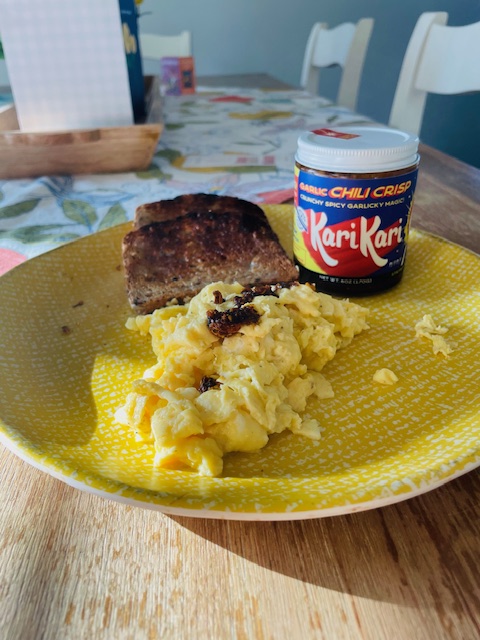
Recently, the food world was in uproar over a company’s trademark on chili crunch, otherwise known as chili crisp. This popular condiment adds a finishing touch over dumplings, noodles, eggs, and avocado toast. The crunchy, oily, spicy condiment is made of dried chili flakes, crispy fried garlic, or shallots, and sometimes sesame seeds. Some cookbooks and websites are dedicated to finding more ways to use the condiment, including as an ice cream topping. Self-proclaimed foodies have multiple jars of different chili crisps in their refrigerators. Terry and I discovered the joy of chili crisp, adding it to stir fries and spaghetti.
The controversy came when Momofuku, a company started by celebrity chef David Chang, decided to trademark his brand of the condiment with the name “chili crunch.” Soon small businesses who used chili crunch in their product name were sent cease-and-desist letters by Momofuku’s legal representation. These small companies, many of whom are using family recipes, had ninety days to rebrand their products. Many food writers and chefs opposed Momofuku’s right to trademark the name “chili crunch”, arguing that the term was ubiquitous for a cultural product.
As a Christian, I have acted like Momofuku, thinking that Christians owned the trademark on truth, love, beauty, and righteousness. As a home educator, I surrounded myself with history books from Christian educators. If a musical artist was not explicitly Christian, I concluded that the music didn’t glorify God. If an artist or writer had any moral failures in their life, I wrote off their painting or book as not important. I thought only Christian organizations were doing important and worthwhile charitable work. I also thought that Christians hit the mark on righteousness and held themselves above reproach.
I have realized my thinking set Christians, me included, above others. Only God has the trademark on truth, love, beauty, and righteousness. All truth, love, beauty, and righteousness reflect the glory of God, no matter the source. This shift in perspective has opened me to more empathy and humility. As a Christian, it helps me validate the importance of the work others are contributing to science, history, medicine, art, music, and writing. I can read Robin Wall Kimmerer’s Braiding Sweetgrass, a book built on her indigenous spiritual worldview, and find some principles, like honorable harvest, rooted in the Bible. I can listen to a Taylor Swift song and see in her music her longing for a lasting love, a desire in all of us only fulfilled by Christ. I can follow Jasmine L. Holme’s Instagram page and find resources that explain how Southern confederate biases influenced some of the homeschooling material I used. I can read poetry by Mary Oliver that speaks beauty into my life.
This trademark belief was also evident when Christian apologists believed that abstract art reflected a post-modern world. I held on to that view for many years, denigrating modern art. Like all my self-righteous thinking, my views on modern art began to change. It started when my sister brought a modern art piece for her kitchen, and it surprised me how much I was drawn to this piece. It added a touch of color to her kitchen, anchoring it with a sense of calmness and warmth. After discovering that I liked that piece, I started looking at more modern art, finding some pieces that inspired joy in me.

Later, I discovered Makoto Fujimura, an abstract artist who is a leader in the slow art movement. He uses a Japanese technique called Nihonga. This style involves the artist grinding colored minerals in a fine powder and layering them onto his art piece. Each layer takes time to dry, and some of his pieces have sixty layers. His Walking on Water series started off as an elegy to the victims of the 2011 Tsunami, and has evolved to pieces addressing climate change. At the end of his book Art + Faith: A Theology of Making, Fujimura writes a Benediction for Makers: “May we steward well what the Creator King has given us and accept God’s invitation to sanctify our imagination and creativity, even as we labor hard on this side of eternity.”
Based on his writings, Fujimura makes a difference between being an artist who is a Christian and being a Christian artist. He warns that art should not be a tool to evangelize and disciple others, instead it should glorify God. By glorifying God, we open the door for conversations with others. Even artists who are not Christians can glorify God in their works by reflecting the beauty of the created world. None of this is more evident than artist Jackson Pollock. Like Ian Falconer’s children’s book character Olivia, I believed I could splatter paint like Jackson Pollock and call it art. How naive and prideful I was, again believing I knew and understood the trademark of beauty.
Jackson Pollock painted his famous artwork by using a “drip” technique. He involved his whole body to paint and used force to cover the whole canvas, almost like dancing. For some, his pieces looked unpredictable and shocking. But again and again, people were drawn to his art. In 1999, physicist and artist Richard Taylor became interested in Pollock’s work in relation to fractals. Fractals are the repeating patterns found in nature starting at a large scale moving to the smallest scale. Imagine a tree, and it starts to fork out into big branches, and then eventually into smaller branches, and this same pattern is repeated down to the veining in a leaf. This pattern is a fractal, and research demonstrates that we find these fractals reassuring and harmonious. Using computer analysis, Taylor discovered that what others had determined to be random drip marks were actually fractals. Pollock referred to his painting style as “I am nature”, but his artwork tapped into God’s creative design in nature. This same computer analysis was used to determine that some recently discovered works thought to be Pollock’s were fakes, later confirmed by paint analysis. I am looking forward to my next visit to MOMA and viewing Pollock’s work with new eyes.
Because of the backlash, Momofuku has dropped the trademark disputes. It’s not clear if they are going to exercise their legal trademark rights in the future, but right now, they seem to have taken a break from owning “chili crunch” as intellectual property. I am a Christian, but I no longer believe that I hold the trademark on truth, love, beauty, and righteousness. I need to keep my eyes on God, who holds all truth, reflects all love and beauty, and is truly righteous. I can also look at both my fellow believers and those who don’t believe and discover how the image of God is reflected in their lives. This curiosity for discovery can help bridge the gap in a divided world.
 By Sherry Collins
Leave a comment