I’m A Bit Much!

“Give her of the fruit of her hands, and let her works praise her in the gates.” Proverbs 31:31 ESV

For our first Pennsylvania Thanksgiving, both my sisters and my in-laws made the trek from Wisconsin, Nebraska, and Illinois to celebrate with us. We had our traditional turkey feast and squeezed in an early Christmas with everyone as well. To keep the season festive, I made everyone’s favorite Christmas treats: Hershey Kiss Cookies, Peanut Butter Balls, Haystacks, Thumbprints and Carrot Cookies. My sister’s boyfriend came with her, and I assumed he would find a cookie amongst our favorites that he would like. When I noticed that Jamin was passing on the cookies, he politely shared that he didn’t like nuts, peanut butter, or carrots in cookies. I felt bad and promised the next holiday we had together, I would bake his favorite cookie or treat. I asked what he liked, half expecting him to announce sugar or gingerbread cookies. His eyes lit up and he exclaimed, “Cornflake Wreaths!” He explained that he and his mother had a tradition of making these treats, and he emphasized the importance of the red-hot candies. Terry snickered in the background, because he had been asking for years to add these same treats to the holiday baking list. I half-heartedly agreed but kept putting them at the bottom of the list.

So, next Christmas, I finally decided to make Cornflake Wreaths for Terry. I looked up the recipe and immediately presumed there was a mistake: 1 tsp. of green food coloring? Surely, that was a misprint, since food coloring is typically measured by drops. I adjusted the food coloring, added a few extra drops, then attempted to form the wreaths. When it was all said and done, my blob-shaped wreaths were the shade of a sick Grinch. I snapped a picture and sent it to Jamin asking what I did wrong. He informed me that buttered hands were necessary to shape the wreaths. He also said a lot of green food coloring was necessary to get the right shade. And when you think you have enough, add some extra.

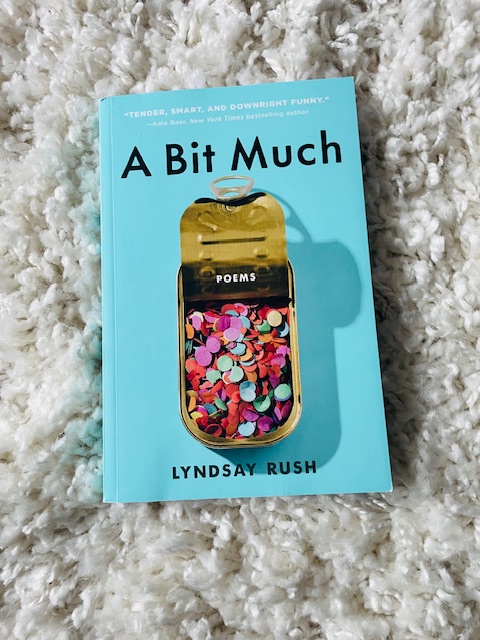
There is a new poet, Lindsay Rush, known on Instagram as Mary Oliver’s drunken cousin, who wrote a poem that went viral and has since become my poetic life mantra. It is titled “She’s A Bit Much.” She takes a common insult made about women and turns it into a compliment. She compares the insulted women to confetti, sprinkles, and the bonus French fry at the bottom of the bag, someone we are to celebrate, and she ends with the line, “Aren’t we lucky she’s here.” Her poem points to a bigger truth: insults made about women, such as she is a bit much, too bossy, manipulative, too driven, not feminine enough, etc., are more about putting women into a box that minimizes their God-given attributes when they should be celebrated.
As I child, I was labeled as bossy by some adults in my circle. I had budding leaderships skills, and needed adult guidance to help develop those skills in a healthy manner. Yes, some children with leadership skills can develop into narcissistic dictators, but most children just need adults to help them recognize that being a leader is not just giving orders but inviting others along to accomplish a goal for the greater good. It is interesting that boys are rarely described as bossy; words like charismatic or having leadership potential are used instead.

I have also been accused, in some circles, of being “too much” and have had conversations with other women who have also been unjustly accused of this as well. Introverted, mild mannered Christian women are held up as the more palatable and less offensive role models. According to the Bible, we are all expected to be humble, gracious, and gentle. Those character traits are not just limited to the female gender. But somehow, we associate those traits with quiet females. I think I can be “too much” in some people’s eyes but still exhibit the fruits of humility, graciousness, and gentleness in my life. It is just how those fruits are manifested that might be different than some of my introverted friends.

The point is, we label women with negative traits that we rarely use to describe men, and somehow, we think that it is okay. Although I don’t like being called bossy or “too much”, I find myself putting other women into a box with the label “brassy.” These so-called “brassy” women boldly state their opinions or ask for what they need from others without qualifications. We all need to learn a level of hospitality and be careful that we are asking and not demanding. Being bold and direct are not bad traits, and I must be careful that I am not labeling a bold woman as brassy when I don’t apply the same standard to men.

Like most consumers, I can be drawn in by certain labels. Terms like “sustainable,” “supports local farmers,” and “produced in small batches” are like catnip to me. I also look for labels in a bookstore and rush to the poetry, memoirs, and literary fiction sections, avoiding the fantasy and science fiction shelves. These labels help me pursue what I am looking for. But when we broadly label women negatively, we impose limits on what we think they can and should achieve, which can sometimes become self-imposed limits.

One of the most controversial women today, Meghan, the Duchess of Sussex, addressed these labels or archetypes on a podcast she did in 2022. She understands firsthand how labels can destroy when the media and trolls describe her as a “gold-digger,” “fake,” “family destroyer” and far worse. She interviewed some women, including Serena Williams, Paris Hilton, and Mariah Carey, exploring the origins and consequences of being labeled ambitious, a bimbo, or a diva. These women shared how they have let go of the negativity and, in some cases, changed the definition to a positive one. One thing from her podcast that stuck with me is when Serena Williams talked about negativity in relation to a woman being described as ambitious. Serena explained how for a long time that label hadn’t impacted her until she met her husband. But then people started describing her ambition in a negative light. “So, since I’ve felt the negativity behind it (referring to ambition), it’s really hard to un-feel it. I can’t unsee it, either, in the millions of girls and women who make themselves smaller, so much smaller—on a regular basis.”

Serena articulated something that I believe most women have felt in their lifetime, and I have no doubt that all the young women I care about have also felt it. When we are labeled as too much, bossy, brassy, and not feminine enough, we often find ourselves becoming smaller, shrinking our influence, agency, ambition, drive, and talents. This often leads us to imposter syndrome where we think we don’t measure up. We then start to second guess our instincts and minimize the character traits that reflect our creator.

Years ago, my husband had a meeting with some people and the subject of me came up. I had been feeling for a while that I was doing something wrong and felt like I was being pushed out of what I deemed the inner circle. Terry directly asked if there was an issue with me. The people in the meeting immediately said no, but one person qualified that sometimes, “Sherry can be too much.” They continued, implying that I can swoop in and get a job done, almost making the “too much” more palatable. But clearly, no one in the room but my husband believed this was a good trait.

Later, when I heard that I was “too much”, I instantly felt swallowed by shame. Hadn’t I written prayers time and time again in my journal asking God to help me be meek and mild? Hadn’t I come to this same group, bearing my soul in one of the worst moments in my life, and pursuing God with humility? Hadn’t I become smaller, hiding my natural extroverted inclinations to fit in with this group? Apparently, despite my best efforts, I was still “too much.” At that point, I was still desperately trying to fit in, so instead of affirming that my “too much” was enough for God, I did the opposite. I became smaller by being less talkative, less present, less involved, and less joyful.

There is one woman in the Bible who did not shrink in a time of need. Esther and her people were facing total annihilation. At first, when confronted by her cousin Mordecai to address the king, Esther started to shrink. Yes, she was the queen, but she still had to submit to the king. Boldly approaching his throne without being called for might lead to her own death. But Mordecai challenged her with these words found in Esther 4:14, “For if you keep silent at this time, relief and deliverance will rise for the Jews from another place, but you and your father’s house will perish. And who knows whether you have not come to the kingdom for such a time as this.”  Esther thought about what he said, and replied with a plan, ending with “and if I perish, I perish.”

Esther decided to go big and be who she was called to be, realizing that shrinking will lead to certain death, but the unknown gave her agency, allowing her to call the shots. By being who God called her to be, she was able to command the king’s attention and save her people and herself. I wonder how many of us women have shrunk in times we were needed because of what others have said about us, and how that leads to us slowly dying inside, never fully living the life we are called into.

In the circle that thought I was “too much”, I was slowly dying and becoming less of who I am. But I am no longer in that circle and have found a safe place to be all that God has called me to be. Yes, I still have character traits that must be balanced and smoothed out. But God’s guidance will help me fully be the woman He created.

I need to talk more about these issues with my friends. When I hear a woman being labeled, I should challenge the speaker with grace, trying to expose how these labels constrict, damage, and restrict women. I also need to address my own complicity in the problem, making sure I don’t fall into the trap of labeling others. I can encourage young women to be exactly who God made them, growing in true inward holiness. This will help #AccelerateAction in removing gender biases.

Sometimes, we need extra food coloring to make things right. Sometimes we need to turn insults into something positive like Lindsay Rush does in her poetry. But we always need women to operate exactly as they were designed; not labeled in a way that brings death but brings life.
Daffodils and Body Positivity

“I praise you, for I am fearfully and wonderfully. Wonderful are your works; my soul knows it very well. My frame was not hidden from you, when I was being made in secret, intricately woven in the depths of the earth.” Psalm 139:14-15

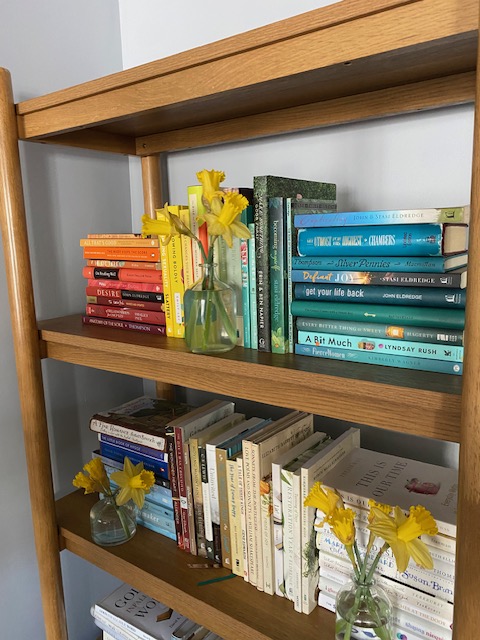
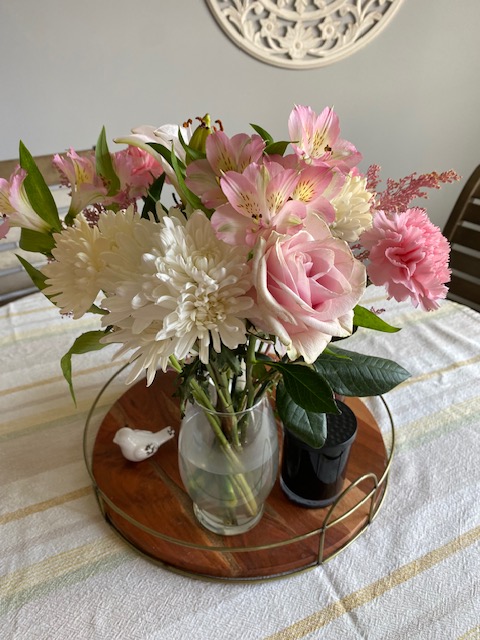
I can smell spring in the air, the faintest scent of dirt exhaling after its long winter slumber, while birds sing their morning songs. The air is still cool, but the sun and the wind whisper warm breezes, hugging my body. Even my music playlists are changing, from the mellow rhythms of yacht music to the upbeat melodies of Cole Poter and Frank Sinatra. To commemorate spring and offset my curmudgeon attitude due to daylight savings time, I bought myself some grocery store flowers. It started when a small bundle of daffodils smiled at me from their bucket. Then I saw another bouquet, full of light pink and white flowers that physically embodied the sounds of robins chirping. Initially, I was going to bundle both bouquets together. I later decided to spread the joy in four separate vases, creating expectant hopes of spring around my home.

The kinds of flowers a person is drawn to are a unique fingerprint of their personality. My mother-in-law loved impatiens, geraniums, and pansies, flowers that grew abundantly, giving her a lot of blooms for her budget. My mother loves ordinary carnations because they last a long time, allowing her to savor the blooms. My daughter’s love for ranunculus helped determine that she would have a spring wedding, so that her bouquet would drip with the delicate pink and yellow blooms. I love daisies because, as Meg Ryan’s character asked in You Got Mail,“Don’t you think daisies are the friendliest flower?”

It is interesting that God designed flowers to be unique. Some have massive heads with lots of tiny individual flowers like hydrangeas, some have intricate patterns like dahlias, and some are just little cups of joy like buttercups. There are even different varieties amongst the same species. Soon, pockets of daffodils will fill fields with sunshine, but if you look closely, you will see some with bright yellow heads, while others are the color of butter. Some will have curvy petals, while others will be fringed with lace. I am delighted our God, in His master artistry, took the time to create flowers unique and individualistic.

In the past few years, I have been on a journey to better health. I have had some setbacks in the last two years, gaining back a lot of the weight I had lost. But I am choosing not to focus just on numbers but on being more active, gaining strength, and becoming more flexible. I am also choosing not to be ashamed of the body I am living in and have bought clothes that fit me well and make me feel comfortable. But as much as I am working towards not being ashamed, I have still let other people around me make comments that demeaned me and others about the size of our bodies. I let the comments slip by, wishing now I had been courageous enough to address how these comments harm women.

One of the comments had to do with a local theater production an acquaintance saw. He noted that the production was good but commented that the female lead seemed too “big for the role.” He felt her size made her less believable as a love interest, although she could sing and dance “well enough.” I listened in disbelief. I am sure that, even in local productions, there were several women trying out for this role. I am also sure that some of the women would have fit his idea of what the lead should look like. But this woman was chosen above every other option because she was the most talented for this role. Additionally, I am curious how “big” this woman really was? Were his perceptions of “big” defined by his narrow view of how a woman should look?

The second comment was made directly to me about me. A different acquaintance of mine looked at the back cover of my book and asked if I dug out my “yearbook photo” for my picture. He didn’t comment on the fact that publishing a book is a major accomplishment. He didn’t remark on how brave I was for addressing a difficult subject or how well my daughter had designed the cover. His only response was pointing out rather unsubtly that I had gained weight. Again, I was stunned by his remarks and started to justify my choice of picture and even casually remarked that I recognized I had gained weight. Meanwhile, he quickly put the book down and started rambling about his upcoming adventure. I left that conversation demeaned.

It is stunning to me that in 2025, despite all the work that has been done in this area, women are still being judged by our size, appearance, and age. We celebrate women such as Andie McDowell who decided to go grey naturally, and Pamela Anderson who decide to walk the red-carpet sans makeup. Yet, Millie Bobbie Brown, a 21-year-old actress, was trolled by critics as “aging badly.” Keely Shaye Bronsan, the wife of actor Pierce Bronsan, is often pictured with before and after pictures, pointing out her weight gain. And if a celebrity has recently lost weight, the assumption is made that she used Ozempic.

I remember writing the author’s biography for my book. As Terry was helping me with the correct wording about where I lived, he added the words “Sherry currently lives in south-central Pennsylvania.” I reacted viscerally to that statement and stated rather emphatically, “I don’t want to take up that much space in my author’s biography. Where I live is not the most interesting thing about me!” I feel the same about my appearance and weight loss/gain; that is not the most interesting thing about me. How I love and care for my family, what I write about, my job as a volunteer coordinator, my passions, and, most importantly, my faith are far more interesting than whether I choose to dye my graying hair, or whether the numbers on the scale have increased or decreased. I do enjoy wearing a nice outfit and taking the time to care for my skin and hair, so I feel confident in accomplishing the things I want to in my world. I do want to move towards a healthier lifestyle so I can live a long and active life. But I don’t want to be defined by my age or my size anymore. And I will no longer tolerate comments made by others that demean me or the women around me.

Ilona Maher is one of the most body-positive role models for women. Maher won a bronze with her American Rugby team at the Paris Olympics this past summer. One of the comments on her social media speculated that she had a BMI of 30. Maher pushed back in a viral TikTok video, confirming she had a BMI of 29.3. She went on to say that the BMI was designed to represent males and was not an accurate representation of what a healthy female athlete’s body looks like. She also stated her weight boldly, remarking that she was not meant to live in a small body. Finally, she stated to the naysayer, “I am going to the Olympics, and you are not!”

If God designed flowers so uniquely, why can’t we accept that women live in different sized bodies, have different facial features, and have different shapes? Why are little girls in middle school still struggling with eating disorders and cutting due to bullying about how they look? Why is “You look fat!” the worst thing you can say to a woman or a girl? And why do we still think appearance, no matter the age, is the most interesting thing about a woman? I am sick of hearing people’s first remarks about a girl or a woman being “She is so pretty,” and then extolling her character, talents, and skills only as secondary considerations. When people remark about a young man, they lead with his character, skills and talents, and rarely address his looks. Will this ever change?

It can only change if I admit how I contribute to the problem. I can work on changing my own language and make sure my comments about women and girls address the character, skills, and talents they offer our world. When I am faced with demeaning comments about women related to their appearances, I can challenge the offender with kindness and curiosity, hoping to make them aware of how their comments demean women. Finally, I can keep addressing the subject with women in my community, hoping that little by little, we can move the conversation forward and #Accelerateaction in conversations about gender bias.

One thing I know for certain is that God made hydrangeas, tulips, and bluebells to be different. And if He was so careful to design flowers differently, I have no doubt that He designed humans to look differently as well, and I believe He looks at His creation and declares it good. It is my responsibility to live well in the body I have been given!

Monica L. and Hyde

“Judge not, that you be not judged.” Matthew 7:1 ESV

During my junior year of college, I had a full schedule. Along with being promoted to a new role as a Program Assistant and other extracurricular activities, I had the toughest class of my psychology major: a research and methods course. Often when I moved around my small campus, my head was down, thinking about the list of things I still needed to accomplish before the day ended. At the end of the school year, I met a freshman with whom I would be working in a summer program for underprivileged high school students. We quickly became friends, and she introduced me to a new, up-and-coming store: Bath & Body Works. Later that summer, she shared how she had tried to make my acquaintance before and, after being ignored a few times, she thought I was pretentious. I was taken aback by this assessment, and it was the first time I realized that I didn’t always appear warm and friendly. I quickly apologized, remembering how often my head was down and my list was long. Unfortunately, at the time, I was not mature enough to recognize that I needed to find healthier ways to deal with my stress and to avoid alienating people.

Since then, I have learned that when I am busy, I tend to have a Jekyll and Hyde transformation, shifting from the warm, friendly Sherry to busy, task-oriented Sherry. Even how I move about my world is different. I go from engaging in conversation with total strangers and inviting people into my home for peanut butter and jelly sandwiches (this was when my children were little) to being laser focused on what needs to be done and barking orders at others. This Mr. Hyde conversion is not my best side, and the various members of my immediate family have often been the ones who faced the brunt of this ugliness. And if you meet me at this time, you might not be enticed enough by the peanut butter jelly sandwiches to come over and visit with me.

Despite being busy with a newborn, I remember the1998 Bill Clinton and Monica Lewinsky scandal blowing up across the different broadcast and cable news networks. Before social media platforms existed, we still managed to be inundated with images of the infamous blue dress and clips of her phone conversations with a so-called friend. Next, we watched as President Clinton denied any sexual relationship, later apologized, and then faced impeachment. For years afterwards, every comedian and talk show host had a joke about Monica Lewinsky, criticizing her body, intelligence, and character. I laughed at some of the jokes and formed my own opinions of her.

But in 1998, we had no common language for the concepts of power differential, body shaming, or trauma. We didn’t understand that critical thinking is not yet fully developed in young adults, resulting in one intern’s naïve idea of love turning into the biggest mistake of her life. Today, I listened to Lewinsky tell her own story on her new podcast, Reclaiming by Monica Lewinsky. My views of Monica Lewinsky had been shifting for the last few years, and I knew I had misjudged her. But it was devastating hearing how hard it has been for her to move forward in her life, find a career, or even be in a healthy relationship because of a mistake she made when her impulse control was not yet fully developed. What was even harder to face was my culpability in her demise. I, along with the rest of the public, had misjudged and mischaracterized her.

This Saturday is International Women’s Day, a day with its roots in women protesting to receive better pay and improved working conditions. It started in the United States and moved across Europe as more women protested poor working conditions, wage gaps, and the inability to vote. In 1975, it was recognized by the United Nations as a day to support gender equality. The theme this year is #AccelerateAction, engaging in concrete ways to improve gender equality. There are still nations like Iran and Afghanistan where girls can’t receive education beyond elementary school, women are not allowed to own businesses, and women can’t leave their homes to have lunch with a friend. I can’t do much about those problems, except bring awareness of those human rights violations, support organizations that are trying to make a change, and vote in ways that address these issues. But I can do one thing that is noted on the International Women’s Day website: I can “call out stereotypes, challenge discrimination, question bias, celebrate women’s success…and share our knowledge and encouragement with others.” But to do this well, I need to recognize my own biases and the ways I need to change to address these issues.

Over the next three weeks, in honor of International Women’s Day, I am going to address issues of body image/body shaming, labeling, and judging women’s paths in life. I have touched on these areas in the past, but I am hoping to examine them from a fresh perspective with some personal anecdotes, pop cultural references, and Biblical principles. I also want to highlight why I, as a Christian, should and can do better about these issues. I hope you will join me in this series and hear how I am evolving.

I am so glad my friend in college laid aside her preconceived notions about me to become my friend. Her friendship, as brief as it was, enriched my life beyond fruity smelling lotions. I know how it feels to be misjudged, and I need to remind myself not to make judgments of others based on my own limited information about that person. My participation in shaming Monica Lewinsky certainly didn’t embody Christian principles and exacerbated her future struggles. But I know better now, and I want to continue to accelerate action to help move the dial forward in treating all women with equality.