Tiramisu Poetry
“When I look at your heavens, the work of your fingers, the moon and the stars, which you have set in place, what is man that you are mindful of him, and the son of man that you care for him?” Psalm 8:3-4
In the 1970’s, having a copy of the World Book Encyclopedias was as important as having a 45-inch flat screen TV today. Despite earning below the poverty line, my mother made monthly payments for us to have those treasures of knowledge, and the Childcraft books that came with it. These beige embossed vinyl books captured my imagination. I would peruse the first volume, pouring over the nursery rhymes making my way through longer poems flanked by delightful artwork. I explored the other volumes, but always came back to the poetry volume reciting Simple Simon Met A Pieman and envisioning magical forests while reading The Sugarplum Tree by Eugene Field. Something about poets’ distinct words conjured up images for me that seemed otherworldly compared to the harsh reality of life. My love for Volume 1 was imprinted with the oils of my fingers, making the embossed covers look worn and beloved.
I stopped reading poetry around age nine. I don’t know what stopped me from delighting in words. It is possible life just became too hard. I didn’t have the time to slow down and let the poets romance me because I was too busy keeping secrets. It could be that in English classes we poured over structure and rhyming schemes, making poetry seem mechanical. It may have been that the areas where poetry touches, feelings and nature, were not familiar or restorative to me. All I know is, for many years, I stopped engaging in my childhood friend, poetry.
Later, with my children, I explored poetry while home educating them. Charlotte Mason, one of my major educational influences, remarked that “poetry could cultivate the seeing eye, the hearing ear, the generous heart.” We read a free verse picture book titled Daring Dog and Captain Cat where family pets had nighttime adventures. As I read the book aloud and found the rhythm, I delighted in the images the author painted with words, like “kitchen pans banging breakfast songs.” Yet, I held poetry at a distance, still believing that my lack of intelligence or imagination prevented us from forming a relationship.
Ann Voskamp, and her poetic prose best seller One Thousand Gifts: A Dare To Live Fully Right Now slowly enticed me back to poetry. Her descriptions of soap suds dancing in the air, and the colors of sunrise captured my senses. I, too, began to write down things I was grateful for, paying attention to how the steaming cup of coffee warmed my hand and soul. I too, listened to the songs of birds chirping and the smell of lilacs wafting across my patio. And, like Ann, “when I’m always looking for the next glimpse of glory, I slow and enter.” This created the soil where my love and appreciation for poetry could grow and thrive.
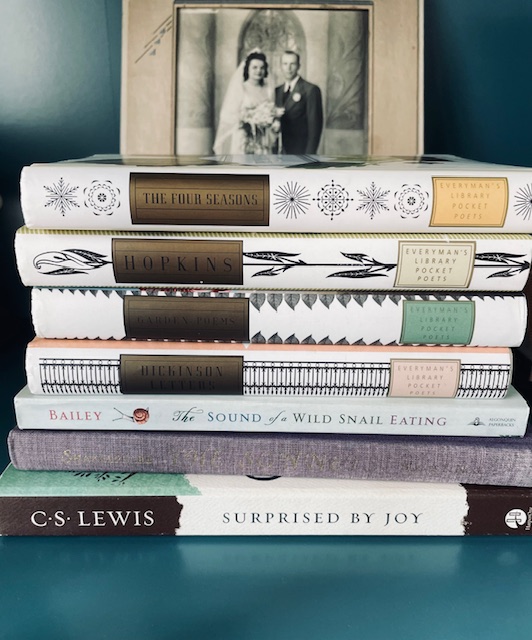
Later, when I was experiencing a lot of life transitions, I was encouraged by authors like Joy and Sarah Clarkson to start reading poetry once again. I picked an anthology, The Four Seasons Poems, edited by J.D. McClatchy in spring of 2018. This compact book, from a series called Everyman’s Library Pocket Poets, stayed at my bedside for a year. Regularly, I would read a poem aloud, listening to how the words danced across my lips, savoring the images the poets created. Sometimes, I could smell the plowed spring earth ready to bear seeds, feel the soft summer wind brush my hair across my face, hear the crickets play their fiddles in fall, and see the giant snowflakes flutter to the ground. As I did this, I found myself paying more attention to the world around me and feeling more appreciative of God, the creator of all things beautiful.
This small book opened up a new world. I began to crave poetry and found both old and modern poets I loved. Christine Rossetti, Wendell Berry, Mary Oliver and Maggie Smith soon became treasured friends. I encouraged my husband to join me, and soon we were reading poems aloud to each other in the evening. I started to open my imagination to answer Mary Oliver’s question in The Summer Day “Tell me, what is it you plan to do with your one wild and precious life?” I started to think harder about where I lived and how I can create community because of Wendell Berry’s insights. I contemplated how I can contribute to making this world beautiful by reading Maggie Smith’s Good Bones. Each poet helped me adjust to the transitions in my life and see that I had a full life ahead of me.
I also saw how poetry can address justice, body positivity, and other issues our world faces today. Amanda Gorman called for “unity, collaboration, and togetherness” as she recited her poem The Hill We Climb at the 2021 Biden inauguration. With her bright yellow coat, she stood elegantly and resolute capturing the hearts of Americans. Kwame Alexander connects young African American men to the importance of family by using sports analogies in his visual poems. Lindsay Rush addresses the stereotypes and stigma women feel in her book of poetry A Bit Much.
My husband tried tiramisu years ago and was disappointed. After two attempts, he concluded that he didn’t like this famous Italian dessert. We then heard others drool and rave about our friend Nate’s famous tiramisu. Everyone requests this dessert from him, and some unashamedly eat it before the main meal at church dinners. After a couple of years hearing about all the fuss and gentle prodding from me, Terry decided to give it a try. His first bite into this rum, espresso, creamy mascarpone concoction opened his eyes to this Italian treasure. The reality is he did like tiramisu, he just needed to find the right recipe for his taste buds.

I have heard from many people resolute about their distaste of poetry for much the same reasons I had vocalized in the past. But like Terry’s experience with tiramisu, it may take some trial and error for you to find the right poet or poem to speak to you. As a Christian, we should challenge ourselves to read poetry because it is a writing technique God used in the Bible. He knew the power of imagery and expressing emotions speaks to the heart of all people. Audre Lorde says “poetry is not a luxury. It is the vital necessity of our existence.”
Here are a few ideas on how to engage in a poetic relationship. Start in Psalms, and although we lose some of the rhythm due to translation, read a few aloud. Pay attention to the imagery and emotions being expressed, and how vulnerable the writer was being. Then, look at some anthologies, like a poem about seasons or gardens, or even a poem a day. Read the poem aloud following the punctuation, it may feel awkward the first few times, but eventually you will feel the heart of the poem. If it describes plants or places or animals you are unfamiliar with, look those images up. I had no idea what a snowdrop looked like until we explored Winterthur Gardens. Now, all the late winter/early spring poems about the snowdrop flower make sense. If reading a book of poetry seems to be daunting, explore some poetry podcasts that read a poem aloud such as Slowdown or Daily Poem. Finally, if one poem does not speak to you, leave it behind. But if it does, take the time to savor the words and images. Maybe even annotate the poem by underling the lines that jump out at you. Also, explore some modern poets like the ones I mentioned in this blog post. Keep trying, because one day you will find a poem that speaks to you.
It is National Poetry Month, so give a poem a try. I promise you will like it!


 By Sherry Collins