Page 7 of 28

Chili Crisp and Jackson Pollock

“He has made everything beautiful in its time. Also, He has put eternity in their hearts, except that no one can find out the work that God does from beginning to end.” Ecclesiastes 3:11 NKJV

Despite being a resident of Pennsylvania for the last 13 years, I still identify as a Wisconsinite, and more specifically, a Sheboyganite. My hometown is famous for its picturesque lakeshore, championship golf courses, award winning bratwursts, and hard rolls. The city and its greater community are also home to some world-renowned businesses, including Kohler Company, Sargento Cheese, Johnsonville Sausage, and Acuity Insurance. Sheboygan is no stranger to pop culture, including references in the movies Some Like It Hot and Home Alone, reinforcing the popularity of polka! Even in Fall River, Massachusetts, a nurse shared with my son her own familiarity of Sheboygan. On the day my grandson was born, the nurse chuckled when my son reported that he was born in Sheboygan. As a child, her mom had threatened that someone would take her to Sheboygan if she misbehaved.

Like all areas, Sheboygan has its own folklore, idiosyncrasies, and even its own dialect. When we go to bakeries, we also eat bakery, aka donuts and pastries. We are super polite at four-way stops where everyone waves to everyone else to go first, even if everyone sits there for a minute or two. We don’t grill out, we fry out, and brat frys are the major fundraisers for local charities. We eat brats on a hard roll, which are not in the shape of a hot dog bun, but rather a hamburger bun. We also call the drinking water fountains bubblers after a local company that made them.

Like bubblers, certain products are identified by brand name. We no longer mop our floors, we swiffer them. I call tissues Kleenex, although I only buy Puffs. I never refer to my phone as my cell phone, but instead my I-Phone. Some brands elicit a strong feeling of loyalty. I once tried to use generic toasted corn flakes in place of Kellog’s Corn Flakes in one of our family’s favorite Christmas cookies. My husband’s discerning taste buds recognized the difference immediately, and since then, we only use the name brand.

Companies protect the names of their product by submitting a trademark with the United States Patent and Trademark office. A trademark is a type of intellectual property consisting of a recognizable sign, design, or expression. The application itself is straightforward, but the process of getting something trademarked can take time. Trademarks can’t be used on something general, like ice cream or ketchup or tissues. But it can be used on specific brands, like Ben & Jerry’s Chunky Monkey, Heinz Ketchup and even the swish on Nike athletic shoes. Once something is trademarked, that intellectual property belongs to an individual or company and can’t be used by any other person or company.

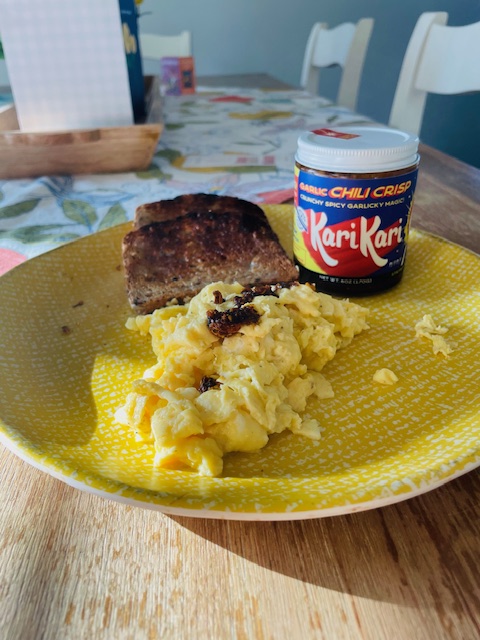
Recently, the food world was in uproar over a company’s trademark on chili crunch, otherwise known as chili crisp. This popular condiment adds a finishing touch over dumplings, noodles, eggs, and avocado toast. The crunchy, oily, spicy condiment is made of dried chili flakes, crispy fried garlic, or shallots, and sometimes sesame seeds. Some cookbooks and websites are dedicated to finding more ways to use the condiment, including as an ice cream topping. Self-proclaimed foodies have multiple jars of different chili crisps in their refrigerators. Terry and I discovered the joy of chili crisp, adding it to stir fries and spaghetti.

The controversy came when Momofuku, a company started by celebrity chef David Chang, decided to trademark his brand of the condiment with the name “chili crunch.” Soon small businesses who used chili crunch in their product name were sent cease-and-desist letters by Momofuku’s legal representation. These small companies, many of whom are using family recipes, had ninety days to rebrand their products. Many food writers and chefs opposed Momofuku’s right to trademark the name “chili crunch”, arguing that the term was ubiquitous for a cultural product.

As a Christian, I have acted like Momofuku, thinking that Christians owned the trademark on truth, love, beauty, and righteousness. As a home educator, I surrounded myself with history books from Christian educators. If a musical artist was not explicitly Christian, I concluded that the music didn’t glorify God. If an artist or writer had any moral failures in their life, I wrote off their painting or book as not important. I thought only Christian organizations were doing important and worthwhile charitable work. I also thought that Christians hit the mark on righteousness and held themselves above reproach.

I have realized my thinking set Christians, me included, above others. Only God has the trademark on truth, love, beauty, and righteousness. All truth, love, beauty, and righteousness reflect the glory of God, no matter the source. This shift in perspective has opened me to more empathy and humility. As a Christian, it helps me validate the importance of the work others are contributing to science, history, medicine, art, music, and writing. I can read Robin Wall Kimmerer’s Braiding Sweetgrass, a book built on her indigenous spiritual worldview, and find some principles, like honorable harvest, rooted in the Bible. I can listen to a Taylor Swift song and see in her music her longing for a lasting love, a desire in all of us only fulfilled by Christ. I can follow Jasmine L. Holme’s Instagram page and find resources that explain how Southern confederate biases influenced some of the homeschooling material I used. I can read poetry by Mary Oliver that speaks beauty into my life.

This trademark belief was also evident when Christian apologists believed that abstract art reflected a post-modern world. I held on to that view for many years, denigrating modern art. Like all my self-righteous thinking, my views on modern art began to change. It started when my sister brought a modern art piece for her kitchen, and it surprised me how much I was drawn to this piece. It added a touch of color to her kitchen, anchoring it with a sense of calmness and warmth. After discovering that I liked that piece, I started looking at more modern art, finding some pieces that inspired joy in me.

French Port by Laurie Anne Gonzalez available on Juniperprintshop.com
French Port by Laurie Anne Gonzalez available on juniperprintshop.com

Later, I discovered Makoto Fujimura, an abstract artist who is a leader in the slow art movement. He uses a Japanese technique called Nihonga. This style involves the artist grinding colored minerals in a fine powder and layering them onto his art piece. Each layer takes time to dry, and some of his pieces have sixty layers. His Walking on Water series started off as an elegy to the victims of the 2011 Tsunami, and has evolved to pieces addressing climate change. At the end of his book Art + Faith: A Theology of Making, Fujimura writes a Benediction for Makers: “May we steward well what the Creator King has given us and accept God’s invitation to sanctify our imagination and creativity, even as we labor hard on this side of eternity.”

Based on his writings, Fujimura makes a difference between being an artist who is a Christian and being a Christian artist. He warns that art should not be a tool to evangelize and disciple others, instead it should glorify God. By glorifying God, we open the door for conversations with others. Even artists who are not Christians can glorify God in their works by reflecting the beauty of the created world. None of this is more evident than artist Jackson Pollock. Like Ian Falconer’s children’s book character Olivia, I believed I could splatter paint like Jackson Pollock and call it art. How naive and prideful I was, again believing I knew and understood the trademark of beauty.

Jackson Pollock painted his famous artwork by using a “drip” technique. He involved his whole body to paint and used force to cover the whole canvas, almost like dancing. For some, his pieces looked unpredictable and shocking. But again and again, people were drawn to his art. In 1999, physicist and artist Richard Taylor became interested in Pollock’s work in relation to fractals. Fractals are the repeating patterns found in nature starting at a large scale moving to the smallest scale. Imagine a tree, and it starts to fork out into big branches, and then eventually into smaller branches, and this same pattern is repeated down to the veining in a leaf. This pattern is a fractal, and research demonstrates that we find these fractals reassuring and harmonious. Using computer analysis, Taylor discovered that what others had determined to be random drip marks were actually fractals. Pollock referred to his painting style as “I am nature”, but his artwork tapped into God’s creative design in nature. This same computer analysis was used to determine that some recently discovered works thought to be Pollock’s were fakes, later confirmed by paint analysis. I am looking forward to my next visit to MOMA and viewing Pollock’s work with new eyes.

Because of the backlash, Momofuku has dropped the trademark disputes. It’s not clear if they are going to exercise their legal trademark rights in the future, but right now, they seem to have taken a break from owning “chili crunch” as intellectual property. I am a Christian, but I no longer believe that I hold the trademark on truth, love, beauty, and righteousness. I need to keep my eyes on God, who holds all truth, reflects all love and beauty, and is truly righteous. I can also look at both my fellow believers and those who don’t believe and discover how the image of God is reflected in their lives. This curiosity for discovery can help bridge the gap in a divided world.

Reclaimed & Restored

“I will seek the lost, and I will bring back the strayed, and I will bind up the injured, and I will strengthen the weak, and the fat and the strong I will destroy. I will feed them in justice.” Ezekiel 34:16

Eleven years ago, my children gave me a lilac bush for Mother’s Day. Lilacs remind me of my own childhood when three lilac bushes framed the living room picture window. Despite all the dark things happening within our home, every spring those bushes would drip with white, lavender, and deep purple blooms. The heady, sweet scent was always a welcome relief from the odor of cigarettes and alcohol. This annual display of beauty gave little Sherry some hope.

My Mother’s Day bush has grown and filled out. Each spring, it seems to be covered with more and more blooms. For a week or two, the scent of lilacs transports me back to a few bright moments in my childhood where hope and beauty collided with despair and darkness. This spring, the lilac bush reminds me again of beauty despite brokenness.

A heavy, late winter snow fell this year, covering the dead brown earth with a fresh white blanket. I sat in my house, enjoying a cup of coffee, marveling as the intricate snowflakes drifted to the ground. Everything looked beautiful and dreamy. The snow coated the branches of every tree and bush in our yard. My privet bushes bowed to the ground with the weight of the snow, while my lilac bush remained sturdy, despite piles of snow coating the branches. Later the temperatures rose, and the snow turned into icy rain. By night, the tree branches glistened with icicles and my whole yard glittered. I went to bed, dreaming of my magical snow globe world.

I was a little worried about the privet bushes. They were so bowed down that I wondered if they would survive the weight of the ice and snow. But when I came downstairs the next morning, they had perked back up, lifting their branches to the bright sun. I went into the kitchen and opened my patio blinds. The sun reflected my snow-covered yard, blinding me for a few seconds when something caught my eye. I noticed two main branches of the lilac bush lying down on the snow. They looked forlorn, and upon closer inspection, I realized they had partially snapped off from the base of the bush. My beautiful snow globe world had cracked, breaking something that was beautiful.

Three weeks ago, I posted on Facebook that I had finished my book. This book has been a labor of love and grace. I had always dreamed of writing a book, perhaps to tell my own story. But I never imagined the journey that it would take for me to get to that place. It started with a series of events that left me wondering who I was, and who I wanted to be. Some of these events were ordinary life transitions like dealing with an empty nest while others were unexpected losses and crises. But through all of it, I felt God was inviting me into a deeper healing process not only from what was going on in my life then, but what had gone on in the past as well.

Instead of jumping to get a job after my children left home, I invested the time to do some internal work. And for this first time in my life, this extrovert craved space and solitude! I wasn’t totally alone; I spent hours communing with God through His word and in prayer. I also spent a lot of time reading and listening to any material that offered me perspective, care, and support such as blogs, books, and podcasts. Finally, I found community, in my Life Groups at church, friends, family, and mostly my husband. These safe places allowed me to share some of the ugly, crushing, shame-filled experiences, as well as the beauty I was now discovering.

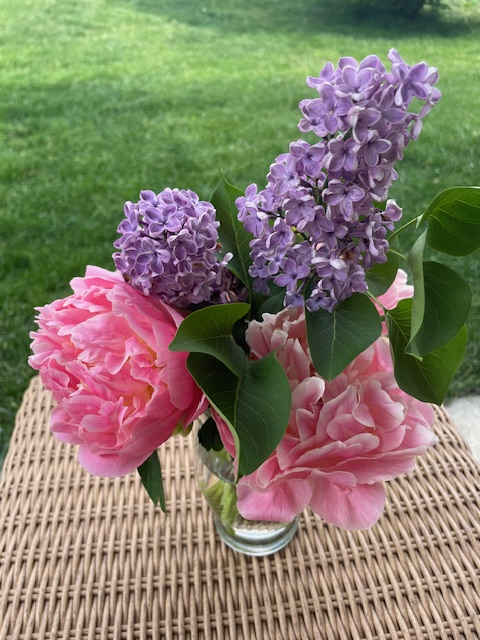
We forgot about the bush this past spring in the midst of editing and finishing my book. Before we knew it, the broken branches were budding with both leaves and blooms. We decided to wait before severing it from the rest of the bush. Why not let it bloom once more before we cut it down? And bloom it did. Soon the branch was saturated with purple flowers, filling vases throughout my home. But something else happened unexpectedly, my peony bush also bloomed at the same time. And it too was covered with vibrant pink flowers. Wanting to capture this moment, I filled the house with vases of lilacs and peonies.

I discovered peonies later in life. They seem more sophisticated than my lilacs. When they first bloom, they open as soon as the sun peaks over the horizon, and close as dusk falls. At the height of their short life, they flash their vivid pink petals for the world to see, displaying delicate yellow stamens and pistils. In the short five years since I planted them, another Mother’s Day gift, my peony bushes now also drip with blooms. These little bushes, if cared for, will continue to bloom throughout my life and beyond. Peonies have been known to bloom for up to 100 years.

These flowering bushes represent my lifelong need for beauty. Even what they symbolize illustrates my past and present. Both the white and lavender lilacs of my childhood embody innocence and spirituality. It should have been a time in my life where childhood innocence was celebrated, and my spiritual formation developed. Peonies represent compassion, healing, and renewal. Since planting my peonies, I have begun learning self-compassion and healing.

The fact that the two different flowers bloomed simultaneously is not lost on me. I had just sent out my book to friends I trust to offer valuable feedback. I want this book to be the best version of itself, so I’m inviting others to critique it before I publish it. Yet, the book had no title. People have offered some great suggestions, but nothing seemed to connect with me. For a while, I had thought about titling it My Ugly House Restored. But for too long, the ugly of my life held sway over the beauty I desired. It defined my living nightmares as a child, the names I was called, and how I saw myself even as an adult. The book has some ugly moments in it, but I am not defined by the ugliness that was perpetrated on me.

My friend Michele sent me another suggestion for the title, the word “Reclaimed”. I looked up the definition of that word along with restored, and although the words are often used synonymously, they have different meanings and applications. I felt my book was both, and that’s when the title hit me. Reclaimed & Restored will be released in October of this year. God reclaimed my life from fourteen years of sexual abuse and has lovingly led me on a thirty-five-years-and-counting restoration journey. After settling on that title, both my lilacs and peonies bloomed together. I can place the lilac blooms from my broken branch into the same vase as the peonies to create a beautiful centerpiece on my table; a centerpiece that integrates my past and present into something beautiful.

Yesterday, Terry cut off the broken branches of the lilac bush. And in a week or two, my peony bush will be devoid of blooms. But right now, I will bask in the goodness of God as their blooms fill my home. And I know that next spring they will bloom again. I have no illusions that I will make the New York Times Best Seller List with my little book. I am self-publishing, so I don’t have a PR team hyping my book. But I do know I have faithfully embarked on a healing journey with God from my days of seeing lilac bushes in the yard to discovering peonies as an adult. If my words impact just one reader, I have done what God has called me to do. And as disturbing as the sexual abuse was, my deepest desire is that the readers will see the beauty God has given me, time and time again!

Stewarding the Earth: Echo Chambers and Climate Change

“but in your hearts honor Christ the Lord as holy, always prepared to make a defense to anyone who asks you for the reason for the hope that is in you; yet do it in gentleness and respect.” 1 Peter 3:15 ESV

Four and half years ago, I titled my blog Graceful Transitions and started writing about my midlife journey. I wanted it to be a space where I could share things I was wrestling with, such as creating more intimacy in my marriage, being transparent about my journey to better health, and moving from parenting to blessing my adult children. Just as I agonized over the names of my children, I picked the name for my blog carefully. I wanted this to be a place that exuded gracefulness. In years past, I had been bold and harsh with my opinions, often alienating those around me. But life has a way of humbling you, and I wanted to operate in that space. My writings could still be bold and confident, but I didn’t want to come off as an expert. Instead, I wanted to share my thoughts in a gentle manner that dignified both God and the reader. The word “transitions” was also carefully thought out. I didn’t want to portray myself as someone who has arrived. Instead, I wanted to be curious, eager to learn and grow in my relationship with Christ. These traits would move me from one place to another with fluidity.

We often walk in a local park that has a tunnel underneath a busy road. Anytime we have children with us, we stop in the tunnel for a few minutes. They sometimes yell each other’s names or just make a loud noise and listen to it reverberate. There is something about hearing an echo that is delightful. Your voice becomes an instrument that can drown out any other sound. And it’s contagious. Once one child makes a sound, other children quickly start doing the same. And soon, the tunnel becomes a cacophony of noise.

Initially, I had no intentions of pontificating on any hot button issues in my blog. Current event noise fills our screens with rants and raves, polarizing our society. But as I continued to write, I found God gracefully transitioning me out of the self-imposed echo chamber I had been in for the last thirty years. This echo chamber informed my political views, how I looked at the world, and what causes I believed in. Like the tunnel, the echo chamber noise of the 2020 election became deafening. And as the world dealt with the pandemic, racism, and immigration issues, I found myself looking for other perspectives.

This led to a spiritual crisis. For so many years, I espoused the idea that you could only vote one way to be a good Christian. I even challenged others on this principle, boldly declaring that God only accepted the votes of one political party. But again and again, I kept reading in scripture how God cared for the poor, the widow, the fatherless, and the sojourner (another word for immigrant). Did my votes support what God truly cares about? Can Christians think differently about issues?

God always has a way of helping you wrestle well these concepts. As I read scripture, God directed me to other Christians who had a different perspective from those on talk radio and certain news outlets. These thinkers researched carefully, believed all people were created in the image of God, and still held fast to scripture. They didn’t water down the gospel, but instead looked at scripture wholly and completely.

All this reading, listening, and thinking led me to this series on Stewarding the Earth. For years, the far right has labeled environmental supporters “wackos and pagan worshippers”. As a follower of Christ, I am troubled by the name calling I used to support. Is name calling helpful in moving the conversation forward and declaring the gospel to those who care about the earth? I now believe you can be a Christian environmentalist. John Muir, one of the biggest environmental supporters had Christian roots. Founder of the Sierra Club and considered the father of the National Parks, Muir believed in God. He was known to share his faith with others on the University of Wisconsin campus. Some scholars acknowledge that Muir struggled with orthodox Christianity later in life, but he did recognize God’s hand in creation throughout his book My First Summer in the Sierra. Today, one of the leading climate change scientists, Katherine Hayhoe, is a Christian. She has been awarded Champion of the Earth, the United Nation’s highest environmental honor. In her bio on her website, she says, “I don’t accept global warming on faith; I crunch the data, I analyze the models. I help engineers and city managers and ecologists quantify the impacts.” There are also some faith based environmental advocacy groups, like A Rocha International and the Evangelical Environmental Network.

I have heard two consistent arguments from fellow Christians against environmental policies. First, they believe that environmentalists worship creation more than the creator. There may be some truth to this in some cases. But scripture supports the fact that when people express awe in creation, it points them to the creator. David says in Psalms 8:3, “When I look at your heavens, the work of your finger, the moon and the stars, which you have set in place.” This sense of awe was reaffirmed by Paul in Romans 1:20, where he says, “For the invisible attributes, namely his eternal power and divine nature, have been clearly perceived, ever since the creation of the world, in the things that have been made.” Psychologist Dacher Keltner, who has studied awe, finds that experiencing awe makes people more curious and less judgmental. It also makes people more humble, generous, and altruistic. If we Christians keep the earth as awe inspiring as we can by reducing our impact on the climate, can we point others to Christ? If we value the created earth, because it points to an awesome creator, can we have conversations with non-believers when they are curious and open to ideas about how God frames our world? These conversations can only happen if we, too, are inspired by awe. This will help us to express curiosity and be less judgmental.

The next argument I hear often is that we were given dominion over the earth from the beginning of time. Again, there is truth in that. Genesis 1:28 says, “Be fruitful and multiply and fill the earth and subdue it and have dominion over the fish of the sea and over the birds of the heavens and over every living thing that moves on the earth.” But the Bible goes on to say in Genesis 2:15, “The Lord God took the man and put him in the garden of Eden to work it and keep it.” The Hebrew word for work is “abad” which also means to serve, and the Hebrew word for keep is “samar” which means to guard and keep watch, protect, and save. When you put the two verses together, it changes our view on the word dominion. We are to operate on God’s behalf, and we are called to rule over the earth by protecting and serving it. By doing this well, we are ensuring that the earth will provide us with the means to survive: a healthy climate where animals and vegetation are thriving, and clean water flows freely. God didn’t give us the authority to destroy and plunder the earth!

There are some great theologians and philosophers who advocate for a more theologically sound view of the environment. C. S. Lewis, great Christian apologist, warned in The Abolition of Man that “Man’s conquest of Nature turns out, in the moment of its consummation, to be Nature’s conquest of man.” Francis Schafer, a leading Christian philosopher, challenged believers in Pollution and the Death of Man, “Christians, of all people, should not be the destroyers. We should treat nature with an overwhelming respect.” Wendell Berry, poet and naturalist, writes in The Art of the Commonplace: The Agrarian Essays, “…the care of the earth is our most ancient and most worthy and, after all, our most pleasing responsibility. To cherish what remains of it, and to foster its renewal, is our only legitimate hope.” These Christians contemplate the word of God and carefully choose words to respond to concerns they have about the environment. I wonder how often the voices that oppose environmental policies contemplate scripture and man’s responsibility towards the earth.

As a follower of Christ, I am expected to shine His light in a dark world. This is more than just sharing my testimony; it should be embodied in how I act and treat others and the earth around me. How I live my life impacts the climate. My carbon footprint increases drought and flood conditions and changes water supplies. It also makes winters warmer, allowing bugs and pests to increase. Their increase can lead to the destruction of forests and other vegetation. Food supply chains are being affected and the sea level is also changing. All this change directly impacts my neighbor, from the person next door to those in Mozambique who contribute little to the carbon footprint. Katherine Hayhoe’s website is full of information about how climate change is affecting our world. She uses scientific research to support her arguments and to counter the opposition.

I have written about noise pollution, our obsessive use of plastics, and how to Leave No Trace. Some of these ideas will help reduce our carbon footprint. Although I don’t personally own a hybrid or electric vehicle, I can argue the benefits of encouraging research and development in making these vehicles more viable. I can also talk about how shopping locally, both for produce and meat, is another way you can reduce your carbon footprint. But the biggest way for me to make an impact is to acknowledge climate change is real and to be educated before I enter the voting booth, both on a national and a local level. Supporting policies that reduce climate change can be one of the most important ways I steward the earth well as a follower of Christ.

This is the end of my series on Stewarding the Earth. Readers, I hope you enjoyed it. Feel free to comment on any of the posts I have made. I will continue the conversation in the future with some interviews with fellow Christians who model these principles well. Additionally, I will likely write about other issues where God has been opening my eyes to a wider and fuller view of scripture. These still fit into the ethos of Graceful Transitions, because I want my words to dignify God and you, my readers. Thank you for all your support.

Stewarding the Earth: Leave No Trace

“And I brought you into a plentiful land to enjoy its fruit and its good things. But when you came in, you defiled my land and made my heritage an abomination.” Jeremiah 2:7 ESV

About six years ago, I was sitting at my table when God whispered to me, “It’s time!” I knew exactly what He meant. He was inviting me into an adventure, where buttered bagels didn’t cover up anxious thoughts and donuts didn’t distract me from loneliness. God’s distinct voice encouraged me to see what was under the layers of fat and cellulite. Who was the woman underneath? What passions and desires had been covered up for decades with cupcakes and cheesy bread? I have written about many of the things I learned on this journey: fat is not a feeling and bread doesn’t fill. But I uncovered something else that I never expected: a woman who craved to be in the outdoors whether it was hiking or taking walks in parks. And this new woman found the outdoors restorative and inspiring.

I am not alone. Since 2020, when the global pandemic made all our worlds smaller, people turned to the outdoors to see that their world was bigger. In a 2023 report from the Outdoor Industry Association, the trend for participating in outdoor recreation continues to increase, seeing 2.3% growth in 2022. Some of the new participants are young and diverse, although compared to the general population, diverse ethnic and racial groups are still wildly underrepresented. The senior age demographic also saw a record high participation, making seniors one out of every five people spending time outdoors.  Whether fishing, hiking, kayaking, or mountain biking, people are finding more ways to spend time outside.

One of the greatest and most inexpensive ways to spend time outdoors is to explore state parks. I am blessed to live in Pennsylvania, where state parks are free. When I lived in Wisconsin, our annual state park pass was only $28, still relatively cheap. Across the United States, the average annual cost of a state park pass is $59.76, the price for two separate family trips to a fast-food restaurant. The state parks are treasure troves for people to explore the outdoors. There are thousands of miles of trails for hiking and biking, and thousands of lakes for kayaking, fishing, and swimming. Additionally, a lot of these parks offer educational opportunities, like workshops on foraging, invasive species, and wildlife. When living in Wisconsin, my children and I participated in a story time hosted by a state park. We learned that owls flew silently, and skunks tapped their back feet as a warning before spraying.

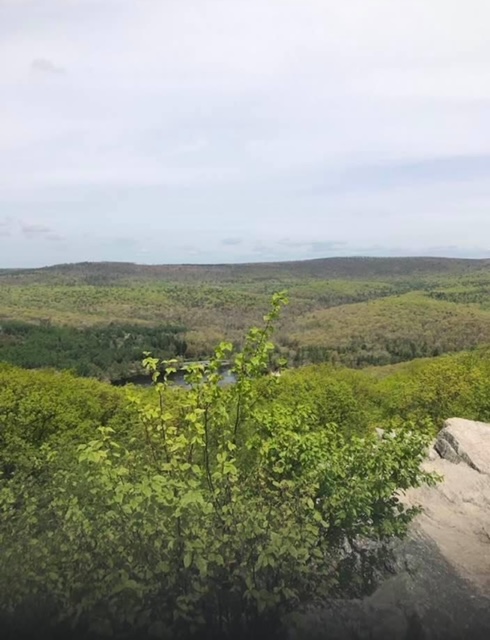
As a child, I occasionally hiked with my Uncle Mike in the Kettle Moraine State Forest in Sheboygan County. Most of these hikes took place in the fall, when the forest canopy was aflame with brilliant red, orange, and yellow leaves. I loved how the saturated green moss contrasted with brown tree bark. I spied birch trees, composing in my mind an imaginary letter on its wispy white bark. I enjoyed the sound of crunching leaves as I trod the paths. It felt otherworldly, taking me away from the chaos of my home. I felt calmer and more hopeful, and for a few hours, I even breathed more freely.

These hikes only lasted for a few years. My uncle got married and started a family, and I was too fraught with anxiety over my abuse to continue hiking. After I got married and had children, I wanted them to have a more well-rounded childhood than I had. We spent time at nature preserves, hiked occasionally in the same places I hiked as a child, and camped. I believed these activities were for my children’s benefit and I didn’t take the time to explore how these activities could be helpful for me as well. Instead, I was just checking the boxes of being a good parent.

But as pounds melted away, I awakened from the calorie-induced coma that I had been in. The air was fresher, birds’ songs were clearer, and the sun was brighter. I longed to be outdoors, exploring places I had never been. I felt God calling me into His beautiful creation to heal the places where food had always been a cheap salve for my pain. John Muir, renowned environmentalist, says it best: “Everybody needs beauty as well as bread, places to play in and pray in, where nature may heal and give strength to body and soul.”

With the increase of depression and anxiety, mental health professionals are encouraging people to spend more time outdoors. Studies have shown that time spent in nature has improved people’s focus, lowered stress, and has reduced the risk of developing a psychiatric disorder. It has also been shown to reduce frustration and increase empathy for others. For a long time, most of these studies were focused on green spaces, time spent strolling in the parks or hiking in the forests. But now, researchers are finding evidence of these same benefits with blue spaces: being able to access views of rivers, lakes, or oceans.

But spending time in nature has a cost. We are entering into lands for our enjoyment, but these are also places where wildlife and vegetation are free to thrive and grow. When we are hiking, kayaking, or fishing, we should be mindful of the impact we are making in that place. And the best way to do that is a catch phrase used across the nation: Leave No Trace.

I have understood the basic tenets of this phrase for years. If I eat a granola bar on my hike, I need to throw away the wrapper at home instead of leaving it amongst the leaves. I know I shouldn’t feed the wildlife, and I should leave flowers and plants alone, so that others can enjoy them on their own hikes. But in listening to a recent podcast on PA state parks and nature, Hemlocks to Hellbenders, I learned ways I was still leaving a trace. The host, Christian Alexandersen, interviewed Ben Lawhon who served as the Director for Education and Research for the Leave No Trace organization for twenty years. Lawhon shared some ways of which I was ignorant about the negative impact I was making when hiking. My apple core or banana peel may be biodegradable, but apples don’t typically grow in forests and bananas don’t even grow in this hemisphere. My waste can introduce wildlife to types of food that are not part of their normal diet. Also, if I avoid the mud puddle on the trail by walking off the path, I may be causing more of the forest to erode, leaving less places for vegetation to thrive. Also, when I camped, dumping my gray water (dish water) on the ground was exposing the earth to chemicals.

It’s easy to say that one banana peel is not a big deal. But during a hiking season, if 100 visitors each throw a banana peel in one park, this could have a major impact on the diet of bears and other wildlife. Walking around one mud puddle may seem insignificant, but if just half of the people walk around that mud puddle, the off-trail vegetation is going to be trampled and destroyed. And finally, dumping one bucket of gray water doesn’t seem like it will have a major impact, but if just half the campers dump their gray water over the course of a summer, the soil will become contaminated.

Earth Day was on Monday. For years, many right-leaning talk show hosts have blasted the environmental policies of the left. Many Christians, because of their political leanings, have sided with their arguments, including myself. In researching for this series of blogs, I have found that many of these so-called arguments were based on faulty science and fake news. As Christians, we can and should do better. If we believe that God made the earth good, we must believe that He knew the benefits nature would provide for our mental health, and emotional and cognitive processing. He chose to create a world of diversity, filled with forests, wetlands, oceans, mountains, and deserts. And He gave us the responsibility to steward it well. Stewardship means we need to examine the science behind climate change, continue the search for alternative sources of energy, and garner support for the benefits of regenerative farming. Good stewardship will ensure that the earth stays in good working order for generations to come!

We also need to support policies that protect and expand our state and national parks. These places are good for everyone, from my grandchildren who have a natural love for exploring the outdoors, to our senior citizens who find the outdoors beneficial to their health. And more than just supporting good policies, we all need to go outdoors more often. I have a goal to take 60 hikes within 60 miles of my house before I turn 60. But more than just a goal, I want to continue the healing process in my life by spending time in nature, God’s natural form of preventive medicine. And as I spend more time outdoors, I am going to continue working on leaving no trace.

My Uncle Mike introduced me to the outdoors, and it is something I have never forgotten. And, although his life was cut short by COVID-19, I see his impact living on in the next generation. All three of his sons explore the outdoors with their children through camping, hiking, and other outdoor activities. I, too, can carry on his legacy by taking my grandchildren on hikes. The more time we spend outside, the more we will learn to care about our earth’s future.

Stewarding the Earth: Plastics in Placentas

“Commit to the Lord whatever you do, and he will establish your plans.” Proverbs 16:3

Terry and I are the dynamic duo of “puppy chow”, one of our family’s favorite snacks. No, we are not making dog food, it’s a sweet snack sometimes known as muddy buddies. I start out by melting butter with chocolate chips. Next, I stir in a generous amount of peanut butter, turn off the heat, and add the cereal. Then Terry takes over. He dumps the coated cereal into the doubled garbage bag filled with powdered sugar. He then closes them up and does what we call the Puppy Chow Rumba Dance. Shaking the bag, he bops around the kitchen to the beat of sugary goodness. After a few minutes, the coated cereal is dumped out into a bowl and put in the fridge to cool. The dance has become so popular that our little friends plead with us to make puppy chow. This weekend, Terry finally performed the dance for our grandchildren, amidst squeals and giggles. And their delight was enhanced when they took their first bite, wanting just one more piece.

Today, I clicked submit on my phone to pay for my trash and recycling pickup. Hiring a waste management company was new for me when we moved to Pennsylvania. In Wisconsin, we didn’t see the expense since it was part of the homeowner’s property taxes. Now that I see it, I am acutely aware of how it has doubled in the last twelve years. I have shopped around for other companies, but although they have lower prices, they hit you with hidden costs, like rental fees for the container. But the biggest problem is that these cheaper companies do not offer recycling services, something I am committed to doing.

Although it is a standard practice, recycling remains a contentious topic. At one end, there are the militants, grabbing the plastic soda cup someone else has carelessly thrown away, rinsing it out and placing it in the recycle bin. On the other side, there are those who believe that recycling is useless, arguing that all trash is going in the same landfill, and almost gleefully choose not to recycle. But I think most of us fall in the middle of these two continuums, recycling to the best of our ability but skeptical as to whether it is making a difference.

For me, I kept dutifully recycling, pleased I had done my part to keep our environment clean. That changed after watching an episode of From the Source, a Magnolia Network show hosted by Katie Button. On her show, Katie explores the origins of ingredients she uses at Curate, her James Beard Award winning restaurant. This episode took her to a Maine farmer who was harvesting oysters using natural materials instead of plastic cages. The farmer then talked about microplastics, a new term for me. Plastics that are not recycled don’t just sit in our landfills. They eventually break down into tiny pieces that leech into our water tables and soil. Evidence of microplastics has been found in our foods, drinking water, and marine animals. They have even found a way into our most vulnerable populations through placentas and breast milk. Yes, the very ways babies, in utero and outside, find nourishment is contaminated with micro plastics. Researchers are studying how microplastics affect our health. Although most research is in its infancy, studies are linking high amounts of microplastics in our systems to irritable bowel syndrome and heart attacks and may explain the reason for the increase in colorectal cancer in a younger demographic.

We love plastic, evident by a simple inventory of our homes. It fills our pantries in the form of peanut butter jars, oil bottles, and our healthy granola bags. Our refrigerator shelves explode with milk jugs and yogurt cups while the door is bursting with condiment containers. All-purpose cleaners, dish soap, and glass cleaner compete for space underneath our sinks while large jugs sit in our laundry room. Our bathrooms are packed with shampoo bottles, hand soap pumps, toothbrushes, and floss sticks. Finally, plastic toys fill our children’s toys boxes. This does not even include our use of plastic shopping bags, drinking straws, and all the iced coffees we buy every week.

At some point, when the last bit of peanut butter is scraped out of the jar, the plastic toy has broken, or the shampoo bottle is empty, the useless plastic is thrown out. The New York Times reports that the average American uses and throws away about 110 lbs. of plastic a year. When you consider how light most of these containers are, that is a lot of plastic! Additionally, despite our best recycling efforts, some research indicates that only 9% of plastic is truly recycled, confirming the skeptics’ views on recycling.

I am disturbed and outraged that my grandchildren will undoubtedly suffer adverse effects from my plastic world. I will continue to recycle plastic because I hope the free market will eventually find a way to reuse it. But I am looking at my overflowing recycle bin with my carefully rinsed plastic differently. I no longer want it to overflow, instead I need to reduce my use of plastic. If Terry and I alone can eliminate just 20 lbs. each of single-use plastic in a year, that is a total of 40 lbs. less plastic in the landfill. Those 40 lbs. may seem insignificant but imagine if everyone in Pennsylvania reduced their plastic by 20lbs, that would be 259,233,600 lbs., a far more significant dent in our plastic consumption!

When I look around my home, it feels overwhelming. Where do I start? Should I buy a trendy shampoo bar? Do I start making my own peanut butter? I believe the Bible has an answer for every problem in our lives. I am not going to find a commandment that says, “Thou shalt not use straws”, but I do find David reminding us in Psalms 24:1, “The earth is the Lord’s and everything in it, the world and all who live in it.” As a Christian, I am called to respect the earth and be mindful that it is for everyone. With this respect, I should engage in behaviors that help make the earth a better place to live, not only for me but for future generations. And finally, as a Christian, if I know that something is potentially harmful, I need to change my behavior to align my actions with my beliefs.

Since becoming aware of the existence of microplastics, Terry and I have started our reduction journey by purchasing several reusable water bottles for traveling and for our bedsides. But purchasing was not enough, we needed to develop the habit of taking our water bottles everywhere to avoid the impulse to buy water. We also decided to use reusable containers instead of plastic bags when packing lunches. We haven’t stopped using these bags completely, but we have significantly reduced their use. After implementing these changes, Terry purchased metal straws to use when he gets a drink. These straws, along with a cleaning brush, are kept in a pouch in the car. I don’t like metal straws, so I found some reusable silicone straws to use instead. Yes, this is still plastic, but at least it is something I can reuse for an extended period.

We are also trying to decrease our use of plastic shopping bags. I use cloth bags when going to the farmer’s market. I am also grateful that my local grocery store uses paper bags for pick-up orders, my preferred way of shopping. We are not perfect, and there are many times we forget to grab our reusable bags, but it’s a start. Additionally, I have decided to tackle the single-use plastics in my laundry room by using Earth Breeze, an eco-sheet full of detergent that dissolves in your wash. So far, this new way of washing laundry is doing the trick. Finally, to avoid the use of plastic and foam takeout containers, we are going to keep a set of containers in the car for leftovers when eating out.

None of these changes are earth-shattering or budget breaking. For us, they are simple changes we can make to cut back on plastic waste. I am contemplating some bigger changes like making our own yogurt and finding refillable deodorant containers. I also hope to visit some local refill stores, looking for ways to be more sustainable. But this is in the future, right now I want to work on making my current habits stick. All too often, I tackle a problem with too many changes, and in the end, find these changes too overwhelming, reverting to old habits.

To be transparent, convenience is a big reason why it can be hard to adapt to new behaviors. It’s easier to put a few chips in a plastic bag for lunch than bring home an empty container to wash. It’s easier to use plastic straws than find an alternative. It’s easy to keep on doing what we are doing, without thinking about the impact. But, when my convenience comes at the cost of someone else’s health, that is when I must lay aside what’s easy for what’s right!

And it may even affect family traditions. After making the puppy chow this weekend, I realized the hypocrisy of using not just one, but two garbage bags. I can only imagine the micro plastic leaching into our sweet snack. This too will have to change, so I am contemplating alternatives while keeping the traditional dance. Along with that, I want to start my grandchildren off with the habit of using reusable water bottles as a normal part of life. Last Christmas, we bought Joel a water bottle with airplanes on it. He loves it and uses it every day. Eva, not wanting to miss out on the fun, kept eyeing my water bottle along with Joel’s. We ordered her a pink confetti one, and she is in love! I hope they see the habits that we have developed as natural, and readily adopt the behaviors we are modeling. I may still live in a plastic world, but I hope in time I will make mine more sustainable!

Stewarding the Earth: Stars and Friends

“There is one glory of the sun, and another glory of the moon, and another glory of the stars; for star differs from star in glory.” 1 Corinthians 15:41

My grandson, Joel, held his mother’s hand as they walked to the car. He had spent the last few hours playing with his friends, Landon and Lydia. They giggled and played in the finished basement while we adults were upstairs chatting about our holidays. Although it was past his bedtime, the crisp cold air along and his time with his friends had invigorated him. He stopped and looked up at the sky and noticed all the twinkling stars. He shared his observation with his parents, that the “Stars were at Landon’s house!” Half an hour later, Joel arrived at our house. With stars and friends still in his mind, he immediately looked up at the sky as he stepped out of the car. To his dismay, clouds covered the night sky, hiding his twinkling stars. Dejected, Joel said “The stars only shine at my friend’s house.”

There is something magical about looking up at the night sky. Vincent van Gogh, the artist who painted Starry Night remarked, “For my part I know nothing with any certainty, but the sight of the stars makes me want to dream.” These tiny specks of light have enamored people for millennia, making astronomy one of the oldest natural sciences. Even David in the Bible pondered his significance when looking at the night sky. He wrote in Psalm 8:3-4, “When I look at your heavens, the work of your fingers, the moon, and the stars, which you have set in place, what is man that you are mindful of him?”

My husband is generally an even-keeled person. But there are a few things that delight this man invoking animated responses, including our grandchildren, books, trees, and the sky. A few nights ago, he yelled across the house, “Sherry, come here quickly!” I stopped my mundane household task and ran to the front door. He grabbed my hand and ushered me outside to gaze at the dark sky. He pointed up to a few bright stars, and named one of them Beetlejuice which, until that moment, I thought was just the title of a strange movie (the actual spelling of the star is Betelgeuse). He recently downloaded an app that would point out any given stars visible on a given night based on our location. I smiled as I held my husband’s hand, sharing in his delight of planets and stars.

But this ability to marvel at the night sky is quickly disappearing due to our addiction to artificial light. This is known as light pollution, a term I didn’t understand. I knew how industries’ careless waste had affected our water, experienced the effects of poor air quality, and despaired how our soil degradation mutes the taste of our food. But what is light pollution and why is it such a big deal? Other than making the night sky less visible, how is light pollution impacting my daily life, and why should I care about it?

This attitude changed after listening to an episode of The 1000 Hours Outside podcast hosted by Ginny Yurich and featuring Paul Bogard. They were discussing Bogard’s book The End of Night: Searching for Natural Darkness in an Age of Artificial Light. I have been struggling with menopausal insomnia along with an overactive bladder, causing me to use the bathroom at night. What resonated the most with me during that podcast is how our use of artificial light decreases and even interrupts our natural melatonin production. Research indicates children and adults alike have an increase in sleep disorders due to our screen addiction and use of light. Along with reducing our use of screens, Bogard suggested using a red nightlight at night instead of flipping on our light switches. This simple change can help maintain our natural melatonin. I shared the idea with my husband. After a little research, we purchased a motion sensor red light for our bathroom. This insignificant purchase was a game changer for me. No longer are the glaring lights waking me up if I have to use the bathroom in the middle of the night, making it difficult to fall back to sleep. Instead, I walk out of the bathroom with the red glow lighting my path, lay down my head on the pillow, and dissolve back into dreamland.

This podcast prompted me to find Bogard’s book at our local library, and I began to read how light pollution affects more than just our melatonin levels. Researchers believe it is changing the habits of nocturnal animals, affecting their mating habits, feeding schedules, and habitats. Frogs croaking during mating season are confused by the artificial light in their habitats, thus reducing reproduction. Baby turtle hatchlings look for the natural light across the ocean’s horizon. They have a short period of time to reach the ocean so that they can grow and thrive. Unfortunately, city lights blazing at night confuse these poor hatchlings, causing hundreds of them to die before reaching the sea. Research demonstrates the impact artificial light has on bats and opossums in the ecosystem. Without these two species living and feeding optimally in the dark, ticks and mosquitos thrive, increasing the risk of Lyme Disease and malaria. And the list goes on and on.

Yet, we believe we need light to be safe and to prevent crime. This is evident by how many homes use bright floodlights near garages and closed businesses light up their parking lots at night. In the book, Bogard refutes this argument. He shows two identical pictures of someone’s yard, one with a light and one without. Even on my e-reader, the grainy images clearly showed how the one with the light prevented me from seeing the person at the gate, whereas the one without the light, I could easily see the potential intruder. The use of light produces shadows and obscures our view. FBI and other crime prevention agencies are not seeing any evidence that well-lit areas are keeping away intruders or preventing crime. Instead, some are arguing that more light increases the likelihood of criminals feeling safe and less obvious in their endeavors. On the other hand, in Bristol, England, officials have seen a 50% drop in crime since the lights were turned off after midnight. People also argue that well-lit highways and roadways at night prevent accidents. Again, the evidence shows that roads with less light force drivers to slow down, thus reducing the potential for accidents.

Finally, we receive an intangible good that we can only access from a dark night full of stars. This is not measured by statistics and dollars. Instead, it’s a feeling of wonder and awe that can only be experienced when looking up at the heavens and actually seeing something. And in turn, this feeling has inspired poets, philosophers, writers, artists, and musicians to create beauty by trying to express this feeling of awe. I had this awe-filled experience a few years ago when I started going for walks in the predawn hours. These dark walks helped me grapple with Covid-19, the death of my uncles, and other major changes in my life. Looking up at the moon and stars reminded me of God’s sovereignty and majesty. Knowing that He artfully placed these lights in the sky and created galaxies larger than I can even imagine, helped me realize that He had everything under control. It made His love feel more comforting and, somehow, He felt closer.

One astronomer, Bob Berman, said to really be swept away by the night sky and feel infinitude, one would need to see about 450 stars in the sky on a given night. Unfortunately, where most of us live, while the stars are there, they are obscured by city lights. We are lucky to see a dozen stars, or maybe a hundred, if we live in the country. To see that many stars it would have to be in a place where the sky is truly dark. For me, the closest place recognized by astronomers as a dark place is Cherry Springs State Park, about three hours north of me. Unfortunately, even the darkest places on earth keep getting diminished by our increasing obsession with neon signs and large light posts. If we keep going at this rate, how many stars will my grandchildren see at night?  Will they ever be awed by the magnitude of the night sky?

I could articulate my concerns, write this piece, and call it the day. But as a Christian and just being a good human, it is not enough for me to express frustration about this form of pollution without tangibly making some changes to how I live. So, I start by looking at how I am personally contributing to the problem. There are a few days a week where Terry and I are gone from early morning till late at night. For a few months, we decided to turn our outside light on for that entire period. It saved us a few seconds of fumbling at the door with our keys. But this light was not only wasting energy, it also was not helping my nocturnal animal friends who pass through my yard. Now, we keep the light off.

I am sharing my newfound knowledge in a nonjudgmental way with friends in casual conversation. I hope this knowledge will help others question their use of lights at night. I am also going to write to the local convenience store chain in our area, addressing their use of bright lights, suggesting some ways they can reduce their electrical bills and help preserve our night sky in a responsible way. The organization DarkSky International has resources on their website to help with this process. On the local level, I want to be an informed voter, voting for people who are interested in addressing light pollution in our municipal policies.

As a Christian, I should care about preserving the night sky. God created the galaxies as a reminder to us of how great He is. He asks some probing questions in Job 38:31-32, reminding Job of his place in creation. Eugene Peterson paraphrase this in the Message Bible with these words “Can you catch the eye of the beautiful Pleiades sisters, or distract Orion from his hunt?”  When we diminish the view of the sky, are we also diminishing His witness to both unbelievers and believers?

But I haven’t always cared. In looking back on my own record of stewarding the earth, I would have given myself a failing grade until five years ago. I consumed media in an echo chamber that mocked environmentalists and minimized the value of Earth Day. I made a point of not teaching my kids the importance of the three Rs: reduce, reuse, and recycle, and instead, prided myself on teaching them the Bible and its principles. But stewardship of the earth is a Biblical principle as well, and a far-reaching one! In reading the Bible with a healthier perspective, I am seeing how God values his creation and that He wants us to steward this earth well. The three Rs are important and so is the night sky.

I do care now. I want to take a trip with my husband to Cherry Springs State Park. I want to see the grandeur of the galaxy. And for my grandson, Joel, I hope that he always associates the stars with his friends.

Stewarding the Earth: Daffodils and Trash

“The Lord God took the man and put him in the garden of Eden to work it and keep it.” Genesis 2:15

A few mornings ago, I was curled up in bed, bundled under the covers. I woke to the melodious songs of birds and the sun streaming through my curtains. I breathed deeply, imagining the smell of spring floating through the air. I quickly stretched as I jumped out of bed and played “Good Day” by Forrest Frank as I embarked on my morning. I instantly felt the winter hibernation cloak sloughing off, while energy surged through my body with fresh ideas and motivation. Spring had arrived and I was ready.

A few days later, I noticed the cheerful daffodils had burst on the scene, welcoming me as I drove along the streets of Carlisle. The lines from William’s Wordsworth’s “I Wandered Lonely as a Cloud” flitted though my mind: “Ten thousand saw I at a glance, tossing their heads in a sprightly dance.” These yellow and white blooms seemed to reaffirm spring’s arrival along with the golden yellow forsythia bushes edging people’s lawns.

It’s interesting that the first signs of spring flourishing come in the form of yellow. Even as the trees’ new leaves start to unfold, the green has a yellowish tint. Baby yellow chicks are appearing at our farm stores, waiting to be purchased. And in my opinion, the original yellow Peeps are the only ones to devour. In color psychology, yellow is often linked to energy, joyfulness, and happiness. It also happens to be my favorite color. This seems to match the vibe early spring is giving off. Winter has ended so let’s energetically spread joy and happiness through nature.

But along with the daffodils, chicks, and forsythia bushes comes the melting of snow, leaving our highway shoulders and medians covered with trash. Plastic bags, fast-food containers, and boxes litter the landscape, dampening my excitement for spring. I can only speculate where this trash came from, hoping that the wind knocked it off the back of someone’s truck. More likely, people threw it out, choosing to make the outdoors their personal garbage dumpster.

The juxtaposition of daffodils and trash in spring leads me to examine my responsibility towards the earth. If I believe that the earth is a good gift from God, and He expects me to steward it well, how am I measuring up? More importantly, would someone see my treatment of the earth as aligning with the Christian values I espouse? And an even greater question, do others see Christians in general valuing the earth?

In honor of Earth Day on April 21, I will explore my relationship to the earth and some changes I have been making in a series of posts called “Stewarding the Earth”. I will share some concepts I have been learning about such as light pollution, plastics in placentas, local ecosystems, and what I hope to leave for my grandchildren in relation to the earth. Please join me for this series and let’s show gratitude to God by our actions towards the earth!

Dogs and Dippy Eggs

“There is no fear in love; but perfect love casts out fear, because fear involves torment. But he who fears has not been made perfect in love.” 1 John 4:18

It is a sultry summer day, and I am playing in my yard, my thick, dark hair messy and loose. Everything is filtered through that 1970s yellow haze, and I am barefoot, wearing a striped terrycloth shirt and shorts. Out of the corner of my eye, I see a coyote-sized dog growling from the edge of yard. I smell fear, like sulfuric rotten eggs, smothering me. I vacillate between two different choices: stay still and hope that the dog thinks I am a tree or run to the trailer for safety. My choice is made when the dog crouches low, ready to run and pounce on me. I ran faster than I ever thought possible and banged on the metal framed screen door for my father to let me in. I hear the clinking of beer bottles, see the wafts of cigarette smoke, and even see my parents and grandparents talking. My cries are ignored, and soon the dog is at my ankles growling and snarling. I turn around see his mouth open with his sharp canine teeth ready to tear my flesh and…I wake up. Panting with fear, breathing heavily, I realize this is just a dream. I try to slow down my breathing and begin to drift off to sleep again.

For about forty years, I had this recurring nightmare. It wasn’t based on the memory of a real event. I recently had a conversation with my mom about it. According to her, the setting of the nightmare took place in a mobile home where we actually lived after she married my stepfather, putting me at two years old. We didn’t have a dog at that time, and she doesn’t remember any dog trying to maul me. But this vivid nightmare has impacted my relationships with animals, especially dogs, for my entire life.

We grew up with dogs, and I say that with a plural for a reason. It wasn’t that we had a lot of dogs at once, we just seemed to have a different dog on a semi-regular basis. Our first dog, Willy, a curly, gray peakapoo, arrived in our home when I was in second grade. Like most little dogs, he scurried around our house, was a bit nippy, and jumped endlessly. I have no idea how long we had him, I just know that one day he ran across our road and was hit by a car. We then had a German Shepherd that my father thought would be a good guard dog. My mom recognized his viciousness and, for our safety, kept him chained up in an outside kennel. She used a rake to push his food bowl to him and insisted that the dog had to go, fearful that he would get loose and maul us. We then had Tippy, possibly a dog named Tuffy, and Budweiser (yes, we had a dog named after a beer). I believe most of the dogs met their demise in the same way that Willy did. We lived in the country, didn’t leash our dogs, and had no underground electrical fencing. With all the chaos going on in our home, we probably should not have added any animals into the mix.

For all the times we had a dog, I don’t remember actively interacting with any of them. I avoided them, rarely petted them, and kept my door closed at night afraid they would crawl into my bed. This may sound heartless, but I don’t even remember shedding tears when any of them died. The only dog I remember being sad over was a tiny cocker-spaniel puppy I named Rose, that was accidentally run over by my stepfather the day after we got her. Even with Rose, I didn’t bond with her enough to shed actual tears, I just felt a little disappointed.

This fear of dogs carried over to cats, goats, rabbits, basically anything that crawls, runs, jumps, or pounces. I have never held a kitten, don’t know how to carry a puppy, and the idea of goat yoga is far from relaxing. Even for the short time we had cats when my children were younger, I would allow Zoe, the timid one, to sit next to me, but I never picked her up.

An amateur Freudian analysis of my dream has led me to two possible conclusions: either my father silenced me with the threat of a dog attack, or I transferred my fear of my father to animals. I’ll likely never know for sure, but for about fifty years, my fear has controlled me, hindered me, and caused me shame. The shame developed from well-meaning people who are shocked by my fear of animals. They don’t intend to make me feel bad, but comments like “it’s just a little puppy” or “how could you not love this face” always made me feel there was something wrong with me. Additionally, many of my friends post the memes “I don’t trust the human who doesn’t like dogs or cats”, solidifying the fear that I am somehow abnormal.

I have worked hard to overcome the fears, triggers, and dislikes caused by my childhood experiences. Some were as simple as using pepper on my food, associating that with my father. I can now hear someone walking in cowboy boots without feeling my skin crawl. And I even have a recliner in my home, now, which I also associated with my father. But there are a few things that have stuck with me since childhood: dogs and dippy eggs.

I do find puppies adorable. And I have seriously thought about getting a dog to help me overcome my fear, plus it will give me more excuses for walking. However, Terry and I have concluded we are too busy and like our freedom to do long day trips or weekends away without having a pet to consider. And there is still my fear.

A few years ago, we changed the place where we worship. Along with the change came new friends with dogs, lots of them. My one friend had a small pack of six dogs, who barked loudly to welcome me when I arrived. Other friends have one or two dogs. But it didn’t matter whose house I went to, a four-footed, furry friend was there.

This exposure to dogs has slowly eroded my fear. I can walk confidently into my friend’s house with the pack of dogs, with no racing heart. Our friends the Kempers, had a dog named Kona, who I not only played catch with but took him on a walk. My other friends, the Hornes, have a mini Bernedoodle, Barkley, who is still a wild puppy, but I have managed to get his leash on him to let him outside. My other friends, the Eplers, have Tucker who I haven’t interacted with much, but I follow his antics on Instagram.

And then there is Winston, a Bernedoodle and part of the McCory family, who has captured both my heart and Terry’s. This sweet fluffy dog looks like a giant bear. He is calm and has the sweetest disposition. He probably sensed my fear, but was determined to win me over, by sitting next to me on the couch and putting his head in my lap. His dark eyes looked so forlorn as if to say, “Please, just pet me, I want to be your friend.” I couldn’t resist him, and soon he and I became pals.

Fears and dislikes rooted in trauma are hard to overcome. They don’t always make sense and can seem unreasonable. I can’t say that I am at the place where I could become a pet owner as our busy lifestyle would make it challenging. I still think if I would pick up a pet, it would appear as awkward as it would feel. And I have no desire to try goat yoga. But I think this fear is slowly diminishing, and I thank all my furry friends and their owners for helping me.

And now, dippy eggs…I can’t even deal with this one, right now!

Heroes of Hospitality

“Do not neglect to show hospitality to strangers, for thereby some have entertained angels unawares.” Hebrews 13:2

A few weeks ago, I binged several episodes of a podcast that featured various teen icons from my high school days. Some of them were part of the 80’s Brat Pack and others were in the music industry. All of them, at some point or another, had their pictures torn out of a Tiger Beat magazine and taped on my bedroom walls. I relived their highlighted moments, remembering the songs and movies of my teen years. I also heard about the darker side of fame: insecurity, jealousy amongst each other, addictions, and broken relationships. Although they may have been smiling on the red carpet, behind the scenes they were dealing with a lot of angst.

It’s common for teenagers to put a certain musician, athlete, or movie star on a pedestal. Today’s generations are looking at Taylor Swift, Timothée Chalamet, and others whose names I don’t even recognize. God admonishes us not to have idols, but the idea of having a hero can be valuable because they can inspire us to be something greater than we are. According to the Britannica Dictionary, a hero is a person who is admired for great or brave acts or fine qualities. Some dictionaries substitute the concepts of fine qualities for noble characteristics. And as a Christian, loving God and loving others are the finest qualities any person can possess.

It was 1994, and I had just moved to Aurora, Illinois, having just taken my first job after college. Coming from a small church, I walked into the doors of a much larger church, where generations of families worshipped together. I quickly learned there were some pillars in the church and made mental notes of the family trees. Two of those families were the Bryants and the Wideners. Despite their large families, they welcomed me in and incorporated me into their church family. Coming from a dysfunctional home, seeing their connections with one another and amongst their children and grandchildren was beautiful. It gave me a picture of what a God-centered family could be.

One of my fondest memories of that time was attending their annual Independence Day picnic. It was an all-day affair, where people gathered laughing, singing, and enjoying homemade ice cream. I had no history with these families, yet I still felt included and accepted. Although my time in Aurora was short-lived, it was filled with many memorable moments like this. And these two families impacted my life far beyond those two years.

My husband, too, had attended that same church, only fifteen years earlier than I did. His time in Aurora was also short. Despite being a shy teenager at the time, he too was impacted by the lives of these two families. Some of them were his youth leaders, helping him to grow in his relationship with God. And although he didn’t attend any of their parties, their kindness was never forgotten.

When Terry and I decided to get married, we spent some time discussing the kind of house we wanted and the trips we wanted to take. But most of the time we dreamed about what kind of family we wanted to create. We both came from dysfunctional homes, with patterns of behavior that we had no desire to repeat. I was still attending church in Aurora at the time and loved the examples the older generations in that church had created with their families, particularly the Bryants and Wideners. They had a strong family identity with traditions, and they laughed a lot, but what I loved the most, is that family was not just limited to DNA. They enlarged their families by including others amongst them. And this gift of hospitality and love was a blueprint for me in creating my own family.

We got married, and eventually moved to Wisconsin, where we started a family. These couples eventually retired and moved to Tennessee, along with some of their children, grandchildren, and now great-grandchildren. But with the advent of social media, I have been able to stay in contact, albeit from a distance.

A month ago, Raymond Bryant, one husband of the two couples, passed away at age 87. It was amazing to see how many visitors came to see him and support the family in his last days. On one day, it was noted that over 50 people had come to his hospital room, some singing old hymns, others praying, and everyone sharing stories. And it was heartbreaking to read the posts about his death and how much he would be missed. A week later, hundreds came to celebrate his life, causing the funeral to be delayed for over half an hour due to the amount of people still waiting in line to pay their respects.

Raymond and Faye Bryant, along with Gordon and Joan Widener, were never ordained into the ministry. They never wrote a book, were never on the cover of a magazine, nor to my knowledge were they ever featured on a podcast. But these four people’s pictures hang on the walls of those who love them, and more importantly, their impact is more far reaching than just pictures on a wall. They served faithfully in whatever churches they belonged to. They loved their children well, doted on their grandchildren, and cherished their great-grandchildren. Throughout their lives, they opened their homes and welcomed countless people. This kindness and hospitality impacted generations of people that they may or may not be aware of, and to me, this is the true definition of a hero.

I met these families almost thirty years ago, and I am now approaching the same age as they were when I met them. At that time, they could have easily been caught up with their own families, pouring all their energy and attention into the numerous grandchildren they had. But they took a little time out for a young single woman from Wisconsin that has paid dividends in my life. And I have no doubt, as they retired and moved to Tennessee, they have continued to impact other people. They did not set out to be heroes, as Joan Widener shared with me in a recent conversation, it was just “part of their fiber.” They embodied the gospel of Jesus by loving others well.

For me, being heroic is not measured by the clicking of cameras while walking the red carpet. It’s not measured by rehashing the story of your fame on a podcast. Being heroic is measured by the lives you have positively impacted within and outside of your family. And it’s not based on your individual temperament either. Joan Widener readily acknowledged that the Bryants had a gift of hospitality and inclusion based on their personalities. Her husband was a little more reserved, and their style of hospitality looked different than that of the Bryants. The Wideners still chose to love others well, thus impacting others in a style that suited them.

Too often, we reach a certain stage in life, where we make our circles smaller and focus on the people in our immediate family. But what if we, like the Bryants and the Wideners, enlarge our circles by including others? What if we invite someone over for a holiday? What if we connect with singles in our church? What if we decide that ministry is not limited to a title or a position?

I’m not setting out to be a hero at this stage of my life. And I have no illusions or desire to walk the red carpet. But I do hope that I love others well and this love is demonstrated in how I live my life.  And I am forever grateful for the examples of the Bryants and Wideners; they continue to inspire me!