Daffodils and Body Positivity
“I praise you, for I am fearfully and wonderfully. Wonderful are your works; my soul knows it very well. My frame was not hidden from you, when I was being made in secret, intricately woven in the depths of the earth.” Psalm 139:14-15
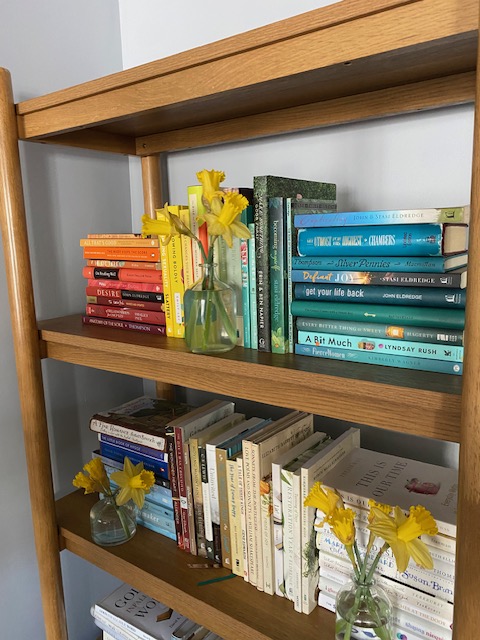
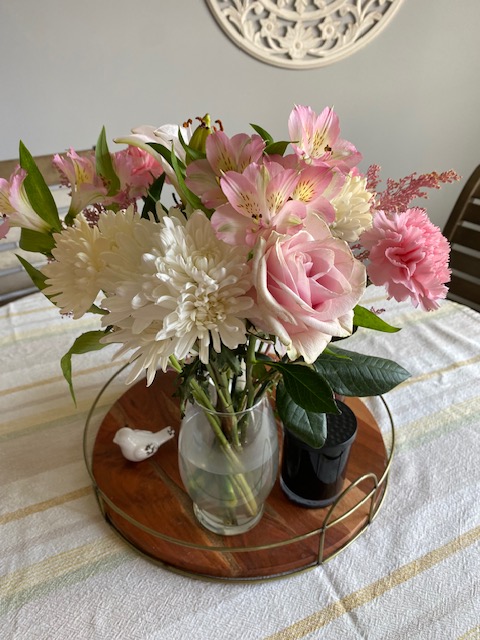
I can smell spring in the air, the faintest scent of dirt exhaling after its long winter slumber, while birds sing their morning songs. The air is still cool, but the sun and the wind whisper warm breezes, hugging my body. Even my music playlists are changing, from the mellow rhythms of yacht music to the upbeat melodies of Cole Poter and Frank Sinatra. To commemorate spring and offset my curmudgeon attitude due to daylight savings time, I bought myself some grocery store flowers. It started when a small bundle of daffodils smiled at me from their bucket. Then I saw another bouquet, full of light pink and white flowers that physically embodied the sounds of robins chirping. Initially, I was going to bundle both bouquets together. I later decided to spread the joy in four separate vases, creating expectant hopes of spring around my home.
The kinds of flowers a person is drawn to are a unique fingerprint of their personality. My mother-in-law loved impatiens, geraniums, and pansies, flowers that grew abundantly, giving her a lot of blooms for her budget. My mother loves ordinary carnations because they last a long time, allowing her to savor the blooms. My daughter’s love for ranunculus helped determine that she would have a spring wedding, so that her bouquet would drip with the delicate pink and yellow blooms. I love daisies because, as Meg Ryan’s character asked in You Got Mail,“Don’t you think daisies are the friendliest flower?”
It is interesting that God designed flowers to be unique. Some have massive heads with lots of tiny individual flowers like hydrangeas, some have intricate patterns like dahlias, and some are just little cups of joy like buttercups. There are even different varieties amongst the same species. Soon, pockets of daffodils will fill fields with sunshine, but if you look closely, you will see some with bright yellow heads, while others are the color of butter. Some will have curvy petals, while others will be fringed with lace. I am delighted our God, in His master artistry, took the time to create flowers unique and individualistic.
In the past few years, I have been on a journey to better health. I have had some setbacks in the last two years, gaining back a lot of the weight I had lost. But I am choosing not to focus just on numbers but on being more active, gaining strength, and becoming more flexible. I am also choosing not to be ashamed of the body I am living in and have bought clothes that fit me well and make me feel comfortable. But as much as I am working towards not being ashamed, I have still let other people around me make comments that demeaned me and others about the size of our bodies. I let the comments slip by, wishing now I had been courageous enough to address how these comments harm women.
One of the comments had to do with a local theater production an acquaintance saw. He noted that the production was good but commented that the female lead seemed too “big for the role.” He felt her size made her less believable as a love interest, although she could sing and dance “well enough.” I listened in disbelief. I am sure that, even in local productions, there were several women trying out for this role. I am also sure that some of the women would have fit his idea of what the lead should look like. But this woman was chosen above every other option because she was the most talented for this role. Additionally, I am curious how “big” this woman really was? Were his perceptions of “big” defined by his narrow view of how a woman should look?
The second comment was made directly to me about me. A different acquaintance of mine looked at the back cover of my book and asked if I dug out my “yearbook photo” for my picture. He didn’t comment on the fact that publishing a book is a major accomplishment. He didn’t remark on how brave I was for addressing a difficult subject or how well my daughter had designed the cover. His only response was pointing out rather unsubtly that I had gained weight. Again, I was stunned by his remarks and started to justify my choice of picture and even casually remarked that I recognized I had gained weight. Meanwhile, he quickly put the book down and started rambling about his upcoming adventure. I left that conversation demeaned.
It is stunning to me that in 2025, despite all the work that has been done in this area, women are still being judged by our size, appearance, and age. We celebrate women such as Andie McDowell who decided to go grey naturally, and Pamela Anderson who decide to walk the red-carpet sans makeup. Yet, Millie Bobbie Brown, a 21-year-old actress, was trolled by critics as “aging badly.” Keely Shaye Bronsan, the wife of actor Pierce Bronsan, is often pictured with before and after pictures, pointing out her weight gain. And if a celebrity has recently lost weight, the assumption is made that she used Ozempic.
I remember writing the author’s biography for my book. As Terry was helping me with the correct wording about where I lived, he added the words “Sherry currently lives in south-central Pennsylvania.” I reacted viscerally to that statement and stated rather emphatically, “I don’t want to take up that much space in my author’s biography. Where I live is not the most interesting thing about me!” I feel the same about my appearance and weight loss/gain; that is not the most interesting thing about me. How I love and care for my family, what I write about, my job as a volunteer coordinator, my passions, and, most importantly, my faith are far more interesting than whether I choose to dye my graying hair, or whether the numbers on the scale have increased or decreased. I do enjoy wearing a nice outfit and taking the time to care for my skin and hair, so I feel confident in accomplishing the things I want to in my world. I do want to move towards a healthier lifestyle so I can live a long and active life. But I don’t want to be defined by my age or my size anymore. And I will no longer tolerate comments made by others that demean me or the women around me.
Ilona Maher is one of the most body-positive role models for women. Maher won a bronze with her American Rugby team at the Paris Olympics this past summer. One of the comments on her social media speculated that she had a BMI of 30. Maher pushed back in a viral TikTok video, confirming she had a BMI of 29.3. She went on to say that the BMI was designed to represent males and was not an accurate representation of what a healthy female athlete’s body looks like. She also stated her weight boldly, remarking that she was not meant to live in a small body. Finally, she stated to the naysayer, “I am going to the Olympics, and you are not!”
If God designed flowers so uniquely, why can’t we accept that women live in different sized bodies, have different facial features, and have different shapes? Why are little girls in middle school still struggling with eating disorders and cutting due to bullying about how they look? Why is “You look fat!” the worst thing you can say to a woman or a girl? And why do we still think appearance, no matter the age, is the most interesting thing about a woman? I am sick of hearing people’s first remarks about a girl or a woman being “She is so pretty,” and then extolling her character, talents, and skills only as secondary considerations. When people remark about a young man, they lead with his character, skills and talents, and rarely address his looks. Will this ever change?
It can only change if I admit how I contribute to the problem. I can work on changing my own language and make sure my comments about women and girls address the character, skills, and talents they offer our world. When I am faced with demeaning comments about women related to their appearances, I can challenge the offender with kindness and curiosity, hoping to make them aware of how their comments demean women. Finally, I can keep addressing the subject with women in my community, hoping that little by little, we can move the conversation forward and #Accelerateaction in conversations about gender bias.
One thing I know for certain is that God made hydrangeas, tulips, and bluebells to be different. And if He was so careful to design flowers differently, I have no doubt that He designed humans to look differently as well, and I believe He looks at His creation and declares it good. It is my responsibility to live well in the body I have been given!


 By Sherry Collins