
Daffodils and Body Positivity

“I praise you, for I am fearfully and wonderfully. Wonderful are your works; my soul knows it very well. My frame was not hidden from you, when I was being made in secret, intricately woven in the depths of the earth.” Psalm 139:14-15

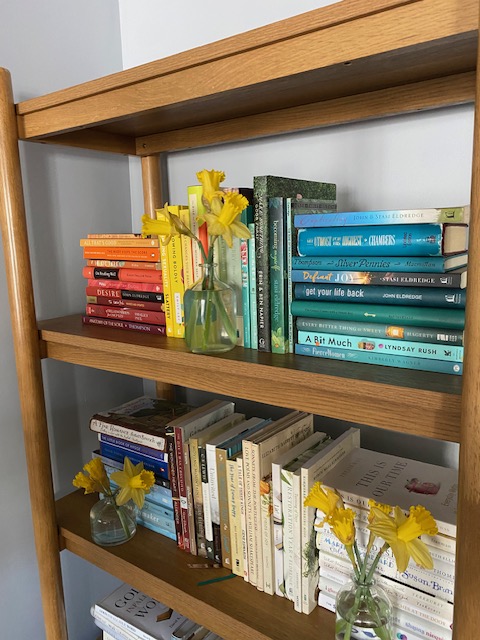
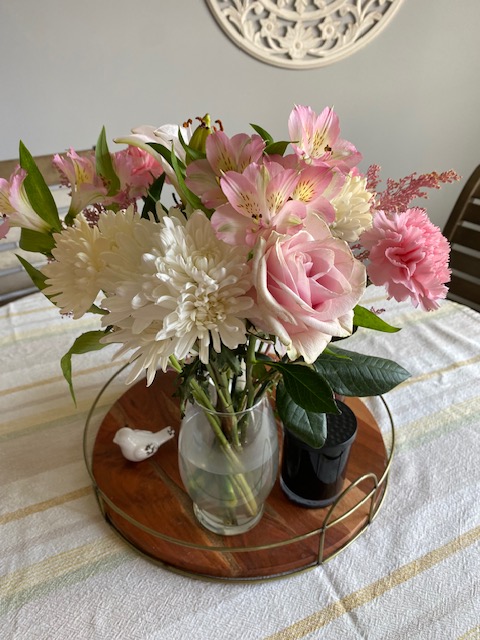
I can smell spring in the air, the faintest scent of dirt exhaling after its long winter slumber, while birds sing their morning songs. The air is still cool, but the sun and the wind whisper warm breezes, hugging my body. Even my music playlists are changing, from the mellow rhythms of yacht music to the upbeat melodies of Cole Poter and Frank Sinatra. To commemorate spring and offset my curmudgeon attitude due to daylight savings time, I bought myself some grocery store flowers. It started when a small bundle of daffodils smiled at me from their bucket. Then I saw another bouquet, full of light pink and white flowers that physically embodied the sounds of robins chirping. Initially, I was going to bundle both bouquets together. I later decided to spread the joy in four separate vases, creating expectant hopes of spring around my home.

The kinds of flowers a person is drawn to are a unique fingerprint of their personality. My mother-in-law loved impatiens, geraniums, and pansies, flowers that grew abundantly, giving her a lot of blooms for her budget. My mother loves ordinary carnations because they last a long time, allowing her to savor the blooms. My daughter’s love for ranunculus helped determine that she would have a spring wedding, so that her bouquet would drip with the delicate pink and yellow blooms. I love daisies because, as Meg Ryan’s character asked in You Got Mail,“Don’t you think daisies are the friendliest flower?”

It is interesting that God designed flowers to be unique. Some have massive heads with lots of tiny individual flowers like hydrangeas, some have intricate patterns like dahlias, and some are just little cups of joy like buttercups. There are even different varieties amongst the same species. Soon, pockets of daffodils will fill fields with sunshine, but if you look closely, you will see some with bright yellow heads, while others are the color of butter. Some will have curvy petals, while others will be fringed with lace. I am delighted our God, in His master artistry, took the time to create flowers unique and individualistic.
In the past few years, I have been on a journey to better health. I have had some setbacks in the last two years, gaining back a lot of the weight I had lost. But I am choosing not to focus just on numbers but on being more active, gaining strength, and becoming more flexible. I am also choosing not to be ashamed of the body I am living in and have bought clothes that fit me well and make me feel comfortable. But as much as I am working towards not being ashamed, I have still let other people around me make comments that demeaned me and others about the size of our bodies. I let the comments slip by, wishing now I had been courageous enough to address how these comments harm women.

One of the comments had to do with a local theater production an acquaintance saw. He noted that the production was good but commented that the female lead seemed too “big for the role.” He felt her size made her less believable as a love interest, although she could sing and dance “well enough.” I listened in disbelief. I am sure that, even in local productions, there were several women trying out for this role. I am also sure that some of the women would have fit his idea of what the lead should look like. But this woman was chosen above every other option because she was the most talented for this role. Additionally, I am curious how “big” this woman really was? Were his perceptions of “big” defined by his narrow view of how a woman should look?

The second comment was made directly to me about me. A different acquaintance of mine looked at the back cover of my book and asked if I dug out my “yearbook photo” for my picture. He didn’t comment on the fact that publishing a book is a major accomplishment. He didn’t remark on how brave I was for addressing a difficult subject or how well my daughter had designed the cover. His only response was pointing out rather unsubtly that I had gained weight. Again, I was stunned by his remarks and started to justify my choice of picture and even casually remarked that I recognized I had gained weight. Meanwhile, he quickly put the book down and started rambling about his upcoming adventure. I left that conversation demeaned.

It is stunning to me that in 2025, despite all the work that has been done in this area, women are still being judged by our size, appearance, and age. We celebrate women such as Andie McDowell who decided to go grey naturally, and Pamela Anderson who decide to walk the red-carpet sans makeup. Yet, Millie Bobbie Brown, a 21-year-old actress, was trolled by critics as “aging badly.” Keely Shaye Bronsan, the wife of actor Pierce Bronsan, is often pictured with before and after pictures, pointing out her weight gain. And if a celebrity has recently lost weight, the assumption is made that she used Ozempic.
I remember writing the author’s biography for my book. As Terry was helping me with the correct wording about where I lived, he added the words “Sherry currently lives in south-central Pennsylvania.” I reacted viscerally to that statement and stated rather emphatically, “I don’t want to take up that much space in my author’s biography. Where I live is not the most interesting thing about me!” I feel the same about my appearance and weight loss/gain; that is not the most interesting thing about me. How I love and care for my family, what I write about, my job as a volunteer coordinator, my passions, and, most importantly, my faith are far more interesting than whether I choose to dye my graying hair, or whether the numbers on the scale have increased or decreased. I do enjoy wearing a nice outfit and taking the time to care for my skin and hair, so I feel confident in accomplishing the things I want to in my world. I do want to move towards a healthier lifestyle so I can live a long and active life. But I don’t want to be defined by my age or my size anymore. And I will no longer tolerate comments made by others that demean me or the women around me.

Ilona Maher is one of the most body-positive role models for women. Maher won a bronze with her American Rugby team at the Paris Olympics this past summer. One of the comments on her social media speculated that she had a BMI of 30. Maher pushed back in a viral TikTok video, confirming she had a BMI of 29.3. She went on to say that the BMI was designed to represent males and was not an accurate representation of what a healthy female athlete’s body looks like. She also stated her weight boldly, remarking that she was not meant to live in a small body. Finally, she stated to the naysayer, “I am going to the Olympics, and you are not!”

If God designed flowers so uniquely, why can’t we accept that women live in different sized bodies, have different facial features, and have different shapes? Why are little girls in middle school still struggling with eating disorders and cutting due to bullying about how they look? Why is “You look fat!” the worst thing you can say to a woman or a girl? And why do we still think appearance, no matter the age, is the most interesting thing about a woman? I am sick of hearing people’s first remarks about a girl or a woman being “She is so pretty,” and then extolling her character, talents, and skills only as secondary considerations. When people remark about a young man, they lead with his character, skills and talents, and rarely address his looks. Will this ever change?

It can only change if I admit how I contribute to the problem. I can work on changing my own language and make sure my comments about women and girls address the character, skills, and talents they offer our world. When I am faced with demeaning comments about women related to their appearances, I can challenge the offender with kindness and curiosity, hoping to make them aware of how their comments demean women. Finally, I can keep addressing the subject with women in my community, hoping that little by little, we can move the conversation forward and #Accelerateaction in conversations about gender bias.

One thing I know for certain is that God made hydrangeas, tulips, and bluebells to be different. And if He was so careful to design flowers differently, I have no doubt that He designed humans to look differently as well, and I believe He looks at His creation and declares it good. It is my responsibility to live well in the body I have been given!
Chili Crisp and Jackson Pollock

“He has made everything beautiful in its time. Also, He has put eternity in their hearts, except that no one can find out the work that God does from beginning to end.” Ecclesiastes 3:11 NKJV

Despite being a resident of Pennsylvania for the last 13 years, I still identify as a Wisconsinite, and more specifically, a Sheboyganite. My hometown is famous for its picturesque lakeshore, championship golf courses, award winning bratwursts, and hard rolls. The city and its greater community are also home to some world-renowned businesses, including Kohler Company, Sargento Cheese, Johnsonville Sausage, and Acuity Insurance. Sheboygan is no stranger to pop culture, including references in the movies Some Like It Hot and Home Alone, reinforcing the popularity of polka! Even in Fall River, Massachusetts, a nurse shared with my son her own familiarity of Sheboygan. On the day my grandson was born, the nurse chuckled when my son reported that he was born in Sheboygan. As a child, her mom had threatened that someone would take her to Sheboygan if she misbehaved.

Like all areas, Sheboygan has its own folklore, idiosyncrasies, and even its own dialect. When we go to bakeries, we also eat bakery, aka donuts and pastries. We are super polite at four-way stops where everyone waves to everyone else to go first, even if everyone sits there for a minute or two. We don’t grill out, we fry out, and brat frys are the major fundraisers for local charities. We eat brats on a hard roll, which are not in the shape of a hot dog bun, but rather a hamburger bun. We also call the drinking water fountains bubblers after a local company that made them.

Like bubblers, certain products are identified by brand name. We no longer mop our floors, we swiffer them. I call tissues Kleenex, although I only buy Puffs. I never refer to my phone as my cell phone, but instead my I-Phone. Some brands elicit a strong feeling of loyalty. I once tried to use generic toasted corn flakes in place of Kellog’s Corn Flakes in one of our family’s favorite Christmas cookies. My husband’s discerning taste buds recognized the difference immediately, and since then, we only use the name brand.

Companies protect the names of their product by submitting a trademark with the United States Patent and Trademark office. A trademark is a type of intellectual property consisting of a recognizable sign, design, or expression. The application itself is straightforward, but the process of getting something trademarked can take time. Trademarks can’t be used on something general, like ice cream or ketchup or tissues. But it can be used on specific brands, like Ben & Jerry’s Chunky Monkey, Heinz Ketchup and even the swish on Nike athletic shoes. Once something is trademarked, that intellectual property belongs to an individual or company and can’t be used by any other person or company.

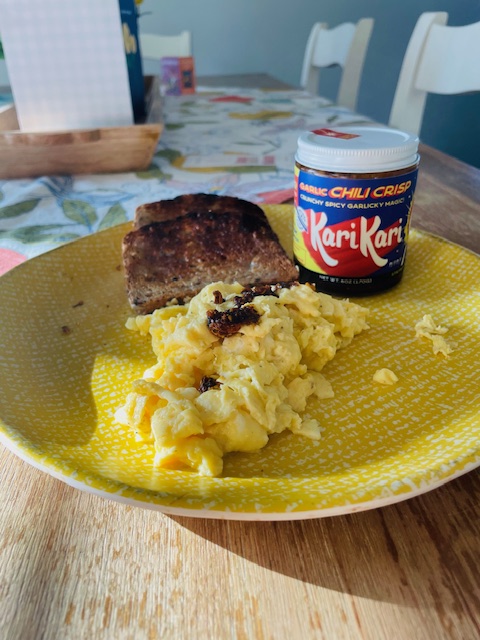
Recently, the food world was in uproar over a company’s trademark on chili crunch, otherwise known as chili crisp. This popular condiment adds a finishing touch over dumplings, noodles, eggs, and avocado toast. The crunchy, oily, spicy condiment is made of dried chili flakes, crispy fried garlic, or shallots, and sometimes sesame seeds. Some cookbooks and websites are dedicated to finding more ways to use the condiment, including as an ice cream topping. Self-proclaimed foodies have multiple jars of different chili crisps in their refrigerators. Terry and I discovered the joy of chili crisp, adding it to stir fries and spaghetti.

The controversy came when Momofuku, a company started by celebrity chef David Chang, decided to trademark his brand of the condiment with the name “chili crunch.” Soon small businesses who used chili crunch in their product name were sent cease-and-desist letters by Momofuku’s legal representation. These small companies, many of whom are using family recipes, had ninety days to rebrand their products. Many food writers and chefs opposed Momofuku’s right to trademark the name “chili crunch”, arguing that the term was ubiquitous for a cultural product.

As a Christian, I have acted like Momofuku, thinking that Christians owned the trademark on truth, love, beauty, and righteousness. As a home educator, I surrounded myself with history books from Christian educators. If a musical artist was not explicitly Christian, I concluded that the music didn’t glorify God. If an artist or writer had any moral failures in their life, I wrote off their painting or book as not important. I thought only Christian organizations were doing important and worthwhile charitable work. I also thought that Christians hit the mark on righteousness and held themselves above reproach.

I have realized my thinking set Christians, me included, above others. Only God has the trademark on truth, love, beauty, and righteousness. All truth, love, beauty, and righteousness reflect the glory of God, no matter the source. This shift in perspective has opened me to more empathy and humility. As a Christian, it helps me validate the importance of the work others are contributing to science, history, medicine, art, music, and writing. I can read Robin Wall Kimmerer’s Braiding Sweetgrass, a book built on her indigenous spiritual worldview, and find some principles, like honorable harvest, rooted in the Bible. I can listen to a Taylor Swift song and see in her music her longing for a lasting love, a desire in all of us only fulfilled by Christ. I can follow Jasmine L. Holme’s Instagram page and find resources that explain how Southern confederate biases influenced some of the homeschooling material I used. I can read poetry by Mary Oliver that speaks beauty into my life.

This trademark belief was also evident when Christian apologists believed that abstract art reflected a post-modern world. I held on to that view for many years, denigrating modern art. Like all my self-righteous thinking, my views on modern art began to change. It started when my sister brought a modern art piece for her kitchen, and it surprised me how much I was drawn to this piece. It added a touch of color to her kitchen, anchoring it with a sense of calmness and warmth. After discovering that I liked that piece, I started looking at more modern art, finding some pieces that inspired joy in me.

French Port by Laurie Anne Gonzalez available on Juniperprintshop.com
French Port by Laurie Anne Gonzalez available on juniperprintshop.com

Later, I discovered Makoto Fujimura, an abstract artist who is a leader in the slow art movement. He uses a Japanese technique called Nihonga. This style involves the artist grinding colored minerals in a fine powder and layering them onto his art piece. Each layer takes time to dry, and some of his pieces have sixty layers. His Walking on Water series started off as an elegy to the victims of the 2011 Tsunami, and has evolved to pieces addressing climate change. At the end of his book Art + Faith: A Theology of Making, Fujimura writes a Benediction for Makers: “May we steward well what the Creator King has given us and accept God’s invitation to sanctify our imagination and creativity, even as we labor hard on this side of eternity.”

Based on his writings, Fujimura makes a difference between being an artist who is a Christian and being a Christian artist. He warns that art should not be a tool to evangelize and disciple others, instead it should glorify God. By glorifying God, we open the door for conversations with others. Even artists who are not Christians can glorify God in their works by reflecting the beauty of the created world. None of this is more evident than artist Jackson Pollock. Like Ian Falconer’s children’s book character Olivia, I believed I could splatter paint like Jackson Pollock and call it art. How naive and prideful I was, again believing I knew and understood the trademark of beauty.

Jackson Pollock painted his famous artwork by using a “drip” technique. He involved his whole body to paint and used force to cover the whole canvas, almost like dancing. For some, his pieces looked unpredictable and shocking. But again and again, people were drawn to his art. In 1999, physicist and artist Richard Taylor became interested in Pollock’s work in relation to fractals. Fractals are the repeating patterns found in nature starting at a large scale moving to the smallest scale. Imagine a tree, and it starts to fork out into big branches, and then eventually into smaller branches, and this same pattern is repeated down to the veining in a leaf. This pattern is a fractal, and research demonstrates that we find these fractals reassuring and harmonious. Using computer analysis, Taylor discovered that what others had determined to be random drip marks were actually fractals. Pollock referred to his painting style as “I am nature”, but his artwork tapped into God’s creative design in nature. This same computer analysis was used to determine that some recently discovered works thought to be Pollock’s were fakes, later confirmed by paint analysis. I am looking forward to my next visit to MOMA and viewing Pollock’s work with new eyes.

Because of the backlash, Momofuku has dropped the trademark disputes. It’s not clear if they are going to exercise their legal trademark rights in the future, but right now, they seem to have taken a break from owning “chili crunch” as intellectual property. I am a Christian, but I no longer believe that I hold the trademark on truth, love, beauty, and righteousness. I need to keep my eyes on God, who holds all truth, reflects all love and beauty, and is truly righteous. I can also look at both my fellow believers and those who don’t believe and discover how the image of God is reflected in their lives. This curiosity for discovery can help bridge the gap in a divided world.

Logs vs Slivers

“And be kind to one another, tenderhearted, forgiving one another, even as God in Christ forgave you.” Ephesians 4:32

I introduced Moses and the burning bush to my Sunday School students when I noticed a few of the boys looking at my feet. I looked down and instantly realized what they were staring at: the knobby bunions protruding out between my sandal straps. One boy, without any guile, blurted out, “Do you have tumors on your feet?” I decided to set the record straight that I had an autoimmune disorder that affected my joints, including my feet, resulting in bunions, hammertoes, and nodules. I spoke without shaming the boys, knowing that this was an honest question and, as one boy stated in the past, “Wow, I thought your feet were uglier than my mom’s.” Children are naturally curious and draw conclusions without understanding possible underlying medical conditions or social protocols. I wanted to be honest and talked for a few minutes and then moved on in the lesson. Soon the students’ attention was back on the burning bush, not on my deformed feet.

I am conscious of my feet and their deformities. Often, after wearing shoes all day, the bunions can be painful and swollen. I have difficulty finding shoes that are comfortable yet stylish. Surgery is an option, but even that has its potential pitfalls. But despite all these challenges, I am thankful that my feet are still able to get me from where I need to go.

It’s easy to be conscious of something obvious like the two-inch bunions on my feet, but harder to be aware of some of my internal shortcomings like selfishness, a judgmental attitude, and labeling of others. Like the boys in my Sunday school class, it’s easier to point out what I see as a fault or character flaw in others, than it is to look at myself and see my own faults and flaws.

Several times in the last few months, God has quietly addressed some of my personal shortcomings while I have been venting to my husband or friends about some frustrations. Every time I spewed unkind or judgmental words from my mouth, God, in his kindness, gave me some epiphanies about myself. While complaining about someone’s lack of generosity with their time, He reminded me that, although I am generous with my time, I can be selfish with my limited finances. While expressing judgement of an expensive purchase someone made, despite their complaints about their limited budget, God reminded me of foolish purchases I have made. And when someone misread my expression as frustrated, I was reminded of the times I have mislabeled my husband as angry or moody. In all these situations, God, in his kindness, has led me to repentance.

God calls us to sacrifice even out of our limitations, to pray for others and show grace, and finally, to show curiosity instead of labeling someone. All these actions require us to be honest about areas where we find it hard to give, pause before talking, pray sincerely for others, and take the time to really listen to others. Yet, instead of those things, my judgmental attitude erupts quickly, just like the young man who blurted out about the “tumors” on my feet. But instead of acting out of a place of innocence, these attitudes flow from years of me thinking that I am right. I easily draw conclusion about others, without internally evaluating myself.

The Bible addresses this failure with a harsh but true word: hypocrite. Even the sound of the word is harsh and staccato to my ears. As a teenager, I recognized the demeaning nature of that word when I hurled the insult at my stepfather, calling him a hypocrite because he was against drugs but had an obvious alcohol problem. Jesus, the only one who can legitimately use this word, uses it to address those of us who point out the “tiny speck” in a friend’s eye when we have a beam in our own eye. My husband envisions a person walking around with a log sticking out of their eye, banging into everyone around them while pointing out a sliver in someone’s pinky.

It may be funny, but this comedic image reflects the sad state of my heart. I discussed this rigid judgmental attitude in last week’s post, “Views” but it prevails across all areas of my life, not just my views on social justice issues, but also how I treat, or think about, others. Empathy is a trait I have consciously cultivated over the years. But in moments of frustration, or when I feel misrepresented, my judgmental heart comes out swinging and I “vent”!

Venting itself is not wrong. It’s important to have a good ventilation system in your home.  It keeps the air fresh and healthy indoors. Good ventilation helps remove unwanted moisture, odors, gases, dust, and other pollutants. And, on a personal level, we need to be able to talk about frustrations and problems we are experiencing. But I need to do so in way that is not tearing down someone else. This is hard and I am not always good at it.

What I am learning is that empathy is easy to apply when the situation doesn’t personally involve you, but less easy when it affects you. Those are the moments when I need to pause. I can address frustrations using “I” statements. I need to examine why I feel frustrated and get to the heart of the issue. In each of the above situations, I had what I deemed were legitimate frustrations, but in examining the reasons for the frustrations, I discovered some hard facts. In one situation, I had pride in the time I offered towards others. In another, I was frustrated that God hadn’t answered a prayer. I also discovered I had no problem labeling others, but I didn’t like having my expressions or actions being misinterpreted. In each of these situations, I discovered my own flawed humanity, placing me humbly at the feet of Jesus. This position of humility can only increase my empathy and keep my personal ventilation system healthy.

The last two books I read have shed light on the beam in my own eye. Sue Klebold’s “A Mother’s Reckoning: Living in the Aftermath of Tragedy” helped me see the other side of the Columbine Massacre. The mother of one of the shooters shares candidly the responsibility she feels and holds her son to with the unfailing love of a mother. It helped me see that good parents can raise children who do horrible things.

Bryan Stevenson’s “Just Mercy: A Story of Justice and Redemption” is changing my view on those in prison and how they are treated. One story that stood out is that of a victim, Debbie Baigre. She suffered a gunshot wound to the jaw, resulting in losing some teeth along with painful damage. Her shooter, Ian Manuel, thirteen years old when he committed the crime, was tried as an adult and sentenced to life imprisonment without parole. He spent the next eighteen years in uninterrupted solitary confinement. After calling Baigre to apologize for his crime, the two developed a relationship that resulted in her advocating for leniency and voicing that the conditions of his incarceration were inhumane.

When reading about these situations, I can see how I have misjudged and mistreated my friends in minor frustrations. Can I learn to be as vulnerable as Sue Klebold is in her book when facing harsh scrutiny? Can I show as much as grace as Debbie Baigre when I have been wounded? How do I choose not to be a hypocrite? The apostle Paul answers this question in his letter to the Ephesians by saying, “Let all bitterness, wrath, anger, clamor, and evil speaking be put away from you with all malice.” This is what my unhealthy venting sounds like. He continues with, “Be ye kind to one another, tenderhearted, forgiving one another, even as God in Christ forgave you.” When I remember how my God graciously forgave me, how can I, in good conscience, help but treat others with more grace? The answer: I can’t!