I’m A Bit Much!
“Give her of the fruit of her hands, and let her works praise her in the gates.” Proverbs 31:31 ESV
For our first Pennsylvania Thanksgiving, both my sisters and my in-laws made the trek from Wisconsin, Nebraska, and Illinois to celebrate with us. We had our traditional turkey feast and squeezed in an early Christmas with everyone as well. To keep the season festive, I made everyone’s favorite Christmas treats: Hershey Kiss Cookies, Peanut Butter Balls, Haystacks, Thumbprints and Carrot Cookies. My sister’s boyfriend came with her, and I assumed he would find a cookie amongst our favorites that he would like. When I noticed that Jamin was passing on the cookies, he politely shared that he didn’t like nuts, peanut butter, or carrots in cookies. I felt bad and promised the next holiday we had together, I would bake his favorite cookie or treat. I asked what he liked, half expecting him to announce sugar or gingerbread cookies. His eyes lit up and he exclaimed, “Cornflake Wreaths!” He explained that he and his mother had a tradition of making these treats, and he emphasized the importance of the red-hot candies. Terry snickered in the background, because he had been asking for years to add these same treats to the holiday baking list. I half-heartedly agreed but kept putting them at the bottom of the list.
So, next Christmas, I finally decided to make Cornflake Wreaths for Terry. I looked up the recipe and immediately presumed there was a mistake: 1 tsp. of green food coloring? Surely, that was a misprint, since food coloring is typically measured by drops. I adjusted the food coloring, added a few extra drops, then attempted to form the wreaths. When it was all said and done, my blob-shaped wreaths were the shade of a sick Grinch. I snapped a picture and sent it to Jamin asking what I did wrong. He informed me that buttered hands were necessary to shape the wreaths. He also said a lot of green food coloring was necessary to get the right shade. And when you think you have enough, add some extra.
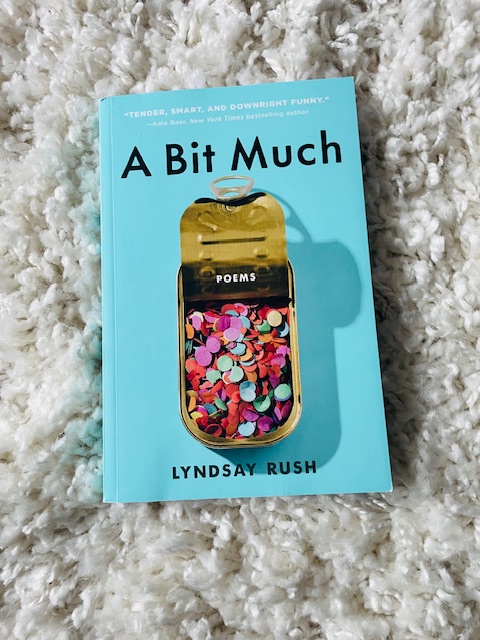
There is a new poet, Lindsay Rush, known on Instagram as Mary Oliver’s drunken cousin, who wrote a poem that went viral and has since become my poetic life mantra. It is titled “She’s A Bit Much.” She takes a common insult made about women and turns it into a compliment. She compares the insulted women to confetti, sprinkles, and the bonus French fry at the bottom of the bag, someone we are to celebrate, and she ends with the line, “Aren’t we lucky she’s here.” Her poem points to a bigger truth: insults made about women, such as she is a bit much, too bossy, manipulative, too driven, not feminine enough, etc., are more about putting women into a box that minimizes their God-given attributes when they should be celebrated.
As I child, I was labeled as bossy by some adults in my circle. I had budding leaderships skills, and needed adult guidance to help develop those skills in a healthy manner. Yes, some children with leadership skills can develop into narcissistic dictators, but most children just need adults to help them recognize that being a leader is not just giving orders but inviting others along to accomplish a goal for the greater good. It is interesting that boys are rarely described as bossy; words like charismatic or having leadership potential are used instead.
I have also been accused, in some circles, of being “too much” and have had conversations with other women who have also been unjustly accused of this as well. Introverted, mild mannered Christian women are held up as the more palatable and less offensive role models. According to the Bible, we are all expected to be humble, gracious, and gentle. Those character traits are not just limited to the female gender. But somehow, we associate those traits with quiet females. I think I can be “too much” in some people’s eyes but still exhibit the fruits of humility, graciousness, and gentleness in my life. It is just how those fruits are manifested that might be different than some of my introverted friends.
The point is, we label women with negative traits that we rarely use to describe men, and somehow, we think that it is okay. Although I don’t like being called bossy or “too much”, I find myself putting other women into a box with the label “brassy.” These so-called “brassy” women boldly state their opinions or ask for what they need from others without qualifications. We all need to learn a level of hospitality and be careful that we are asking and not demanding. Being bold and direct are not bad traits, and I must be careful that I am not labeling a bold woman as brassy when I don’t apply the same standard to men.
Like most consumers, I can be drawn in by certain labels. Terms like “sustainable,” “supports local farmers,” and “produced in small batches” are like catnip to me. I also look for labels in a bookstore and rush to the poetry, memoirs, and literary fiction sections, avoiding the fantasy and science fiction shelves. These labels help me pursue what I am looking for. But when we broadly label women negatively, we impose limits on what we think they can and should achieve, which can sometimes become self-imposed limits.
One of the most controversial women today, Meghan, the Duchess of Sussex, addressed these labels or archetypes on a podcast she did in 2022. She understands firsthand how labels can destroy when the media and trolls describe her as a “gold-digger,” “fake,” “family destroyer” and far worse. She interviewed some women, including Serena Williams, Paris Hilton, and Mariah Carey, exploring the origins and consequences of being labeled ambitious, a bimbo, or a diva. These women shared how they have let go of the negativity and, in some cases, changed the definition to a positive one. One thing from her podcast that stuck with me is when Serena Williams talked about negativity in relation to a woman being described as ambitious. Serena explained how for a long time that label hadn’t impacted her until she met her husband. But then people started describing her ambition in a negative light. “So, since I’ve felt the negativity behind it (referring to ambition), it’s really hard to un-feel it. I can’t unsee it, either, in the millions of girls and women who make themselves smaller, so much smaller—on a regular basis.”
Serena articulated something that I believe most women have felt in their lifetime, and I have no doubt that all the young women I care about have also felt it. When we are labeled as too much, bossy, brassy, and not feminine enough, we often find ourselves becoming smaller, shrinking our influence, agency, ambition, drive, and talents. This often leads us to imposter syndrome where we think we don’t measure up. We then start to second guess our instincts and minimize the character traits that reflect our creator.
Years ago, my husband had a meeting with some people and the subject of me came up. I had been feeling for a while that I was doing something wrong and felt like I was being pushed out of what I deemed the inner circle. Terry directly asked if there was an issue with me. The people in the meeting immediately said no, but one person qualified that sometimes, “Sherry can be too much.” They continued, implying that I can swoop in and get a job done, almost making the “too much” more palatable. But clearly, no one in the room but my husband believed this was a good trait.
Later, when I heard that I was “too much”, I instantly felt swallowed by shame. Hadn’t I written prayers time and time again in my journal asking God to help me be meek and mild? Hadn’t I come to this same group, bearing my soul in one of the worst moments in my life, and pursuing God with humility? Hadn’t I become smaller, hiding my natural extroverted inclinations to fit in with this group? Apparently, despite my best efforts, I was still “too much.” At that point, I was still desperately trying to fit in, so instead of affirming that my “too much” was enough for God, I did the opposite. I became smaller by being less talkative, less present, less involved, and less joyful.
There is one woman in the Bible who did not shrink in a time of need. Esther and her people were facing total annihilation. At first, when confronted by her cousin Mordecai to address the king, Esther started to shrink. Yes, she was the queen, but she still had to submit to the king. Boldly approaching his throne without being called for might lead to her own death. But Mordecai challenged her with these words found in Esther 4:14, “For if you keep silent at this time, relief and deliverance will rise for the Jews from another place, but you and your father’s house will perish. And who knows whether you have not come to the kingdom for such a time as this.” Esther thought about what he said, and replied with a plan, ending with “and if I perish, I perish.”
Esther decided to go big and be who she was called to be, realizing that shrinking will lead to certain death, but the unknown gave her agency, allowing her to call the shots. By being who God called her to be, she was able to command the king’s attention and save her people and herself. I wonder how many of us women have shrunk in times we were needed because of what others have said about us, and how that leads to us slowly dying inside, never fully living the life we are called into.
In the circle that thought I was “too much”, I was slowly dying and becoming less of who I am. But I am no longer in that circle and have found a safe place to be all that God has called me to be. Yes, I still have character traits that must be balanced and smoothed out. But God’s guidance will help me fully be the woman He created.
I need to talk more about these issues with my friends. When I hear a woman being labeled, I should challenge the speaker with grace, trying to expose how these labels constrict, damage, and restrict women. I also need to address my own complicity in the problem, making sure I don’t fall into the trap of labeling others. I can encourage young women to be exactly who God made them, growing in true inward holiness. This will help #AccelerateAction in removing gender biases.
Sometimes, we need extra food coloring to make things right. Sometimes we need to turn insults into something positive like Lindsay Rush does in her poetry. But we always need women to operate exactly as they were designed; not labeled in a way that brings death but brings life.

 By Sherry Collins