“a time to seek, and a time to lose, a time to keep, and a time to cast away” Ecclesiastes 3:6
My husband and I started a family tradition the first year we were married. We bought each other a special ornament to place on our tree. As we added to our family, we also added ornaments to our tree. Sometimes, the ornaments represented what we were interested in at the time, like my son’s billiard ball and my daughter’s kayak. Other times, the ornaments were picked because they sparked joy in our lives, like my husband’s globe and my blue Volkswagen with a wreath on top! Every year, as we unpack our ornaments, we are delighted to place our treasures on the tree. After my son was married, I gently packed up Ethan’s ornaments, and gave them for him to put on his own tree. Teary eyed, I handed a piece of his childhood over to him, knowing that he would be creating his own traditions with his family. I could not hang onto the past, I had to let go.
Sometimes, the Christmas season can seem overwhelming with its demands and obligations. Years ago, I stressed myself and my family by trying to participate in every wonderful experience Christmas had to offer. After some tears of frustration on my part, I realize that this speed was not good for our family dynamic, especially when you have two strong introverts, so I decided to let go! We would not read every favorite Christmas book, or watch every Christmas movie, or participate in every Christmas activity. Instead, we did what we could and let go of the rest. Some years, we fit more into the season, other seasons we did less. It made Christmas manageable.
Photo credit to Margaret Collins
This Christmas, my schedule is already a lot more open than usual due to the pandemic. But rather than letting go of activities, I am choosing to let go of disappointments. I am focusing more on letting go of frustrations and sadness about situations the pandemic has forced upon me. Not only does my schedule need to be manageable, but my heart needs to be peaceful during this season. Ask yourself if there is anything you need to let go of this season.
“After all this, Lord, will you hold yourself back? Will you keep silent and punish us beyond measure?” Isaiah 64:12
“When God is silent, He is not still. God does some of His best work in the dark. Trust Him–He’s there.” Tony Evans
Sometimes silence can be peaceful, other times silence can be a little disconcerting. Have you ever sent a sensitive message or letter, eagerly waiting for a response, and days went by with no answer? If you ever have moments of insecurity like me, you start to imagine the worst-case scenario: maybe the recipient is mad or hurt by the message. Or maybe, they just do not care! Most of the time you end up getting a response, but, occasionally, none ever comes, leaving things unresolved.
The Bible records that the Hebrews, God’s chosen people who had a covenant relationship with him, experienced the same disconcerting silence on a much larger scale. For centuries, they heard direct messages from God through judges or prophets. They not only heard his voice, but He helped them conquer lands and performed amazing miracles on their behalf. The nations around them recognized that the Hebrew God was different and that He had a special relationship with His people. Then, after 3,400 years of direct interaction, suddenly, God was silent! Not just a few days of silence or even a few weeks but four hundred years of silence! No one, neither priest nor prophet, heard anything directly from God. I can imagine that the Hebrews were wondering what they had done to incur God’s silence. Did this silence indicate that God was mad, or, worse yet, did he not care about them anymore? He had promised them a Messiah, a king that would provide redemption and restoration for them. What if His promises were not true?
Yet, if you follow the genealogy of Jesus, God was not as silent as the Hebrews thought. As each generation passed, He was continuing a family line that would eventually lead to Jesus. He was waiting for the perfect time and place to introduce the Messiah, not just a Savior for the Hebrews, but for all of mankind! This is a reminder to all of us that, no matter how silent God may appear, He is always working behind the scenes and is faithful to His promises!
“for unto you is born this day in the city of David a Savior, which is Christ the Lord.” Luke 2:11
Baby announcements are always exciting! Last Thanksgiving, our son announced the future birth of his child to the squeals and shouts of everyone present. After seven years of infertility, another friend of ours announced his wife’s pregnancy with a short poem, resulting in many who knew their journey rejoicing with tears. No matter how elaborate or simple the announcement is made, the impending arrival of a baby should always be celebrated. It is a great gift from God wrapped in a small but miraculous package!
When reflecting on the story of Jesus, I am always astounded that the first announcement of His arrival was made to a group of shepherds watching their flocks on what seemed to be an ordinary night. The darkness of an ordinary night was shattered as the “glory of the Lord shone around them”. Terrified, they fell to their knees, when an angel gave them the “good news of great joy” manifested in the birth of Jesus found in a nearby stable. When the angel spoke his last word, the praises of a “heavenly host”, defined in the Greek as “an army”, of angels filled the sky for a few moments. And then, in a flash, the sky was dark again, but no longer just an ordinary night, changing not only those shepherds’ lives, but our lives as well. Today, take a few minutes to listen to the carol, “Angels We Have Heard on High.” As you listen to the song, reflect not only on what it was like for the shepherds, but also on when you first heard about Jesus and how your life was forever changed by that announcement!
“O God, thou art my God; early will I seek thee: my soul thirsteth for thee, my flesh longeth for thee in a dry and thirsty land, where no water is;” Psalm 63:1
My favorite Christmas mug!!! Photo credit by Margaret Collins
I love early mornings during the Christmas season. After pouring my winter fuel into my favorite “Jolly” mug lined with candy cane stripes, I turn on the lights of my Christmas tree and listen to Christmas music by the Piano Guys. Often, the sun is just starting to rise, and I sit in my favorite chair reading my daily devotions. Not only is my home silent from any clatter, but the neighborhood is also calm. It is my thirty minutes of peace before any chaos ensues.
Although my daily devotions are part of my regular routine, it seems especially important to maintain this routine during the holiday season. If Advent is about anticipating Jesus’s birth and second coming, how can I make room for this reflection if I am always busy doing? It is extremely easy to get caught up in the bustle of the season: gifts to be bought and wrapped, parties to attend, performances to watch, cards to write and send, and time to be volunteered. Most of these are good things, yet if I am not careful, I can get so busy “doing” that I’m not spending time reflecting on the coming of Jesus. Yes, I could make effective use of these silent mornings and write out a few Christmas cards or plan Christmas dinner and shop with my fingertips for a few gifts. But I think it would be far more effective for my soul to keep to my regular routine of daily devotions; slowing down my life for thirty minutes to focus on Jesus before anything else!
“And I will put enmity between you and the woman, and between your offspring and hers; he will crush your head, and you will strike his heel.” Genesis 3:15
It only took six days for God to create the world. He spoke everything into existence, from the majestic Alps to the fluttering Monarch butterfly, to the simple blades of grass. Then, instead of words, He used His hands to create man, and gave him His very breath to bring him to life. This creation was different from everything else He made because He chose to create man in His own image, reflecting His creativity, intelligence, and character. God rested on the seventh day and said It was good. The Bible does not record exactly how long it was, but we can safely assume that, within a short period of time, Eve’s encounter with Satan changed creation’s perfection forever. Their disobedience led to consequences for not only Adam and Eve, but also for generations of humanity to come. Although things looked bleak for mankind, God, with unending mercy and infinite wisdom, had a plan in place to redeem His beloved creation. He told Eve that someday her offspring would conquer sin! That promise came to fruition about four thousand years later in the birth of a little baby in Bethlehem.
Crayon and pencil by Sr. Grace Remington, OCSO Copyright 2005, Sisters of the Mississippi Abbey
Christmas has not always been a holly jolly season for me filled with wonder. Some Christmases have been hard, like the one our family faced five years ago. Christmas plans were in place, gifts were waiting to be bought when we found out the unexpected news that my husband had been laid off. With our income being cut by more than half and the uncertainty of the future, we quickly changed plans and simplified our Christmas. Yet, seeds of bitterness and anger about the injustice of the situation welled up within me. Despite my hardened heart, God used the generosity of others to demonstrate His grace and mercy. Within a few short weeks, financial blessings poured in that more than made up for our loss of income during the Christmas season. These blessings reminded me during the next hard six months while my husband remained unemployed that God had a plan, just like He did in Bethlehem!
“so Christ was sacrificed once to take away the sins of many; and he will appear a second time, not to bear sin, but to bring salvation to those who are waiting for him.” Hebrews 9:28
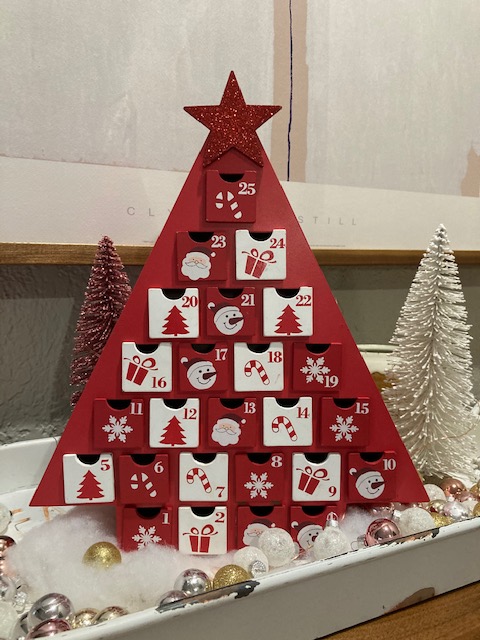
Ayla and Eli, my niece and nephew, rush to their Advent calendar every morning to find a little treat during the Christmas season. Photo credit by Cheryl Horst.
Advent calendars can be found in stores everywhere, from Walmart to Pottery Barn. Some are simple pieces of cardboard made with little doors for children to pry open, others are elaborately carved boxes with drawers that have little messages or pieces of candy. Pinterest abounds with DIY patterns to make one for your family while even beauty specialty stores and coffee shops have created ones to appeal to adults. Even though it has become extremely commercialized, the root of this countdown activity to Christmas has a significant spiritual meaning.
In Latin, advent simply means “coming”. Although how it is celebrated has evolved over the years, the main premise of the Advent season is anticipating the coming of Christ. We can spend time reflecting not only on the miraculous birth of our savior, Jesus, but also anticipating His return. For Christians, our lives have already been changed by Jesus’s birth, death, and resurrection. Yet, even with salvation, we still experience loss, heartache, sickness, and death. But our hope lies beyond those painful moments. We have the assurance that Jesus is coming again! We can look forward to a time when “He will wipe every tear from their eyes. There will be no more death or mourning or crying or pain” (Revelation 21:4). This Christmas, I want to spend more time anticipating Jesus’ return!
“You who bring good news to Zion, go up on a high mountain. You who bring good news to Jerusalem, lift up your voice with a shout, lift it up, do not be afraid; say to the towns of Judah, “Here is your God.” Isaiah 40:9
When I had children, I was intentional about bringing Jesus into the Christmas season. Yes, I wanted my children to experience the magic of Christmas: the twinkling lights, the glistening tinsel and all the traditions that went along with the season. But I also wanted them to know the real reason why we were celebrating Christmas: the miraculous birth of our Savior! So, I filled my home with books, music, and Bible verses focusing on Jesus’ birth. However, despite all my efforts, it never felt like enough, like I was slightly off target.
For the past month, my husband and I have been discussing the concept of Advent. What is it? Why is it important? How does one strike a balance between celebrating Christmas with its twinkle lights, and still focusing on the true wonder of season? What can I learn from Advent? How can I avoid getting caught up in the hustle and bustle of the typical Christmas?
I invite you to explore some of the answers I have to these questions in the month of December. Starting tomorrow, I will be posting twenty-five daily micro-blogs through Christmas day. Along with unwrapping Advent, I will be sharing a simple cookie recipe, or a favorite book, the history behind some of my favorite songs, and some favorite family traditions.
I promise these micro-blogs will be short, a paragraph or two (three at the absolute most). My prayer for these Advent posts is that they will not be just things to check off on your to-do list, but instead they will be a few moments of your day that you find restorative to your soul. Discover with me the true joy of Christmas for these next twenty-five days. And if you want to make sure you do not miss any of my blogs, please subscribe to my blog. It will come directly to your email daily. Thank you for allowing me to be a part of your holiday season!
“Parents tell their children about your faithfulness.”
Isaiah 38:19
“I miss Mayberry, sitting on the porch drinking ice-cold cherry Coke where everything is black and white, picking on a six string where people pass by and you call them by their first name, watching the clouds roll by. Bye, Bye.”
“Mayberry” written by Arlos Smith, performed by Rascal Flatts
One of my favorite days of the year is daylight savings time in the fall. The weather has cooled enough to add the flannel sheets to my bed. Curled up in my blankets, I fall asleep delighted to know that I am magically gaining an extra hour of rest. Yet, with all the chaos of 2020, I had to concur with the meme floating around Facebook: “Can we skip fall back, I don’t want another hour in 2020!”
It has been a tough year for everyone, a year that has left us all unsettled and desperately trying to adapt to a new normal. So many of us have experienced losses and broken traditions. With the holidays approaching and COVID-19 cases rising, the holiday season will likely look different for many of us. Travel plans may be cancelled, holiday gatherings are smaller and seasonal celebrations have gone virtual. As a family, we have made the responsible decision to cancel our annual hot chocolate party. This is one of the highlights of my year: opening our home, sharing homemade hot chocolate and homemade peppermint marshmallows with friends and family for the past eight years. Yet, we don’t want to potentially expose ourselves or others to the virus. While taking my daily walk, an older neighbor shared with me that she will be spending her Thanksgiving alone for the first time. My heart reached out to her, wanting to invite her to our home. But the reason for her seclusion was not that she didn’t have family to spend the holidays with, but rather for her protection. Sadly, I do not think her case is unique.
Traditions are important. They anchor a family together and help create a sense of identity. By their very nature of being repetitive, they provide a consistency in children’s lives, providing them with memorable moments. They also aid in passing on family beliefs and values. One of my homeschooling heroes, Sally Clarkson, reflected in a past blog post, “Yet, now that my children are grown, I am amazed how much they communicate over and over again how much our family traditions meant to them, I think it planted very deep roots intertwined around their hearts that tie us all together to the same faith, the same moral values, the same purposes that we share as we live life from day to day.” Traditions connect us to one another by helping us share our values across generations.
A few weeks ago, I took a trip to a Mayberry-like place in West Virginia when visiting my brother-in-law, Don, and his family. They live in a hollow (pronounced “holler” for those of you with northern accents). A hollow is a depression between two mountains or hills in the Appalachian range. It differs from a valley because the depression is close, and you can literally “holler” from one hill to the other. This hollow has been in my sister-in-law’s family for generations. As we walked down to her mother’s home, Anita shared with me some of the history. Her great-grandparents were the first to plant roots in the hollow. They later moved from the land when her grandfather was three years old. At this age he was already attached to the land, refusing to move, and hiding in the wood box. They finally promised him that if he moved, he would be allowed to gather all the eggs in the chicken coop the next morning. That night, his parents took all their eggs and hid them around the chicken coop. Later, as a married adult, her grandfather returned to his beloved hollow and raised his five children there. Anita also grew up in the hollow most of her life, playing with her cousins, exploring the woods, and creating memories.
After Don and Anita were married, they moved into town, about five minutes away. Her mother, along with a few other family members, still lived on portions of the land, enabling Anita’s three daughters to create memories there as well. A few years ago, Don and Anita were blessed to be able to purchase a portion of the land with a house at the top of the hollow. This piece of real estate was not just a future place to spend retirement, but also an opportunity to allow their grown daughters and their families to build homes on the land. One of their daughters has already built a home on the exact spot where Anita’s grandfather raised his family.
A piece of land that has long been in the family’s name is not enough to make this a Mayberry. What made Anita’s hollow special were the traditions created on this land. As she was sharing the history of the land, we were walking to her mother’s house at the bottom of the hill for the famous “Fudge Night”. A few years ago, I heard about Fudge Night and became enchanted with the idea. I admit, when we planned our visit, I knew that if we arrived early enough, we would have the privilege to be invited to the traditional Fudge Night!
Miss Linda, Anita’s mother, is absolutely one of the sweetest ladies I have ever met! She exudes southern charm and hospitality, making everyone feel welcome as soon as they meet her. She loves her family passionately and dotes on her great-grandchildren. Behind her bright smile, is a lady filled with confidence in God’s promises. She faced one of the worst nightmares of any parent, the death of her son, Jeff. As a teenager, Jeff was diagnosed with a rare form of cancer and, for five years, she traveled with him back and forth to a cancer treatment center in Maryland. During this time, she kept a diary, sharing her faith, fears and, ultimately, her trust in the Lord. Her son, eventually, lost his battle with cancer, forever leaving an empty place in her life and home. Recently, she released a book based on her diary from that time. To find out more about her incredible journey of faith, you can find the book here on Amazon.
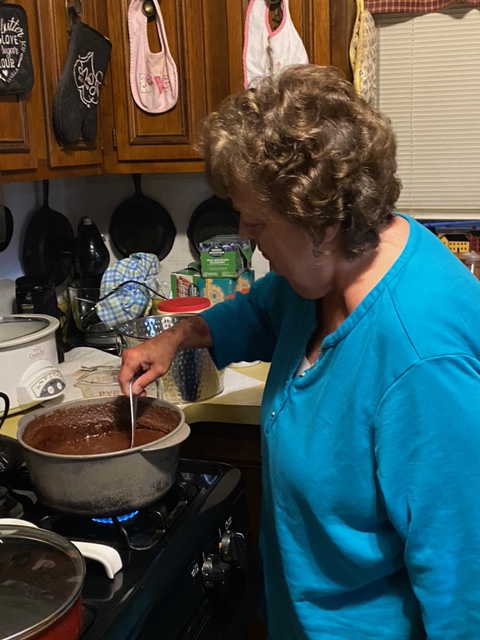
Prior to Jeff’s death, Miss Linda started making homemade fudge in an old pot on the stove. She would invite family members over, and as soon as it was ready, hot decadent fudge would be spooned onto plates, waiting to be devoured. After Jeff’s death, she made fudge every Friday night and has continued this tradition for the past thirty-one years. In addition to Fudge Night, Miss Linda still makes the traditional Sunday dinner, where her daughter and granddaughters gather with their families, along with nieces and nephews and cousins, eating some of her famous dishes like meatloaf and pot roast.
Fudge Night is not just an opportunity for the family to indulge in a chocolate fantasy, it’s also an opportunity to connect with one another. Despite life’s busyness and trials, it has remained a constant in their lives, a constant that provides a place of refuge, filled with laughter and love. Although she follows a recipe, Miss Linda knows instinctively when to add the creamy peanut butter to make it the right consistency. As it is poured into a pan, the love that goes into making the fudge adds a quality that no recipe can record. Within minutes, little hands, along with big hands, crowd around the pot to eat the hot fudge, while stories and laughter continue amongst everyone.
In their small West Virginia community, Fudge Night is somewhat of a legend. One of Anita’s cousins proposed to his future wife at a fudge night. One year, when my niece, Lindsay, was a cheerleader, the high school football team won a big game. After the game, the entire team, along with most of the high school, ended up at Miss Linda’s home celebrating at Fudge Night. Over the years, they have had people knock on the door, asking if they could come to the famous Fudge Night, and they are always welcomed by the family!
Fudge Night was all that I imagined it to be and so much more! Typically, I find fudge a little too sweet, but this fudge was different. It had a deep cocoa flavor enriched with the creaminess of the peanut butter. I started off with a modest portion in the beginning, enjoying the conversation, delighted to see my two-year grandniece devouring the fudge with bright twinkling eyes. I soon realized my portion was gone, and demurely, went back for more. The house was filled with laughter, stories, and love while thirteen of us shared a pan of fudge.
As we headed back up the hollow a few hours later, I was left with a sense of awe. I realized I had just visited Mayberry. It felt like a sacred moment, a gentle reminder to me of the importance of traditions, family, love, and values. It showed me the power of one woman, who kept her faith and, along with her family, built some memorials to the faithfulness of God. Yes, she had experienced a devastating loss, but she didn’t let that loss paralyze her life. She poured into her daughter and her daughter’s future family a sense of permanency by opening her home every Friday night with fudge, reminding them that God was still good. This is such a beautiful example of the gospel in action!
Yes, my hot chocolate party is canceled. Yes, my holiday gatherings and traditions might look a little different, this year. Despite these losses, God is still good and faithful! Instead of focusing on the losses of the season, I am still going to keep some of my traditions, celebrate with my family and build some memorials for my children and grandchild. And, hopefully, sometime in 2021, I can plan another visit to Mayberry and Fudge Night!
“However, as it is written:”What no eye has seen, what no ear has heard, and what no human mind has conceived”, the things God has prepared for those who love him.”
1 Corinthians 2:9
When I was in the fifth grade, I entered Narnia for the first time when I discovered The Lion, the Witch, and the Wardrobe on a shelf in the Sheboygan Falls Library. Taking the book home, I devoured the pages as fast as Edmund devoured his Turkish Delight. I imagined discovering a wardrobe, climbing inside, and being transported to a new land. I wanted to meet a faun and have dinner with talking beavers. I cried when Aslan died at the hand of the White Witch and rejoiced when he came back to life. I continued with the other books in the series, but they did not really capture my attention until later.
I rediscovered the land of Narnia as a new mother, when I was looking for some light reading while caring for two active toddlers. I quickly realized that what I thought was light reading was really a treasure trove of spiritual insights. I celebrated the beauty of creation reading The Magician’s Nephew. I longed for the boldness of Reepicheep, a little mouse, when defending the kingdom. I was moved to repentance when I saw Eustace, a boy who was turned into a dragon, have his pride stripped away along with his dragon skin by Aslan’s claws. I longed for heaven reading The Last Battle.
C.S. Lewis, the author of The Chronicles of Narnia series, is considered one of the foremost apologists of the twentieth century. He not only wrote children’s books, but also many books on Christianity, discussing, among other things, the concepts of faith, joy, and grace. He is often quoted by many modern theologians. Although his Narnia books can point someone towards God, Lewis would be the first to argue that the Bible, a rich living text, should be the ultimate source for understanding God. He had a rich understanding of the Bible and how it applied to the bigger picture, the picture of our story fitting into God’s story.
The whole Bible, from Genesis to Revelation, is the epic story of God. In Women of the Word, Jen Wilkin says, “the Bible is telling us about the reign and rule of God. Its topography speaks of creation, fall, redemption, and restoration in every vista.” It is not just a manual on how to live as a Christian or a map pointing our way toward heaven. It is God’s story, revealing His character. His majesty and artistry are displayed through His words as He speaks creation into existence in Genesis. He bestowed a special status on humans when He created them in His own image, longing to fellowship with them. Yet, this state of perfection was marred when sin separated man from his creator. Despite this fallen state, God had a merciful plan fully revealed in the life of Jesus. Jesus redeemed man from sin by dying on the cross, bringing to us the hope of restoration through His resurrection!
This epic story, the Bible, has lots of supporting characters, such as Abraham, Moses, Rahab, Esther, Daniel, Peter, and Paul. All these characters have different stories in different settings. Some spent their lives wandering in deserts while others lived in palaces. Some were fishermen while others earned their living through prostitution. Yet, despite the vast differences in these characters and their various circumstances, God ordained these stories to be a part of His written word because they played a part in His larger story. For example, Rahab, although she was a prostitute, recognized the power of the God and chose to hide the Hebrew spies. This simple act of faith resulted in her family being rescued from the fall of Jericho. Furthermore, her reputation was restored when her name was recorded in the lineage of Jesus! She had no idea that generations later, despite her past, her DNA would play a part in the redemption of the whole world.
It is easy to get a microscopic view of our lives. We get caught up in our day to day living, not realizing that our lives are bigger than the short years we live on earth. Our story, with God’s hand, plays a part in not just the lives of those immediately around us, but in generations to come, as well. Like Rahab, we have an epic part to play in God’s story.
Although this is an old picture, it is one of my favorites of me and my uncle. We definitely need to update our photos.
Although I am in the process of writing a book about my own epic story, my story starts with my Uncle Dennis, as a young man searching for God in 1975. Dennis, my mom’s older brother, had his hunger stirred for God by a friend’s testimony. He attended a church service in a different city from where he lived and immediately saw his need to be baptized. He left that service, having given his heart to God and with a desire to know God more. He started reading the Bible, found a local church to attend, and has served God ever since.
Although Dennis has an extensive knowledge of the Bible, he never felt called to preach. He has never been a Sunday School teacher. He does not write a blog or make Facebook posts expounding on his faith. Yet, in his quiet faithful way, he has impacted many lives, including mine and, as a result, the lives of my children and my grandchild. First, as a little girl, I can remember my uncle being the first man to compliment me on my appearance. As a five-year-old, I would twirl around in my strawberry peasant dress, soaking in his compliments, grinning from ear to ear when he called me “strawberry shortcake.” These simple words acted as antidote to the insults I heard at home, giving me hope that I was something more. He was also the person who introduced me to God by bringing me to Sunday School as a child. For a short season, those few hours every Sunday morning provided me with peace from the swirling chaos at home. Later, after I stopped attending regularly, he continued to pray for me, sometimes prompted by dreams God had given to him. I believe these prayers provided a hedge of protection around me and my family. Finally, my Uncle Dennis and Aunt Brenda, despite being in the middle of one of their darkest moments, reached out to me when my brokenness came to light. They embodied the love of Christ by setting aside their own pain and reaching out to a shattered teenager, giving her hope when she felt hopeless. This simple act was the beginning of my restoration process!
My story was not the only story impacted by my uncle’s life. The obvious transformation of his life by Jesus gave him the boldness to invite a co-worker, Marvin, out to a revival service. Later, Marvin shared with his wife about the invitation, while their son, Wayne, who had been searching for God on his own, overheard the conversation in his room. Wayne instantly felt a stirring in his heart and, of his own volition, attended a revival service that Sunday evening. He walked into the church not knowing anyone personally, but knowing only the name of his father’s coworker, Dennis. Wayne was later instrumental in leading his whole family and others into a relationship with the Lord. In addition, Dennis and Brenda ministered to countless teenagers, mentoring them in their walks with God. Finally, Dennis provided a source of consistency and strength in the life of his wife and daughter. This quiet man would not describe his life as being epic, but his impact, like most supporting characters in the Bible, is impacting generational stories in the epic story of God!
As an adult, I understand more of the symbolism in the stories of Narnia. I get chills every time I read the last chapter of The Magician’s Nephew. The main character, a young boy named Digory, has brought darkness into the newly created world of Narnia by his sinful behavior. After partially redeeming himself for his mistake, Digory later plants a Narnian seed at his home in London. This seed grows into a magnificent tree, which is later cut down and the wood used to build a wardrobe. This same wardrobe becomes the gateway for others to enter the land of Narnia. My story and your story, just like my Uncle Dennis’ story, can become the gateway to the redemption of others by God, leading to their own story of restoration!
In The Last Battle, C.S. Lewis ends The Chronicles of Narnia series with the following paragraph:
“And as He spoke He no longer looked to them like a lion; but the things that began to happen after that were so great and beautiful that I cannot write them. And for us this is the end of all the stories, and we can most truly say that they all lived happily ever after. But for them it was only the beginning of the real story. All their life in this world and all their adventures in Narnia had only been the cover and the title page: now at last they were beginning Chapter One of the Great Story, which no one on earth has read: which goes on for ever in which every chapter is better than the one before.”
Our stories may have different characters, settings, and conflicts. However, despite these differences, we all need to find resolutions to our own individual conflicts through the life of Jesus, taking our place in His epic story. What is amazing is that our story can continue to be written for eternity, finding complete restoration with God. With our finite minds, we cannot imagine what God has in store for us. 1 Corinthians 2:9 declares, “What no eye has seen, what no ear has heard, and what no human has conceived, the things God has prepared for those who love him.”
“Wherefore, my beloved brethren, let every man be swift to hear, slow to speak, slow to wrath:” James 1:15
A few years ago, I went to New York City with my sister-in-law and nieces. We walked among the streets of New York, taking in the sights. We looked for Eloise in the Plaza Hotel, ate pizza at John’s and window shopped at Tiffany’s. While we were in Rockefeller Center, we saw a Kate Spade store and decided to look at designer purses. Although I typically buy my purses at Target, I must admit I was a bit entranced with the merchandise. The purses were in bright vivid colors with whimsical patterned linings peeking out from the inside. One purse, a small picnic basket with strawberries on top, seemed perfect to carry while taking a stroll in Central Park. Even her umbrellas were delightful, making me want to sing for rain like Christopher Robin.
After leaving New York, I did a little research on Kate Spade. She started designing handbags that were both functional and stylish, without being too formal, in her living room. Her designs were known for their touch of whimsy and eventually became staples at Barney’s and Macy’s. She expanded her designs to housewares, including dishes and linens. She even wrote a few books on her design philosophy and has a few notable quotes such as, “She makes the day brighter; she leaves a little sparkle wherever she goes.” “Think, travel, celebrate, charm, decorate, dress, live-colorfully” is another quote of hers often appearing on Pinterest boards. I identified with her optimistic view of life along with her designs, which created a secret desire to someday own a Kate Spade purse!
A few months later, I was shocked to hear that this woman, who told others to “Eat cake for breakfast”, was found dead by her own hand at age 55! According to her husband, she had struggled with anxiety and depression for years and decided to end her own life. This woman, who created beautiful purses that exuded happiness, struggled with darkness within herself that diminished her spark. We, as consumers, had no idea of the true story Kate Spade was living.
I want to acknowledge that Kate Spade suffered from a mental illness that is sometimes hard to control, even with medication. I believe she was genuine in wanting to make women’s days brighter by creating beautiful handbags. Her mental illness, like any other illness, eventually affected her optimism, creating a sense of hopelessness and resulting in her ending her life.
We live in a world full of “Kate Spades”. People are always posting Instagram pictures of their family eating a homemade meal, when after the perfect picture, the meal is consumed in silence due to familial tensions. We see people in the store faking smiles, while inwardly they are falling apart because of broken relationships, addictions, or health concerns. We wave to our neighbors and make small talk about the weather, not knowing they may have lost their job or are having problems with anger. We attend church with people who greet us with “I’m fine” but are on the verge of tears because they feel alone or like a failure. Even though our world looks larger by how many friends we have on Facebook, survey after survey has indicated that people feel more disconnected than ever. The recent need to “socially distant” has likely heightened this sense of disconnection. The “Kate Spades” around us have stories that need to be heard!
My only Kate Spade item, a small plate purchased at TJ Maxx.
In my last post, I recognized how my own story has played out in my life. This recognition has awakened a curiosity in me. What are other people’s stories? How do their stories shape them? What can I learn from them? This curiosity does not stem from nosiness or a desire to analyze a person’s behavior. Instead, it has made me more empathetic towards others, less prone to judgment, and more apt to listen. It has also made me ponder why so many of us avoid sharing our stories with others. What fears hold us back from revealing the messiness of our life, and instead choose to suffer in silence? What does a community need to look like to be safe for others to share their story?
For the last few years, I have struggled with feeling rejected by a person in my life. This person, because of their position, has had the opportunity to speak encouragement and wisdom into my life. Instead, I have felt ignored and devalued by their lack of interest or even acknowledgement of major accomplishments and trials in my life. I have spent a lot of time in prayer and discussing the matter with a few trusted friends, trying to gain some healthy perspective on the situation. I have asked myself hard questions. Why do I feel a need for approval from this person? Is it possible that I am just reading the situation wrong? It finally reached a climax, and I was ready to confront this person, but God had a better plan. Instead of confronting, God provided me with the opportunity to hear that person. While listening, I realized, that they, too, have had a lot going on in their life. This person was feeling stressed by multiple situations and completely spent emotionally, with little energy to give. When I got a glimpse of their story, I instantly felt compassion. All the energy I had invested in feeling rejected because they did not acknowledge my story was mitigated by hearing their story.When we know someone’s story, it allows us to be more forgiving of their shortcomings. I am not saying that we give them a pass for bad behavior, or we ignore healthy boundaries in our life. But I am saying that knowing someone’s story can diminish a perceived offense and give you a window into their soul. It gives you an opportunity of being a light in their life. We all have a desire to be known, and when we truly listen to another person’s story, we give them an opportunity to feel valued and heard!
Recently, my family had two new friends over for Sunday dinner. Afterward, we sat down together and started talking. Somehow the conversations moved from generic topics, like jobs and places we had lived, to sharing our stories. Within a few hours, we had the privilege of hearing how God was working in the lives of these two people. After my guests left, I felt in awe with what had transpired. A simple Sunday meal turned into an opportunity for all of us to hear about God’s transforming power!
This Sunday dinner conversation was not something I had orchestrated, but I do believe my family and I did a few things to create an environment where open conversations could transpire. First, we invited people into our home. This simple act let our guests know that they were important enough to be included in our personal, everyday life. Second, we were authentic and engaged. We did not focus on the food or the table setting, but instead focused on getting to know our guests and making them feel comfortable and welcome. Third, we listened and were careful with our interjections. It is important when listening to a person’s story that we are careful to respond thoughtfully. When sharing their stories, people are not looking for trite platitudes. Instead, they are looking for someone to listen to them and validate their feelings. Creating a community where people feel safe and connected is a key component for helping other share their stories.
One of my all-time favorite books is “Little Women”. It is the story of the lives of four sisters. Every time I read this book, I am struck by how much I learn from each of the characters. Meg, Jo, Beth, and Amy all have different personalities, strengths, and weaknesses. Although they live in the same home with the same parents, they each have different stories. At different points in my life, I have learned from Jo’s pride, Meg’s desire to feel included, Amy’s desire for nice things, and Beth’s acceptance of her fate. As I learn and grow from books I read, I can also learn from the stories that other’s share. Too often, I have thought about what I can bring to the conversation to support others. Instead, I am realizing that what I can learn from their stories is just as important. This desire to learn eliminates any pressure to have the right response. Instead, it puts everyone on the same playing field, each with their own story of brokenness needing the intervention of the transforming power of God!
Our world is extremely divided: politically, socially, racially, and spiritually. Our social media feeds are filled with vicious insults from all perspectives. We have created new terms to define our differences like “the cancel culture. Yet, I believe healing can happen if we, in part, learn to set aside our differences and be willing to listen to each other’s stories. Everybody has a story, and I have the obligation, as it says in James 1:19, to “be swift to hear, slow to speak, slow to wrath.” My prayer is that all of us everywhere learn to listen well.










 By Sherry Collins