
Page 5 of 28

Tiramisu Poetry

“When I look at your heavens, the work of your fingers, the moon and the stars, which you have set in place, what is man that you are mindful of him, and the son of man that you care for him?” Psalm 8:3-4

In the 1970’s, having a copy of the World Book Encyclopedias was as important as having a 45-inch flat screen TV today. Despite earning below the poverty line, my mother made monthly payments for us to have those treasures of knowledge, and the Childcraft books that came with it. These beige embossed vinyl books captured my imagination. I would peruse the first volume, pouring over the nursery rhymes making my way through longer poems flanked by delightful artwork. I explored the other volumes, but always came back to the poetry volume reciting Simple Simon Met A Pieman and envisioning magical forests while reading The Sugarplum Tree by Eugene Field. Something about poets’ distinct words conjured up images for me that seemed otherworldly compared to the harsh reality of life. My love for Volume 1 was imprinted with the oils of my fingers, making the embossed covers look worn and beloved.

I stopped reading poetry around age nine. I don’t know what stopped me from delighting in words. It is possible life just became too hard. I didn’t have the time to slow down and let the poets romance me because I was too busy keeping secrets. It could be that in English classes we poured over structure and rhyming schemes, making poetry seem mechanical. It may have been that the areas where poetry touches, feelings and nature, were not familiar or restorative to me. All I know is, for many years, I stopped engaging in my childhood friend, poetry.

Later, with my children, I explored poetry while home educating them. Charlotte Mason, one of my major educational influences, remarked that “poetry could cultivate the seeing eye, the hearing ear, the generous heart.” We read a free verse picture book titled Daring Dog and Captain Cat where family pets had nighttime adventures. As I read the book aloud and found the rhythm, I delighted in the images the author painted with words, like “kitchen pans banging breakfast songs.” Yet, I held poetry at a distance, still believing that my lack of intelligence or imagination prevented us from forming a relationship.

Ann Voskamp, and her poetic prose best seller One Thousand Gifts: A Dare To Live Fully Right Now slowly enticed me back to poetry. Her descriptions of soap suds dancing in the air, and the colors of sunrise captured my senses. I, too, began to write down things I was grateful for, paying attention to how the steaming cup of coffee warmed my hand and soul. I too, listened to the songs of birds chirping and the smell of lilacs wafting across my patio. And, like Ann, “when I’m always looking for the next glimpse of glory, I slow and enter.” This created the soil where my love and appreciation for poetry could grow and thrive.

Later, when I was experiencing a lot of life transitions, I was encouraged by authors like Joy and Sarah Clarkson to start reading poetry once again. I picked an anthology, The Four Seasons Poems, edited by J.D. McClatchy in spring of 2018. This compact book, from a series called Everyman’s Library Pocket Poets, stayed at my bedside for a year. Regularly, I would read a poem aloud, listening to how the words danced across my lips, savoring the images the poets created. Sometimes, I could smell the plowed spring earth ready to bear seeds, feel the soft summer wind brush my hair across my face, hear the crickets play their fiddles in fall, and see the giant snowflakes flutter to the ground. As I did this, I found myself paying more attention to the world around me and feeling more appreciative of God, the creator of all things beautiful.
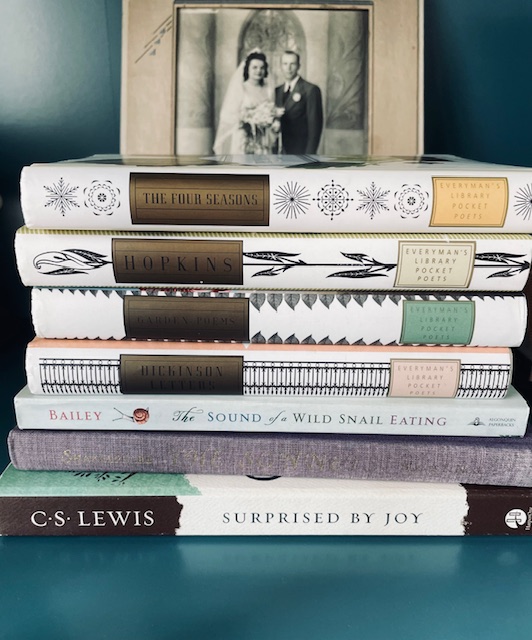
This small book opened up a new world. I began to crave poetry and found both old and modern poets I loved. Christine Rossetti, Wendell Berry, Mary Oliver and Maggie Smith soon became treasured friends. I encouraged my husband to join me, and soon we were reading poems aloud to each other in the evening. I started to open my imagination to answer Mary Oliver’s question in The Summer Day “Tell me, what is it you plan to do with your one wild and precious life?” I started to think harder about where I lived and how I can create community because of Wendell Berry’s insights. I contemplated how I can contribute to making this world beautiful by reading Maggie Smith’s Good Bones. Each poet helped me adjust to the transitions in my life and see that I had a full life ahead of me.

I also saw how poetry can address justice, body positivity, and other issues our world faces today. Amanda Gorman called for “unity, collaboration, and togetherness” as she recited her poem The Hill We Climb at the 2021 Biden inauguration. With her bright yellow coat, she stood elegantly and resolute capturing the hearts of Americans. Kwame Alexander connects young African American men to the importance of family by using sports analogies in his visual poems. Lindsay Rush addresses the stereotypes and stigma women feel in her book of poetry A Bit Much.

My husband tried tiramisu years ago and was disappointed. After two attempts, he concluded that he didn’t like this famous Italian dessert. We then heard others drool and rave about our friend Nate’s famous tiramisu. Everyone requests this dessert from him, and some unashamedly eat it before the main meal at church dinners. After a couple of years hearing about all the fuss and gentle prodding from me, Terry decided to give it a try. His first bite into this rum, espresso, creamy mascarpone concoction opened his eyes to this Italian treasure. The reality is he did like tiramisu, he just needed to find the right recipe for his taste buds.

I have heard from many people resolute about their distaste of poetry for much the same reasons I had vocalized in the past. But like Terry’s experience with tiramisu, it may take some trial and error for you to find the right poet or poem to speak to you. As a Christian, we should challenge ourselves to read poetry because it is a writing technique God used in the Bible. He knew the power of imagery and expressing emotions speaks to the heart of all people. Audre Lorde says “poetry is not a luxury. It is the vital necessity of our existence.”

Here are a few ideas on how to engage in a poetic relationship. Start in Psalms, and although we lose some of the rhythm due to translation, read a few aloud. Pay attention to the imagery and emotions being expressed, and how vulnerable the writer was being. Then, look at some anthologies, like a poem about seasons or gardens, or even a poem a day. Read the poem aloud following the punctuation, it may feel awkward the first few times, but eventually you will feel the heart of the poem. If it describes plants or places or animals you are unfamiliar with, look those images up. I had no idea what a snowdrop looked like until we explored Winterthur Gardens. Now, all the late winter/early spring poems about the snowdrop flower make sense. If reading a book of poetry seems to be daunting, explore some poetry podcasts that read a poem aloud such as Slowdown or Daily Poem. Finally, if one poem does not speak to you, leave it behind. But if it does, take the time to savor the words and images. Maybe even annotate the poem by underling the lines that jump out at you. Also, explore some modern poets like the ones I mentioned in this blog post. Keep trying, because one day you will find a poem that speaks to you.

It is National Poetry Month, so give a poem a try. I promise you will like it!

Epilogue: Worth

“Learn to do good; seek justice, correct oppression; bring justice to the fatherless, plead the widow’s cause.” Isaiah 1:17

As I write the epilogue, we are deep into the editing process. Thoughts race through my mind. Did I miss something? Should I have written certain chapters with more vulnerability? Did I address all the areas I hoped to cover? And the list continues. But my husband keeps reminding me that I need to close the book. And he’s right. This book was never meant to be an exhaustive window into my healing process, because it is fluid, and I continue to grow. Nor was this book meant to be a comprehensive overview of all the therapeutic models that have helped me and could help other victims. Just as the home remodeling shows edit hours and hours of footage down to a 44-minute show, I also must edit all the heart, soul, and mind material that I have dealt with in my healing process. I can’t cover everything, and some things are still so raw and vulnerable that I am not ready to share them with the world.

I therefore close with a thought that Rachael Denhollander, a victim of sexual assault, shared in her victim impact statement at the sentencing hearing of Olympic Gymnastics doctor, Larry Nassar. She asked the judge, “So what is a little girl worth?”1 This later became the title of her own memoir about sexual assault. It is a simple question but one with many layers to it. And it’s a question I ask you, my readers: What is a little girl worth?

I know the answer is not found in the voices of perpetrators who crush victims. It is not found in people who lack insight and knowledge of how to handle trauma. It is only found in the gospel. As Christians, we can and should be a support system that has confronted and dealt with our own misconceptions about sexual assault and has created a safe place for victims to heal.

I ask you, again: What is a little girl, a little boy, a woman, or a man worth? Are you willing to arm yourself with knowledge and material that will help educate and inform you on the effects of trauma? Are you willing to let experts like Rachael Denhollander, Dan Allender, and Chanel Miller educate you on the harm this kind of trauma did in their lives and the lives of others? Only one of these is a licensed therapist. Their expertise is not based on the letters after their names, it’s based on their own experiences with sexual assault. All too often, victims are further dismissed for being a sexual assault advocate. Rachael Denhollander said in her impact statement, “Once it became known that I too had experienced sexual assault, people close to me used it as an excuse to brush off my concerns when I advocated for others who had been abused, saying I was just obsessed because of what I had gone through.”2 I also have experienced this dismissal. But who better to understand and advocate for a victim’s rights than a person who has experienced it herself?

So once again, I ask you: What is the person sitting next to you in church worth? What is the person in your small group worth? What is your sister worth? What is your neighbor worth? If they are valuable and made in the image of God, will you invest some time to unpack sexual assault in more depth? I have included in this epilogue a list of books and podcasts that have helped shape me and correct my own misconceptions about sexual assault, rape, and harassment. Not all these are written by Christians, but truth is truth, no matter the source. Take some time to read a few of these books, or, if you prefer, download them as audiobooks. Listen to a few of the podcasts. It will help inform your compassion and empathy.

List of Resources

Books: The Wounded Heart: Hope For Adult Victims of Childhood Sexual Abuse: Dr. Dan B. Allender; What is a Girl Worth?: My Story of Breaking the Silence and Exposing the Truth about Larry Nassar and USA Gymnastics: Rachael Denhollander; What My Bones Know: A Memoir of Healing from Complex Trauma: Stephanie Foo; Rid of My Disgrace: Hope and Healing for Victims of Sexual Assault: Justin S. Holcomb and Lindsey A. Holcomb; She Said: Breaking the Sexual Harassment Story that Helped Ignite a Movement: Jodi Kantor and Megan Twohey; The Body Keeps the Score: Brain, Mind, and Body in the Healing of Trauma: Dr. Bessel van der Kolk; Know My Name: Chanel Miller; All My Knotted-Up life: A Memoir: Beth Moore

Podcasts: The Healing Trauma Podcast: Monique Koven; Java with Juli: Dr. Juli Slattery; The Place We Find Ourselves: Adam Young; The Allender Center Podcast: Dan Allender and Rachael Clinton Chen

One Car

“Do nothing from selfish ambition or conceit, but in humility count others more significant than yourselves.” Philippians 2:3

Recently, an acquaintance asked a question in a judgmental tone that upset me, “Now that you are working, are you finally going to get a second car?” I instantly felt like I had to explain my choices and justify the decisions my husband and I have made. Instead, I remembered some of the work I have done, and that not everyone deserves an explanation, especially when they have already formed their own opinion. I replied “no” and moved the conversation in a different direction.

For many, our almost 29 years of marriage may seem like we are in the dark ages, with our choice to have only one vehicle. For most of the time, Terry has worked within 5 to 10 minutes from our home. This made it convenient when I had appointments or home school activities. I would just take him to work in the morning and continue my day. I also lived close to parks and the library, putting a lot of miles on my stroller odometer. Money was tight, and keeping up a second car was not something that fit into our budget.

For the past 10 years, other than during the pandemic interruption, my husband has commuted 45-60 minutes to work. This made appointments a little bit challenging, but again we found ways to work around those obstacles. I was providing childcare for a family, who had an extra vehicle which I used for taking their kids to appointments and school. They generously allowed me to use it for my own appointments as well. I lived close to my family doctor and chose to walk to her office on a few occasions. Also, my children were driving and had purchased their own cars, so occasionally they helped with a few errands.

The one-car family idea became a little more challenging when I took a part-time job, and for 9 months, I drove more than I had driven in the past 5 years. We knew all the miles we were putting on our car were not sustainable, so we moved closer to my work. Two months later, Terry accepted a new position making both of our commutes 5-6 minutes in the same direction from our home. We have decided that the cost of a second car is not important to our lives, using the extra money for travel and day excursions.

I know that Women’s History month is over, but I want to end this series on how we can support all women in their choices concerning their marital status, if or when they are going to have children, whether they choose to stay home or work while raising children, and how they decide to educate their children. All of these have elicited some strong opinions in the church and have caused women to go both on the offense and on the defense. Within all these areas, we even micro-judge whether they breastfeed, what they feed their family, and what they let their children watch.

Years ago, while in college, I made some arrogant statements over time to a dear friend about the importance of higher education and being career oriented. With her usual grace, she wrote a letter to me, sharing with me how my opinions had demeaned her choice to be a stay-at-home mom, and that there was room for both of us to have our goals without tearing each other down. I instantly felt bad and apologized. Ironically, I didn’t learn my lesson when I made the decision to stay home with my kids and home-educate. I soon found myself on the other side of the table, judging working moms. This view was reinforced by my insulated circle of friends and acquaintances, all of us reading books by home education leaders and listening to Christian talk-radio shows (this was before podcasts were a thing).

Recently, I had a few people hang up on me as I was making phone calls for donations to a local nonprofit. The first time, I was offended but quickly remembered I have done the same to various other organizations trying to raise funds. I cushioned the hang up by saying I was not interested and ended the call before the person had a chance to respond. Now, being on the other side of the call, I realized even a cushioned hang-up felt rude.

Author Tyler Merrit says in his book I Take My Coffee Black, “proximity breeds empathy. And with empathy, humanity has a fighting chance.” My sister, Cheryl, entered college slightly later than her peers. She finished her bachelor’s degree and went on to complete her master’s degree. She later found a great job at a major university. She then decided to pursue her law degree, while getting married, followed by having two children. After having her children, she continued working full-time while finishing her law degree. I saw how hard she worked towards achieving her goals. I also knew how much she loved her children and wanted what was best for them. She wanted them to have healthy, whole lives supported by a loving mother. Her goals in parenting were not different from mine. What was different was the application, and that didn’t make either of our approaches better than the other.

Just like me, she sacrificed her finances and personal time to meet the needs of her growing family. I chose to have one car; she chose to spend money on an excellent daycare for her children. I made some sacrifices with my professional goals, while she limited her opportunities so she could be fully present in the evening with her kids. We both stayed home with our sick kids, giving them the extra cuddles they needed. We both took our children to the library, created family traditions, and researched the best ways to raise our children.

I saw how hard my sister worked, and continues to work, as a mom while still excelling in her chosen career. Being close to her gave me insight into working moms. Just like stay-at-home moms, they love their children passionately. Their reasons for working are to help provide for their family, achieve some professional goals, and some may have no other option as single parents. No matter what their reason is, this doesn’t make them less of a mother. It just means they work differently than stay-at-home moms.

I remember going to camp where competition between cabins was fierce. We created chants about our cabin name, often belittling the different cabins, hoping to win the coveted Best Cabin award at the end of the week. This was fine for a one-week experience as a middle-schooler. The stakes are higher when we continue as adults to put ourselves into camps of our different choices in marriage, children, work, and education. We automatically create an “us vs. them” culture which leads to belittling attitudes and judgements. But Paul reminds us there is a different way to operate. He states in Galatians 3:28, “There is neither Jew nor Greek, there is neither slave no free, there is no male and female, for you are all one in Christ Jesus.” Paul was teaching a principle that our differences don’t separate us from Christ, and in turn, shouldn’t separate us from each other.

Sienna Miller, who welcomed a new baby at age 41, addressed the ageism question in Hollywood. She pointed out that she gets a lot of negative feedback on how “old” she was to be having a baby. She also pointed out that stars like Robert De Niro and Al Pacino, who welcomed children at 79 at 83 respectively, were celebrated instead of questioned on their geriatric age. Though these arguments plague Hollywood, can’t we of the Christian faith do better? Let’s cheer on mothers who embrace motherhood at older ages. Let’s support those who choose to remain single by embracing them into the greater family of God. Let’s champion those mothers who choose to use formula. Let’s recognize that all parents want the best education for their children, and that they have a right to delegate that to private or public schools.

Again, like all the other topics I have discussed in the last three blogs, this can only happen when I personally identify the ways I have judged other women in the past and choose to be supportive in the future. I have some amazing friends who parent passionately and have made different choices than I did. I have some amazing friends that are single, who support the kingdom in so many tangible ways and their choices should be validated. It’s time to embrace the differences so we can chant the hashtag of International Women’s Day, let’s #AccelerateAction, by recognizing that these differences make us a more effective body of Christ. This proximity to differences will increase our empathy, and in turn, our witness.

We have one car, and we are content with our choice. I chose to raise my family the way God called us to as a family unit, which resulted in me staying home, home educating, and a limited income. Our way was right for our family, but not for everyone. In the future, I want to champion my friends and families who make different choices than me.

Monica L. and Hyde

“Judge not, that you be not judged.” Matthew 7:1 ESV

During my junior year of college, I had a full schedule. Along with being promoted to a new role as a Program Assistant and other extracurricular activities, I had the toughest class of my psychology major: a research and methods course. Often when I moved around my small campus, my head was down, thinking about the list of things I still needed to accomplish before the day ended. At the end of the school year, I met a freshman with whom I would be working in a summer program for underprivileged high school students. We quickly became friends, and she introduced me to a new, up-and-coming store: Bath & Body Works. Later that summer, she shared how she had tried to make my acquaintance before and, after being ignored a few times, she thought I was pretentious. I was taken aback by this assessment, and it was the first time I realized that I didn’t always appear warm and friendly. I quickly apologized, remembering how often my head was down and my list was long. Unfortunately, at the time, I was not mature enough to recognize that I needed to find healthier ways to deal with my stress and to avoid alienating people.

Since then, I have learned that when I am busy, I tend to have a Jekyll and Hyde transformation, shifting from the warm, friendly Sherry to busy, task-oriented Sherry. Even how I move about my world is different. I go from engaging in conversation with total strangers and inviting people into my home for peanut butter and jelly sandwiches (this was when my children were little) to being laser focused on what needs to be done and barking orders at others. This Mr. Hyde conversion is not my best side, and the various members of my immediate family have often been the ones who faced the brunt of this ugliness. And if you meet me at this time, you might not be enticed enough by the peanut butter jelly sandwiches to come over and visit with me.

Despite being busy with a newborn, I remember the1998 Bill Clinton and Monica Lewinsky scandal blowing up across the different broadcast and cable news networks. Before social media platforms existed, we still managed to be inundated with images of the infamous blue dress and clips of her phone conversations with a so-called friend. Next, we watched as President Clinton denied any sexual relationship, later apologized, and then faced impeachment. For years afterwards, every comedian and talk show host had a joke about Monica Lewinsky, criticizing her body, intelligence, and character. I laughed at some of the jokes and formed my own opinions of her.

But in 1998, we had no common language for the concepts of power differential, body shaming, or trauma. We didn’t understand that critical thinking is not yet fully developed in young adults, resulting in one intern’s naïve idea of love turning into the biggest mistake of her life. Today, I listened to Lewinsky tell her own story on her new podcast, Reclaiming by Monica Lewinsky. My views of Monica Lewinsky had been shifting for the last few years, and I knew I had misjudged her. But it was devastating hearing how hard it has been for her to move forward in her life, find a career, or even be in a healthy relationship because of a mistake she made when her impulse control was not yet fully developed. What was even harder to face was my culpability in her demise. I, along with the rest of the public, had misjudged and mischaracterized her.

This Saturday is International Women’s Day, a day with its roots in women protesting to receive better pay and improved working conditions. It started in the United States and moved across Europe as more women protested poor working conditions, wage gaps, and the inability to vote. In 1975, it was recognized by the United Nations as a day to support gender equality. The theme this year is #AccelerateAction, engaging in concrete ways to improve gender equality. There are still nations like Iran and Afghanistan where girls can’t receive education beyond elementary school, women are not allowed to own businesses, and women can’t leave their homes to have lunch with a friend. I can’t do much about those problems, except bring awareness of those human rights violations, support organizations that are trying to make a change, and vote in ways that address these issues. But I can do one thing that is noted on the International Women’s Day website: I can “call out stereotypes, challenge discrimination, question bias, celebrate women’s success…and share our knowledge and encouragement with others.” But to do this well, I need to recognize my own biases and the ways I need to change to address these issues.

Over the next three weeks, in honor of International Women’s Day, I am going to address issues of body image/body shaming, labeling, and judging women’s paths in life. I have touched on these areas in the past, but I am hoping to examine them from a fresh perspective with some personal anecdotes, pop cultural references, and Biblical principles. I also want to highlight why I, as a Christian, should and can do better about these issues. I hope you will join me in this series and hear how I am evolving.

I am so glad my friend in college laid aside her preconceived notions about me to become my friend. Her friendship, as brief as it was, enriched my life beyond fruity smelling lotions. I know how it feels to be misjudged, and I need to remind myself not to make judgments of others based on my own limited information about that person. My participation in shaming Monica Lewinsky certainly didn’t embody Christian principles and exacerbated her future struggles. But I know better now, and I want to continue to accelerate action to help move the dial forward in treating all women with equality.

Do I Deserve the Guacamole?

“Whatever is good and perfect comes comes down to us from God our Father, who created all lights in the heavens.” James 1:17 NLT

I discovered guacamole way too late in life. Tony, a friend of mine who has lived in Arizona for many years, made the dish about 17 years ago at his mother’s holiday gathering in Wisconsin. The vibrant green stood out against the platters of brown and yellow: summer sausage, crackers, and cheese. I had recently discovered avocado at a local restaurant where it was added to a grilled cheese, elevating an ordinary sandwich with a fresh grassy note and a creamy texture. I couldn’t wait to try avocados in other ways, so I was magnetically drawn to the guacamole. My first bite transported me from the cold, bitter Wisconsin winter of slush and brown snow to a land of perpetual sunshine where I could feel the warm breezes whisper their song against my body. I had to know the secret to this magic green delight.

I asked Tony for the recipe, hoping to replicate this at home as soon as possible. Tony shared that he had mashed avocados with fresh lime juice and salt. He then folded in fresh tomatoes and onions. Finally, he added chopped cilantro, and adjusted the seasonings as needed. It sounded so simple, and within a day, I was buying the ingredients. My first batch wasn’t perfect, but after many attempts, I, too, was making the transformative guacamole for myself, adding it to our famous Collins’ fajita dinner. But for many years, when I went out for Southwestern or Mexican food, I refused to pay extra for guacamole. It may have been partially because our budget was tight, but it ran deeper. And this “not paying extra for guacamole” showed up in all sorts of ways in my life. It showed up in the old, tattered clothes I kept in my closet, or when I made all the cookies my family liked, putting the raspberry Linzers that I loved last on the list. It showed up during a vacation where I spent all my time cooking and cleaning, feeling resentful inside while everyone else was having a great time. The underlying reason for all of this was I didn’t feel I deserved the extras that made life joyful. After all, wasn’t I Christian? Shouldn’t my only joy be found in serving Christ and benefiting the kingdom of God?

The Bible emphasizes throughout scripture that we are to be servants; humble and loving our neighbors as ourselves. When we contrast that with what fills our social media feeds, secular magazine articles, and podcasts, the differences seem to be in direct opposition. The memes about mommies needing wine time, and the self-care movement, along with the need to set aside “Me-Time” seem rooted in selfishness, indulgence, and pride. Often, these messages cause us to pivot the other direction where we perceive ourselves to be selfless, sacrificial, and humble. But in the last few years, I have been asking myself: is that pivot to the opposite end of the spectrum really what God was calling for? Do we really understand the principles of God, or are we trying to measure things according to standards rooted in Puritanical thinking that set an unrealistically high bar? Did God really object to me splurging on guacamole? And why do I use the word splurge? Is that word itself implying extravagance that I don’t deserve?

I think the key to all these answers is what is in my heart and how I perceive God. The Bible clearly recognizes the importance of self-care. Jesus himself departed from the crowds occasionally to refuel and recharge himself. This sets an example for us to make sure we get adequate rest and recognize our limitations. I am consistently reminded of the importance of rest because my Rheumatoid Arthritis causes inflammation in my joints when I am too busy and not taking care of myself. I also recognize that I am not the person who should help someone move because of my physical limitations. Instead, I can bring a meal to a family after they have moved. But self-care becomes indulgence when I know I could help with something and make excuses as to why I can’t: I’m too busy, it’s a big ask, or I’ll wait to see if someone else volunteers.

There may be seasons where I am too busy, but I must ask myself some hard questions before I determine how busy I am: how much time do I spend reading or watching or scrolling?  None of those things are bad, but it may inform me how well I manage my time. I also must ask myself if I’m only helping when it is convenient in my schedule? Finally, if I am waiting for someone else to volunteer, there is a strong chance that someone won’t, and maybe the whisper I am hearing is God calling me to an act of service.

Loving my neighbor, as exemplified by the Good Samaritan, is sometimes a big ask in relation to our resources and time. The Samaritan saw a Jewish man lying on the road, beaten and barely holding on to life. The Bible says the Samaritan had compassion, which in Greek was the word splagchnixomai. It truly is a fun word to pronounce, with an interesting definition. It implies that he was moved with a deep compassion from his bowels. This doesn’t mean you contort your face like you are constipated to demonstrate your compassion. The bowels were considered the seat of your mercy and pity. This compassion was so deep, it moved the Samaritan to action. He bandaged the man, cleaning up the dirt and blood caked on the man’s body. He took him into the city, stayed with him overnight and paid the bill for the man’s expenses until the man was healed. He did not do this because he was obligated and checked off the boxes for being a good Samaritan. Instead, he took care of this man because he had empathy for the man’s vulnerability. When I serve out of obligation, I am no different than the Levite or the Priest that passed by. I am exactly like the Pharisees bragging about my gifts before God. But when I love my neighbors as God calls me to, I will be moved with compassion to action. There is no indication that the Samaritan checked his schedule to see if he had the time to care for the man on the roadside. There is no record that he had an abundant bank balance. Instead, he loved his neighbor well because he coupled his empathy with action. If I am truly seeking the kingdom of God, there will be times I will be moved with compassion to love my neighbor well, and I won’t count the cost. I will act decisively with a heart towards my neighbor’s vulnerability. But when I am resentful of serving, that’s an indication that my heart is not in the right place.

As a Christian, we need to position ourselves in humility, but does this mean we don’t deserve good things? The answer to that question has a lot to do with what I believe about God and myself. I would like to say that I drew this conclusion freely, but I struggled with finding the right answer, and I phoned a pastor friend, Mike Kemper, who helped me examine this rightly. Mike reminded me that we have a good God who promised the Hebrews a land that flowed with milk and honey, “not water and protein powder.” God gives us good gifts, and for me that may mean guacamole and the means to afford it. When I receive a good gift from God, I can express my gratitude like David and so many of the psalmists did. It reminds me that my God is generous with His goodness and mercy. When I get into a place where I feel like I deserve something, I start to elevate myself and move into the position of the provider. It places me at the center, instead of God.

So, where does this leave me with the guacamole, tattered clothes, raspberry Linzers and the endless meal preparation when I am on vacation. First, I am the daughter of a good Father who wants to lavish blessings on me. If I remain in a place of gratitude and live within my means, I think the extra $2.75 for guacamole is just fine. He created me to love the mixture of avocado with lime and the right genes to enjoy the fresh taste of cilantro, unlike my husband who thinks it tastes like soap. I don’t think God expects me to stay in tattered clothing, but I also need to balance that with contentment and an eye on my budget. Going into debt for fashion, furniture, cars, or anything is an indication that I don’t trust God. It’s okay to make a cookie you like during the holidays, that also brings festivity to the platter without artificial colors. It also means I need to voice my own desires for a vacation, where I am not in the kitchen all the time, and where I am getting the same rest and rejuvenation everyone else is getting.

“Yes, please, I want the guacamole!” will be my answer for the near future! (Unless we get into a trade war with Mexico, where tariffs make avocados a luxury item! But that is a totally different discussion.)

Dreams and Contentment

“Not that I speak in regard to need, for I have learned in whatever state I am, to be content.” Philippians 4:12 NKJV

Almost 27 years ago, I had a moment when I was about to lose it; not just a minor eruption, but one comparable to Mt. Vesuvius. I was in labor expecting my first child, after a challenging pregnancy. The whole pregnancy had been filled with relentless nausea along with chronic fatigue. For the last trimester I endured constant heartburn, and now I started labor with help from Pitocin. I was focused on trying natural labor, and in the last stages, I was ready to push my bundle of joy out into the world. Nothing in my life prepared me for that first push, and I started shaking uncontrollably as if I was going into shock. Scared, I looked into my husband’s eyes and cried “I can’t do this!” The nurse, who had delivered lots of babies and dealt with hysterical women in the past, spoke firmly to me, “You have no choice, there is no other way right now for your baby to come, you have to continue.” Those simple words snapped me back to reality, helping me push on through the next 35 minutes. Soon, I was holding my son, experiencing complete joy at the wonder of his little body.

Two weeks ago, I shared that we moved. It had been a move anticipated for a while, waiting for the right place to become available. We had been slowly purging our stuff, deciding how many blankets we needed for guests. We donated five of the Trivial Pursuit games, keeping only two. We simplified our holiday décor by keeping only what we loved. We gave away some items and sold others. When we found a place in Carlisle at the end of October, we knew we needed to do more purging. Our new place was maintenance free; sans yard or patio. That meant everything in our garage needed to go. We also had a craft table speckled with the colors of previous projects that needed to disappear, along with all the craft paint. Since the new place was smaller, my “forever table” that I blogged about, needed to be sold as well.

Parting with stuff wasn’t as hard as I expected, except the table. But when the young couple delighted over the table as an ideal place to gather for the holidays, I felt like my forever table was going to a good home. As each item left my home, I looked forward to creating a new space, with a more modern feel and less heavy footprint than my previous more traditional style.

The actual moving day went smoothly. My son-in-law and daughter arrived early, helping us finish last-minute tasks like filling nail holes in the walls and taking down curtain rods. With my amazing moving crew of friends and family, the truck was loaded and on the road in less than an hour. We started a little after 9:00, and after a 40-minute drive to our new place, we were unloaded and eating pizza by 12:15. Feeling a bit overwhelmed by all the boxes, both Terry and I needed some time to get our bearings, and declined offers to stay and help unpack.

By Monday morning, I was about to lose it, just like I did 27 years ago. I hadn’t slept well in days, and I accidentally hit the rinse button too many times on the washer, leading me to believe it wasn’t working. After resolving that issue, I felt at a loss with my kitchen. The more boxes I unpacked, the more obstacles I saw. By no means did my last home have a large, modern kitchen with a butler’s pantry to store all the needed items for a serious foodie and entertainer. But I did have a decent kitchen, where I could store my everyday items in an organized fashion, loose and carefree. Where were my cute little porcelain snack bowls going to go, how was I going to fit all my serving dishes in the cupboards, and where was the immersion blender and food processor going to fit?

My sweet daughter arrived, venti coffee in hand, offering to help me unpack. I started to cry, feeling overwhelmed. She spoke calmly to me and started to inspect my new cupboards. She shifted things around and stacked things on top of each other and spoke firmly, “Mom, you have enough space, you just need to stack things.” Those simple words snapped me back to reality and propelled me forward. Quickly, I found ways to fit my kitchen items into my much smaller space. I even started to get a vision of what we wanted the home to look like and found a shaggy white rug to warm up the living room, along with the perfect little electric fireplace to anchor the space. With a limited budget, we found a bench on Facebook Marketplace to put our shoes in when leaving, keeping the rug pristine. We also found a round dining room table to fit our space, until we can afford the one we want.

I don’t live in my dream home, the open concept cottage with arched doorways and built-in nooks to display my growing cookbook collection. But I do live in a home where I can dream big and create a space where others feel welcomed. This can be done on any budget, in any size home, with patience and perseverance. But whether I live in my dream home or a place where I can dream big, the key to creating a welcoming space is to be content.

I haven’t always felt content, but over the years, I have learned how to cultivate contentment. It started when my friends purchased their first homes, and we were still renting. I was truly happy for them, but it hit a part of me that felt like I was a failure in how we managed our money. At those times, I came to the Lord with those hard feelings and asked Him to make me truly content and to be a cheerleader for the accomplishments of my friends. If I saw myself being critical of anything about their homes, or how they handled their finances, I went back to my knees, asking God to help me act right, even if I didn’t always feel right. I didn’t always do this well, and I sometimes offered critical comments, but when I saw that ugly critic rising, I went back to God. Overtime, through prayer and honest examination of my heart, I saw myself becoming more content with where I was in my life.

That doesn’t mean that when others have made some off-putting comments to me, they haven’t hit hard. One person recently asked after coming to my new home, “Is this just a stepping stone?” I knew that the person wasn’t offering criticism. They responded with what they believed to be some encouragement when I explained that we had no yard. But at that moment, some deep spot in me felt a dull ache, and after the person left, I had to examine what I was feeling.

The reality is when something is not your dream, you must mourn what you have lost or what you have not yet received. I lost a beautiful yard where we had cultivated trees, flowers, and plants. Now, I have a townhouse with little real estate for potted plants. That is a loss, and it is okay to grieve that loss. But I must guard my heart that grief doesn’t turn into bitterness which will result in discontentment. I do this by grieving and letting go.

As we were unpacking, we realized our much smaller linen closet would not hold what we had kept in two full bathroom linen closets at the previous place. We counted 32 washcloths between two people. Even when we have company, we do have a washer where we can throw in a load of towels and washcloths to make sure we are keeping on top of everything during the visit. So, we limited ourselves to a reasonable amount and donated the rest to Community CARES, the homeless shelter where I work. And after a little rearranging, we were able to make the rest fit.

It is not lost on me that my move took place when so many people lost their homes due to the California wildfires. Some of these were beautiful homes with architectural details that can’t be replicated. Other homes were small bungalows where families lived extraordinarily simple lives. But for everyone, the destruction of their homes and communities is devastating and traumatic. They lost photos of treasured family moments, baby books filled with milestones, and objects that held memories. I may have to do some rearranging, but currently, all the important items that I treasure are finding places in my new home. And with that, I can practice gratitude for my space. The writer of Hebrews records in 13:5 (NKJV), “Let your conduct be without covetousness; be content with such things you have.” My conduct, even in the deep-down places of my soul, needs to be free from desiring or coveting what I don’t have. Instead, it needs to show contentment with what I do have.

It is a new season for the Collins, and we have had a few visitors in our new home. One friend brought a meal made by her youngest daughter and some of her friends that not only nourished our bodies but also our souls with their homemade glitter cards. Some dear friends dropped off some ice cream from our favorite local ice cream shop. My daughter made alfredo from scratch in my home, while my son-in-law helped my husband put together some final pieces of furniture. Maggie also gave me a basket full of welcome home gifts, including a plant. Another friend stopped by with her two little ones to visit, and her 8-year-old helped my husband put together a shelf. Each visit reminded me that this is a home where people feel welcomed, and I believe they feel welcomed partially by my sense of contentment

Goodbye, Home

“The Lord bless you and keep you; the Lord make his face shine on you and be gracious to you; the Lord turn his face toward you and give you peace.” Numbers 6:24-26

Dear Resident,

For the past 13 years, this house has been our home. We moved to Pennsylvania from Wisconsin when our children were tweens, filling the home with music, laughter, and memories. Additionally, between the in-home childcare I have done, and opening our home to visitors from out of state, this house has always been full. We have celebrated Christmases with 9 Annual Hot Chocolate Parties with homemade peppermint marshmallows. We also hosted many small bonfires where hot dogs were roasted, and children played “Ghost in the Graveyard.” We played many games of Canasta, Risk, and Monopoly. Our children crossed into adulthood here with the usual milestones: first jobs, driver’s licenses, graduating both high school and college, and even getting married. The last four years, new sounds have been heard when our grandchildren would come and visit, exploring our home, playing with the Yak (our furry white ottoman), and peeking out the windows looking for squirrels and bunnies.

We want to share with you a few things about your yard, some things we have planted and some that were here before us. The Jane Magnolia tree adjacent to the driveway was picked out in honor of my dear mother-in-law, who passed away in 2018 from breast cancer. It blooms in spring, but we have also seen a few blooms in the fall. The White Oak tree outside of the living room window is not dying, despite the brown leathery leaves still clinging to the branches in winter. This oak holds onto its leaves in winter as a form of protection. The Flowering Crabapple tree next to the oak is starting to fill out nicely. The maple tree off the patio was much smaller when we moved in. It has grown, and many children have found it delightful to climb among its branches.

The side of the house is full of blooming plants when spring and summer sweep in. The pink peony will bloom first, dripping with flowers. If you pick them in the morning, you are less likely to deal with ants. The white peony blooms next and is just as delightful. The hydrangea next to it hasn’t done as well. If you have a greener thumb than us, maybe you can coax it to flourish. Next to it are the climbing rose bushes that in some years are full of abundant blossoms. If all the leaves disappear in a day, it just means some deer have visited it in the evening. You can find some sprays to prevent them from munching on the rose bush leaves. On either side of the rose bushes are two purple rhododendrons. They bloom in spring and have beautiful purple flowers. Unfortunately, an evasive species, called the Tree of Heaven, is growing behind the bushes. We continuously cut it down, but it is persistent.

The ring outside the octagon window was here before we came. The azalea blooms in spring, looking like the bush is on fire with its vibrant blooms. We have also planted a rhubarb plant in the ring, it had a rough year last year, and hopefully this year it will be more productive, if you like rhubarb. Finally, in the past, we have planted Cosmos and Poppies in the ring.  They have repeatedly gone to seed, so you may see a few pop up in the summer, bringing some extra joy to the summer heat. Finally, we planted some lavender last spring. We are not sure if it will survive, but you may see it blooming as well. Next to the ring is a privet bush that grows very large but can be trimmed back if you desire.

Finally, the backyard has been one of our favorite places.  We see many birds in the spring: and some have even tried to create a nest in the various trees in the yard, and once even in our grill in the spring. Our children gifted us the lilac bush planted between the two yards, and it blooms in spring, filling the patio with its fragrance. There is another azalea bush beside it as well. We also have two thornless blackberry bushes on the rise in the back yard. If you want berries, you will have to get a net to cover them before the birds and squirrels get them. Also, beware of the slugs when you have a lot of rain. They cling to the drainpipe and leave trails across the patio. There is also another privet bush between the maple tree and the blackberry bushes.

The front of the house is flooded with sunshine, so whatever you plant there must be watered often. I have found zinnias do the best in the front of the house. We also put out potted mums in early October, they are more likely to survive from that point on with the sun.

We share this with you because we want you to know what to expect this spring. We hope the plants add to making this house feel like your home. We also believe that whether you own or rent, a home is created with love and community. We are sure you will decorate this place with your own style and create many memories. You may even decide you don’t like rhubarb and rip it out, and we are okay with that. We leave knowing that this house has served us well. If these walls could talk, they would tell you that it has been a home well-loved and well-cared for. We hope this place blesses your life for however long you live here. We know it has blessed our lives, and we leave a little bit of our hearts behind with it. This neighborhood is great, and you will enjoy the serenity and getting to know your new neighbors.

Welcome to this home: your home!

Lessons From Dickens

Day 20: Lessons From Dickens

“Peace I leave with you; my peace I give to you. Not as the world gives do I give to you. Let not your hearts be troubled, neither let them be afraid.” John 14:27

“Marley was dead” is the opening sentence in to one of the most beloved Christmas stories of all time.  Charles Dickens quickly penned the novella, “A Christmas Carol”, in six weeks, hoping to inspire England to celebrate Christmas with more charity, and to improve his own financial situation.  It is reported that as Scrooge was traveling London with ghosts on paper, Dickens himself was wandering the streets of London for inspiration.  In 1843, the people of London were divided into two different worlds.  The first world was filled with bounty, lavish homes and furnishings, and idle entertainment.  The second world, containing most of the population of London, was marked by a lack of food and clothing, children working twelve-hour days in factories, poor houses, and debtor’s prisons.  Dickens hoped that his little ghost story would “help open the hearts of the prosperous and powerful towards the poor and powerless.”  In his sixty-six-page manuscript, Scrooge’s encounters with ghosts lead to his redemption with the declaration, “I will honour Christmas in my heart and try to keep it all the year.”  Not only did Scrooge redeem his life, Dicken’s “A Christmas Carol” helped reform much of London, inspiring changes not only in laws but also in hearts.

Like Scrooge, just maybe, I needed to redeem my Christmas in 2020.  This Advent season, I am using the quietness of Christmas in the middle of a pandemic as a reset for me.  I am not rushing around shopping, or busy with Christmas programs and activities.  Instead, I am spending that time leaning into Advent, exploring it through a few devotionals, rereading portions of scripture, and listening to Advent poetry.  For the first time, Terry and I are reading “A Christmas Carol” aloud together, engrossed in Dickens’ imagery with phrases like, “You may be an undigested bit of beef.”  I feel calmer and more peaceful than I ever have, even though my oven coil broke yesterday morning in the middle of cookie baking.  Even my research for my Advent blog posts has awakened a deeper curiosity about the big picture of Jesus’ birth and the redemption it brings for mankind.  Although I am looking forward to celebrating Christmas 2021 without a pandemic, like Scrooge, “I will not shut out the lessons” I have learned this Advent season!

Atmosphere

“So, whether you eat or drink, or whatever you do, do all to the glory of God.” 1 Corinthians 10:31

A few days ago, I woke with the sun peeking through my curtains. Clad in my pajamas, I headed downstairs to see that frost had blanketed the lawn, while the cool crisp air from outside had seeped into my home. Shivering, I adjusted the heat, covered up with one of my cozy throws, and opened my Bible. The heat kicked in, and the rising sun lit the room with a warm glow. But something didn’t quite feel right, and I knew instantly what was wrong. The icy fingers of the silence snatched away any warmth supplied by the throws, the sun, or the heat. I knew it was time to start filling the home with joyous Christmas music, and I knew just where to start. I asked Alexa to play “O Come, O Come, Emmanuel” by The Piano Guys. Instantly, the mellow notes of the cello filled the room with hope, soon followed by the tinkling notes of the piano, giving the hope wings.  The atmosphere changed as peace and joy flooded my home and my soul.

It has been two weeks since the cacophony of the election ads, accusations from both sides, and shouts of despair have quieted. The polls have closed, and with that, ended one of our nation’s most tumultuous elections. Some who read these words spent the next day rejoicing, while others were in despair. I have had a lot of thoughts about this election, and how as a Christian I personally felt called to vote. I know my views were in direct opposition to many of my friends and surprised some on the other side. I have no intention of justifying my reasons or trying to persuade others of the wisdom of my decision. I can say that I thoughtfully prayed, listened carefully to some people I respect on the issues, and cast my vote, confident of making the right choice for my faith.

The biggest takeaway from the election is not about who was right and who was wrong. No one on either side can say in truth that God favored the winner and frowned upon the loser. They only thing we can definitively say is that God is in control. It’s also not important for me to lay out my own personal interpretation of why one candidate won and the other lost. I will leave that analysis to Tim Alberta, David French, and Sarah Steward Holland and Beth Silvers from Pant Suit Politics, a new independent podcast I have discovered. The real takeaway is this: how do I, as a Christian, move forward in our nation, sharing the peace, joy, and hope that I feel in Christ? How can I create an atmosphere that others of different beliefs can feel and maybe experience?

God prioritizes creating the right atmosphere. Eden was full of different fruits, plants, and animals, creating a beautifully diverse world. Later, God set up his tabernacle appealing to all our senses. He charged designers to carefully craft intricately carved gold furnishings. He had curtains carefully woven so that visually they told a story. Candles burned eternally, creating a place of reverence and light. He used special ingredients for the incense whose scent would distinctly remind visitors that this was the place where God dwelled. The sound of prayers offered up to God were heard throughout the tabernacle. Even the sense of taste was used in the tabernacle, when the priests ate the shewbread every Sabbath, reminding us that we need to come to God regularly for our daily needs.

Beyond the tabernacle, the New Testament exemplifies Jesus using His senses to minister to other’s needs. He saw the disreputable tax collector, Zacchaeus, hiding in a tree, and invited Himself over to Zacchaeus’ home. Virtue flowed out of Jesus when the hemorrhaging woman grasped His robe. His hands molded dirt with spit and placed this poultice on the eyes of a blind person to bring sight. He heard His disciples’ cries during an epic storm, responding to their fears by defying all scientific principles, calming the storm with His command. He ignored the scent of Lazarus’s decaying body, bringing life back to His friend.

As a Christian, I am called to be a witness for Christ by being a peacemaker, speaking truth with love, and glorifying God in everything I do. I can model myself after Jesus by engaging my senses to minister to those around me. Like Jesus, I can keep my eyes open for those who are marginalized and invite them over dinner. Showing hospitality opens doors for conversations with others who may not think or believe the way I do. I can pay attention to those who are in desperate situations and reaching out for help by acknowledging their identity in Christ. Jesus called the hemorrhaging woman His daughter, inviting her into relationship with Him. When I recognize everyone as being created in the image of God, respect should flow from me to them with my conversation and social medial posts. I can use my hands to minister to those who are in need by making meals, writing cards, or cleaning someone’s home when needed. When people feel stressed by what’s going on in the world, I can offer peace by remaining calm and listening to their concerns. Finally, when the stench of controversy and divisiveness floods social media and dinner tables, I can quietly turn the conversations back toward life by addressing the hard issues, and by acknowledging what Jesus cared about most: making broken people whole.

This doesn’t mitigate my concerns for the next four years. I have concerns that some potential cabinet candidates with checkered pasts relating to sexual misconduct and assault will silence victims and empower perpetrators by giving them legitimacy. I believe in strong borders but am concerned about the consequences mass deportation would have on those who are desperately trying to have a better life. Labeling immigrants, legal or not, as “not humans” or “Hannibal Lectors” denies the fact that all people are created in the image of God. I believe in the sanctity of life, but it goes far beyond a baby in the womb. I do not believe the incoming administration will offer support to single mothers by extending childcare credits or offering decent health insurance. And my list continues. But staying in a constant state of worry doesn’t move the dial forward toward solutions on any of the issues. Instead, I need to do my part whenever and wherever I can. I also can work toward being a peacemaker in my own circles.

Thanksgiving is right around the corner. Menus have been planned; turkeys will soon start their journey toward juicy, brown goodness; and pumpkin pie dreams fill my grandchildren’s heads. Often, our tables are full of people we love, but who think or believe differently than we do. I will sit at many tables during this holiday season where people think differently than I do. I am sure some of the conversations around the table will cross political lines. For me, I am going to try to create an atmosphere around these tables that represents Jesus, sharing the hope, peace, and joy I feel. These will always remain no matter who is president.

Roller Coaster Launch

“For everything there is a season, and a time for every matter under heaven: a time to weep, and a time to laugh;a time to mourn, and a time to dance:” Ecclesiastes 3:1,4

My husband used to be a roller coaster enthusiast. He loved the thrills, stomach-lurching drops, and the speed of racing down the track. He beamed when he reminisced about trips to Six Flags Great America, a Chicago area amusement park. We even chose to spend one day there during our honeymoon. When our children finally reached the necessary height to ride the coasters, he gleefully explained the various rides they would encounter at the park. He may have even drawn a diagram for my son who loved the details.

We arrived early at the park on a bright, sunny summer day. The children skipped along with their father, excited to experience the thrills. We decided to start with a small coaster, to break them in gently. This one had no loops, just a few drops, and lots of twisty curves. While we waited in line, both our kids were chatty, excited to share their dad’s enthusiasm.

However, as we entered the cars, I saw a flash of uneasiness on my cautious son’s face. I tried to encourage him, and as we sat next to each other on the ride, I could see that he was not enjoying the twists or speed. When we got off, Terry’s animated face asked both children what they thought, expecting hurrahs and shouts of “Let’s keep going!” Ethan reluctantly shared his true feelings, desperately not wanting to disappoint his father. Terry understood Ethan’s trepidation and affirmed his concerns. So, he grabbed the hand of Maggie, our constant thrill seeker since toddlerhood, and went on to another coaster. But much to his dismay, he realized halfway through the ride, Maggie’s screams were not joyful, instead full of fear. The rest of day was spent watching shows and eating amusement park food.

It has been a while since I have come to the keyboard to write. The past month and half, my book launches consumed my energy and time. I experienced a roller coaster of emotions, some completely unrelated to the release of the book. It felt like my own twisted version of reality TV was flashing before my eyes.

About a month and half before the book launched, I found a lump in my breast. The first available appointment was the morning of my book release. I tried to ignore the lump, truly believing it was nothing significant. But every evening, I verified that it was still there, and wondered: Was this the beginning of my ending? Instead of having a cup of coffee lazily starting my day as I confirmed on social media that people were buying my book, I was squeezed and flattened to take the necessary images. Fortunately, after the examination, the radiologist informed me that nothing was wrong.

Two weeks prior to that, I found out that one of my sisters from my biological father had died unexpectedly. In Reclaimed & Restored, I share how I discovered in the last few years that I have more siblings. My only contact with her had been a few Facebook messages in the last year with the hope of meeting someday. I had a hard time processing her death: how do you mourn what should have been? The only bright side is that a few friends of hers reached out to me and shared that she was joyful and full of hospitality. I also connected with a cousin who shared the only pictures of my grandmother, Jessica Whitefeather, I have ever seen. I inherited her high cheekbones and her love for gingham.

I love my non-profit job, and I have been overwhelmed with the generosity of individuals, businesses, and churches during this holiday season. I regularly get new information from others on how they want to give, organize drives, and feed our clients. The time spent following up on these opportunities is all-consuming. Thus, Microsoft Excel has moved into the “friend zone” because it helps me keep track of all the generosity.

Additionally, we ordered author copies of my book for the book launch. Three days before the actual launch, Amazon had not updated my shipping information. Borderline late for a meeting, I sat in my car trying to figure out with a customer service representative where my books were. They hesitantly guaranteed that the books would arrive on time. I chose not to put my faith in them, but in God, trusting that these books would arrive. And they did, one day after my phone call. I opened the box and tears flowed with gratitude and awe! I was an author; Amazon verified it.

Grandma Jessica Whitefeather

This roller coaster of activity and emotion caught up with my body a few days before the launch. Having RA, I started what is referred to as a flare. All my joints were swollen and painful. I experienced stiffness after sitting, and pain when I moved. RA fatigue kicked in, making me exceptionally tired. And on top of that, because of my compromised immune system, I couldn’t shake the cold I had. I am looking forward to following up with the rheumatologist in December, when I will be back on the much-needed medicine. But until then, I will continue to struggle.

Finally, the book launch weekends came with a roller coaster of emotions: delight, joy, and some anxiety. I was glad that both my children and their families were able to attend the book launch in Chambersburg. My sister, Cheryl, sent me a beautiful bouquet of flowers, and I celebrated by doing shots of espresso with some of my closest friends, signing books, and reading two excerpts. I left the first book launch in awe of the generosity of an anonymous benefactor who paid my event space rental fee!

No words can adequately express my feelings about the book launch in Wisconsin. I was surrounded by friends and family from all different points in my life who came to celebrate with me. People traveled for hours to attend the launch. Most importantly, some of my heroes were there: my Aunt Debbie, Bob and Roxanne St. Pierre, Tina and Claudette Weiterman, and Michele Cassaday. These people played pivotal roles in my life, and you read about them in my book. There were a lot of big feelings that day, but mostly I sat in awe of what God has done and continues to do in my life.

The thrill or fear of a roller coaster only lasts a few minutes. After the ride, you unbuckle the harness, put your feet firmly back on the ground, and continue to live. I feel like the last few months have been a continuous roller coaster. Now, I am off the ride with my feet back on the ground. And I need to continue to live my ordinary but extraordinary life. I do this best when I process my experiences through writing my blog and my next book. There are a lot of things I plan to write about, including my feelings about the election and a big move we are making.

I will continue unashamedly encouraging readers to buy Reclaimed & Restored from Amazon. I believe that this little book can impact others. If you have already bought it, when you finish, please review it on Goodreads and Amazon. Thanks!