Page 7 of 27

Stewarding the Earth: Plastics in Placentas

“Commit to the Lord whatever you do, and he will establish your plans.” Proverbs 16:3

Terry and I are the dynamic duo of “puppy chow”, one of our family’s favorite snacks. No, we are not making dog food, it’s a sweet snack sometimes known as muddy buddies. I start out by melting butter with chocolate chips. Next, I stir in a generous amount of peanut butter, turn off the heat, and add the cereal. Then Terry takes over. He dumps the coated cereal into the doubled garbage bag filled with powdered sugar. He then closes them up and does what we call the Puppy Chow Rumba Dance. Shaking the bag, he bops around the kitchen to the beat of sugary goodness. After a few minutes, the coated cereal is dumped out into a bowl and put in the fridge to cool. The dance has become so popular that our little friends plead with us to make puppy chow. This weekend, Terry finally performed the dance for our grandchildren, amidst squeals and giggles. And their delight was enhanced when they took their first bite, wanting just one more piece.

Today, I clicked submit on my phone to pay for my trash and recycling pickup. Hiring a waste management company was new for me when we moved to Pennsylvania. In Wisconsin, we didn’t see the expense since it was part of the homeowner’s property taxes. Now that I see it, I am acutely aware of how it has doubled in the last twelve years. I have shopped around for other companies, but although they have lower prices, they hit you with hidden costs, like rental fees for the container. But the biggest problem is that these cheaper companies do not offer recycling services, something I am committed to doing.

Although it is a standard practice, recycling remains a contentious topic. At one end, there are the militants, grabbing the plastic soda cup someone else has carelessly thrown away, rinsing it out and placing it in the recycle bin. On the other side, there are those who believe that recycling is useless, arguing that all trash is going in the same landfill, and almost gleefully choose not to recycle. But I think most of us fall in the middle of these two continuums, recycling to the best of our ability but skeptical as to whether it is making a difference.

For me, I kept dutifully recycling, pleased I had done my part to keep our environment clean. That changed after watching an episode of From the Source, a Magnolia Network show hosted by Katie Button. On her show, Katie explores the origins of ingredients she uses at Curate, her James Beard Award winning restaurant. This episode took her to a Maine farmer who was harvesting oysters using natural materials instead of plastic cages. The farmer then talked about microplastics, a new term for me. Plastics that are not recycled don’t just sit in our landfills. They eventually break down into tiny pieces that leech into our water tables and soil. Evidence of microplastics has been found in our foods, drinking water, and marine animals. They have even found a way into our most vulnerable populations through placentas and breast milk. Yes, the very ways babies, in utero and outside, find nourishment is contaminated with micro plastics. Researchers are studying how microplastics affect our health. Although most research is in its infancy, studies are linking high amounts of microplastics in our systems to irritable bowel syndrome and heart attacks and may explain the reason for the increase in colorectal cancer in a younger demographic.

We love plastic, evident by a simple inventory of our homes. It fills our pantries in the form of peanut butter jars, oil bottles, and our healthy granola bags. Our refrigerator shelves explode with milk jugs and yogurt cups while the door is bursting with condiment containers. All-purpose cleaners, dish soap, and glass cleaner compete for space underneath our sinks while large jugs sit in our laundry room. Our bathrooms are packed with shampoo bottles, hand soap pumps, toothbrushes, and floss sticks. Finally, plastic toys fill our children’s toys boxes. This does not even include our use of plastic shopping bags, drinking straws, and all the iced coffees we buy every week.

At some point, when the last bit of peanut butter is scraped out of the jar, the plastic toy has broken, or the shampoo bottle is empty, the useless plastic is thrown out. The New York Times reports that the average American uses and throws away about 110 lbs. of plastic a year. When you consider how light most of these containers are, that is a lot of plastic! Additionally, despite our best recycling efforts, some research indicates that only 9% of plastic is truly recycled, confirming the skeptics’ views on recycling.

I am disturbed and outraged that my grandchildren will undoubtedly suffer adverse effects from my plastic world. I will continue to recycle plastic because I hope the free market will eventually find a way to reuse it. But I am looking at my overflowing recycle bin with my carefully rinsed plastic differently. I no longer want it to overflow, instead I need to reduce my use of plastic. If Terry and I alone can eliminate just 20 lbs. each of single-use plastic in a year, that is a total of 40 lbs. less plastic in the landfill. Those 40 lbs. may seem insignificant but imagine if everyone in Pennsylvania reduced their plastic by 20lbs, that would be 259,233,600 lbs., a far more significant dent in our plastic consumption!

When I look around my home, it feels overwhelming. Where do I start? Should I buy a trendy shampoo bar? Do I start making my own peanut butter? I believe the Bible has an answer for every problem in our lives. I am not going to find a commandment that says, “Thou shalt not use straws”, but I do find David reminding us in Psalms 24:1, “The earth is the Lord’s and everything in it, the world and all who live in it.” As a Christian, I am called to respect the earth and be mindful that it is for everyone. With this respect, I should engage in behaviors that help make the earth a better place to live, not only for me but for future generations. And finally, as a Christian, if I know that something is potentially harmful, I need to change my behavior to align my actions with my beliefs.

Since becoming aware of the existence of microplastics, Terry and I have started our reduction journey by purchasing several reusable water bottles for traveling and for our bedsides. But purchasing was not enough, we needed to develop the habit of taking our water bottles everywhere to avoid the impulse to buy water. We also decided to use reusable containers instead of plastic bags when packing lunches. We haven’t stopped using these bags completely, but we have significantly reduced their use. After implementing these changes, Terry purchased metal straws to use when he gets a drink. These straws, along with a cleaning brush, are kept in a pouch in the car. I don’t like metal straws, so I found some reusable silicone straws to use instead. Yes, this is still plastic, but at least it is something I can reuse for an extended period.

We are also trying to decrease our use of plastic shopping bags. I use cloth bags when going to the farmer’s market. I am also grateful that my local grocery store uses paper bags for pick-up orders, my preferred way of shopping. We are not perfect, and there are many times we forget to grab our reusable bags, but it’s a start. Additionally, I have decided to tackle the single-use plastics in my laundry room by using Earth Breeze, an eco-sheet full of detergent that dissolves in your wash. So far, this new way of washing laundry is doing the trick. Finally, to avoid the use of plastic and foam takeout containers, we are going to keep a set of containers in the car for leftovers when eating out.

None of these changes are earth-shattering or budget breaking. For us, they are simple changes we can make to cut back on plastic waste. I am contemplating some bigger changes like making our own yogurt and finding refillable deodorant containers. I also hope to visit some local refill stores, looking for ways to be more sustainable. But this is in the future, right now I want to work on making my current habits stick. All too often, I tackle a problem with too many changes, and in the end, find these changes too overwhelming, reverting to old habits.

To be transparent, convenience is a big reason why it can be hard to adapt to new behaviors. It’s easier to put a few chips in a plastic bag for lunch than bring home an empty container to wash. It’s easier to use plastic straws than find an alternative. It’s easy to keep on doing what we are doing, without thinking about the impact. But, when my convenience comes at the cost of someone else’s health, that is when I must lay aside what’s easy for what’s right!

And it may even affect family traditions. After making the puppy chow this weekend, I realized the hypocrisy of using not just one, but two garbage bags. I can only imagine the micro plastic leaching into our sweet snack. This too will have to change, so I am contemplating alternatives while keeping the traditional dance. Along with that, I want to start my grandchildren off with the habit of using reusable water bottles as a normal part of life. Last Christmas, we bought Joel a water bottle with airplanes on it. He loves it and uses it every day. Eva, not wanting to miss out on the fun, kept eyeing my water bottle along with Joel’s. We ordered her a pink confetti one, and she is in love! I hope they see the habits that we have developed as natural, and readily adopt the behaviors we are modeling. I may still live in a plastic world, but I hope in time I will make mine more sustainable!

Stewarding the Earth: Stars and Friends

“There is one glory of the sun, and another glory of the moon, and another glory of the stars; for star differs from star in glory.” 1 Corinthians 15:41

My grandson, Joel, held his mother’s hand as they walked to the car. He had spent the last few hours playing with his friends, Landon and Lydia. They giggled and played in the finished basement while we adults were upstairs chatting about our holidays. Although it was past his bedtime, the crisp cold air along and his time with his friends had invigorated him. He stopped and looked up at the sky and noticed all the twinkling stars. He shared his observation with his parents, that the “Stars were at Landon’s house!” Half an hour later, Joel arrived at our house. With stars and friends still in his mind, he immediately looked up at the sky as he stepped out of the car. To his dismay, clouds covered the night sky, hiding his twinkling stars. Dejected, Joel said “The stars only shine at my friend’s house.”

There is something magical about looking up at the night sky. Vincent van Gogh, the artist who painted Starry Night remarked, “For my part I know nothing with any certainty, but the sight of the stars makes me want to dream.” These tiny specks of light have enamored people for millennia, making astronomy one of the oldest natural sciences. Even David in the Bible pondered his significance when looking at the night sky. He wrote in Psalm 8:3-4, “When I look at your heavens, the work of your fingers, the moon, and the stars, which you have set in place, what is man that you are mindful of him?”

My husband is generally an even-keeled person. But there are a few things that delight this man invoking animated responses, including our grandchildren, books, trees, and the sky. A few nights ago, he yelled across the house, “Sherry, come here quickly!” I stopped my mundane household task and ran to the front door. He grabbed my hand and ushered me outside to gaze at the dark sky. He pointed up to a few bright stars, and named one of them Beetlejuice which, until that moment, I thought was just the title of a strange movie (the actual spelling of the star is Betelgeuse). He recently downloaded an app that would point out any given stars visible on a given night based on our location. I smiled as I held my husband’s hand, sharing in his delight of planets and stars.

But this ability to marvel at the night sky is quickly disappearing due to our addiction to artificial light. This is known as light pollution, a term I didn’t understand. I knew how industries’ careless waste had affected our water, experienced the effects of poor air quality, and despaired how our soil degradation mutes the taste of our food. But what is light pollution and why is it such a big deal? Other than making the night sky less visible, how is light pollution impacting my daily life, and why should I care about it?

This attitude changed after listening to an episode of The 1000 Hours Outside podcast hosted by Ginny Yurich and featuring Paul Bogard. They were discussing Bogard’s book The End of Night: Searching for Natural Darkness in an Age of Artificial Light. I have been struggling with menopausal insomnia along with an overactive bladder, causing me to use the bathroom at night. What resonated the most with me during that podcast is how our use of artificial light decreases and even interrupts our natural melatonin production. Research indicates children and adults alike have an increase in sleep disorders due to our screen addiction and use of light. Along with reducing our use of screens, Bogard suggested using a red nightlight at night instead of flipping on our light switches. This simple change can help maintain our natural melatonin. I shared the idea with my husband. After a little research, we purchased a motion sensor red light for our bathroom. This insignificant purchase was a game changer for me. No longer are the glaring lights waking me up if I have to use the bathroom in the middle of the night, making it difficult to fall back to sleep. Instead, I walk out of the bathroom with the red glow lighting my path, lay down my head on the pillow, and dissolve back into dreamland.

This podcast prompted me to find Bogard’s book at our local library, and I began to read how light pollution affects more than just our melatonin levels. Researchers believe it is changing the habits of nocturnal animals, affecting their mating habits, feeding schedules, and habitats. Frogs croaking during mating season are confused by the artificial light in their habitats, thus reducing reproduction. Baby turtle hatchlings look for the natural light across the ocean’s horizon. They have a short period of time to reach the ocean so that they can grow and thrive. Unfortunately, city lights blazing at night confuse these poor hatchlings, causing hundreds of them to die before reaching the sea. Research demonstrates the impact artificial light has on bats and opossums in the ecosystem. Without these two species living and feeding optimally in the dark, ticks and mosquitos thrive, increasing the risk of Lyme Disease and malaria. And the list goes on and on.

Yet, we believe we need light to be safe and to prevent crime. This is evident by how many homes use bright floodlights near garages and closed businesses light up their parking lots at night. In the book, Bogard refutes this argument. He shows two identical pictures of someone’s yard, one with a light and one without. Even on my e-reader, the grainy images clearly showed how the one with the light prevented me from seeing the person at the gate, whereas the one without the light, I could easily see the potential intruder. The use of light produces shadows and obscures our view. FBI and other crime prevention agencies are not seeing any evidence that well-lit areas are keeping away intruders or preventing crime. Instead, some are arguing that more light increases the likelihood of criminals feeling safe and less obvious in their endeavors. On the other hand, in Bristol, England, officials have seen a 50% drop in crime since the lights were turned off after midnight. People also argue that well-lit highways and roadways at night prevent accidents. Again, the evidence shows that roads with less light force drivers to slow down, thus reducing the potential for accidents.

Finally, we receive an intangible good that we can only access from a dark night full of stars. This is not measured by statistics and dollars. Instead, it’s a feeling of wonder and awe that can only be experienced when looking up at the heavens and actually seeing something. And in turn, this feeling has inspired poets, philosophers, writers, artists, and musicians to create beauty by trying to express this feeling of awe. I had this awe-filled experience a few years ago when I started going for walks in the predawn hours. These dark walks helped me grapple with Covid-19, the death of my uncles, and other major changes in my life. Looking up at the moon and stars reminded me of God’s sovereignty and majesty. Knowing that He artfully placed these lights in the sky and created galaxies larger than I can even imagine, helped me realize that He had everything under control. It made His love feel more comforting and, somehow, He felt closer.

One astronomer, Bob Berman, said to really be swept away by the night sky and feel infinitude, one would need to see about 450 stars in the sky on a given night. Unfortunately, where most of us live, while the stars are there, they are obscured by city lights. We are lucky to see a dozen stars, or maybe a hundred, if we live in the country. To see that many stars it would have to be in a place where the sky is truly dark. For me, the closest place recognized by astronomers as a dark place is Cherry Springs State Park, about three hours north of me. Unfortunately, even the darkest places on earth keep getting diminished by our increasing obsession with neon signs and large light posts. If we keep going at this rate, how many stars will my grandchildren see at night?  Will they ever be awed by the magnitude of the night sky?

I could articulate my concerns, write this piece, and call it the day. But as a Christian and just being a good human, it is not enough for me to express frustration about this form of pollution without tangibly making some changes to how I live. So, I start by looking at how I am personally contributing to the problem. There are a few days a week where Terry and I are gone from early morning till late at night. For a few months, we decided to turn our outside light on for that entire period. It saved us a few seconds of fumbling at the door with our keys. But this light was not only wasting energy, it also was not helping my nocturnal animal friends who pass through my yard. Now, we keep the light off.

I am sharing my newfound knowledge in a nonjudgmental way with friends in casual conversation. I hope this knowledge will help others question their use of lights at night. I am also going to write to the local convenience store chain in our area, addressing their use of bright lights, suggesting some ways they can reduce their electrical bills and help preserve our night sky in a responsible way. The organization DarkSky International has resources on their website to help with this process. On the local level, I want to be an informed voter, voting for people who are interested in addressing light pollution in our municipal policies.

As a Christian, I should care about preserving the night sky. God created the galaxies as a reminder to us of how great He is. He asks some probing questions in Job 38:31-32, reminding Job of his place in creation. Eugene Peterson paraphrase this in the Message Bible with these words “Can you catch the eye of the beautiful Pleiades sisters, or distract Orion from his hunt?”  When we diminish the view of the sky, are we also diminishing His witness to both unbelievers and believers?

But I haven’t always cared. In looking back on my own record of stewarding the earth, I would have given myself a failing grade until five years ago. I consumed media in an echo chamber that mocked environmentalists and minimized the value of Earth Day. I made a point of not teaching my kids the importance of the three Rs: reduce, reuse, and recycle, and instead, prided myself on teaching them the Bible and its principles. But stewardship of the earth is a Biblical principle as well, and a far-reaching one! In reading the Bible with a healthier perspective, I am seeing how God values his creation and that He wants us to steward this earth well. The three Rs are important and so is the night sky.

I do care now. I want to take a trip with my husband to Cherry Springs State Park. I want to see the grandeur of the galaxy. And for my grandson, Joel, I hope that he always associates the stars with his friends.

Stewarding the Earth: Daffodils and Trash

“The Lord God took the man and put him in the garden of Eden to work it and keep it.” Genesis 2:15

A few mornings ago, I was curled up in bed, bundled under the covers. I woke to the melodious songs of birds and the sun streaming through my curtains. I breathed deeply, imagining the smell of spring floating through the air. I quickly stretched as I jumped out of bed and played “Good Day” by Forrest Frank as I embarked on my morning. I instantly felt the winter hibernation cloak sloughing off, while energy surged through my body with fresh ideas and motivation. Spring had arrived and I was ready.

A few days later, I noticed the cheerful daffodils had burst on the scene, welcoming me as I drove along the streets of Carlisle. The lines from William’s Wordsworth’s “I Wandered Lonely as a Cloud” flitted though my mind: “Ten thousand saw I at a glance, tossing their heads in a sprightly dance.” These yellow and white blooms seemed to reaffirm spring’s arrival along with the golden yellow forsythia bushes edging people’s lawns.

It’s interesting that the first signs of spring flourishing come in the form of yellow. Even as the trees’ new leaves start to unfold, the green has a yellowish tint. Baby yellow chicks are appearing at our farm stores, waiting to be purchased. And in my opinion, the original yellow Peeps are the only ones to devour. In color psychology, yellow is often linked to energy, joyfulness, and happiness. It also happens to be my favorite color. This seems to match the vibe early spring is giving off. Winter has ended so let’s energetically spread joy and happiness through nature.

But along with the daffodils, chicks, and forsythia bushes comes the melting of snow, leaving our highway shoulders and medians covered with trash. Plastic bags, fast-food containers, and boxes litter the landscape, dampening my excitement for spring. I can only speculate where this trash came from, hoping that the wind knocked it off the back of someone’s truck. More likely, people threw it out, choosing to make the outdoors their personal garbage dumpster.

The juxtaposition of daffodils and trash in spring leads me to examine my responsibility towards the earth. If I believe that the earth is a good gift from God, and He expects me to steward it well, how am I measuring up? More importantly, would someone see my treatment of the earth as aligning with the Christian values I espouse? And an even greater question, do others see Christians in general valuing the earth?

In honor of Earth Day on April 21, I will explore my relationship to the earth and some changes I have been making in a series of posts called “Stewarding the Earth”. I will share some concepts I have been learning about such as light pollution, plastics in placentas, local ecosystems, and what I hope to leave for my grandchildren in relation to the earth. Please join me for this series and let’s show gratitude to God by our actions towards the earth!

Dogs and Dippy Eggs

“There is no fear in love; but perfect love casts out fear, because fear involves torment. But he who fears has not been made perfect in love.” 1 John 4:18

It is a sultry summer day, and I am playing in my yard, my thick, dark hair messy and loose. Everything is filtered through that 1970s yellow haze, and I am barefoot, wearing a striped terrycloth shirt and shorts. Out of the corner of my eye, I see a coyote-sized dog growling from the edge of yard. I smell fear, like sulfuric rotten eggs, smothering me. I vacillate between two different choices: stay still and hope that the dog thinks I am a tree or run to the trailer for safety. My choice is made when the dog crouches low, ready to run and pounce on me. I ran faster than I ever thought possible and banged on the metal framed screen door for my father to let me in. I hear the clinking of beer bottles, see the wafts of cigarette smoke, and even see my parents and grandparents talking. My cries are ignored, and soon the dog is at my ankles growling and snarling. I turn around see his mouth open with his sharp canine teeth ready to tear my flesh and…I wake up. Panting with fear, breathing heavily, I realize this is just a dream. I try to slow down my breathing and begin to drift off to sleep again.

For about forty years, I had this recurring nightmare. It wasn’t based on the memory of a real event. I recently had a conversation with my mom about it. According to her, the setting of the nightmare took place in a mobile home where we actually lived after she married my stepfather, putting me at two years old. We didn’t have a dog at that time, and she doesn’t remember any dog trying to maul me. But this vivid nightmare has impacted my relationships with animals, especially dogs, for my entire life.

We grew up with dogs, and I say that with a plural for a reason. It wasn’t that we had a lot of dogs at once, we just seemed to have a different dog on a semi-regular basis. Our first dog, Willy, a curly, gray peakapoo, arrived in our home when I was in second grade. Like most little dogs, he scurried around our house, was a bit nippy, and jumped endlessly. I have no idea how long we had him, I just know that one day he ran across our road and was hit by a car. We then had a German Shepherd that my father thought would be a good guard dog. My mom recognized his viciousness and, for our safety, kept him chained up in an outside kennel. She used a rake to push his food bowl to him and insisted that the dog had to go, fearful that he would get loose and maul us. We then had Tippy, possibly a dog named Tuffy, and Budweiser (yes, we had a dog named after a beer). I believe most of the dogs met their demise in the same way that Willy did. We lived in the country, didn’t leash our dogs, and had no underground electrical fencing. With all the chaos going on in our home, we probably should not have added any animals into the mix.

For all the times we had a dog, I don’t remember actively interacting with any of them. I avoided them, rarely petted them, and kept my door closed at night afraid they would crawl into my bed. This may sound heartless, but I don’t even remember shedding tears when any of them died. The only dog I remember being sad over was a tiny cocker-spaniel puppy I named Rose, that was accidentally run over by my stepfather the day after we got her. Even with Rose, I didn’t bond with her enough to shed actual tears, I just felt a little disappointed.

This fear of dogs carried over to cats, goats, rabbits, basically anything that crawls, runs, jumps, or pounces. I have never held a kitten, don’t know how to carry a puppy, and the idea of goat yoga is far from relaxing. Even for the short time we had cats when my children were younger, I would allow Zoe, the timid one, to sit next to me, but I never picked her up.

An amateur Freudian analysis of my dream has led me to two possible conclusions: either my father silenced me with the threat of a dog attack, or I transferred my fear of my father to animals. I’ll likely never know for sure, but for about fifty years, my fear has controlled me, hindered me, and caused me shame. The shame developed from well-meaning people who are shocked by my fear of animals. They don’t intend to make me feel bad, but comments like “it’s just a little puppy” or “how could you not love this face” always made me feel there was something wrong with me. Additionally, many of my friends post the memes “I don’t trust the human who doesn’t like dogs or cats”, solidifying the fear that I am somehow abnormal.

I have worked hard to overcome the fears, triggers, and dislikes caused by my childhood experiences. Some were as simple as using pepper on my food, associating that with my father. I can now hear someone walking in cowboy boots without feeling my skin crawl. And I even have a recliner in my home, now, which I also associated with my father. But there are a few things that have stuck with me since childhood: dogs and dippy eggs.

I do find puppies adorable. And I have seriously thought about getting a dog to help me overcome my fear, plus it will give me more excuses for walking. However, Terry and I have concluded we are too busy and like our freedom to do long day trips or weekends away without having a pet to consider. And there is still my fear.

A few years ago, we changed the place where we worship. Along with the change came new friends with dogs, lots of them. My one friend had a small pack of six dogs, who barked loudly to welcome me when I arrived. Other friends have one or two dogs. But it didn’t matter whose house I went to, a four-footed, furry friend was there.

This exposure to dogs has slowly eroded my fear. I can walk confidently into my friend’s house with the pack of dogs, with no racing heart. Our friends the Kempers, had a dog named Kona, who I not only played catch with but took him on a walk. My other friends, the Hornes, have a mini Bernedoodle, Barkley, who is still a wild puppy, but I have managed to get his leash on him to let him outside. My other friends, the Eplers, have Tucker who I haven’t interacted with much, but I follow his antics on Instagram.

And then there is Winston, a Bernedoodle and part of the McCory family, who has captured both my heart and Terry’s. This sweet fluffy dog looks like a giant bear. He is calm and has the sweetest disposition. He probably sensed my fear, but was determined to win me over, by sitting next to me on the couch and putting his head in my lap. His dark eyes looked so forlorn as if to say, “Please, just pet me, I want to be your friend.” I couldn’t resist him, and soon he and I became pals.

Fears and dislikes rooted in trauma are hard to overcome. They don’t always make sense and can seem unreasonable. I can’t say that I am at the place where I could become a pet owner as our busy lifestyle would make it challenging. I still think if I would pick up a pet, it would appear as awkward as it would feel. And I have no desire to try goat yoga. But I think this fear is slowly diminishing, and I thank all my furry friends and their owners for helping me.

And now, dippy eggs…I can’t even deal with this one, right now!

Heroes of Hospitality

“Do not neglect to show hospitality to strangers, for thereby some have entertained angels unawares.” Hebrews 13:2

A few weeks ago, I binged several episodes of a podcast that featured various teen icons from my high school days. Some of them were part of the 80’s Brat Pack and others were in the music industry. All of them, at some point or another, had their pictures torn out of a Tiger Beat magazine and taped on my bedroom walls. I relived their highlighted moments, remembering the songs and movies of my teen years. I also heard about the darker side of fame: insecurity, jealousy amongst each other, addictions, and broken relationships. Although they may have been smiling on the red carpet, behind the scenes they were dealing with a lot of angst.

It’s common for teenagers to put a certain musician, athlete, or movie star on a pedestal. Today’s generations are looking at Taylor Swift, Timothée Chalamet, and others whose names I don’t even recognize. God admonishes us not to have idols, but the idea of having a hero can be valuable because they can inspire us to be something greater than we are. According to the Britannica Dictionary, a hero is a person who is admired for great or brave acts or fine qualities. Some dictionaries substitute the concepts of fine qualities for noble characteristics. And as a Christian, loving God and loving others are the finest qualities any person can possess.

It was 1994, and I had just moved to Aurora, Illinois, having just taken my first job after college. Coming from a small church, I walked into the doors of a much larger church, where generations of families worshipped together. I quickly learned there were some pillars in the church and made mental notes of the family trees. Two of those families were the Bryants and the Wideners. Despite their large families, they welcomed me in and incorporated me into their church family. Coming from a dysfunctional home, seeing their connections with one another and amongst their children and grandchildren was beautiful. It gave me a picture of what a God-centered family could be.

One of my fondest memories of that time was attending their annual Independence Day picnic. It was an all-day affair, where people gathered laughing, singing, and enjoying homemade ice cream. I had no history with these families, yet I still felt included and accepted. Although my time in Aurora was short-lived, it was filled with many memorable moments like this. And these two families impacted my life far beyond those two years.

My husband, too, had attended that same church, only fifteen years earlier than I did. His time in Aurora was also short. Despite being a shy teenager at the time, he too was impacted by the lives of these two families. Some of them were his youth leaders, helping him to grow in his relationship with God. And although he didn’t attend any of their parties, their kindness was never forgotten.

When Terry and I decided to get married, we spent some time discussing the kind of house we wanted and the trips we wanted to take. But most of the time we dreamed about what kind of family we wanted to create. We both came from dysfunctional homes, with patterns of behavior that we had no desire to repeat. I was still attending church in Aurora at the time and loved the examples the older generations in that church had created with their families, particularly the Bryants and Wideners. They had a strong family identity with traditions, and they laughed a lot, but what I loved the most, is that family was not just limited to DNA. They enlarged their families by including others amongst them. And this gift of hospitality and love was a blueprint for me in creating my own family.

We got married, and eventually moved to Wisconsin, where we started a family. These couples eventually retired and moved to Tennessee, along with some of their children, grandchildren, and now great-grandchildren. But with the advent of social media, I have been able to stay in contact, albeit from a distance.

A month ago, Raymond Bryant, one husband of the two couples, passed away at age 87. It was amazing to see how many visitors came to see him and support the family in his last days. On one day, it was noted that over 50 people had come to his hospital room, some singing old hymns, others praying, and everyone sharing stories. And it was heartbreaking to read the posts about his death and how much he would be missed. A week later, hundreds came to celebrate his life, causing the funeral to be delayed for over half an hour due to the amount of people still waiting in line to pay their respects.

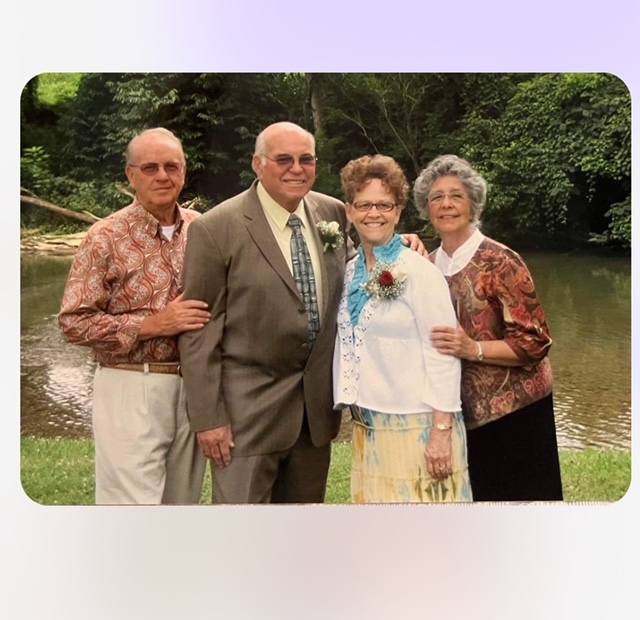
Raymond and Faye Bryant, along with Gordon and Joan Widener, were never ordained into the ministry. They never wrote a book, were never on the cover of a magazine, nor to my knowledge were they ever featured on a podcast. But these four people’s pictures hang on the walls of those who love them, and more importantly, their impact is more far reaching than just pictures on a wall. They served faithfully in whatever churches they belonged to. They loved their children well, doted on their grandchildren, and cherished their great-grandchildren. Throughout their lives, they opened their homes and welcomed countless people. This kindness and hospitality impacted generations of people that they may or may not be aware of, and to me, this is the true definition of a hero.

I met these families almost thirty years ago, and I am now approaching the same age as they were when I met them. At that time, they could have easily been caught up with their own families, pouring all their energy and attention into the numerous grandchildren they had. But they took a little time out for a young single woman from Wisconsin that has paid dividends in my life. And I have no doubt, as they retired and moved to Tennessee, they have continued to impact other people. They did not set out to be heroes, as Joan Widener shared with me in a recent conversation, it was just “part of their fiber.” They embodied the gospel of Jesus by loving others well.

For me, being heroic is not measured by the clicking of cameras while walking the red carpet. It’s not measured by rehashing the story of your fame on a podcast. Being heroic is measured by the lives you have positively impacted within and outside of your family. And it’s not based on your individual temperament either. Joan Widener readily acknowledged that the Bryants had a gift of hospitality and inclusion based on their personalities. Her husband was a little more reserved, and their style of hospitality looked different than that of the Bryants. The Wideners still chose to love others well, thus impacting others in a style that suited them.

Too often, we reach a certain stage in life, where we make our circles smaller and focus on the people in our immediate family. But what if we, like the Bryants and the Wideners, enlarge our circles by including others? What if we invite someone over for a holiday? What if we connect with singles in our church? What if we decide that ministry is not limited to a title or a position?

I’m not setting out to be a hero at this stage of my life. And I have no illusions or desire to walk the red carpet. But I do hope that I love others well and this love is demonstrated in how I live my life.  And I am forever grateful for the examples of the Bryants and Wideners; they continue to inspire me!

Sourdough MESSages

“And do not be conformed to this world, but be ye transformed by the renewing of your mind, that you may prove what is that good and acceptable and perfect will of God.” Romans 12:2

I am done! A few Saturdays ago, I came home to find my sourdough starter exploding all over my counter. It bubbled over, looking like a cave-dwelling ogre hugging the outside of the glass jar. I sighed with disgust as I scrubbed the dried sourdough cement off my counter. Despite its reviews and the Amazon algorithms, the thin, well-shaped glass was not designed for sourdough. At least once a week, my sourdough feasted, causing it to overflow, resulting in a mess for me to clean up. I was tired of trying to fit my dough in a glass that didn’t work. It was time to change jars!

Just like my sourdough fiasco, I have spent a lifetime trying to fit into places that didn’t fit me. I tried to be demure to compensate for when my extroverted nature was seen as offensive. I stifled my opinions and ideas, knowing they wouldn’t be welcomed. I curbed my passions when they would be seen as “too much”. And I ignored the voice of God because I thought others were more in tune than I was. Now, in my early fifties, I declare, “I AM DONE!”

This doesn’t give me a pass to be overbearing or prideful. But it does change the amount of energy and attention I put towards trying to fit in. I need to look for places where I am loved and valued for who I am. I need to trust my gut and my ability to discern the voice of God. But even in this declaration, I know I am battling lifelong patterns of minimizing and judging myself.

I find these same patterns developing in a group of young tween girls that I love, with the age-old messages most women wrestle with; messages like “I am too fat”, “I am not smart enough”, or “I don’t fit in.” Generation after generation, these comments corrode a young girl’s sense of worth like acid. They create well-trod paths in her brain leading to self-doubt and lack of confidence. These paths prevent her from recognizing who she is in God and from moving forward.

Despite the explosions, when the sourdough is feeding and growing well, I have made some delicious, crusty loaves of bread. I have also made delicious, flaky sourdough piecrust to cover individual turkey pot pies. My grandchildren have indulged in the sourdough discard crackers my daughter-in-love has baked. And, although I haven’t yet tried them, I have pinned recipes for sourdough cookies, cakes, and pancakes. This dough, when in the right jar, has endless possibilities. But that Saturday afternoon, I just saw a mess.

I see the “mess” created by the messages that young girls receive about themselves, along with the messages I have received about myself. And before I choose a different jar, I need to clean up my mess. This starts by examining how I live my life and the messages I believe about myself. What I say can and will influence those younger women in my circle, including my nieces and granddaughters. And even more importantly, I need to evaluate the messages I convey to younger girls and how those messages may reinforce the negative views they have of themselves.

Honestly, I struggle with how much or how little we should comment to a young girl on her appearance. Being the young girl who rarely received comments on how pretty she was, I felt that void in a big way. This slight becomes glaringly obvious when your peers are praised for their beauty, and you are mostly ignored except for the occasional “You have a pretty face.” Comments that would have made me feel beautiful and feminine and would have been a balm for my broken soul were withheld. It took me twenty-five years into my marriage to a committed husband to really believe he found me attractive.

On the flipside, these comments can make a young girl feel like her appearance is the only valuable thing she has to offer. It objectifies her as something to be put on display and viewed. It ignores her talents, strengths, character traits, and intelligence. And when we don’t praise those traits in young women, they will also feel the void.

And this puts us back to where we started. How can I help future generations stop trying to fit into places that don’t fit them? How can they work on changing those destructive messages in their teens and early twenties? And how can we prevent those destructive messages from even being contemplated?

Along with cleaning up my own mess, I need to understand how I define beauty and how my definition contrasts with God’s definition. Do I see beauty as being a certain size, hair style, or type of dress? Do I recognize that God made everyone in His image, and His image is not limited by height, weight, or bone structure? The closer I get to God’s definition, the more inclusive and encouraging I will become.

Next, I don’t think eliminating all affirmations about appearance is the answer. Instead, it’s making the jar large enough to encompass all the beautiful traits that make each woman valuable. This means an honest evaluation of the type of compliments I give. Besides complimenting a young girl on her appearance, am I pointing out times she is kind, courageous, and demonstrating perseverance? When she is sweaty and playing hard, am I cheering her on while she is engaging in habits that promote wellness? Most importantly, when she is modeling Jesus, am I encouraging her with praise? These simple acts of affirmation can help her see that she is beautiful both inwardly and outwardly.

The more I deal with my own mess, align my concept of beauty with God’s, and take an honest evaluation of how I am complimenting young women, the more I believe I can make a dent in this mess that we have created in our society. And I think the more women who join me, the more we can impact future generations with the idea that anything is possible.

It’s Women’s History Month. We should look back and honor the women who have made an impact on our lives historically. But it’s also a time we can pave the way for younger women to make a future impact in our society. So, let’s look at our jars!

Two Snows

“But whoever hates his brother is in the darkness and walks in the darkness, and does not know where he is going, because the darkness has blinded his eyes.” 1 John 2:11

Last Tuesday, I awoke to a winter wonderland. Heavy snow blanketed all the trees and bushes in our yard. One bush laden with snow created an umbrella sanctuary for all creatures, both real and imaginary (the fairies I wish existed). I snapped a few pictures and sent it to my family remarking on the beauty God had landscaped. Throughout the day, I gazed out the windows, soaking in the views. The world felt magical, fresh, and peaceful.

Five weeks ago, this same scene didn’t evoke any feelings of beauty and serenity. I awoke to my alarm at 5:00 am, bundled up, and started the herculean task of shoveling my driveway. Later, my husband joined me, and after shoveling for over an hour, I walked into my house as he headed off to work. After pouring myself a cup of coffee, I turned on a podcast, and dozed off in our recliner. An hour later, still half asleep, I answered the phone to my ordinarily calm husband’s panicked voice, “Honey, I had a car accident! I’m not hurt but I’m waiting for the police to come.” He quickly described how he hit some slush on the interstate, and ended up spinning around three times, staying in his own lane. He knocked into a concrete embankment several times during his spin-out. This interstate is normally filled with tractor-trailers and other vehicles. But due to the conditions, and the size of our car, Terry managed not to hit anyone else. We both believe this was a miracle.

Hazy and shaken, I called my children to let them know about the accident. Maggie promptly took charge, calling her dad for more details. Within twenty minutes, she and Will were on their way to pick up Terry and bring him home. For the next two hours, I paced around my home, staring out into my yard at the treacherous snow. Tears fell as I imagined the “what if’s”. And when Terry walked in and I hugged him tight, so thankful that he was alive and well.

Snow, like many things in life, can be beautiful or deadly. Last Tuesday, my son and his family played in the snow and created a snowman that Joel called “Frosty”. Others may have chosen to go sledding or ride the trails with a snowmobile. This winter wonderland turned into a playground for many delighting in winter. But this same day, I am sure there were more severe accidents than the one my husband had had five weeks earlier. And the results could be lifelong injuries or the loss of a family member. And with this tragedy, these family members may never look at a snowstorm the same as before.

Even if the advent of snow doesn’t result in a life-changing accident, the very fact of snow can illicit different responses. Although I have no desire to live in Anchorage where they have received 101.9 inches of snow, I still love the accumulation of etched snowflakes. Like a child, I look forward to snowy days. I conjure feelings of Hygge and can’t wait to curl up on my couch with a cozy blanket and a book. I light candles, dim the lights, and drink coffee, alternating it with hot chocolate. It’s a day when my extroverted nature is pushed aside, and I embrace the solitude that a snow day brings. I don’t even mind shoveling and love the sound of the snowplow going through my neighborhood.

Prior to the accident, my husband didn’t share my sentiments. He finds snow to be cold, messy, and stressful, especially with his hour-long commute. And although he found the snow fall last Tuesday beautiful, long term snow piles make him feel claustrophobic. Yes, he likes curling up with a good book, wrapping up in a throw, and drinking coffee.  But he doesn’t need snow to add to the ambiance of Hygge. He concedes that one snowfall on Christmas Eve is all he needs, and then he’s ready to move on and embrace spring. And with the accident, his lackluster attitude towards snow has diminished even more.

It’s Black History month, and as someone who identifies as a white American, I have my view of the world. But those who are African American have a different view of the same world. And although God gives salvation to all of us freely, we live in a fallen world where others are not treated the same nor given the same freedoms. And although God sees us as equals, too often our world has treated others less than equally.

Just like my husband sees snow differently than I do, it doesn’t mean his perspective is wrong. This is based on his experience of having to navigate icy roads on a regular basis. I rarely drive in snow and can relax in the comfort of my home while watching the snow fall. But until his accident, I hadn’t acknowledged how dangerous snow can be. And for that day, I walked in his shoes and saw how my magical snow could be treacherous.

I haven’t experienced the blatant racism African Americans face along with the microaggressions they deal with on a regular basis. I may understand trauma on a personal level, but I haven’t experienced the trauma of slavery, Jim Crow laws, lynchings, and police brutality that has been passed on for generations. Their experience has created a sense of hopelessness, lack of agency, and anger towards any expression of racism, blatant or not. But this lack of experience doesn’t give me a pass on expressing empathy and understanding. As a Christian, I am called to love as Jesus loved, unconditionally, regardless of gender, race, or ethnicity.

I just finished my book this week but am a long way from publishing it. We have lots of editing, a cover to design, and formats to be decided. I hope to publish it by the end of summer. This as-yet-untitled memoir is about God’s restoration from a childhood fraught with sexual abuse. My daughter suggested that I make it clear who my intended audience is. I believe the book is for everyone. I am inviting readers into my suffering so that they have a better understanding of how sexual abuse affects a person throughout their life. I hope it dismantles some of the myths of sexual assault and the ludicrous idea that a person just needs to “forgive and move on.” I hope that the reader comes to the book with an open mind and is changed by my story.

For me, reading is a gateway into understanding different viewpoints. Last year, I read a few books about the black experience in prison, George Floyd’s life, and Tyler Merritt’s experience as an African American. These books helped me walk in their shoes for a little while, seeing the reality of their struggles and challenges. This year, I am planning on reading two of Esau McCaulley’s works. As a professor and theologian, his Reading While Black: African American Biblical Interpretation as an Exercise in Hope and How Far to the Promise Land will help me reform some of my ideas of race within the context of Christianity. McCaulley challenges, “If the church is going to be on the side of peace in the United States, there has to be an honest accounting of what this country has done and continues to do to Black and Brown people.”

In addition to reading, I listen to podcasts and follow Instagram accounts of other thinkers in the Christian world who offer a more nuanced perspective on race. Jasmine L. Holmes’ Instagram feed is full of myths with scholarly research combating some of those ideas that have plagued Christian circles, particularly the homeschooling circuit, for years. These include the idea that the Civil War was not about slavery, but mostly about states’ rights, and most slaves were treated like family and given the gospel. The daughter of a major speaker at home education conferences, Holmes has insight into some of the racist material that was being marketed to home educators. In her book Mother to a Son: Letters to a Black Boy on Identity and Hope, she writes “The truth of the gospel is not threatened by the truth we learn elsewhere, but highlighted by it.”

It’s been almost four years since George Floyd’s death, and I don’t believe we have resolved the racial tensions in the United States. White supremacy groups continue to flourish, and hate is marketed. I am not called to justify my position before Christ, but to present myself as a person who needs sanctification. And this sanctification looks like being honest about my own privilege and inviting myself into the sufferings of others through their stories. And if I hope that my own memoir moves the dial in being more empathetic towards rape victims, I need to do the same about race. Black History month might look very different for everyone. Take the opportunity and be open to changing your view, maybe through a podcast, an Instagram feed, or even a book. And like both McCaulley and Holmes state, we must reckon with both the history and current treatment of Black and Brown people and how it illuminates the gospel and our response to it.

Football, Donuts, and Flowers

“Let us consider how to stir up one another to love and good works, not neglecting to meet together, as is the habit of some, but encouraging one another, and all the more as you see the day drawing near.” Hebrews 10:24-25 ESV

The Super Bowl, Fasnacht Day, and Valentine’s Day have hit the calendar this week with a bang. Wings, donuts, and flowers packed shelves in the grocery stores. Travis Kelce and Taylor Swift, Madri Gras, and restaurant menus fill my social media feed. It’s a week of feasting, partying, and celebrating. Although all three events are supported by food, these three days are distinct with very different vibes. But if you set aside the commercials, beads, and flowers, they all point to the importance of connection. And with our polarized nation, we all need more opportunities to connect.

Because of my Wisconsin roots, I call myself a Packers fan, but I am not a football aficionado. I may have watched two Super Bowls in my entire life. And this year, even though we didn’t watch the game, we still made mini appetizers to enjoy while spending the evening together. I fully recognize that we are in the minority here. This year, the Super Bowl had the largest viewership ever at 123.4 million. If I am doing my math right, this means one out of every three Americans watched the big game. And I am sure that those who were not watching were like me, still checking their phones for updates and to hear the buzz about the commercials.

Now some may argue that it’s just a game unworthy of all the hype. Others may say viewership was up due to the “Swifties” showing interest. But whatever the case, this is one of the only major events that Americans seems to come together and share collectively. And I think it’s important we have these types of events, whether it’s football, the Olympics, or the Barbie movie. It forces us to put aside our differences and have fun. And this “fun” or play is valuable because it helps to create camaraderie. It reminds us that we are not so different, and as a Christian, it reminds me that everyone is created in His image.

Whether you call it Fat Tuesday, or Fasnacht Day, Tuesday, February 13, 2024, is another day that most people recognize on the calendar. Historically, this was the last day before the start of Lent. People would empty out their pantries of sugar, butter, and lard to prevent spoilage over the next forty days of fasting. An easy way to do this was to make donuts, named Fasnacht by the Pennsylvania Dutch. Even if you were not a liturgical Christian, you would still benefit by indulging in donuts due to your neighbor’s excess. The point of this indulgence was not to eat as many calories as you can, but to mark the upcoming season of remembrance of the death, burial, and resurrection of Jesus.

Since moving to Pennsylvania, the Collins family has celebrated Fasnacht Day by sharing donuts with our family and friends. I discovered this day thirteen years ago, a lonely month and half after leaving Wisconsin. The idea of a day set aside for donuts made the hard move seem more palatable. It’s hard to eat a donut and not be joyful. And a donut shared in the company of others makes the donut even sweeter. Additionally, my first Fasnacht day gave me hope that my move to Pennsylvania could be sweet. I could make new friends and new traditions.

Traditionally, Valentine’s Day has been set aside for couples to celebrate romantic love. But like all holidays, the love has spread with Valentine gift exchanges in schools and Galentine Day celebrations. Today, we don’t celebrate with just a card and an appropriate sentiment. Instead, the National Retail Federation estimates that Americans will spend an average of $185.81 per person letting their loved ones, including pets, know that they are special with cards, flowers, candy, and gifts. And if money is an indicator of importance, it seems many Americans believe this day is as valuable as our relationships!

At different points in our marriage, we have prioritized this day to a greater or lesser extent. How we celebrated was often an indicator of the healthiness of our marriage. This year, we are not spending the average amount, but we are still taking time to be together as a couple and celebrate our love of 28 years. In no way do I think flowers or chocolate will heal a broken marriage, but I do think setting aside days to celebrate love is important. It signals to those you love that they are valuable and cherished.

All polls, whether related to politics, economic satisfaction, or mental health indicate that there is a prevailing sense of apathy, anxiety and loneliness across all ages, genders, and backgrounds. The average American feels a general sense of hopelessness for the future. And with that lack of hope comes a higher rate of suicide, depression, and substance addiction. Additionally, our avid use of devices, whether for social media or news headlines, increases our anxiety and sense of being alone. How does one look to the future with an impending election that guarantees more divisiveness? How does one look past the genocides and wars happening across the world? How does one find support if they are struggling or support others who are struggling with mental health issues?

I don’t have all the answers, but I think a little football, donuts, and flowers are good ways to start. I need to find ways to connect with others in larger gatherings centered on fun. This may involve a game night at my home or watching a movie with friends. This checking in with people can help others feel less isolated or alone. It also reminds us not to take everything so seriously, but to spend time just enjoying each other’s company. Plus, whenever you have a group together, laughter is both likely and contagious!

On a smaller note, connecting with small groups is another way to combat hopelessness. Joy is not found just in a bundle of fried sweet dough; it’s found in meaningful conversation that glorifies God. Although my extroverted nature thrives in large gatherings, my most meaningful connections are with a small group of friends. These connections not only contain laughter, but also moments of truth and beauty found in deep abiding relationships. This is where I refuel and glean from others. It’s a place of safety, where I am known and loved. And if I feel this from my friends, I am confident that others feel this as well in small groups. And just like buying a box of donuts gave me a glimpse of hope, I can cultivate small groups in my life as well to bring hope.

Finally, the health of my most treasured relationships should reflect where I spend my time, money, and energy. If I value my husband, my adult children and in-loves, and my grandchildren, they should receive the best of what I have to offer. This doesn’t require extravagant gifts, but it does require me to be intentional in my relationships. It is all too easy to take for granted those you love the most. And the gift of Valentine’s Day is that it is a reminder to put those you love front and center.

Like most people, it is easy for me to fall into despair over the upcoming election, the state of our world, and the myriad crises we face. But this week is a gentle reminder to me that there is a lot to celebrate and, more importantly, lots of ways I can personally build connections. And if football, donuts, and flowers can’t get you out of the doldrums, watch the Dunkin’ Super Bowl commercial. I promise the Dunkin’ tracksuits alone will make you laugh!

Shadows and Groundhogs

“Every good gift and every perfect gift is from above, coming down from the Father of lights, with whom there is no variation or shadow due to change.” James 1:17 ESV

Last Friday, men in top hats and tails gathered in front a huge crowd to see Punxsutawney Phil, one of the world’s most famous rodents. Music played, speeches were made, and cameras clicked as this groundhog crept out of his man-made burrow. Everyone held their collective breath, awaiting the groundhog and the view of his shadow. Soon, an early spring was declared with pomp and cheers. Due to the cloud cover, Phil did not see his shadow, and a 137-year tradition continued.

Years ago, I met a woman and her two children at the library. We struck up a conversation and immediately found a common interest with both of us being home educators. Soon, our families were eating dinner and playing games together. She seemed eager for community and would often bring little gifts of appreciation or write kind notes. Our husbands got along, and I was looking forward to building a lasting friendship.

Within a few months of the budding friendship, I opened an email from her but addressed to her husband and mistakenly sent it to me. I was confused, and the confusion only grew as I read the contents of the email. It was an angry tirade about a Walmart employee who had made a simple mistake. My new friend used expletives that I had never heard her use. Her anger seemed out of proportion, and she even threatened to call management and possibly sue the store. I was stunned! Was this the same lady who had just brought over blueberry muffins the week before? I realized this message was sent to me by accident, deleted it, and tried to believe that this was an outlier incident.

But it wasn’t. Within a few more months, other similar incidents happened, and this time her anger was directed towards me and my family. It got ugly quickly, and my husband and I decided, with prayer, that it was in all our best interests to end the friendship peacefully and go our separate ways.

We all have ways we want to be perceived by others, it’s the ideal version of ourselves. I want others to perceive me as friendly, joyful, and a good listener. I pray that they actively see Christ working in me. This is what psychiatrist Carl Jung referred to as our ego. Yet, I can be distracted, and am sometimes irritable and talk more than I listen. This unpleasant version of Sherry most often appears within the four walls of my home in front of the people I love the most. Carl Jung refers to this as our shadow side.

Recently, I heard writer John Mark Comer talk about this ego and shadow side in the context of Christianity. It’s good to pursue Godly character, to cultivate goodness, patience, gentleness, and joy in life. But often, our true nature, our shadow side comes out. We are humans and make choices that don’t always align themselves with Christ. And often this is the side we try to hide from others. Comer went on to say that the most integrated people are those who have the least amount of difference between their ego and shadow side. They are who they present, and they don’t have hidden sides that people would be startled at if they read an unexpected email.

In the case of Punxsutawney Phil, his shadow’s visibility is due to a law of physics. For a shadow to appear, an object needs to come between a light source and a surface. On a cloudy day, with no light, Phil would not see his shadow, thus predicting an early spring. Although physics can explain shadows, they are not often seen as neutral in life. In literature and films, shadows suggest something sinister, while children discovering shadow puppets find shadows humorous and delightful.

In the Bible, the apostle John compares God to being light, “and the light shineth into darkness”. This was more than just a metaphor, seen both when Moses was on Mount Sinai and the mountaintop transfiguration of Jesus. In both cases, the light from God was so blinding that it affected the face of Moses and the clothes of Jesus, reflecting His glory. And this same light continues as I listen to sermons, read His word, spend time in prayer, and meditate on God. And as I see the glory of God, it moves me to sanctification by illuminating the shadows in my life. The more I know God and am in relationship with Him, the more my shadow side is visible. I see where I fall short, where my character is lacking, and where sin has crept into my life.

Recently, I made a dark chocolate cheesecake. The dark cocoa and the melted chocolate are in direct contrast with the pure white cream cheese and sugar. If the cream cheese is not softened well, no matter how well I mix, it is likely that small white chunks of cream cheese will remain when baked. Then when I serve the cheesecake, instead of a uniform creamy chocolate consistency, a person will taste the sharp tang of unmixed cream cheese.

I may have the light of God shining on me, but if I don’t allow humility to soften my heart, that shadow side will dominate. I am not likely to send an email filled with expletives, but I can still be sharp with unkindness and unloving behavior. And to be humble, I must be focused on God and less on my own image. Theologian Timothy Keller defines humility this way: “I cannot feel superior to anyone, and yet I have nothing to prove to anyone. I do not think more of myself nor less of myself. Instead, I think of myself less.”

God is exactly who He said he would be. James records in 1:16-17, “Do not be deceived my beloved brothers. Every good gift and every perfect gift is from above, coming down from the Father of lights, with whom there is no variation or shadow due to change.” And although I will never be perfectly like God, I can allow His light, coupled with my humility and my pursuit of Him, to help me become more like Him.

Brown or Copper

“Judge not, that ye be not judged.” Matthew 7:1

One of the many reasons I love my husband is his love of trees. Terry enjoys hiking through the forest under the canopy of trees. He marvels at big oak trees with their gnarly branches. While living in Wisconsin, he discovered a ginkgo tree at his work and couldn’t wait to show me their fan shaped leaves. Once, he joined our then teenagers and their friends in climbing a tree in Kitty Hawk, North Carolina. Even if a tree is diseased and dying, he mourns the inevitable cutting down. As we are driving, he remarks on the ghosts of trees that have met their demise on our usual routes. And one of his greatest dreams is to see the majestic redwood forests.

When we moved into our house, our yard had only one small maple tree that has more than doubled in size and breadth in the last twelve years. Though we did have some privet bushes and climbing roses, and we added a lilac bush, the yard had only that one solitary tree until six years ago. That spring, Terry wanted to plant some trees. It had been a particularly hard fall and winter for us personally, culminating in the devastating loss of his mother. Eva Jane, his mother, loved trees as well. She, too, remarked on trees and the beauty and shade they provided. And in honor of his mother, Terry wanted to grow something despite the great loss he felt. And maybe, in nurturing something, he would find peace and hope.

As with most decisions, we had very different ideas. I love anything that flowers and produces fruits. Terry, on the other hand, loves cedar trees, stately oaks, and other shade trees. We went to the local nursery and walked around, oohing, remarking, and maybe even debating a little on what trees we wanted to purchase. We finally compromised. We found a magnolia tree that seemed destined to be in our yard, with the species name “Jane Magnolia”, in honor of my late mother-in-law. We also found a crabapple tree, and Terry got his wish: an oak. Soon, he was digging holes and planting trees. He faithfully watered the trees all that summer to ensure they were well established before the coming winter.

The trees have grown since that spring. The magnolia blossoms each spring, and a sweet bird has built her nest in the tree for the last three years. The crabapple has spread its branches, while the oak thrives having added a protective layer of bark to its trunk as it also branches out across the yard. I often see my husband staring out into the yard, gazing at the trees with wonder and satisfaction.

But I am going to let you in on a little secret: I have borderline despised the oak tree each fall. The first year, despite turning a flat dull brown, the tree didn’t drop her leaves in late October. Instead, she clutched the leaves throughout the winter, appearing like she was in her final stages of life. Then in spring, when everything was brimming with life, the tree dropped her leaves, with new growth and new buds appearing. The dead brown leaves lying on the grass polluted my ideas of spring. As she continued to grow, her clutch of dead brown leaves grew as well. This pattern has continued for the last five years, the oak gripping its dead leaves in an apparent act of defiance. And in my mind, it was an eyesore in winter, when I look forward to fresh snow artfully covering the bare branches.

Terry researched briefly and found that some species of oak hold onto their leaves with no apparent explanation. This bothered me. Why didn’t we do research ahead of time and pick a proper leaf-dropping oak? He continued to love his tree, but I had major buyer’s remorse. He continued to remark on its’ growth, and I half listened to his praise.

Last week, I saw an Instagram post from Michaux State Forest casting Terry’s oak tree in an entirely new light. The post stated “here’s a reminder to look beyond the drab winter landscape on your next forest trek”. The post changed my dull brown leaves to “persistent copper-colored leaves” explaining that these oaks offer visual interest and a bit of mystery. They don’t lose their leaves like all the other trees due to a “quirk known as marcescence”. Scientists offer some possible explanations. It might be a way for a young tree to protect its lower branches from hungry deer. Or when the leaves do drop in spring, it might help protect the forest floor by aiding with moisture retention. But, for whatever reason, God created this tree with this apparent quirk for good reasons.

I like to believe I champion differences in people. I embrace cultural differences and love to hear stories about others’ traditions. I choose books that expand my knowledge and understanding of the world. I encourage others to follow their passions, even if it falls out of the norms of what is popular. And fundamentally, I believe that God has created us in His image, and that our way of making the world beautiful reflects His character.

But as much as I try to champion people, I still fall into the trap of being judgmental. Recently, someone I love reminded me of times I had pushed him to be something he wasn’t. I didn’t support his God-given personality trait of being an introvert. Yes, even as an introvert, you need community. Yes, even as an introvert, you need to be friendly and have good communication skills. But the need for space and solitude recharges an introvert so that they can be in community, be friendly, and communicate well. When that space is taken away, it can leave the person feeling trapped with a need to close off. But out of misguided love, I pushed this person too hard. It left him feeling uncomfortable and unsupported.

On the flip side, for a time in my life I was in a space dominated by introverts. My need for socialization was deemed needy, my outgoing enthusiasm was too much, and my communication skills too loud. And, like the introvert that I was pushing, I felt trapped, uncomfortable, and unsupported. I tried to be calmer, less outgoing, and quieter. But inside, I was withered and dying. And until I changed my space, where I could be more of who I am, I wasn’t flourishing.

Despite my previous disdain for that tree, the oak is thriving. It has grown several feet and even produced a few tiny acorns this year. But what if the tree had dropped its leaves? Is it possible that the deer would have stripped it of its tender branches during the winter? Is it possible that the tree would have stopped growing and flourishing?

God has made all of us unique. Some of us are extroverts who thrive at parties and meeting new people. Others are introverts, who need smaller spaces to connect. Some of us love spontaneity and flexibility, others like Excel spreadsheets and day planners. These are just a few of the ways we are different. And all these differences reflect the characteristics of God. I need to recognize that and not see the differences in others as “dull brown”, wishing or pushing them to be something they are not. And just maybe if I suspend judgment, what might seem like dull brown is actually beautiful copper, exactly the way God intended.