Page 18 of 28

Cabbage Patch and Repentance

“…not realizing that God’s kindness is intended to lead you to repentance?” Romans 2:4b

Around Christmas of 1983, outside of Kohl’s Department Store, in the bitter Wisconsin cold, a line of women waited for the doors to open. Their mission: to find the “Willy Wonka Golden Ticket” in the form of a Cabbage Patch doll. Elementary-aged girls, including myself, desperately wanted to adopt these dolls with hard plastic heads and cloth bodies. One of these women was my grandmother, who managed to purchase one for me that day. Upon receiving my doll, I quickly filled out the paperwork and waited for my official adoption papers to arrive in mail for my little Oliver Xavier. A few years ago, I found my doll in a crate. He was stained, scuffed and, to my surprise, one of the ugliest dolls I have ever seen! As an adult, I have no idea why these dolls captured the imagination of my generation. Despite its ugliness, I remember treating this doll like a real beautiful baby.

 A few years ago, I made a rude comment to a family member. I called this person out publicly on what I perceived as hypocrisy in a situation that, frankly, was none of my business. I justified it by claiming righteous indignation. Even though there was truth in what I said, my attitude and response were completely wrong. I offended someone that I cared about, and even though I tried to rectify the situation, my sinful response damaged that relationship permanently.

 My heart breaks when I think of how many times my responses towards others have been sinful. Like the situation above, I have justified my actions and words. These justifications have often been rooted in my own insecurities, hurt feelings, and pride. My feelings were real: I did feel diminished, shamed, excluded, and humiliated. But no matter what I was feeling, I had no right to diminish someone else’s self-worth or character.

Recently, I heard a sermon by Timothy Keller where he juxtaposes the concepts of grace and legalism within Christianity. His sermon is so full of incredible insights that I am linking the totality of his message here. His concept of repentance changed my paradigm of how I want to approach God. Keller says, “the legalistic repents out of fear and anxiety, the Christian repents out of gratitude for what Christ has done for him or her, and for a desire to be like Christ.” This simple statement helps me to clearly see the God that is written about in scriptures, especially the scripture in Roman 2:4, where Paul writes, “not knowing that God’s kindness is meant to lead you to repentance.”

Although I have sung songs about his kindness that leads to repentance and have read that scripture, it didn’t totally resonate with me. I didn’t see God as some do, a terrible judge who was ready to pounce on me anytime I did something wrong. But I also didn’t see God as this benevolent father whose grace would inspire me to repentance. Instead, I landed somewhere in between, often repenting out of a sense of duty and obedience, which lead to feelings of guilt and shame. After repenting, I worked hard to discipline myself, focusing on character flaws like my unruly tongue. I would then study out scripture on what God expected of me and desperately try to align myself to His word. Then situations in ordinary life would test my resolve and I would find myself failing again instead of measuring up, repeating the cycle of repentance, discipline, and failure without success all over again. This approach closely aligned itself to the legalistic paradigm of Christianity. I certainly didn’t have this sense of gratitude that Timothy Keller talks about, until recently.

 Gratitude is defined as an appreciation for someone else’s kindness. In the case of God, it is appreciation for His unmerited kindness. When I mediate upon how He loves me despite the times I have been insulting, spoken words out of anger, and been unkind, it shifts my perspective. It humbles me that, despite my apparent ugliness, the creator of the universe loves me! Not only does He love me, but that He wants to spend eternity with me. His desire was so strong that He was willing to pay a debt I couldn’t pay. He was abandoned by his friends, publicly humiliated by the religious leaders, stripped naked, beaten, and, ultimately, hanged on a cross to satisfy my debt of sin. He did all of this because He loves me. And when I think about the cross and Jesus’ love for me, I am forever grateful. Now, when I sin, which I am prone to do, I repent out of gratefulness and my desire to be more like Jesus.

 After seeing my once prized Cabbage Patch doll through adult eyes, I decided that this ugly doll was not worth keeping. I chose to throw it away. I am so thankful that God never decides we are not worth saving. He sees the ugly stains of sin on us and chooses to invite us into a relationship with Him. He knocks on the door of my soul and waits patiently, even when I ignore Him. And because of this kindness, I can truly repent with gratitude!

The Two C’s: Cookbooks and Connection

“Jesus called his disciples to him and said, “I have compassion for these people; they have already been with me three days and have nothing to eat. I do not want to send them away hungry, or they may collapse on the way.” Matthew 15:32

Terry and I are bibliophiles, a fancy word for people obsessed with books.  We have friends who still mention the trauma they felt twenty-five years ago when carrying twenty huge plastic totes filled with books upstairs into our apartment.  The number of books we have owned has waxed and waned over the years.  At one point, we had well over a thousand books crammed into a dozen bookshelves.  Our library cards always have items checked out on them, our books-to-be-read list continues to grow, and we explore new places often through their bookstores.

Between the two of us, our interests cover a lot of different genres.  We love classics, both for adults and young people.  We read a lot of personal development books based on Christian principles and we love good biographies.  However, we differ in some areas.  Terry loves a good science fiction story, thriller, or mystery.  I love both literary and historical fiction, along with memoirs, travel, and nature books.  Recently, I discovered a new genre that has pleasantly surprised me: cookbooks.

I have always loved beautiful cookbooks.  The glossy pictures of different recipes have inspired me to try new dishes in my kitchen.  I have sometimes purchased cookbooks solely based on the quality of their photographs.  But my interest in cookbooks has been limited to the list of ingredients and the steps of the recipes.  In my opinion, cookbooks were just beautiful instruction books, until this year.

Some of my personal cookbooks along with favorites from the library. Photo credit Terry Collins

My journey of cookbook enlightenment started with Shanua Niequist’s “Bread & Wine: A Love Letter to Life Around the Table with Recipes.”  In this book, each chapter is a short, memoir-style essay that closes with a recipe that has captured her heart.  These essays and recipes tell stories about her life: the highlights, the challenges, and her growth personally and within community.  She states in her introduction, “Food is the starting point, the common ground, the thing to hold and handle, the currency we offer to one another.”

 I read this book, cover to cover.  I even discovered more insights into what are called the “headnotes” of a recipe.  This is the short blurb after the name of the dish but before the ingredient list.  I found myself reading the recipe itself, noting any tips or suggestions she offered.  It was the first time I have ever had a visceral experience with a cookbook!  Just like a novel, I not only felt sad that it ended but also wanted to share its delights with others.

I wondered to myself, do other cookbooks offer this much insight into life through their recipes?  Can I find the “common ground” that Niequist refers to in other books as well?  Immediately, I went to the library and found “Ripe Figs” by Yasmin Khan.  It sparked joy as soon as I picked it up with its beautiful cover photo of perfectly sliced figs bordered by an exotic blue and white graphic design.  This cookbook explored food and culture through migration in Turkey, Cyprus, and Greece.  Khan not only shares some of the that hardships refugees experience but interweaves them with her own struggles recovering from a miscarriage as she explores different cultures.  She attempts to recreate the recipes she loved in her own kitchen with ingredients that can be easily found in most cities.  Her sentences danced across the page, enticing my palate with foreign spices, fruits, and vegetables.  I loved the book so much, I immediately searched for more of her cookbooks and bought “Ripe Figs” for my sister on her birthday!

Since then, I have checked out several other cookbooks, usually focused on Middle Eastern and Indian cuisine.  These books have allowed me to armchair travel, exploring other cultures through food.  When reading “Chaat” by Maneet Chauhan, I could sense the busyness of Indian railway stations with vendors selling their delectable bites to travelers passing through.  In “Sumac: Recipes and Stories from Syria” by Anas Atassi, I wanted the linens on my tables to create memories for my family similar to the ones that Atassi experienced as a child in his grandmother’s home.  While reading “Parwana” by Durkhani Ayubi, I got a timely lesson on the Afghan people through the eyes of one family and their food.

These books have not only exposed me to different ingredients and cultures but have also reminded me of the importance of gathering around a table with family and friends.  We were never meant to be alone, God always intended us to be in community.  It struck me that when Jesus performed miracles, instead of sending the people home afterward, he invited them to have dinner despite his lack of food. Through His hospitality, He performed a miracle that not only provided them with physical nourishment for their bodies but let them know He cared about all their needs.  Like any good host, I imagine Jesus walked through the crowd asking each family if they had enough.  This personal interaction probably made each person feel like he was not just a number Jesus could record as a miracle, but that he or she was valued as an individual.  This means of connecting though food is illustrated throughout the gospels with records of Jesus dining not only his with chosen disciples and friends but with people of ill-repute as well.  Despite criticism from the religious elite, Jesus chose to connect with people through food.

 If social media Is any indicator of trends, our current world is filled with divisiveness on all sides covering all sorts of issues.  This is not only causing discord in society but between family members, friends, and the body of Christ.  In “Bread and Wine”, Niequist says, “The heart of hospitality is about creating space for someone to feel seen and heard and loved.  It’s about declaring your table a safe zone, a place of warmth and nourishment.”  That is the desire of my heart as well!  I don’t mind having lively conversations on controversial topics.  But more than my desire to debate or enlighten, I want my guests to feel seen, heard, and loved.  I want to connect across the able over a steaming bowl of soup, a comforting dish of pasta or a savory roast.  Like Jesus, I want to welcome people to my table, no matter their background, beliefs, or opinions.  Just like the authors of these cookbooks have connected me with their cultures, I believe that through this simple act of hospitality, miracles will unfold that connect us to one another!

My Glory Story

“For the earth will be filled with the knowledge of the glory of the LORD as the waters cover the sea.” Habakkuk 2:14

Recently, I read a story in Emily Ley’s “Growing Boldly” that has been resonating with me.  She interviewed her friend Christie about her family and the challenges they face.  After years of miscarriages, Christie and her husband finally had the family they desired, two daughters and two sons.  It’s easy to assume that the miscarriages were the “hard seasons” that Christie and her husband had to endure, concluding that their life would be relatively smooth from this point on.  But the real hard was just beginning when they found out that their oldest son was diagnosed with cystinosis, a rare genetic disorder with only five hundred cases currently in the United States.  After dealing with this diagnosis, they later found out that their youngest son also had cystinosis.  This disease has no cure, only treatments, and the prognosis is terminal.  Christie did not hesitate to share the hard details of her life because she believes that “this is our glory story” and she wants “to point people back to the Lord.”

Read that paragraph again and let the gravity of what this woman is saying sink in.  Two of her sons deal with medical challenges that most of us can’t even begin to comprehend.  Yes, medicine is making advances, but, currently, there is no cure in sight.  She is not bitter or in despair, instead she is motivated to use her testimony to bring glory to God, no matter where this story takes her.

Barb Houston, the wife of one of our pastors, recently shared with our congregation something that God was speaking to her during a Sunday morning service.  She said that it is one thing to know that God is faithful, but that God has more to reveal to us during hard seasons.  She encouraged us to show gratitude, responding with this sentiment during hard seasons.  “I know that this looks very dark, but I know who You are, and You will work in this situation.  You will bring good.  You will deliver, You will heal, You will glorify Your name and I will see it and I thank you!”  By this very action, by choosing to thank God for the tough situations and know that His glory will be revealed, we will not only be strengthened, but we will be a testimony of His glory to others.

  My story has not always been pleasant.  I was repeatedly raped by my stepfather for over a decade.  I hid my shame by stuffing food into my mouth, resulting in weighing well over 350 pounds.  And in the past few years, I have dealt with some hard situations.  Although I can’t change my past, I can choose whether it is my story or my glory story.  If it is my story, I will identify with the brokenness, obesity, hurt and despair.  If I choose to let it be my “glory story”, I will use it as a testimony to declare the goodness of God.  And by seeing the goodness of God in my past, I can rest assured that in the future, no matter what happens, God is good, and His glory will be revealed!

In 1870, Horatio Spafford appeared to be a man who was on a path for a blessed life.  As a successful lawyer, he had invested into real estate in the booming city of Chicago.  In addition, he was a man of faith, married with five children.  But like a modern-day Job, he soon lost everything.  First, his four-year-old son died of pneumonia.  Next, the Chicago Fire destroyed all his real estate holdings, leaving him in financial ruin.  He slowly started to rebuild his life which included helping to rebuild Chicago.  He also chose to invest not only in real estate but also in his faith by helping the evangelist D. L. Moody with some missionary work in Europe.  In 1873, he sent his wife and daughters on ahead to Europe, while he wrapped up some business dealings.  Tragedy struck again, when his family’s ship collided with an iron sailing vessel, killing 226 people.  His wife sent a telegram with the simple words, “Saved alone.”

Spafford turned his story into a glory story while he traveled to Europe.  As his ship passed the same spot where his daughters had died, he penned a poem.  This poem would later be put to music, becoming one of the most famous hymns sung today.  The first stanza ends with the words, “Whatever my lot, Thou hast taught me to say, it is well, it is well with my soul.”

 My “glory story” is not over.  I am still dealing with some of the aftereffects of the last few years.  I still have loved ones who are experiencing some real struggles.  I still have hurts and disappointments that I must work through.  But even if these situations seem insurmountable or out of my control, my identity is not found in these situations.  I am choosing to believe that God’s goodness will be revealed in these situations.  And while these situations may continue to exist, I can say “It is well with my soul!”

Graceful Transitions 2nd Anniversary

“If I must boast, I will boast of the things that show my weakness.: 2 Corinthians 11:30

This past summer, I purchased a swimming pool for my grandson to splash in.  It’s exactly the kind of pool that I would have loved as a child: a red mushroom canopy on top with a bright yellow base.  I envisioned him splashing with glee in the pool while I sat next to him on the outside, living vicariously through him.  But I forgot one key point: my grandson, like his father as a child, needs some time to adapt to new situations.  In addition to that, he also wasn’t feeling the greatest that week.  Instead of splashing with glee, he whimpered when we placed him in the pool.  He gradually grew calmer, but never really gained any enthusiasm for the idea.  The pool is now packed away for next summer when we will try again.

Two years ago, I began to write this blog out of a place of brokenness, confusion, and uncertainty.  I felt like my life was transitioning in so many ways, some positive and some not so much.  After twenty-plus years of home educating my own children and providing childcare for different families, my responsibilities were changing, and I had more free time on my hands.  I was also navigating some tough situations that affected all areas of my life.  After praying about some different options, I felt led to spend some time writing, both this blog and a book about my life.

Last year’s anniversary shoot, photo credit to Margaret Collins

I remember nervously posting my first blog, wondering if anyone would read it!  I knew I wasn’t an Ann Voskamp who writes poetic prose that makes you pause and reflect.  I also knew I wasn’t a Lysa TerKeurst who can directly address issues of the heart and bring new Biblical insights to light.  Although I admire these writers, I had no expectation of having the kind of influence they have garnered.  I did know that I was an ordinary woman who served a good God who helped me create an extraordinary life despite brokenness and hardship.

Just like my grandson, I was a little cautious in my first blogs, testing the waters with my vulnerability.  Can I really share some of the hard stories of my life?  Do I want to publicly reveal the shame of obesity I carried around?  Do I want to share some of the failures I have experienced in life?  Dare I expose the loneliness that I have battled for the last eight years?

Post by post, I revealed more and more, and found that my little corner of the social media world felt safe.  As I poured my heart out in words, I felt like I gained a new perspective on some of the struggles I have gone through.  Unlike my grandson, I found that, over the course of time, this “pool” of blogging was a fun place to be, where I could express myself through words, sharing with others what God was doing in me despite my faults and shortcomings.

The biggest lesson I have learned is how the shame script had impacted my life.  It had shaped how I viewed myself, how I related to my husband, how I parented my children, and, most importantly, how I viewed God.  Writing and seeing how others have responded to my posts has helped dismantle this shame.  Brene’ Brown says, “If we can share our story with someone who responds with empathy and understanding, shame can’t survive.”

Readers, thank you for taking the time to read my blog and for your empathetic responses.  My greatest desire through this experience was that my words somehow will resonate with you and minister to you wherever you are in your life!  I am finding that God is using my blog to do far more inside of me than my desire to minister to others.  In this journey of transition and self-growth, I will continue to write with openness and transparency.  I’m still on a journey, and I hope you will continue to walk with me!

Wedding Salsa

“The earth has yielded its increase; God, our God, shall bless us.” Psalms 67:6

My daughter’s menu for her upcoming wedding is one of our family favorites: chicken fajitas with all the fixings.  It has been a crowd pleaser for years: spicy, lime-marinated chicken with peppers, different salsas to fit everyone’s flavor profile, and creamy queso on the side.  I wouldn’t say my recipe is unique, but the key is using my homemade fajita seasoning, Terry’s grilling skills, and freshly grated cheese.  With the wedding only nine months away, I am prepping ahead of time.  I promise none of this prep involves the possibility of food poisoning, but instead canning some homemade salsa for the wedding.

It’s amazing to me how far one $12-box of tomatoes can go when it comes to canning.  I have made 12 pint jars of corn salsa, 10 pint jars of regular salsa, and I still have a lot of tomatoes left!  I plan on quartering the rest of the tomatoes, brushing them with olive oil, then grilling them over medium heat until they blister on all sides.  Next, I put them in a glass bowl and cover them with plastic wrap.  Once they are cool enough to handle, I take the skin off and remove the seeds.  Finally, I pop them into a freezer bag and then into the deep freezer to use later in stews, chili, and soups.

 I want to share my Corn Salsa recipe with you.  I found this recipe a few years ago and have since adapted it to make it my own.  It’s an amazing combination of sweet and spicy heat, with charred corn, poblano peppers and tomatoes.  This was the first recipe where I used coriander seed.  When crushed, this tiny seed packs a big punch with its bright lemony flavor.  This is not a salsa that induces self-control.  I know several people who have devoured a jar of this salsa in one sitting.

Photo credit by Terry Collins

Grilled Corn Salsa

  • 6 ears of corn (about 3 cups)
  • 1-2 T. olive oil
  • 5 c. tomatoes (about 3lbs.)
  •  2 large poblano peppers
  • 1-2 jalapenos, de-seeded, ribs removed, and finely chopped
  • 1 c. diced red onion
  • 1 1/2 c. apple cider vinegar
  • 1 6 oz. can of tomato paste
  • 1/4 c. of freshly squeezed lime juice
  • 2/3 c. sugar
  • 1 1/2 t. cumin seeds
  • 1 t. coriander seed (crushed in a bag with a rolling pin)
  • 1/2 t. red pepper flakes
  • 1 t. salt
  • 1/2 t. pepper
  • 1 c. fresh cilantro, chopped

Preheat grill to medium heat.  Husk and de-silk the corn.  Brush with olive oil.  Place on grill for 2-4 minutes each side until they get a little char, rotate ears until each side is slightly charred.  After ears cool, cut corn off husk.  After you have 3 cups, set it aside.

Place poblano peppers on grill on medium-high heat.  Grill each side until it blisters.  Take off the grill and place in a bowl, covering it with plastic wrap.  When they are cool enough to handle, take skin and most of the seeds and rib out.  Finely chop and set aside.

Blanch 3-4 tomatoes at a time in boiling water for 1-3 minutes until the skin breaks open.  Place immediately in ice-cold water to stop the cooking process, then drain.  After all the tomatoes have been processed, remove skin and seeds.  Dice into small pieces and place in a large stock pot.

Add corn, poblano and jalapeno peppers, onions, tomato paste, vinegar, lime juice, sugar, and all the seasonings except the cilantro.  Bring to a boil on medium heat.  Once it reaches a boil, turn down the heat to simmer and let it simmer for 12 minutes until the liquid slightly reduces.  Add cilantro and cook for another two minutes.  Taste, and adjust salt and seasonings if needed.

If you want to can this in a water bath, make sure jars, lids and seals are all processed correctly.  Place in jars leaving a little headspace, seal, and place in a canner with boiling water a few inches above the jars for 15 minutes.  If they properly seal, you can store for 12-18 months.

I recently saw a meme that made me laugh.  The meme was a picture of people running and the caption says, “Quick!  It’s the forty-five minutes a year when tomatoes taste incredible!”  We are on minute 44 of the 45 minutes, so if you have a lot of tomatoes left, give the corn salsa a try!

Aging With Grace

“So we do not lose heart. Though our outer self is wasting away, out inner self is being renewed day by day.” 2 Corinthians 4:16 ESV

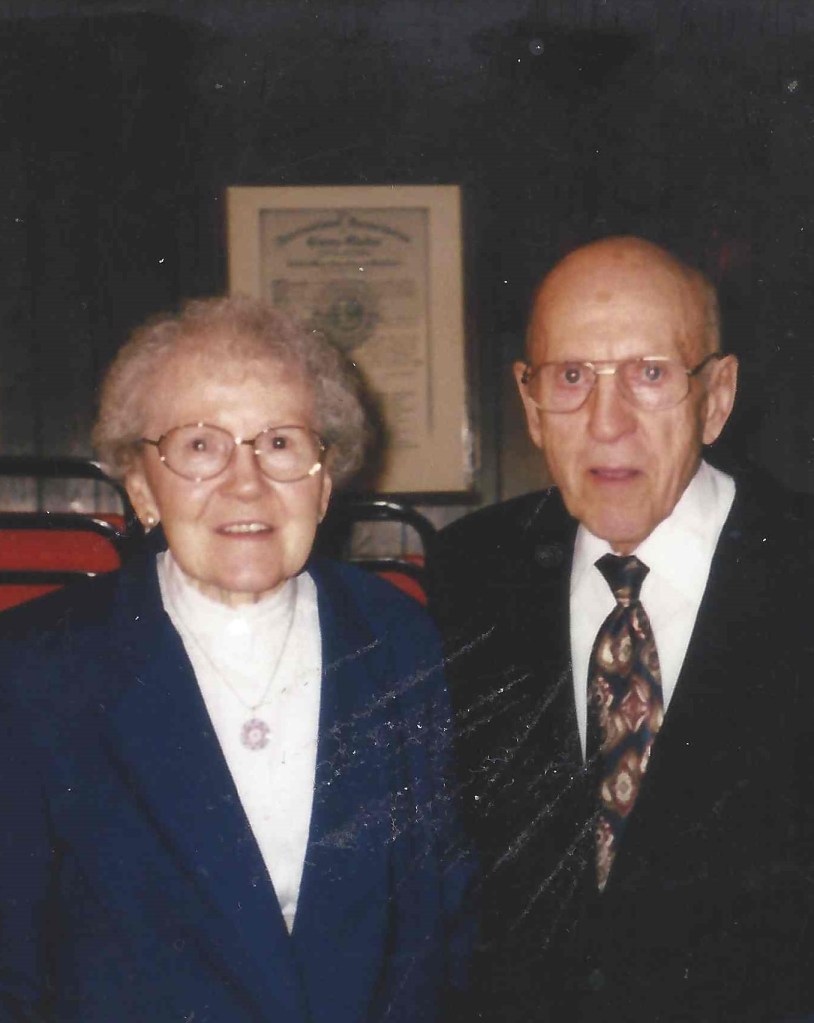
My great aunt, Lucille Feldkamp, my grandfather’s sister, was one of most beautiful ladies I have ever met.  I didn’t know her well since she only visited during major family celebrations like golden anniversaries and birthdays that marked a new decade.  Her ivory hair framed her pixie face, her eyes twinkled like my grandfather’s, no lines etched the porcelain skin of her face, and she walked into a room gracefully.  I don’t remember her saying much, but her few polite words were always accompanied by a smile and an expression of gentle interest.  I saw their quiet watchful eyes as she sat next to my grandfather, and I wondered what interesting stories the two of them could share with the family gathered around them.  I remember my aunt asking Lucille’s daughter, Delores, what was the secret to her mother’s beauty regime.  She responded that she had no idea, except that her mother always wore hats when she gardened.

My Great Aunt Lucille and my Grandpa, Jerome Walter.

Recently, I was lamenting the truths of aging: the beginning of hot flashes, dry eyes, thinning white hair, and the increase of age spots on my face.  As I lamented, my friend, Bonnie, reminded me of God’s grace, and “wasn’t one of His gifts that we age slowly over the course of time” instead of hitting an age where everything suddenly falls apart.  It stopped my complaints and I have been pondering that for a while, asking myself what are the gifts God is giving me as I age?  The answers I have found are characteristic of the goodness of God.  They demonstrate His generosity, His faithfulness, and His sense of humor.

As far as his generosity, despite my years of obesity, I feel the strongest I have every felt in my life, in addition to having the most amount of flexibility.  The years of obesity could have caused an utter deterioration of my joints, resulting in the need for knee or hip replacements.  Instead, all the weight I have lost has given me a new lease on life.  I spend time racing across my yard to see a bird’s nest, make future play dates with children to splash in puddles, hike with friends, and practice flexibility through Pilates.  I have even attempted to climb a tree, something I rarely did as a child.

His faithfulness is expressed in His willingness to use my words to encourage others.  Twenty years ago, a wrinkle-free and glowing Sherry would have written a blog full of judgmental opinions and acid responses.  Fortunately, although I was prideful in a lot of areas in my life, I lacked confidence in writing, so I never pursued a blog.  God allowed me to forge my own path in pride and experience some failures that led me back to His arms.  He then set me on a different path paved with His word.  Now, I recognize that my age spots, wrinkles, and white hair mark time spent maturing in life experiences.  I can now reflect on my past through God’s eyes instead of youthful pride.

Finally, God has a sense of humor reflected not only in his design of the platypus, but also in my hair.  For all my life, I have had to contend with wavy hair, otherwise known as frizzy, but not quite curly hair.  I desperately wanted to have curly hair like the actress, Minnie Driver.  I would even stop women in public whose curls I deemed perfect and tell them I loved their hair!  My prayers have been answered now that I am in my late forties.  For the past year, my hair has been coming in curly at the roots, to the point that I have had to learn to use different products and techniques to manage it.  I would no longer define my hair as wavy but full-blown curly.  I believe that God answered my prayers through hormonal changes.

Aging does not have to be something we dread.  Yes, we will have wrinkles, move slower, and have thin graying hair.  But these aspects of aging do not have to define us.  Upon reflection of my great Aunt Lucille, it wasn’t just her physical beauty that impressed me, but it was also the fact that she was kind to those around her.  Recently, I spent some time talking to her daughter, Delores.  She shared with me how much her mom embraced the concept of being a homemaker.  She loved gardening and the kitchen was a place where she shined.  She created memories for her family in the meals and desserts she prepared.  Her family has even created a cookbook of their favorite recipes with notes from children and grandchildren explaining why these recipes meant so much to them.  What a beautiful legacy that Lucille gave to her family.  Her inner beauty inspires me to age with grace and dignity!

Butter and Beauty

“One thing have I asked of the Lord, that will I seek after:that I may dwell in the house of the Lord all the days of my life, to gaze upon the beauty of the Lord and to inquire in his temple.” Psalm 27:4 ESV

Chef Sara Moulton recently shared a story about Julia Child on the podcast, Cherry Bombe that made me laugh.  Years ago, Julia Child was at a culinary conference focused on the benefits of healthy eating during the height of the anti-fat trend.  A panel of experts had just spoken about eliminating all fat when cooking and the marvels of breeding pork to be lean.  When the moderator turned to the crowd for any feedback, Julia made a poignant statement in her recognizable voice, “I just don’t understand what is so terribly wrong with butter.  I just love butter!”

 Her words were a lifeline to me during my recent ailment when I couldn’t taste or smell anything.  I ate only because I could feel hunger pains and I needed nourishment to help fight the illness.  When temperature, texture, and color become your only identification with food, oatmeal is warm mush, cherry tomatoes are red wet balls, and coffee is hot brown water.  But Julia Child’s statement about butter kept me going, reminding me that food did have flavor and, someday, my senses of smell and taste would return, and I would, once again, be able to enjoy it.

Photo credit to Terry Collins

This temporary loss made me appreciate God and His creativity and goodness found in the world He designed.  He filled our world with colors, sounds, textures, smells, and flavors that appeal to us and bring enjoyment to our lives.  He could have made the world black and white, where everything we touch is smooth and hard, and smells and taste are one note.  Instead, He paints the sky with citrus colors dusted with blush pinks at sunset, designs birds to sing cheerful morning music, allows spiny hedgehogs to roam pine-scented forests, and gives us salty, rich butter to cover our toast.  I recognize that senses help us take in information about our world and can provide a form of protection for us.  But God had a bigger plan for us; He created beauty in the world for us to see, hear, taste, smell, and touch.  This beauty enriches our lives and points us toward a creative God.

The Bible is full of passages that, through our senses, invite us to learn more about God.  In Psalm 19:1, we are told that “The heavens declare the glory of God, the skies proclaim the works of his hands.”  In Psalm 34:8, He challenges us to “taste and see that the Lord is good.”  Our testimony and praise “spreads the fragrance of the knowledge of him everywhere,” according to 2 Corinthians 2:15.  1 John 5:14 states, “the confidence that we have toward him, that if we ask anything according to his will he hears us.”  Finally, we can be assured that God is doing a work in us because Isaiah 64:8 declares, “you are our Father, we are the clay, and you are the potter, we all are the work of your hands,”.

Twenty years ago, if I had had the privilege to serve Julia Child a meal, she would have asked me the same question about butter.  I was trying to make healthy choices when I prepared vegetables for my children, serving them slightly steamed mixed vegetables with just a dash of salt.  My children obediently choked down their flavorless vegetables, never declaring their goodness.  As I have grown in my culinary skills, I now recognize the importance of fat, such as butter or good olive oil, because it provides flavor and balance to foods.  I would still be nervous to cook for Julia Child, but she wouldn’t need to ask me why I thought butter was so terrible!

Just like butter helps to make vegetables a little more palatable, we need beauty in our lives to get through hard moments.  We need to watch sunrises, taste mint chutney, listen to Vivaldi’s concertos, feel the warmth of plush, cozy throws, and smell cinnamon rolls baking in the oven.  Beauty gives us a reason to pause, reflect, praise, and thank God for His multitude of blessings.  Hannah Anderson, in her book All That’s Good: Recovering the Lost Art of Discernment, says, “for when we seek whatever is lovely, we are lifted above the paltry urgencies of this life and given a vision of the next.  When we seek whatever is lovely, we are drawn to the One who is altogether lovely”.  Beautiful things are all around us to enjoy, but I have a responsibility to seek those things.   Just maybe, having my senses impaired for a brief period was a gentle reminder of the importance of drawing closer to the lovely One.

Egg Chairs and Cricket Sonatas

“As long as the earth endures, seed time and harvest, cold and heat, summer and winter, day and night will never cease.” Genesis 8:22

The last four weeks have been a whirlwind!  We spent almost a week in Rhode Island, including a day trip to Nantucket.  We followed that up with major family celebrations: Joel’s first birthday; Maggie’s and Will’s engagement; Maggie’s birthday; our anniversary.  We returned home only to have my son and his family follow a few days later for a week long vacation in Pennsylvania.  After tearful goodbyes, I had a day to do laundry and pack for a short getaway to celebrate a friend’s 50th birthday.  The whirlwind ended in quarantine with a positive COVID-19 diagnosis!  As I write this, I am slowly recovering without my sense of smell and taste.  It might sound like poor planning on all our parts, but it was crazy, busy fun, except for COVID-19!  We laughed, played Canasta, took walks, drank a lot of coffee, and had meaningful conversations.  I wouldn’t trade a single moment of it for anything!

According to Facebook memories, this time of the year always seems to be busy.  In the last few weeks, I have reread posts about Joel’s birth, Maggie’s missionary trips, Ethan’s packing for college, and his later move to Rhode Island.  I even saw a post from 2009 when Terry took Ethan and a group of boys camping up in northern Wisconsin while Maggie and I had a girl’s weekend at home.  These posts remind me of treasured moments with my family while I soak up the last gifts of summer.  They also remind me of how time doesn’t stop.   Your son’s boxes filling your living room while he prepares to leave for college are replaced with suitcases and gifts for his son in what seems to have been a seamless transition, five years later.

Summer is quickly winding down.  In the weeks ahead, many children head back to school, whether traditional, virtual, or home school.  Apples and pumpkins will replace peaches and watermelon at farmers’ markets.  Flannels and wool socks will be my clothing choices, retiring the flip-flops and short sleeves.  Even now, I see hints of everything pumpkin spice creeping into stores.  As I sit on my porch soaking up the ninety-degree heat while cicadas drown out my worship music, and bees and butterflies hover over my flowers, I realize that summer isn’t over!

For several springs, I have rushed to the Target patio furniture displays and drooled over the egg chairs, large, egg-shaped wicker chairs that are suspended from a pole.  Each year, the styles slightly change with different shades of the cushion, but the dream of sitting in an egg chair on my patio, cozied up with a book, remained the same.  Until recently, I never seriously entertained the idea because I was far above the weight limit.  But now that I am under the weight limit, I kept eyeing the chairs, dreaming about it on my patio.  For our anniversary, our children surprised us with the egg chair!  l was overwhelmed with their generosity and have been sitting in the chair every chance I get.  Even on the hottest days, sitting in the egg chair has made summer even more enjoyable.

Photo Credit by Terry Collins

Two weeks ago, I mentioned that too often we live in past seasons by only focusing on what has been.  We reminisce about when our children were still young, and life seemed easier.  On the flip-side, I think there is also danger in always looking forward to the next season.  We can miss the important moments happening right now if we are always looking ahead.  Yes, my past four weeks have been busy, but I am so thankful for the crazy-busy moments: the walks in my yard with my grandson; watching my daughter glow in her new status as an engaged young woman; strolling along the beach with my husband; the life-affirming conversations I had with friends and family.  I lived in the moment, not looking ahead to the future.

 It’s still summer and I am going to really enjoy the rest of the season.  Being quarantined has made me appreciate moments on my patio more.  My daily walks are on hold and the patio is the one place it is safe for me to enjoy nature.  If the days are hot, I am not going to complain.  Instead, I intend to soak up the heat and stay hydrated.  Sitting in my egg chair, I enjoy hearing the crickets play their last sonatas of the summer season.  I have even seen hummingbirds flitting around eating as much nectar as they can before they head for the tropics.  I love fall, but summer is still here, and I am going to choose to live in the moment, today!

Farmers’ Markets and Engagements

“The land yields its harvest, God, our God, blesses us.” Psalm 67:6

I am a little obsessed with local farmers’ markets and farm stands.  Actually, the truth is I am a lot obsessed!  Whenever I research new areas to visit and the local farmers’ markets get any press, you can pretty much guarantee that I will stop by.  There is something special about walking among the stands, looking at piles of rainbow Swiss chard and summer tomatoes, discovering a new local cheese artisan, or finding a food truck making donuts.  The farmers are usually full of information and ideas on how to use their produce, and you feel good about supporting a local business.

Photo credit by Terry Collins

Last year, I blogged in Strawberry Anniversary about how incredible freshly picked strawberries are compared to ones you find in the middle of winter at the grocery store.  The color, texture, and taste do not even compare!  The grocery store ones have been shipped in trucks from who knows where, often picked long before they were ready and have only the barest essence of real strawberries.  The ones you find locally in season are exactly what God intended strawberries to taste like: a lush, sweet delight!  But I find this contrast of flavors limited not only to strawberries, but to all foods in general.

 Too often, I have prepared my menus based on what I felt like eating instead of what was currently in season.  This approach ends up costing me a little more money and leaves with me meals that are less tasty.  Additionally, I often use the same vegetables over and over again, unwilling to explore the wide variety that God has created.

After reading a few cookbooks and watching several food shows, I have decided to be a little more creative and adventurous with my produce.  This summer and fall, I am choosing to embrace what is in season, purchasing most of these from local farmers, whenever possible.  Sometimes, I go to a farmers’ market with no agenda in mind and buy what is available.  I then go home, search through recipes, finding a simple but tasty way to prepare whatever I have purchased.  This has led to a garlic scape pesto that I used on a grilled vegetable sandwich, and rainbow chard with northern beans.  Not every recipe is a success, but it is challenging me to eat more veggies and fruit.  I have also tried different fruits, including a bright, sunny yellow, plum that has a sweet-tart flavor, like a cherry.

I am nearing the finish line in my parenting journey.  My daughter recently got engaged!  Within a year, my daughter will be married and creating a home for herself and her husband.  I know that when the day comes, I will have some tears as she moves out.  But just like eating strawberries out of season, I do not want to focus on the past seasons of raising toddlers and children.  Those were joyous seasons in my life I really enjoyed.  This upcoming empty nest season is a time for me to explore new ministry opportunities, spend time investing in relationships, mentor younger women, and build upon my marriage.  If I always look back on what was, I will miss what comes ahead!

Margaret and Will taking a selfie the day that got engaged!

I cannot wait till this Saturday’s visit at the farmers’ market.  I have no idea what produce I might find, but I know it will be an adventure!  Additionally, I am looking forward to my future and the plans God has for me.

Body Shame and Leg Warmers

“I praise you because I am fearfully and wonderfully made; your works are wonderful, I know that full well.” Psalms 139:14

                In the 1980s, leg warmers were the fashion rage.  The JC Penney Fall/Winter catalog featured 5’10” models wearing knitted leg warmers over their jeans with suede ankle boots.  Often, the patterns or colors would coordinate with the slightly oversize sweater the model was wearing.  Like all middle-school students, I desperately wanted to fit in, so I bought a pair of leg warmers.  Leg warmers came one size fits all meaning that they were a good fit for the general population.  But I was not the general population, so it was a bit challenging to fit them over my plus size jeans.  After getting them on, I tried to scrunch them down to make them look casually slumpy, trying to recreate the look the mannequins wore in the stores.  Feeling stylish, I headed over to my grandmother’s house.  This feeling lasted only for a few hours when a great aunt broke out of her conversation and looked at me saying, “You are too fat for leg warmers!”  She continued with her conversation, while I sat mortified, feeling like a fashion misfit.

                After thirty-five years, I cannot tell you how many times I have tried something on and found myself still echoing her words, “You are too fat for this!”  Worse yet, I thought I was protecting my daughter by pointing out a hairstyle that I deemed as less than flattering, hoping she would avoid someone else’s unwanted criticism.  Little did I realize that my words would be even more harmful, causing her shame, leading me to apologize for the pain I caused her.

Photo Credit by Margaret Collins

                 For the past few weeks, I have been listening to Jess Connolly talk about her book, “Breaking Free from Body Shame” on several different podcasts.  I have not yet read the book, but her interviews have challenged me in so many ways.  She broke free from body shame by implementing some strategies she shares in the book.  One of these strategies involves eliminating negative criticism of herself and of others.  For example, she no longer looks at pictures of herself and says to friends, “Please delete that picture, it makes me look bad.”  She also gently speaks truth to her friends when they are being harsh about themselves by saying, “Please don’t say that about my friend, I love her!”.

                This is not a feel-good positivity message Jess Connolly is trying to peddle.  Instead, it is rooted in the principle that we are made in God’s image and that what He made is very good, including our bodies.  Too often, we live in a place where we are dissatisfied with how we look, and these feelings capture our attention, energy, and imagination.  We live in a place where we feel “less than.”  We determine our self-worth by how we look in the mirror, or whether the latest fashion flatters us.  We insist on being the one taking the pictures in order not to be captured by the camera in ways we deem as unflattering.  And if we do take pictures, we use filters to soften wrinkles, take off pounds, and make us look better.  Connolly is working to change her internal messages so that she can accept being fully known and loved by God.  This place of acceptance creates space for her to grow, bless others and be confident in what God has called her to do.

                I frequently struggle with this sense of shame in my own body.  I have lost a significant amount of weight, but I look at the hanging skin on my arms and feel “less than”, looking for sleeves that are three-quarter length to cover up my shame.  I look at the BMI chart and still find myself in the obesity category, even though I am the most fit I have ever been in my life.  I see the effects of long-term obesity as flashing red lights warning me that I will never be enough.  I hear my friends echoing the same issues with their own bodies as well, no matter their size or shape.

                This August, I am challenging myself to consciously work on finding my worth in God; not in the tightness of my skin, not in the BMI charts, and not in the scale that I step on every few days.  I am going to work on reframing my negative body messages by first paying attention to what I am internally saying.  When it is negative, I am going to remind myself what God thinks, replacing my messages with the truth found in His word.  I will still choose to eat healthy and exercise regularly because it is what my body needs to perform optimally the way God intended.  But I am going to show myself some grace.  I am going to put away my scale for the month because my health is not found in the numbers on the scale.  I am going to look at the skin on my arms and remind myself that hanging skin is evidence of God helping me conquer some strongholds in my life!

                Recently, I wrote about what a life free from body shame and food fixation would look like for me.  I wrote that the amount of mental energy I spend feeling ashamed and focused on food could be spent being creative with the gifts God has given me.  I could walk into rooms feeling confident in God, not feeling “less than”.  This confidence could be a witness to others, giving testimony to God’s unconditional love for us.  By no means, do I think that one month will erase decades of body shame…but I must start somewhere!