“See what kind of love the Father has given to us, that we should be called children of God; and so we are.” 1 John 3:1
It was a Saturday morning when God ushered a healing moment into my life. It didn’t happen with me crying at the altar, pouring my heart out to the Lord, although moments have happened there. It didn’t happen with me coming to a revelation while engaged in professional counseling, although at times it has happened there. It didn’t happen with me finding a scripture and dissecting it till it imprinted meaning on my life, although it has happened there, too. Instead, it happened on an ordinary morning where I was unexpectedly graced with the Lord’s gift of restoration.
My husband, Terry, had had a busy week at work and at church. I can’t recall the exact details of what was going on. It could have been late nights due to overtime, or maybe he was working on putting some music together for choir, but whatever the reasons, my 4-year-old blond-haired, blue-eyed daughter, Maggie, had felt slightly neglected by her father. She had been playing quietly on the floor when her dad stepped into the room. She pleaded with her soft, sweet voice saying, “Daddy, can you please sit down by me?” He quickly plopped on the floor next to this child that we called our sunshine. She sat across from him and said, “Daddy, I’ve missed you. Can you please just hold my hands?” Terry gently took his large man hands and held the dainty hands of our daughter for a few moments, just gazing with love and wonderment in his eyes. He then quietly whispered the words “I love you,” and she beamed with joy, her mouth smiling widely, causing her eyes to crinkle.
Maggie and Terry on her wedding day!
At that exact moment, I felt God’s peace flood my soul. In Philippians 4:7 (ESV), scripture describes this as “the peace of God, which surpasses all understanding.” I felt God whispering to me that this is an example of the beautiful relationship He intended all daughters to have with their fathers. It is the relationship He, as my Heavenly Father, intended for me, His daughter, to have with Him. He continued to whisper that He was going to use my daughter’s relationship with her father to demonstrate to me what He intended. My daughter’s healthy relationship with her father would provide restoration for my troubled and ugly childhood. No, it would not erase my memories of what had happened. No, it would not make everything better. No, it would not answer all the why’s in my life. But He would take the brokenness in my life and continue the work of restoring me. He would show me how much He had loved me even when I was being abused and neglected by the man I called my father. He would show me the beauty of restoration.
“And I am sure of this, that he who began a good work in you will bring it to completion at the day of Jesus Christ.” Philippians 1:6 ESV
Note to Reader: This blog was previously posted in June 2020 as a test to see if I could put my story out to the world. You will learn in my upcoming memoir, how I reacted to my first post.
Last Sunday marked another year; another year I did not buy a Father’s Day card for my father. In fact, I don’t recall ever buying a card for either my biological father, or my stepfather. It is possible that in grade school I may have made a card, but I have no clear memory of doing so. I have purchased cards for my husband, celebrating the wonderful, nurturing father he has been to our children. I have also bought cards for my grandfather, my father-in-law and my uncle, who acted as positive male role models in my life. Yet, I will never make a warm sappy post highlighting that I am still a “Daddy’s girl” on Instagram. I will never share a picture of my father walking me down the aisle on my wedding day, instead it was my uncle who fulfilled that role. The harsh reality is that I don’t have a father to celebrate or honor!
For you to understand my situation, I will share a brief history of my family. My biological father signed away his parental rights when I was a baby. I did meet him once and subsequently decided the relationship was not worth an investment. I was raised by my stepfather, an alcoholic who sexually abused me. He was later arrested and convicted of sexual assault. It’s easy to understand why I don’t buy a Father’s Day card for either of them.
I could close my blog right now, and I am sure comments of sympathy and empathy would ensue. I might even get questions about the details, or about the importance of expressing forgiveness. But not spending $5.99 for a Hallmark sentiment on Father’s Day is just a prologue to the main story. It doesn’t tell the story of a woman in her late forties who cherished and treasured every picture her friends shared on Father’s Day with their own amazing dads. It doesn’t tell about the woman who loves to plan a full day celebrating her husband on Father’s Day. It doesn’t show the restoration that has taken place.
Restoration is defined as the action of returning something to a former condition. I love old furniture, but unlike antique purists such as my father-in-law, I don’t love to restore furniture. Instead, I love to paint pieces a fun, new color and replace the old hardware. It fits my décor style and takes less time. And a good coat of paint can cover up a lot of damage. But true restoration takes time and effort. Often, you have strip away the old finish, sand the piece down, and carefully stain it to its former glory. My husband and I toured The Breakers, the old Vanderbilt mansion in Newport, Rhode Island. The curators of this mansion did an amazing job trying to find as many original period pieces as possible to furnish the house. The restoration of these pieces was carefully done and is priceless, demonstrating the amazing craftsmanship of the designer!
Picture Credit to Margaret Diller
Imagine with me that when I was born, I was a beautiful table, designed and carefully carved by God himself. My wood grain was stained carefully to let the beauty of the piece shine through. Yet, within a few short years of my life, this table was damaged beyond recognition by misuse and abuse. In some areas, the beautiful wood grain was marred with scratches that cut deeply into its surface. It no longer functioned as a table and most people would not have even bothered trying to sell it at their yard sale. Its battered surface and legs looked worthless and unsalvageable.
Thirty-one years ago, this table, my life, was on its way to the dump, all but crushed by the weight of worries and burdens I was never meant to carry. I had just shared with the police and social workers the details of my years of sexual abuse. My stepfather was immediately arrested, and I was experiencing post-traumatic shock. Yet, within a few months, I experienced the love of Jesus, an unconditional love that forever changed my life. Being filled with His spirit, I felt peace amidst the chaos, pain and brokenness.
This infilling of God’s spirit was the beginning of the restoration process. This involved therapy with counselors, but a lot of the process involved God using His word, His spirit, and His body of believers to restore me. Some of the process involved stripping me of the wounds of abuse, carefully sanding my distorted thoughts and views to bring out the beautiful grain. It included refinishing me with a new stain, restoring in me the trust and beauty found in a marriage, family and friends. It entailed ripping out damaged places such as coping mechanisms that led to food addiction and replacing them with new, sturdier hardware, including the satisfaction and fulfillment found only in God. This restoration didn’t happen overnight, and I can’t say that it is complete, yet. I can’t say that there aren’t some scars underneath the table that still need to be uncovered and healed. However, I can say that God has done an incredible work in my life, restoring me to what He had intended from the beginning. I am not the same table that I was when I was born. God, through his restoration process, has created a new masterpiece that reflects His amazing craftsmanship!
This is just a glimpse into a major project I am working on: writing a book about the restoration of a life. In this blog I have used the metaphor of restoring a piece of furniture for simplicity’s sake. In my book, I am relating my life to the restoration of a home, a deeper and more involved project than a simple table. My goal in the book is to walk you through my restoration process, unfolding how God has ministered to me in different areas of my life. This journey of restoration is my story, but I believe, whether it is childhood trauma, as in my case, or a failed marriage, an unexpected death, or any situation that causes us to be broken, we all have areas where we need God’s intervention to help bring us back to a place of restoration. In Jeremiah 30:17, the Lord prophesies, “For I will restore health unto thee, and I will heal thee of thy wounds.” According to the Matthew Henry commentary, most of Jeremiah’s prophecies fall in the area of reproof and threats. Yet, this chapter is one of two chapters that stand out as a source of comfort and hope. Despite the effects of sin, whether self-induced, or inflicted by others, God had a plan to restore His people to health and heal their wounds. This promise was not only for Israel, but for us, today, as well!
Father’s Day will arrive every year for the rest of my life, and there will always remain some “nevers” in my life, including never buying my father a Father’s Day card. But this is not a source of pain or contention for me, but rather a reminder of God’s grace and love. Like the Apostle Paul says in Philippians 1:6, “Being confident of this very thing, that he which hath begun a good work in “Sherry” will perform it until the day of Jesus Christ.” God has begun a good work in me, and I can’t wait to finish my book so that you can read about it!
“Let your steadfast love, O Lord, be upon us, even as we hope in you.” Psalm 33:22 ESV
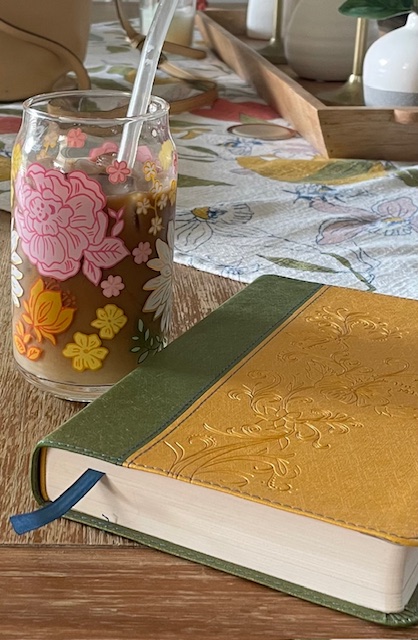
Black mold leached across the inside of the wooden lid of my floral painted glass tumbler. I scrubbed and scrubbed but was unable even with brushes to eradicate the mold underneath the rubber seal. There was nothing to do but throw the lid away. I was devastated; my thoughtful daughter, Maggie, had purchased this tumbler for my birthday. One of the best gift givers I know, she picked out something that was both cheerful and sustainable with a glass straw. For a solid month, I used the glass regularly. But one night, after an exciting book club meeting on Zoom, I left the glass, with water in it, on my desk, and forgot about it for about a week. And over the course of that week, mold developed and ruined the lid.
For the past few years, I have struggled with finding where my faith intersects with my political views. For years, I believed that my party held high moral ground when it came to supporting candidates. We took a strong stance when one president had an inappropriate relationship with an intern, and even moved to impeach him (I struggle with using the words “inappropriate relationship” when power dynamics are involved). But then came 2016 and the Hollywood Access tapes, and all the same issues that plagued former President Bill Clinton seemed to be ignored when dealing with Donald Trump. I heard again and again, vote for the one who supports causes Christians believe in, it doesn’t matter what his character has been. I watched while fellow Christians who voted for Donald Trump, and as he gained office and passed legislation, they seemed to put him on the same pedestal as Jesus.
Four years later, when protestors stormed the Capitol, these same Christians justified his actions. As more allegations have come against him, including credible sexual assault, Christians have chosen to align themselves even closer to former President Trump. They ignore all the hate speech, white supremacy connections, and belittling comments he makes. Instead, they focus on his candidates for the Supreme Court, some of his policies, and create memes where angels and Jesus are watching over his candidacy.
I have found some Christian community that doesn’t support Trump. Russell Moore, David and Nancy French, Tim Alberta and others take a strong and EDUCATED stance against Trump because of their faith. They articulate their views on various podcasts, op-eds in different newspapers, and have even written some books that explain how we as Evangelicals have gotten to the Trump era. They don’t profess that as Christians we have to be perfect. But they do believe that as Christians, we need to be ethical in who we support in politics.
By now, we have all heard of the assassination attempt on former President Donald Trump. As much as I oppose Donald Trump and have major concerns if he is elected, I am thankful that the assassination was not a success. Russell Moore stated on the social medial platform X that “Political violence is evil to the core and is an attack on everything this nation represents. Attempted murder is an attack on the image of God.” David French commented on Threads, “In moments like this, it’s imperative to condemn political violence, full stop. Don’t what-about. Don’t measure which side is worse. Just say it’s wrong, loudly and clearly.” They are the middle of the road voices that believe in God, rule of law, and decency.
Unfortunately, on both sides of the political spectrum, there are extremely loud voices that don’t hold themselves to these same standards. Instead, conspiracy theories are running amok in social media, wild assumptions about the hand of God and where the bullet should have gone are also being articulated, and more memes are shared about the wings of angels guarding certain individuals.
The mold on my lid spread because it had the perfect environment. Our air conditioning was on the fritz for the past few weeks. Therefore, the hotter temperatures in that room were causing the water to condense on the inside of the lid. It probably only took a few days before the mold developed, and within that few days my lid was ruined.
A week after the assassination attempt, President Biden has chosen not to seek reelection. With this new election drama, just like the mold, hyperbole is spreading from extremists on both sides. They each claim that democracy is at stake and accuse the other side of being fascist or socialist.
A few Sundays ago, my husband spoke boldly when leading prayer in our church. He asked the church at large to truly follow Jesus, instead of making certain hot button issues our religion or a certain politician our messiah. When I reflect on Terry’s focused prayer, I pause to consider what my personal rhetoric endorses.
As a Christian, I have asked myself some hard questions in the last few years. I continue to wrestle with these questions amid a divided nation, assassination attempts, and suspended campaigns. Do I follow Jesus, or do I follow a political party? Do I recognize the Bible as truth, including its consistent advocacy for the marginalized groups, or do I continue to vote in a way that further marginalize these groups? Finally, do I educate myself on these issues, instead of just accepting the views from certain perspectives, whether right or left?
This has been a journey for me, and in my community, I often feel alone with some of my views. I struggle with the urge to persuade others to take this journey with me. I try to hide my expressions as I cringe when Christians share a belief that I find contrary to my faith. I know my reactions, both verbal and nonverbal, should reflect Christ.
Where does this leave me in this upcoming election? First, local elections are far more important than I have ever believed. I am going to take the time to educate myself on who is running for school boards, council positions, and state offices. I think these positions can have a more direct impact than I initially believed on some of the causes I support. I also recently heard on a few podcasts a theme of hope, no matter who wins this election. This hope is not in a particular party, platform, or agenda. My hope needs to rest in Christ. Therefore, the outcome of the November election is not going to determine my joy or my peace. I am going to place my hope in the only place that sustains—in the arms of a just and gracious God, the only place I can find peace.
Terry was right to challenge me to follow Jesus; only He can save and lead!!
“but in your hearts honor Christ the Lord as holy, always prepared to make a defense to anyone who asks you for the reason for the hope that is in you; yet do it in gentleness and respect.” 1 Peter 3:15 ESV
Four and half years ago, I titled my blog Graceful Transitions and started writing about my midlife journey. I wanted it to be a space where I could share things I was wrestling with, such as creating more intimacy in my marriage, being transparent about my journey to better health, and moving from parenting to blessing my adult children. Just as I agonized over the names of my children, I picked the name for my blog carefully. I wanted this to be a place that exuded gracefulness. In years past, I had been bold and harsh with my opinions, often alienating those around me. But life has a way of humbling you, and I wanted to operate in that space. My writings could still be bold and confident, but I didn’t want to come off as an expert. Instead, I wanted to share my thoughts in a gentle manner that dignified both God and the reader. The word “transitions” was also carefully thought out. I didn’t want to portray myself as someone who has arrived. Instead, I wanted to be curious, eager to learn and grow in my relationship with Christ. These traits would move me from one place to another with fluidity.
We often walk in a local park that has a tunnel underneath a busy road. Anytime we have children with us, we stop in the tunnel for a few minutes. They sometimes yell each other’s names or just make a loud noise and listen to it reverberate. There is something about hearing an echo that is delightful. Your voice becomes an instrument that can drown out any other sound. And it’s contagious. Once one child makes a sound, other children quickly start doing the same. And soon, the tunnel becomes a cacophony of noise.
Initially, I had no intentions of pontificating on any hot button issues in my blog. Current event noise fills our screens with rants and raves, polarizing our society. But as I continued to write, I found God gracefully transitioning me out of the self-imposed echo chamber I had been in for the last thirty years. This echo chamber informed my political views, how I looked at the world, and what causes I believed in. Like the tunnel, the echo chamber noise of the 2020 election became deafening. And as the world dealt with the pandemic, racism, and immigration issues, I found myself looking for other perspectives.
This led to a spiritual crisis. For so many years, I espoused the idea that you could only vote one way to be a good Christian. I even challenged others on this principle, boldly declaring that God only accepted the votes of one political party. But again and again, I kept reading in scripture how God cared for the poor, the widow, the fatherless, and the sojourner (another word for immigrant). Did my votes support what God truly cares about? Can Christians think differently about issues?
God always has a way of helping you wrestle well these concepts. As I read scripture, God directed me to other Christians who had a different perspective from those on talk radio and certain news outlets. These thinkers researched carefully, believed all people were created in the image of God, and still held fast to scripture. They didn’t water down the gospel, but instead looked at scripture wholly and completely.
All this reading, listening, and thinking led me to this series on Stewarding the Earth. For years, the far right has labeled environmental supporters “wackos and pagan worshippers”. As a follower of Christ, I am troubled by the name calling I used to support. Is name calling helpful in moving the conversation forward and declaring the gospel to those who care about the earth? I now believe you can be a Christian environmentalist. John Muir, one of the biggest environmental supporters had Christian roots. Founder of the Sierra Club and considered the father of the National Parks, Muir believed in God. He was known to share his faith with others on the University of Wisconsin campus. Some scholars acknowledge that Muir struggled with orthodox Christianity later in life, but he did recognize God’s hand in creation throughout his book My First Summer in the Sierra. Today, one of the leading climate change scientists, Katherine Hayhoe, is a Christian. She has been awarded Champion of the Earth, the United Nation’s highest environmental honor. In her bio on her website, she says, “I don’t accept global warming on faith; I crunch the data, I analyze the models. I help engineers and city managers and ecologists quantify the impacts.” There are also some faith based environmental advocacy groups, likeA Rocha International and theEvangelical Environmental Network.
I have heard two consistent arguments from fellow Christians against environmental policies. First, they believe that environmentalists worship creation more than the creator. There may be some truth to this in some cases. But scripture supports the fact that when people express awe in creation, it points them to the creator. David says in Psalms 8:3, “When I look at your heavens, the work of your finger, the moon and the stars, which you have set in place.” This sense of awe was reaffirmed by Paul in Romans 1:20, where he says, “For the invisible attributes, namely his eternal power and divine nature, have been clearly perceived, ever since the creation of the world, in the things that have been made.” Psychologist Dacher Keltner, who has studied awe, finds that experiencing awe makes people more curious and less judgmental. It also makes people more humble, generous, and altruistic. If we Christians keep the earth as awe inspiring as we can by reducing our impact on the climate, can we point others to Christ? If we value the created earth, because it points to an awesome creator, can we have conversations with non-believers when they are curious and open to ideas about how God frames our world? These conversations can only happen if we, too, are inspired by awe. This will help us to express curiosity and be less judgmental.
The next argument I hear often is that we were given dominion over the earth from the beginning of time. Again, there is truth in that. Genesis 1:28 says, “Be fruitful and multiply and fill the earth and subdue it and have dominion over the fish of the sea and over the birds of the heavens and over every living thing that moves on the earth.” But the Bible goes on to say in Genesis 2:15, “The Lord God took the man and put him in the garden of Eden to work it and keep it.” The Hebrew word for work is “abad” which also means to serve, and the Hebrew word for keep is “samar” which means to guard and keep watch, protect, and save. When you put the two verses together, it changes our view on the word dominion. We are to operate on God’s behalf, and we are called to rule over the earth by protecting and serving it. By doing this well, we are ensuring that the earth will provide us with the means to survive: a healthy climate where animals and vegetation are thriving, and clean water flows freely. God didn’t give us the authority to destroy and plunder the earth!
There are some great theologians and philosophers who advocate for a more theologically sound view of the environment. C. S. Lewis, great Christian apologist, warned in The Abolition of Man that “Man’s conquest of Nature turns out, in the moment of its consummation, to be Nature’s conquest of man.” Francis Schafer, a leading Christian philosopher, challenged believers in Pollution and the Death of Man, “Christians, of all people, should not be the destroyers. We should treat nature with an overwhelming respect.” Wendell Berry, poet and naturalist, writes in The Art of the Commonplace: The Agrarian Essays, “…the care of the earth is our most ancient and most worthy and, after all, our most pleasing responsibility. To cherish what remains of it, and to foster its renewal, is our only legitimate hope.” These Christians contemplate the word of God and carefully choose words to respond to concerns they have about the environment. I wonder how often the voices that oppose environmental policies contemplate scripture and man’s responsibility towards the earth.
As a follower of Christ, I am expected to shine His light in a dark world. This is more than just sharing my testimony; it should be embodied in how I act and treat others and the earth around me. How I live my life impacts the climate. My carbon footprint increases drought and flood conditions and changes water supplies. It also makes winters warmer, allowing bugs and pests to increase. Their increase can lead to the destruction of forests and other vegetation. Food supply chains are being affected and the sea level is also changing. All this change directly impacts my neighbor, from the person next door to those in Mozambique who contribute little to the carbon footprint. Katherine Hayhoe’s website is full of information about how climate change is affecting our world. She uses scientific research to support her arguments and to counter the opposition.
I have written about noise pollution, our obsessive use of plastics, and how to Leave No Trace. Some of these ideas will help reduce our carbon footprint. Although I don’t personally own a hybrid or electric vehicle, I can argue the benefits of encouraging research and development in making these vehicles more viable. I can also talk about how shopping locally, both for produce and meat, is another way you can reduce your carbon footprint. But the biggest way for me to make an impact is to acknowledge climate change is real and to be educated before I enter the voting booth, both on a national and a local level. Supporting policies that reduce climate change can be one of the most important ways I steward the earth well as a follower of Christ.
This is the end of my series on Stewarding the Earth. Readers, I hope you enjoyed it. Feel free to comment on any of the posts I have made. I will continue the conversation in the future with some interviews with fellow Christians who model these principles well. Additionally, I will likely write about other issues where God has been opening my eyes to a wider and fuller view of scripture. These still fit into the ethos of Graceful Transitions, because I want my words to dignify God and you, my readers. Thank you for all your support.




 By Sherry Collins