Moldy Divisions
“Let your steadfast love, O Lord, be upon us, even as we hope in you.” Psalm 33:22 ESV
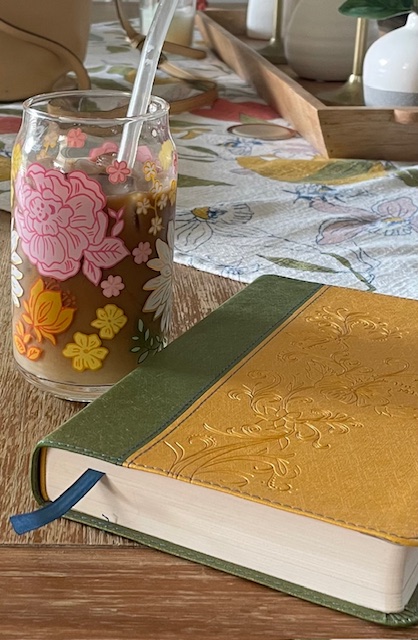
Black mold leached across the inside of the wooden lid of my floral painted glass tumbler. I scrubbed and scrubbed but was unable even with brushes to eradicate the mold underneath the rubber seal. There was nothing to do but throw the lid away. I was devastated; my thoughtful daughter, Maggie, had purchased this tumbler for my birthday. One of the best gift givers I know, she picked out something that was both cheerful and sustainable with a glass straw. For a solid month, I used the glass regularly. But one night, after an exciting book club meeting on Zoom, I left the glass, with water in it, on my desk, and forgot about it for about a week. And over the course of that week, mold developed and ruined the lid.
For the past few years, I have struggled with finding where my faith intersects with my political views. For years, I believed that my party held high moral ground when it came to supporting candidates. We took a strong stance when one president had an inappropriate relationship with an intern, and even moved to impeach him (I struggle with using the words “inappropriate relationship” when power dynamics are involved). But then came 2016 and the Hollywood Access tapes, and all the same issues that plagued former President Bill Clinton seemed to be ignored when dealing with Donald Trump. I heard again and again, vote for the one who supports causes Christians believe in, it doesn’t matter what his character has been. I watched while fellow Christians who voted for Donald Trump, and as he gained office and passed legislation, they seemed to put him on the same pedestal as Jesus.
Four years later, when protestors stormed the Capitol, these same Christians justified his actions. As more allegations have come against him, including credible sexual assault, Christians have chosen to align themselves even closer to former President Trump. They ignore all the hate speech, white supremacy connections, and belittling comments he makes. Instead, they focus on his candidates for the Supreme Court, some of his policies, and create memes where angels and Jesus are watching over his candidacy.
I have found some Christian community that doesn’t support Trump. Russell Moore, David and Nancy French, Tim Alberta and others take a strong and EDUCATED stance against Trump because of their faith. They articulate their views on various podcasts, op-eds in different newspapers, and have even written some books that explain how we as Evangelicals have gotten to the Trump era. They don’t profess that as Christians we have to be perfect. But they do believe that as Christians, we need to be ethical in who we support in politics.
By now, we have all heard of the assassination attempt on former President Donald Trump. As much as I oppose Donald Trump and have major concerns if he is elected, I am thankful that the assassination was not a success. Russell Moore stated on the social medial platform X that “Political violence is evil to the core and is an attack on everything this nation represents. Attempted murder is an attack on the image of God.” David French commented on Threads, “In moments like this, it’s imperative to condemn political violence, full stop. Don’t what-about. Don’t measure which side is worse. Just say it’s wrong, loudly and clearly.” They are the middle of the road voices that believe in God, rule of law, and decency.
Unfortunately, on both sides of the political spectrum, there are extremely loud voices that don’t hold themselves to these same standards. Instead, conspiracy theories are running amok in social media, wild assumptions about the hand of God and where the bullet should have gone are also being articulated, and more memes are shared about the wings of angels guarding certain individuals.
The mold on my lid spread because it had the perfect environment. Our air conditioning was on the fritz for the past few weeks. Therefore, the hotter temperatures in that room were causing the water to condense on the inside of the lid. It probably only took a few days before the mold developed, and within that few days my lid was ruined.
A week after the assassination attempt, President Biden has chosen not to seek reelection. With this new election drama, just like the mold, hyperbole is spreading from extremists on both sides. They each claim that democracy is at stake and accuse the other side of being fascist or socialist.
A few Sundays ago, my husband spoke boldly when leading prayer in our church. He asked the church at large to truly follow Jesus, instead of making certain hot button issues our religion or a certain politician our messiah. When I reflect on Terry’s focused prayer, I pause to consider what my personal rhetoric endorses.
As a Christian, I have asked myself some hard questions in the last few years. I continue to wrestle with these questions amid a divided nation, assassination attempts, and suspended campaigns. Do I follow Jesus, or do I follow a political party? Do I recognize the Bible as truth, including its consistent advocacy for the marginalized groups, or do I continue to vote in a way that further marginalize these groups? Finally, do I educate myself on these issues, instead of just accepting the views from certain perspectives, whether right or left?
This has been a journey for me, and in my community, I often feel alone with some of my views. I struggle with the urge to persuade others to take this journey with me. I try to hide my expressions as I cringe when Christians share a belief that I find contrary to my faith. I know my reactions, both verbal and nonverbal, should reflect Christ.
Where does this leave me in this upcoming election? First, local elections are far more important than I have ever believed. I am going to take the time to educate myself on who is running for school boards, council positions, and state offices. I think these positions can have a more direct impact than I initially believed on some of the causes I support. I also recently heard on a few podcasts a theme of hope, no matter who wins this election. This hope is not in a particular party, platform, or agenda. My hope needs to rest in Christ. Therefore, the outcome of the November election is not going to determine my joy or my peace. I am going to place my hope in the only place that sustains—in the arms of a just and gracious God, the only place I can find peace.
Terry was right to challenge me to follow Jesus; only He can save and lead!!


 By Sherry Collins