“Give her of the fruit of her hands, and let her works praise her in the gates.” Proverbs 31:31
I have a magazine subscription that is a splurge in my life. The path that led to this magazine started with stumbling upon a podcast. I am not sure how I found Radio Cherry Bombe. It could have been an Instagram post, another podcast, or a chef I was curious about. But somehow, in 2021, I started to listen to host Kerry Diamond interview women in the food industry. These interviews exposed me to the ingenuity of women despite barriers and how camaraderie and collaboration helped women become more successful. It was more than the delightful aprons created by Ellen Bennet for Hedley & Bennet, or the celebrations that Elisa Sunga hosted with her Cake Picnic. It was coming together as women, recognizing the obstacles that have held us back, and moving towards the future where women can be creative, lead, and live fully.
Last Sunday, I prayed with three young women. Our pastor instructed us to pray over one another a blessing of some sort for their future lives. I had been sitting behind the three young women in church, watching them interact with one another. Laughing, worshipping, and praying, I saw them connected in a way only tween/teen girls can be. They giggle at the same things, pretend disdain at adults’ attempts at humor, share heartbreaks and challenges with one another, and love each other fiercely. They are on the brink of womanhood, with so many dreams, goals, and ideas. When I came up to them, I didn’t have anything profound to say that spoke to their future. Instead, I felt led to bless their friendship and ask God to help them be hospitable whenever new tweens/teens entered the group. I prayed that God would help them enlarge their circles despite their strong connections. After a group hug, I felt as blessed as I hoped my prayer would be for them.
When I became a Christian, I was one of the outsiders coming into a group of friends that shared a history. They all attended a small Christian school while I attended public school. They could all sing beautifully and even had matching outfits for a vocal ensemble they were competing in. When I sang, it was less than harmonious. Yet, despite their connections, they were able to invite me to be a part of their group. I never felt like an outsider. They celebrated my wins and helped shape the woman I am today. Today, I am still in a relationship with two of these women, our friendship spanning almost 40 years.
This past Sunday was International Women’s Day. It was affirming to see women across different industries celebrating other women in their industry. Reese Witherspoon paid tribute to other actresses, Ina Garten honored Julia Child and Martha Stewart, along with other women who “were fabulous chefs and food writers.” Other women praised their moms, aunts, and teachers who made an impact on their lives.
In this post, I wish I could list all the women who inspire me. From my aunts to my sisters, to my oldest friends, to my daughter and daughter-in-law, to my newest friends, to my co-workers, to my volunteers, to all the young women in my life—you are all amazing! I hope to always be your biggest cheerleader, to sit by your side when life is hard, and to advocate for you when life seems unfair. Thank you for being amazing women, and let’s continue to make this world a better place for all women!
“For everything there is a season, a time for every activity under heaven.” Ecclesiastes 3:1
A few months ago, I made Erin French’s Butter Cake. Erin, a self-taught chef, has created a culinary experience in the sleepy town of Freedom, Maine. Late spring, she opens her restaurant on the weekend to lucky individuals who travel from around the world to her tables. She serves different courses highlighting local produce in an artful way that leaves the diners feeling connected, loved, and cared for. One of her favorite desserts is a simple butter cake, which she slices and adds fresh fruit and whipped cream. Despite butter being the main ingredient, and soaked with a butter glaze, the cake is surprisingly light and ethereal. It left you satisfied with a hint of wanting just one more bite.
It’s been an eventful year; I entered the workforce after being a home educator and childcare provider at home for 26 years. This resulted in a long commute for work for both Terry and me. This prompted a move to Carlisle, and in the process, Terry found out his company was closing. He took a new position which now makes our commute less than 7 minutes. Besides all the driving we did for work, we made 6 trips to Rhode Island, and 3 trips to Wisconsin. We both had some pressing health issues that resulted in new medication for me and a biopsy for Terry. Amid this chaos, I finished writing, editing (with Terry’s help), and published my memoir, Reclaimed & Restored. The biggest highlight of the year was welcoming our newest granddaughter.
The word weight is a loaded term. It conjures up images of heaviness, judgment, and burdens for me. As a woman, I have been judged by the flashing numbers on my scale, how I prioritize my responsibilities, and whether I am making meaningful contributions to my family, church, and world. This results in a weight that is unseen, but that yokes me together with feelings of failure, a constant need to be productive, and never being enough. And the weight of this pressure extinguishes my creativity and crushes my dreams.
We both recognized as soon as I took this position, that life would need to change. For most of our marriage, I took responsibility for meal planning and preparation, cleaned and maintained our home, organized our schedule, and managed our finances. But even working only three days a week (which often ended up being 4-5 days a week), I could no longer manage the load I carried before. Even more importantly, I didn’t want to. I was tired of being solely responsible for cleaning the house, knowing when certain projects like de-scaling the coffee pot needed to be done. I was done with making dinner every evening. I was tired of being defined solely by what I did at home.
To be fair, Terry has always been a great partner in our marriage. He always helped with chores on weekends and cleaned up after dinner. He picks up after himself, and to his credit, I have only had to pick up his dirty socks once in our almost 29 years of marriage (we won’t discuss the amount of bobby pins or hair ties that he picks up). We both had idealized traditional roles and didn’t recognize how the weight of these roles hindered both of us. By taking this new position, I turned our worlds upside down. Even though we both needed to change we didn’t know how to communicate with one another about what changes needed to happen which led to resentment in me and Terry feeling inadequate.
I quickly learned that me responding to his inquiries about what needs to be done with “You’re an adult, figure it out” wasn’t helpful or kind. But I also didn’t like treating him like a child with a honey-do list. We both needed to get past the resentment and feelings of inadequacy. After a few heated discussions, we sat down and talked reasonably about how our idealized traditional roles left little time for me to explore creative endeavors or pursue other interests. I was not only maintaining the house, but also home educating our children and doing full-time childcare as well. This seemed reasonable when he was going to school part time and working full-time. But when that changed for him, my load didn’t lessen. I want to reiterate, Terry was not lazy, he helped any time I asked or when he saw me doing something. My resentment came with the weight of the responsibility and the lack of initiative.
This is common in a lot of marriages, regardless of the women’s working status. My generation entered the workforce and struggled with the mental weight of managing the home as well. Often, women were expected to do most of the meal planning, clean the house and adjust their work schedules when their kids were sick. Sitcoms picked up on this discrepancy, often making men look like buffoons or idiots. Many in the evangelical Christian circles pushed against these stereotypes. They felt like it made men seem insignificant and worthless. Yet, if you go back a few generations, TV shows like Leave it to Beaver,I Love Lucy and the Geroge Burns and Gracie Allen Show made their leading ladies look unintelligent, silly, or ditzy. Yet, I have yet to see these same Evangelical Christians address how these stereotypes denigrate women. We are all created in God’s image and although humor is an important outlet, it should never be sanctioned when it supports stereotypes in way that is destructive.
After long conversations, Terry and I are working at creating a new normal. We both have some clear responsibilities in the house. I no longer cook every meal completely on my own. We share responsibilities depending on each other’s schedules. We are flexible to pick up the slack when the other person has some extra responsibilities at work. It feels like a true partnership, where I no longer carry the mental load of running the household.
I heard recently something that has challenged my beliefs about marriage. On the Bare Marriage podcast, author Sheila Wray Gregorie and her husband discussed that when the premise that marriage is hard is accepted, people tend to accept the disappointments and struggles as normal and their burden to bear. Instead, they suggest if we view marriage as a good thing and beneficial for both parties, we are more willing to address the hard things and work together to find a solution. We don’t carry resentment because we address things that seem unfair. I thought about this in my own situation. For years, I accepted the mental load as my burden to carry. I never addressed how it made me feel. I know if I had addressed this earlier, Terry would have been responsive and willing to adjust. Instead, I accepted the status quo and chose to endure the burden.
We think of butter as being a heavy ingredient, like it is in French food, where the rich sauces are tasty but leave you feeling a bit sluggish. Erin French took this same ingredient and created a cake, brushed with butter, and made it light. Maybe I need to look at all things in my life and learn to make things lighter, including the weights that burden me.
“Do nothing from selfish ambition or conceit, but in humility count others more significant than yourselves.” Philippians 2:3
Recently, an acquaintance asked a question in a judgmental tone that upset me, “Now that you are working, are you finally going to get a second car?” I instantly felt like I had to explain my choices and justify the decisions my husband and I have made. Instead, I remembered some of the work I have done, and that not everyone deserves an explanation, especially when they have already formed their own opinion. I replied “no” and moved the conversation in a different direction.
For many, our almost 29 years of marriage may seem like we are in the dark ages, with our choice to have only one vehicle. For most of the time, Terry has worked within 5 to 10 minutes from our home. This made it convenient when I had appointments or home school activities. I would just take him to work in the morning and continue my day. I also lived close to parks and the library, putting a lot of miles on my stroller odometer. Money was tight, and keeping up a second car was not something that fit into our budget.
For the past 10 years, other than during the pandemic interruption, my husband has commuted 45-60 minutes to work. This made appointments a little bit challenging, but again we found ways to work around those obstacles. I was providing childcare for a family, who had an extra vehicle which I used for taking their kids to appointments and school. They generously allowed me to use it for my own appointments as well. I lived close to my family doctor and chose to walk to her office on a few occasions. Also, my children were driving and had purchased their own cars, so occasionally they helped with a few errands.
The one-car family idea became a little more challenging when I took a part-time job, and for 9 months, I drove more than I had driven in the past 5 years. We knew all the miles we were putting on our car were not sustainable, so we moved closer to my work. Two months later, Terry accepted a new position making both of our commutes 5-6 minutes in the same direction from our home. We have decided that the cost of a second car is not important to our lives, using the extra money for travel and day excursions.
I know that Women’s History month is over, but I want to end this series on how we can support all women in their choices concerning their marital status, if or when they are going to have children, whether they choose to stay home or work while raising children, and how they decide to educate their children. All of these have elicited some strong opinions in the church and have caused women to go both on the offense and on the defense. Within all these areas, we even micro-judge whether they breastfeed, what they feed their family, and what they let their children watch.
Years ago, while in college, I made some arrogant statements over time to a dear friend about the importance of higher education and being career oriented. With her usual grace, she wrote a letter to me, sharing with me how my opinions had demeaned her choice to be a stay-at-home mom, and that there was room for both of us to have our goals without tearing each other down. I instantly felt bad and apologized. Ironically, I didn’t learn my lesson when I made the decision to stay home with my kids and home-educate. I soon found myself on the other side of the table, judging working moms. This view was reinforced by my insulated circle of friends and acquaintances, all of us reading books by home education leaders and listening to Christian talk-radio shows (this was before podcasts were a thing).
Recently, I had a few people hang up on me as I was making phone calls for donations to a local nonprofit. The first time, I was offended but quickly remembered I have done the same to various other organizations trying to raise funds. I cushioned the hang up by saying I was not interested and ended the call before the person had a chance to respond. Now, being on the other side of the call, I realized even a cushioned hang-up felt rude.
Author Tyler Merrit says in his book I Take My Coffee Black, “proximity breeds empathy. And with empathy, humanity has a fighting chance.” My sister, Cheryl, entered college slightly later than her peers. She finished her bachelor’s degree and went on to complete her master’s degree. She later found a great job at a major university. She then decided to pursue her law degree, while getting married, followed by having two children. After having her children, she continued working full-time while finishing her law degree. I saw how hard she worked towards achieving her goals. I also knew how much she loved her children and wanted what was best for them. She wanted them to have healthy, whole lives supported by a loving mother. Her goals in parenting were not different from mine. What was different was the application, and that didn’t make either of our approaches better than the other.
Just like me, she sacrificed her finances and personal time to meet the needs of her growing family. I chose to have one car; she chose to spend money on an excellent daycare for her children. I made some sacrifices with my professional goals, while she limited her opportunities so she could be fully present in the evening with her kids. We both stayed home with our sick kids, giving them the extra cuddles they needed. We both took our children to the library, created family traditions, and researched the best ways to raise our children.
I saw how hard my sister worked, and continues to work, as a mom while still excelling in her chosen career. Being close to her gave me insight into working moms. Just like stay-at-home moms, they love their children passionately. Their reasons for working are to help provide for their family, achieve some professional goals, and some may have no other option as single parents. No matter what their reason is, this doesn’t make them less of a mother. It just means they work differently than stay-at-home moms.
I remember going to camp where competition between cabins was fierce. We created chants about our cabin name, often belittling the different cabins, hoping to win the coveted Best Cabin award at the end of the week. This was fine for a one-week experience as a middle-schooler. The stakes are higher when we continue as adults to put ourselves into camps of our different choices in marriage, children, work, and education. We automatically create an “us vs. them” culture which leads to belittling attitudes and judgements. But Paul reminds us there is a different way to operate. He states in Galatians 3:28, “There is neither Jew nor Greek, there is neither slave no free, there is no male and female, for you are all one in Christ Jesus.” Paul was teaching a principle that our differences don’t separate us from Christ, and in turn, shouldn’t separate us from each other.
Sienna Miller, who welcomed a new baby at age 41, addressed the ageism question in Hollywood. She pointed out that she gets a lot of negative feedback on how “old” she was to be having a baby. She also pointed out that stars like Robert De Niro and Al Pacino, who welcomed children at 79 at 83 respectively, were celebrated instead of questioned on their geriatric age. Though these arguments plague Hollywood, can’t we of the Christian faith do better? Let’s cheer on mothers who embrace motherhood at older ages. Let’s support those who choose to remain single by embracing them into the greater family of God. Let’s champion those mothers who choose to use formula. Let’s recognize that all parents want the best education for their children, and that they have a right to delegate that to private or public schools.
Again, like all the other topics I have discussed in the last three blogs, this can only happen when I personally identify the ways I have judged other women in the past and choose to be supportive in the future. I have some amazing friends who parent passionately and have made different choices than I did. I have some amazing friends that are single, who support the kingdom in so many tangible ways and their choices should be validated. It’s time to embrace the differences so we can chant the hashtag of International Women’s Day, let’s #AccelerateAction, by recognizing that these differences make us a more effective body of Christ. This proximity to differences will increase our empathy, and in turn, our witness.
We have one car, and we are content with our choice. I chose to raise my family the way God called us to as a family unit, which resulted in me staying home, home educating, and a limited income. Our way was right for our family, but not for everyone. In the future, I want to champion my friends and families who make different choices than me.
“I praise you, for I am fearfully and wonderfully. Wonderful are your works; my soul knows it very well. My frame was not hidden from you, when I was being made in secret, intricately woven in the depths of the earth.” Psalm 139:14-15
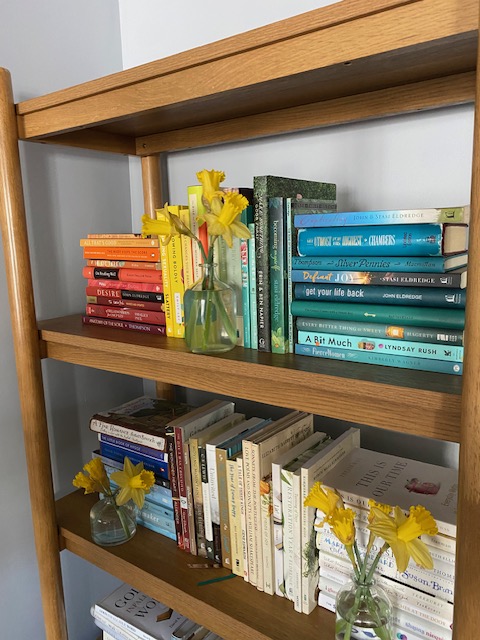
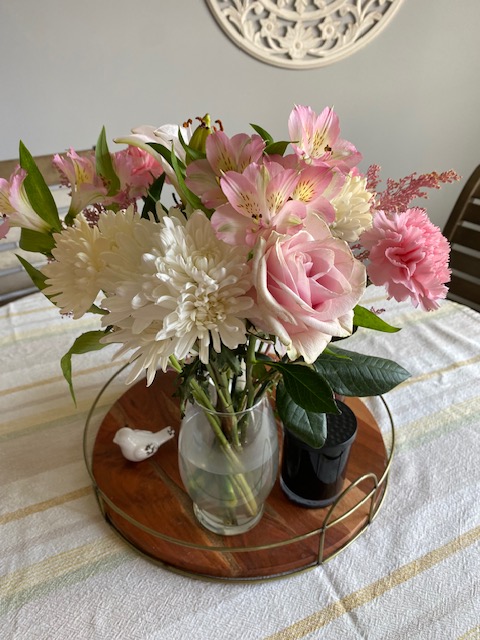
I can smell spring in the air, the faintest scent of dirt exhaling after its long winter slumber, while birds sing their morning songs. The air is still cool, but the sun and the wind whisper warm breezes, hugging my body. Even my music playlists are changing, from the mellow rhythms of yacht music to the upbeat melodies of Cole Poter and Frank Sinatra. To commemorate spring and offset my curmudgeon attitude due to daylight savings time, I bought myself some grocery store flowers. It started when a small bundle of daffodils smiled at me from their bucket. Then I saw another bouquet, full of light pink and white flowers that physically embodied the sounds of robins chirping. Initially, I was going to bundle both bouquets together. I later decided to spread the joy in four separate vases, creating expectant hopes of spring around my home.
The kinds of flowers a person is drawn to are a unique fingerprint of their personality. My mother-in-law loved impatiens, geraniums, and pansies, flowers that grew abundantly, giving her a lot of blooms for her budget. My mother loves ordinary carnations because they last a long time, allowing her to savor the blooms. My daughter’s love for ranunculus helped determine that she would have a spring wedding, so that her bouquet would drip with the delicate pink and yellow blooms. I love daisies because, as Meg Ryan’s character asked in You Got Mail,“Don’t you think daisies are the friendliest flower?”
It is interesting that God designed flowers to be unique. Some have massive heads with lots of tiny individual flowers like hydrangeas, some have intricate patterns like dahlias, and some are just little cups of joy like buttercups. There are even different varieties amongst the same species. Soon, pockets of daffodils will fill fields with sunshine, but if you look closely, you will see some with bright yellow heads, while others are the color of butter. Some will have curvy petals, while others will be fringed with lace. I am delighted our God, in His master artistry, took the time to create flowers unique and individualistic.
In the past few years, I have been on a journey to better health. I have had some setbacks in the last two years, gaining back a lot of the weight I had lost. But I am choosing not to focus just on numbers but on being more active, gaining strength, and becoming more flexible. I am also choosing not to be ashamed of the body I am living in and have bought clothes that fit me well and make me feel comfortable. But as much as I am working towards not being ashamed, I have still let other people around me make comments that demeaned me and others about the size of our bodies. I let the comments slip by, wishing now I had been courageous enough to address how these comments harm women.
One of the comments had to do with a local theater production an acquaintance saw. He noted that the production was good but commented that the female lead seemed too “big for the role.” He felt her size made her less believable as a love interest, although she could sing and dance “well enough.” I listened in disbelief. I am sure that, even in local productions, there were several women trying out for this role. I am also sure that some of the women would have fit his idea of what the lead should look like. But this woman was chosen above every other option because she was the most talented for this role. Additionally, I am curious how “big” this woman really was? Were his perceptions of “big” defined by his narrow view of how a woman should look?
The second comment was made directly to me about me. A different acquaintance of mine looked at the back cover of my book and asked if I dug out my “yearbook photo” for my picture. He didn’t comment on the fact that publishing a book is a major accomplishment. He didn’t remark on how brave I was for addressing a difficult subject or how well my daughter had designed the cover. His only response was pointing out rather unsubtly that I had gained weight. Again, I was stunned by his remarks and started to justify my choice of picture and even casually remarked that I recognized I had gained weight. Meanwhile, he quickly put the book down and started rambling about his upcoming adventure. I left that conversation demeaned.
It is stunning to me that in 2025, despite all the work that has been done in this area, women are still being judged by our size, appearance, and age. We celebrate women such as Andie McDowell who decided to go grey naturally, and Pamela Anderson who decide to walk the red-carpet sans makeup. Yet, Millie Bobbie Brown, a 21-year-old actress, was trolled by critics as “aging badly.” Keely Shaye Bronsan, the wife of actor Pierce Bronsan, is often pictured with before and after pictures, pointing out her weight gain. And if a celebrity has recently lost weight, the assumption is made that she used Ozempic.
I remember writing the author’s biography for my book. As Terry was helping me with the correct wording about where I lived, he added the words “Sherry currently lives in south-central Pennsylvania.” I reacted viscerally to that statement and stated rather emphatically, “I don’t want to take up that much space in my author’s biography. Where I live is not the most interesting thing about me!” I feel the same about my appearance and weight loss/gain; that is not the most interesting thing about me. How I love and care for my family, what I write about, my job as a volunteer coordinator, my passions, and, most importantly, my faith are far more interesting than whether I choose to dye my graying hair, or whether the numbers on the scale have increased or decreased. I do enjoy wearing a nice outfit and taking the time to care for my skin and hair, so I feel confident in accomplishing the things I want to in my world. I do want to move towards a healthier lifestyle so I can live a long and active life. But I don’t want to be defined by my age or my size anymore. And I will no longer tolerate comments made by others that demean me or the women around me.
Ilona Maher is one of the most body-positive role models for women. Maher won a bronze with her American Rugby team at the Paris Olympics this past summer. One of the comments on her social media speculated that she had a BMI of 30. Maher pushed back in a viral TikTok video, confirming she had a BMI of 29.3. She went on to say that the BMI was designed to represent males and was not an accurate representation of what a healthy female athlete’s body looks like. She also stated her weight boldly, remarking that she was not meant to live in a small body. Finally, she stated to the naysayer, “I am going to the Olympics, and you are not!”
If God designed flowers so uniquely, why can’t we accept that women live in different sized bodies, have different facial features, and have different shapes? Why are little girls in middle school still struggling with eating disorders and cutting due to bullying about how they look? Why is “You look fat!” the worst thing you can say to a woman or a girl? And why do we still think appearance, no matter the age, is the most interesting thing about a woman? I am sick of hearing people’s first remarks about a girl or a woman being “She is so pretty,” and then extolling her character, talents, and skills only as secondary considerations. When people remark about a young man, they lead with his character, skills and talents, and rarely address his looks. Will this ever change?
It can only change if I admit how I contribute to the problem. I can work on changing my own language and make sure my comments about women and girls address the character, skills, and talents they offer our world. When I am faced with demeaning comments about women related to their appearances, I can challenge the offender with kindness and curiosity, hoping to make them aware of how their comments demean women. Finally, I can keep addressing the subject with women in my community, hoping that little by little, we can move the conversation forward and #Accelerateaction in conversations about gender bias.
One thing I know for certain is that God made hydrangeas, tulips, and bluebells to be different. And if He was so careful to design flowers differently, I have no doubt that He designed humans to look differently as well, and I believe He looks at His creation and declares it good. It is my responsibility to live well in the body I have been given!
“Judge not, that you be not judged.” Matthew 7:1 ESV
During my junior year of college, I had a full schedule. Along with being promoted to a new role as a Program Assistant and other extracurricular activities, I had the toughest class of my psychology major: a research and methods course. Often when I moved around my small campus, my head was down, thinking about the list of things I still needed to accomplish before the day ended. At the end of the school year, I met a freshman with whom I would be working in a summer program for underprivileged high school students. We quickly became friends, and she introduced me to a new, up-and-coming store: Bath & Body Works. Later that summer, she shared how she had tried to make my acquaintance before and, after being ignored a few times, she thought I was pretentious. I was taken aback by this assessment, and it was the first time I realized that I didn’t always appear warm and friendly. I quickly apologized, remembering how often my head was down and my list was long. Unfortunately, at the time, I was not mature enough to recognize that I needed to find healthier ways to deal with my stress and to avoid alienating people.
Since then, I have learned that when I am busy, I tend to have a Jekyll and Hyde transformation, shifting from the warm, friendly Sherry to busy, task-oriented Sherry. Even how I move about my world is different. I go from engaging in conversation with total strangers and inviting people into my home for peanut butter and jelly sandwiches (this was when my children were little) to being laser focused on what needs to be done and barking orders at others. This Mr. Hyde conversion is not my best side, and the various members of my immediate family have often been the ones who faced the brunt of this ugliness. And if you meet me at this time, you might not be enticed enough by the peanut butter jelly sandwiches to come over and visit with me.
Despite being busy with a newborn, I remember the1998 Bill Clinton and Monica Lewinsky scandal blowing up across the different broadcast and cable news networks. Before social media platforms existed, we still managed to be inundated with images of the infamous blue dress and clips of her phone conversations with a so-called friend. Next, we watched as President Clinton denied any sexual relationship, later apologized, and then faced impeachment. For years afterwards, every comedian and talk show host had a joke about Monica Lewinsky, criticizing her body, intelligence, and character. I laughed at some of the jokes and formed my own opinions of her.
But in 1998, we had no common language for the concepts of power differential, body shaming, or trauma. We didn’t understand that critical thinking is not yet fully developed in young adults, resulting in one intern’s naïve idea of love turning into the biggest mistake of her life. Today, I listened to Lewinsky tell her own story on her new podcast, Reclaiming by Monica Lewinsky. My views of Monica Lewinsky had been shifting for the last few years, and I knew I had misjudged her. But it was devastating hearing how hard it has been for her to move forward in her life, find a career, or even be in a healthy relationship because of a mistake she made when her impulse control was not yet fully developed. What was even harder to face was my culpability in her demise. I, along with the rest of the public, had misjudged and mischaracterized her.
This Saturday is International Women’s Day, a day with its roots in women protesting to receive better pay and improved working conditions. It started in the United States and moved across Europe as more women protested poor working conditions, wage gaps, and the inability to vote. In 1975, it was recognized by the United Nations as a day to support gender equality. The theme this year is #AccelerateAction, engaging in concrete ways to improve gender equality. There are still nations like Iran and Afghanistan where girls can’t receive education beyond elementary school, women are not allowed to own businesses, and women can’t leave their homes to have lunch with a friend. I can’t do much about those problems, except bring awareness of those human rights violations, support organizations that are trying to make a change, and vote in ways that address these issues. But I can do one thing that is noted on the International Women’s Day website: I can “call out stereotypes, challenge discrimination, question bias, celebrate women’s success…and share our knowledge and encouragement with others.” But to do this well, I need to recognize my own biases and the ways I need to change to address these issues.
Over the next three weeks, in honor of International Women’s Day, I am going to address issues of body image/body shaming, labeling, and judging women’s paths in life. I have touched on these areas in the past, but I am hoping to examine them from a fresh perspective with some personal anecdotes, pop cultural references, and Biblical principles. I also want to highlight why I, as a Christian, should and can do better about these issues. I hope you will join me in this series and hear how I am evolving.
I am so glad my friend in college laid aside her preconceived notions about me to become my friend. Her friendship, as brief as it was, enriched my life beyond fruity smelling lotions. I know how it feels to be misjudged, and I need to remind myself not to make judgments of others based on my own limited information about that person. My participation in shaming Monica Lewinsky certainly didn’t embody Christian principles and exacerbated her future struggles. But I know better now, and I want to continue to accelerate action to help move the dial forward in treating all women with equality.
“Whatever is good and perfect comes comes down to us from God our Father, who created all lights in the heavens.” James 1:17 NLT
I discovered guacamole way too late in life. Tony, a friend of mine who has lived in Arizona for many years, made the dish about 17 years ago at his mother’s holiday gathering in Wisconsin. The vibrant green stood out against the platters of brown and yellow: summer sausage, crackers, and cheese. I had recently discovered avocado at a local restaurant where it was added to a grilled cheese, elevating an ordinary sandwich with a fresh grassy note and a creamy texture. I couldn’t wait to try avocados in other ways, so I was magnetically drawn to the guacamole. My first bite transported me from the cold, bitter Wisconsin winter of slush and brown snow to a land of perpetual sunshine where I could feel the warm breezes whisper their song against my body. I had to know the secret to this magic green delight.
I asked Tony for the recipe, hoping to replicate this at home as soon as possible. Tony shared that he had mashed avocados with fresh lime juice and salt. He then folded in fresh tomatoes and onions. Finally, he added chopped cilantro, and adjusted the seasonings as needed. It sounded so simple, and within a day, I was buying the ingredients. My first batch wasn’t perfect, but after many attempts, I, too, was making the transformative guacamole for myself, adding it to our famous Collins’ fajita dinner. But for many years, when I went out for Southwestern or Mexican food, I refused to pay extra for guacamole. It may have been partially because our budget was tight, but it ran deeper. And this “not paying extra for guacamole” showed up in all sorts of ways in my life. It showed up in the old, tattered clothes I kept in my closet, or when I made all the cookies my family liked, putting the raspberry Linzers that I loved last on the list. It showed up during a vacation where I spent all my time cooking and cleaning, feeling resentful inside while everyone else was having a great time. The underlying reason for all of this was I didn’t feel I deserved the extras that made life joyful. After all, wasn’t I Christian? Shouldn’t my only joy be found in serving Christ and benefiting the kingdom of God?
The Bible emphasizes throughout scripture that we are to be servants; humble and loving our neighbors as ourselves. When we contrast that with what fills our social media feeds, secular magazine articles, and podcasts, the differences seem to be in direct opposition. The memes about mommies needing wine time, and the self-care movement, along with the need to set aside “Me-Time” seem rooted in selfishness, indulgence, and pride. Often, these messages cause us to pivot the other direction where we perceive ourselves to be selfless, sacrificial, and humble. But in the last few years, I have been asking myself: is that pivot to the opposite end of the spectrum really what God was calling for? Do we really understand the principles of God, or are we trying to measure things according to standards rooted in Puritanical thinking that set an unrealistically high bar? Did God really object to me splurging on guacamole? And why do I use the word splurge? Is that word itself implying extravagance that I don’t deserve?
I think the key to all these answers is what is in my heart and how I perceive God. The Bible clearly recognizes the importance of self-care. Jesus himself departed from the crowds occasionally to refuel and recharge himself. This sets an example for us to make sure we get adequate rest and recognize our limitations. I am consistently reminded of the importance of rest because my Rheumatoid Arthritis causes inflammation in my joints when I am too busy and not taking care of myself. I also recognize that I am not the person who should help someone move because of my physical limitations. Instead, I can bring a meal to a family after they have moved. But self-care becomes indulgence when I know I could help with something and make excuses as to why I can’t: I’m too busy, it’s a big ask, or I’ll wait to see if someone else volunteers.
There may be seasons where I am too busy, but I must ask myself some hard questions before I determine how busy I am: how much time do I spend reading or watching or scrolling? None of those things are bad, but it may inform me how well I manage my time. I also must ask myself if I’m only helping when it is convenient in my schedule? Finally, if I am waiting for someone else to volunteer, there is a strong chance that someone won’t, and maybe the whisper I am hearing is God calling me to an act of service.
Loving my neighbor, as exemplified by the Good Samaritan, is sometimes a big ask in relation to our resources and time. The Samaritan saw a Jewish man lying on the road, beaten and barely holding on to life. The Bible says the Samaritan had compassion, which in Greek was the word splagchnixomai. It truly is a fun word to pronounce, with an interesting definition. It implies that he was moved with a deep compassion from his bowels. This doesn’t mean you contort your face like you are constipated to demonstrate your compassion. The bowels were considered the seat of your mercy and pity. This compassion was so deep, it moved the Samaritan to action. He bandaged the man, cleaning up the dirt and blood caked on the man’s body. He took him into the city, stayed with him overnight and paid the bill for the man’s expenses until the man was healed. He did not do this because he was obligated and checked off the boxes for being a good Samaritan. Instead, he took care of this man because he had empathy for the man’s vulnerability. When I serve out of obligation, I am no different than the Levite or the Priest that passed by. I am exactly like the Pharisees bragging about my gifts before God. But when I love my neighbors as God calls me to, I will be moved with compassion to action. There is no indication that the Samaritan checked his schedule to see if he had the time to care for the man on the roadside. There is no record that he had an abundant bank balance. Instead, he loved his neighbor well because he coupled his empathy with action. If I am truly seeking the kingdom of God, there will be times I will be moved with compassion to love my neighbor well, and I won’t count the cost. I will act decisively with a heart towards my neighbor’s vulnerability. But when I am resentful of serving, that’s an indication that my heart is not in the right place.
As a Christian, we need to position ourselves in humility, but does this mean we don’t deserve good things? The answer to that question has a lot to do with what I believe about God and myself. I would like to say that I drew this conclusion freely, but I struggled with finding the right answer, and I phoned a pastor friend, Mike Kemper, who helped me examine this rightly. Mike reminded me that we have a good God who promised the Hebrews a land that flowed with milk and honey, “not water and protein powder.” God gives us good gifts, and for me that may mean guacamole and the means to afford it. When I receive a good gift from God, I can express my gratitude like David and so many of the psalmists did. It reminds me that my God is generous with His goodness and mercy. When I get into a place where I feel like I deserve something, I start to elevate myself and move into the position of the provider. It places me at the center, instead of God.
So, where does this leave me with the guacamole, tattered clothes, raspberry Linzers and the endless meal preparation when I am on vacation. First, I am the daughter of a good Father who wants to lavish blessings on me. If I remain in a place of gratitude and live within my means, I think the extra $2.75 for guacamole is just fine. He created me to love the mixture of avocado with lime and the right genes to enjoy the fresh taste of cilantro, unlike my husband who thinks it tastes like soap. I don’t think God expects me to stay in tattered clothing, but I also need to balance that with contentment and an eye on my budget. Going into debt for fashion, furniture, cars, or anything is an indication that I don’t trust God. It’s okay to make a cookie you like during the holidays, that also brings festivity to the platter without artificial colors. It also means I need to voice my own desires for a vacation, where I am not in the kitchen all the time, and where I am getting the same rest and rejuvenation everyone else is getting.
“Yes, please, I want the guacamole!” will be my answer for the near future! (Unless we get into a trade war with Mexico, where tariffs make avocados a luxury item! But that is a totally different discussion.)
“Behold, children are a heritage from the Lord,” Psalm 127:3
Dear Little Sherry,
I want to start off by saying I love you and I am so thankful that you were brave and survived, but I so wish things had been different for you.
I wish you had had pretty dresses that you could twirl in. I wish you could have felt like a princess and beamed with delight that you were enough. I am sorry that you wore leggings and jeans that were ripped in between your legs because of your thighs rubbing together. I am sorry that you had to wear the army green jacket that made you feel ugly. I would give you more pink and yellow, colors that made you feel beautiful and cheerful, the child you were meant to be.
I wish someone had taken the time to make breakfast for you. I wish they had poured your cold grape juice in a glass like you preferred and made you soft scrambled eggs or oatmeal. You deserved someone to make your favorite meal special.
I wish you had laughed more and not been laughed at. I would sit with you and watch the funny cartoons like Bugs Bunny and listen to your giggle. I am sure your laughter would have filled the room with sunshine.
I wish you had played more. I don’t remember when you stopped playing, but I know you have no memories of toys or using your imagination except to escape your abuse. I can imagine you playing for hours with things like Barbies or baby dolls. Maybe you would have built things with blocks or designed pictures with art supplies.
I wish someone had written notes to you on your first day of school, letting you know they believed in you and that you would make friends. I wish someone had told you that you were a good big sister, and not held you accountable for all the things that went wrong.
I wish you had been tucked in at night, with a special blanket and stuffed animal, and had a story read to you that made you dream. I wish someone would have asked you what your favorite thing was for the day, and you would tell them about a fun activity at school. I wish you had a safe place to go when you had nightmares, instead of trembling in your bed from the fear of something that no child should ever dream of, let alone experience.
I wish someone had encouraged you to take more walks in nature and look for the beauty God had created. As an adult, you get excited when you see vibrant verdant moss covering a path or wild purple mushrooms growing next to a tree. I can only imagine the squeals of delight you would have made as a child seeing the explosive beauty of nature. I wish someone had taken you to the library after these walks so your insatiable curiosity could be satisfied instead of spending hours in front of the television.
I wish you had someone safe to share your common childhood disappointments with, instead of stuffing them with food. When you were bullied on the bus, I wish you had been able to come home and tell someone, instead of coming home to endure more bullying. I wish when you realized you couldn’t sing on key or dance with rhythm, that someone had told you to sing and dance anyway. I wish they had played your favorite music and had a dance party with you at home.
I wish someone had encouraged you to write, even if you struggled with your penmanship. I wish they would have realized how much you identified with Jo in Little Women and bought you a desk so you could create stories and newspapers. I wish they had bought you special journals so you could write down what you observed.
I wish someone had shown you how to file your nails, fix your hair with a curling iron, and walk in high heels. I wish you had always had clean towels, top sheets, and fruity smelling lotion. I wish you hadn’t felt the responsibility of keeping the house clean by doing hours of laundry and dishes, only to find your attempts futile.
I wish so much for you little Sherry, and I hope, as an adult, you find restoration for all the things that were taken from you.
“See what kind of love the Father has given to us, that we should be called children of God; and so we are.” 1 John 3:1
It was a Saturday morning when God ushered a healing moment into my life. It didn’t happen with me crying at the altar, pouring my heart out to the Lord, although moments have happened there. It didn’t happen with me coming to a revelation while engaged in professional counseling, although at times it has happened there. It didn’t happen with me finding a scripture and dissecting it till it imprinted meaning on my life, although it has happened there, too. Instead, it happened on an ordinary morning where I was unexpectedly graced with the Lord’s gift of restoration.
My husband, Terry, had had a busy week at work and at church. I can’t recall the exact details of what was going on. It could have been late nights due to overtime, or maybe he was working on putting some music together for choir, but whatever the reasons, my 4-year-old blond-haired, blue-eyed daughter, Maggie, had felt slightly neglected by her father. She had been playing quietly on the floor when her dad stepped into the room. She pleaded with her soft, sweet voice saying, “Daddy, can you please sit down by me?” He quickly plopped on the floor next to this child that we called our sunshine. She sat across from him and said, “Daddy, I’ve missed you. Can you please just hold my hands?” Terry gently took his large man hands and held the dainty hands of our daughter for a few moments, just gazing with love and wonderment in his eyes. He then quietly whispered the words “I love you,” and she beamed with joy, her mouth smiling widely, causing her eyes to crinkle.
Maggie and Terry on her wedding day!
At that exact moment, I felt God’s peace flood my soul. In Philippians 4:7 (ESV), scripture describes this as “the peace of God, which surpasses all understanding.” I felt God whispering to me that this is an example of the beautiful relationship He intended all daughters to have with their fathers. It is the relationship He, as my Heavenly Father, intended for me, His daughter, to have with Him. He continued to whisper that He was going to use my daughter’s relationship with her father to demonstrate to me what He intended. My daughter’s healthy relationship with her father would provide restoration for my troubled and ugly childhood. No, it would not erase my memories of what had happened. No, it would not make everything better. No, it would not answer all the why’s in my life. But He would take the brokenness in my life and continue the work of restoring me. He would show me how much He had loved me even when I was being abused and neglected by the man I called my father. He would show me the beauty of restoration.
“He shall be to you a restorer of life and nourisher of your old age.” Ruth 4:15 ESV
In our quest to be healthier, Terry and I made some sourdough morning glory muffins. Instead of refined sugar, we used honey and blackstrap molasses. Following the recipe, we filled the batter with fresh pineapple, grated carrots and zucchini, walnuts, and coconut. Next, we decided to add our own flair: orange zest. I love orange zest! It brightens pasta dishes and adds fresh notes to a salad dressing. It balances desserts and the pop of color is delightful. But in this muffin, after fermenting for the prescribed 24 hours, the zest gave the muffins a bitter aftertaste. I don’t know if the zest reacted badly to the fermentation or contrasted badly with the molasses. I do know I won’t be adding zest the next time.
I turned fifty-two a few weeks ago, and aging is happening before my eyes. My daughter showed me a picture of my husband and I from seven years ago. She remarked about how young we looked, and as much as I wanted to deny it, I could clearly see the difference. Our hair is a little grayer, and our fine lines a little more obvious. Along with the aches and pains of aging, I have read articles on aging that indicate that I should expect my olfactory senses to dull as my taste buds shrink. In the next few decades, food may taste less flavorful and require more salt. By the time I hit my late 70’s, I might like the zest in my morning muffin.
As a young child, the oldest people I knew were my great-grandmother and her sisters. I was forced to endure their presence at major holiday events and celebrations. Scrawny with permed hairdos, they wore polyester pants and patterned blouses. Their sour expressions were accentuated with bright red lipstick. Their penchant for cannibal sandwiches (ground beef tartar and raw onions) was as unpleasant as their complaints about relatives that were not in the room. They were judgmental, often remarking how misbehaved I and my siblings were. They prided themselves on being frank, sharing unwanted advice and opinions. It was one of these ladies who humiliated me by saying I was too fat to wear leg warmers. I clearly remember saying to myself I never want to be a grumpy, crotchety old lady.
The stereotype of being a grumpy old man and a crotchety old lady is illustrated in literature, movies, and TV shows. Archie Bunker embodied grumpiness with his wry remarks to his son-in-law. Ruth Zardo, the fictional poet in Louise Penny’s Three Pines series, frustrates her neighbors but shows unusual affection for her duck. Although these are stereotypes, I do see evidence of growing prickliness in people my age and older. Sometime, much to my dismay, I even see evidence of it creeping into my own life.
It starts with minor complaining: remarking that young moms should be stricter with their toddlers, passing judgment on someone’s Starbucks budget, or sarcastic comments made about the newest fashions. Soon, these comments morph into conclusions about a whole generation, assuming the motivations for their behavior and choices. They might see the younger generation as being disrespectful, distracted, and lazy. I have fallen down this slippery slope, and it’s just a matter of time before this judgmental attitude will potentially transform me into one of those dreadful old great-great aunts, sans the cannibal sandwiches!
Although I can do nothing about my aging taste buds, I can keep from becoming a grumpy old lady. It starts with being more open to new ideas and opinions. Yes, I have more life experiences and, hopefully, a little more wisdom than a twenty-year-old, but I have not arrived. If I remain in a posture of humility, I can maintain curiosity as I invest in my relationships with younger generations. This position has helped me change my assumptions. I’ve learned that my children’s generation believe in working hard, but also value a better work/life balance than previous generations. They don’t see working excessive amounts of overtime as the pinnacle of success. They also value mutual respect and will set healthy boundaries with people when their respect is violated. My generation struggled with boundaries, often partaking in events with cantankerous family members, then leaving frustrated and diminished. Finally, many of the younger generation value authentic relationships, and they see us as being just as attached to our devices as they are.
These are some of the ladies I have served with in MOMCo!
Recently, I saw a post on Jen Hatmaker’s Instagram page about the trend of wearing crocs or tennis shoes with dressier clothes. Her thread went on with comments about how comfortable the young women were in their fashion decisions at major events like proms. They purchase fancy dresses with sequins and tulle. They embrace getting their hair done and nails manicured. But they draw the line when it comes to wearing uncomfortable heels. They wear their fancy dresses and corsages with gym shoes or with crocs and socks, and they wear it proudly. It brought back a painful memory of being in New York City with my sister Cheryl. We dressed up and had dinner at the famous 21. We then went to see the musical Wicked with the original cast, ending the night with a carriage ride in Central Park. I wore heels that night, and they were fine for the first 5 hours. But by the end of the night, my feet pinched, and my toes were crunched. At one point, I took off my shoes and walked in my tights along Broadway for a few minutes, relieved of the pain. I wish I had had as much confidence as those young women have, choosing to wear more sensible shoes in New York City.
Along with being humble, I have chosen to actively connect with some younger women. I volunteer with a group of incredible older women as mentors for MOMCo (formally MOPS). As a mentor, we connect with younger moms who are parenting infants, toddlers, and preschoolers. Our role is to listen, encourage, validate, and occasionally offer a bit of wisdom. As much as I am volunteering my time, I find myself learning from these moms about how difficult parenting is in our current world. These new moms have the same desires I did: to raise their children to love God and to be healthy and whole. They have the added difficulty of sifting through information overload on what’s the best method for raising children. If I keep their same desires in perspective, it doesn’t matter if they co-sleep and or use baby-led weaning when feeding their babies. What matters is that they need a bit of encouragement and authenticity on my part, recognizing that motherhood is hard.
Finally, the last part is probably the hardest: I need to curb my criticism. My grandbabies love fruit/vegetable pouches for snacks. I love that they are getting kale, beets, and berries, even if it’s in a puree form. But I wasn’t as open-minded about it. Prior to being a grandparent, I voiced my criticism of what I perceived as overuse of pouches. My daughter defended the mothers who used the pouches for snacks, remarking that it was convenient, and was a way to get extra fruits and vegetables into their toddlers. After thinking about what she had said, I realized how critical I had been. Although I wasn’t saying this directly to the mothers, my criticism was just as ugly as a thought as the voiced opinion about my leg warmers.
As a Christian, I am called to speak truth. But too often, we forget the second part of Paul’s admonishment. He says in Ephesians 4:15, “speaking the truth in love.” Additionally, if you read the whole chapter, he has some other qualifiers about walking in unity with other believers. He encourages us to position ourselves with “all humility and gentleness, with patience, bearing with one another in love, eager to maintain the unity of the Spirit in the bond of peace.” (Ephesians 4:2-3 ESV). I don’t think this approach should be just with believers, but with everyone. If I speak the truth critically, without Paul’s guidelines, I am hurting those around me. But if I foster a relationship based on love, I may be able to speak truth that will help guide someone to make better decisions.
I look back on the Sander sisters, my old great-great-aunts, and wonder what brought them to that place of being crotchety. I know my great-grandmother lost her toddler son after he fell into a bucket of hot lye, later dying of pneumonia. I heard rumors that one of the great-great-aunts had a back-alley abortion that ruined her chances of ever having children. I have heard they warned others about staying away from some “touchy-feely” male family members, implying that there were potential pedophiles in their midst. Looking back, I have more compassion for them, wishing I knew their stories. But despite their stories, we all make choices regarding how we treat younger generations.
At fifty-two, I am choosing to listen to the stories of the older women in my life, for inspiration and for wisdom. I am also choosing to be actively interested in those women younger than me who inspire me. I hope others perceive me as a colorful, encouraging older woman who eats a lot of humus.
“Let us consider how to stir up one another to love and good works, not neglecting to meet together, as is the habit of some, but encouraging one another, and all the more as you see the day drawing near.” Hebrews 10:24-25 ESV
The Super Bowl, Fasnacht Day, and Valentine’s Day have hit the calendar this week with a bang. Wings, donuts, and flowers packed shelves in the grocery stores. Travis Kelce and Taylor Swift, Madri Gras, and restaurant menus fill my social media feed. It’s a week of feasting, partying, and celebrating. Although all three events are supported by food, these three days are distinct with very different vibes. But if you set aside the commercials, beads, and flowers, they all point to the importance of connection. And with our polarized nation, we all need more opportunities to connect.
Because of my Wisconsin roots, I call myself a Packers fan, but I am not a football aficionado. I may have watched two Super Bowls in my entire life. And this year, even though we didn’t watch the game, we still made mini appetizers to enjoy while spending the evening together. I fully recognize that we are in the minority here. This year, the Super Bowl had the largest viewership ever at 123.4 million. If I am doing my math right, this means one out of every three Americans watched the big game. And I am sure that those who were not watching were like me, still checking their phones for updates and to hear the buzz about the commercials.
Now some may argue that it’s just a game unworthy of all the hype. Others may say viewership was up due to the “Swifties” showing interest. But whatever the case, this is one of the only major events that Americans seems to come together and share collectively. And I think it’s important we have these types of events, whether it’s football, the Olympics, or the Barbie movie. It forces us to put aside our differences and have fun. And this “fun” or play is valuable because it helps to create camaraderie. It reminds us that we are not so different, and as a Christian, it reminds me that everyone is created in His image.
Whether you call it Fat Tuesday, or Fasnacht Day, Tuesday, February 13, 2024, is another day that most people recognize on the calendar. Historically, this was the last day before the start of Lent. People would empty out their pantries of sugar, butter, and lard to prevent spoilage over the next forty days of fasting. An easy way to do this was to make donuts, named Fasnacht by the Pennsylvania Dutch. Even if you were not a liturgical Christian, you would still benefit by indulging in donuts due to your neighbor’s excess. The point of this indulgence was not to eat as many calories as you can, but to mark the upcoming season of remembrance of the death, burial, and resurrection of Jesus.
Since moving to Pennsylvania, the Collins family has celebrated Fasnacht Day by sharing donuts with our family and friends. I discovered this day thirteen years ago, a lonely month and half after leaving Wisconsin. The idea of a day set aside for donuts made the hard move seem more palatable. It’s hard to eat a donut and not be joyful. And a donut shared in the company of others makes the donut even sweeter. Additionally, my first Fasnacht day gave me hope that my move to Pennsylvania could be sweet. I could make new friends and new traditions.
Traditionally, Valentine’s Day has been set aside for couples to celebrate romantic love. But like all holidays, the love has spread with Valentine gift exchanges in schools and Galentine Day celebrations. Today, we don’t celebrate with just a card and an appropriate sentiment. Instead, the National Retail Federation estimates that Americans will spend an average of $185.81 per person letting their loved ones, including pets, know that they are special with cards, flowers, candy, and gifts. And if money is an indicator of importance, it seems many Americans believe this day is as valuable as our relationships!
At different points in our marriage, we have prioritized this day to a greater or lesser extent. How we celebrated was often an indicator of the healthiness of our marriage. This year, we are not spending the average amount, but we are still taking time to be together as a couple and celebrate our love of 28 years. In no way do I think flowers or chocolate will heal a broken marriage, but I do think setting aside days to celebrate love is important. It signals to those you love that they are valuable and cherished.
All polls, whether related to politics, economic satisfaction, or mental health indicate that there is a prevailing sense of apathy, anxiety and loneliness across all ages, genders, and backgrounds. The average American feels a general sense of hopelessness for the future. And with that lack of hope comes a higher rate of suicide, depression, and substance addiction. Additionally, our avid use of devices, whether for social media or news headlines, increases our anxiety and sense of being alone. How does one look to the future with an impending election that guarantees more divisiveness? How does one look past the genocides and wars happening across the world? How does one find support if they are struggling or support others who are struggling with mental health issues?
I don’t have all the answers, but I think a little football, donuts, and flowers are good ways to start. I need to find ways to connect with others in larger gatherings centered on fun. This may involve a game night at my home or watching a movie with friends. This checking in with people can help others feel less isolated or alone. It also reminds us not to take everything so seriously, but to spend time just enjoying each other’s company. Plus, whenever you have a group together, laughter is both likely and contagious!
On a smaller note, connecting with small groups is another way to combat hopelessness. Joy is not found just in a bundle of fried sweet dough; it’s found in meaningful conversation that glorifies God. Although my extroverted nature thrives in large gatherings, my most meaningful connections are with a small group of friends. These connections not only contain laughter, but also moments of truth and beauty found in deep abiding relationships. This is where I refuel and glean from others. It’s a place of safety, where I am known and loved. And if I feel this from my friends, I am confident that others feel this as well in small groups. And just like buying a box of donuts gave me a glimpse of hope, I can cultivate small groups in my life as well to bring hope.
Finally, the health of my most treasured relationships should reflect where I spend my time, money, and energy. If I value my husband, my adult children and in-loves, and my grandchildren, they should receive the best of what I have to offer. This doesn’t require extravagant gifts, but it does require me to be intentional in my relationships. It is all too easy to take for granted those you love the most. And the gift of Valentine’s Day is that it is a reminder to put those you love front and center.
Like most people, it is easy for me to fall into despair over the upcoming election, the state of our world, and the myriad crises we face. But this week is a gentle reminder to me that there is a lot to celebrate and, more importantly, lots of ways I can personally build connections. And if football, donuts, and flowers can’t get you out of the doldrums, watch the Dunkin’ Super Bowl commercial. I promise the Dunkin’ tracksuits alone will make you laugh!







 By Sherry Collins