The 7th Annual Book Review
“My dear brothers and sisters, take note of this: Everyone should be quick to listen, slow to speak, and slow to become angry.” James 1:19
For writing, last year was a dismal year. I can make all kinds of excuses, but the reality is, it was easier to scroll than to process. I thought my November Formations series would help, but I forgot that December is a crazy month in the non-profit world. Therefore, my Christmas Genes series will be postponed till 2026 Christmas.
My reading life also took a bit of a hit, but again, I am not going to bemoan this. I still managed to read 43 books. Looking over my Year in Books on Goodreads, I read over 13,235 pages. I indulged in poetry, reading poems aloud with my husband at night. I immersed myself in fiction that helped me escape some of the tough situations I was navigating. And I read books that made me laugh, despite the tough topics they addressed.
This is my 7th Annual Book Review List, and looking back over past years, I see a list of books that still impact my life and that I continually recommend to others. I always evaluate my choices with Terry, partly because he is my favorite person to talk with about books. The other part is that he helps me keep the list diverse. He also reminds me of my reading experience. For example, he mentioned a book I finished earlier in the year that I repeatedly discussed with him.
I did something this year that I won’t do again. I finished a book I hated. It was lent to me by a friend, and I felt an obligation to complete it. The book was fiction and was written from a Christian point of view. I found the themes of misogyny and abuse being justified by the author, elevating the trope of the pious, long-suffering Christian woman. I kept hoping the book would redeem itself. Instead, I finished the book disappointed and will never recommend this author to anyone.
So here is the list: -drumroll, confetti fall, and I wish I had a red carpet where the books could display themselves in their full glory. I hope my words entice you to pick up one or two of these titles.
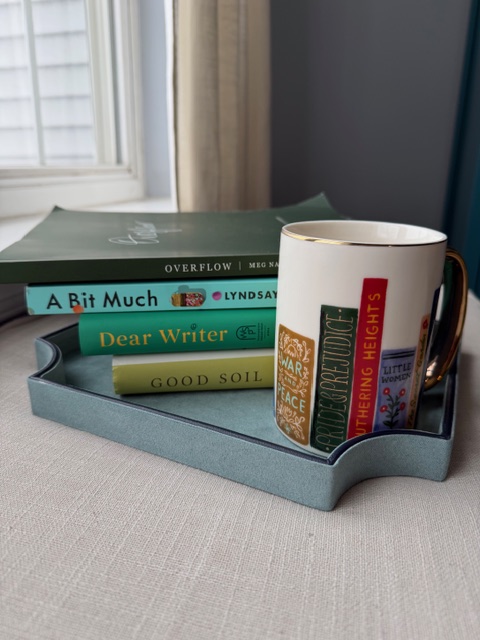
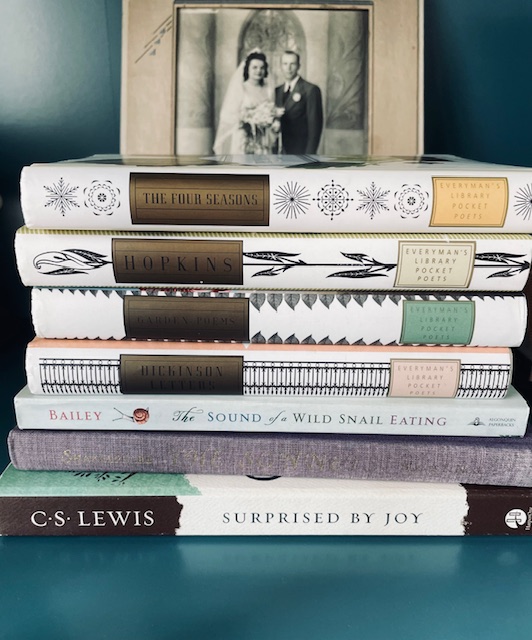
Poetry was a theme this year, with Terry and me completing 5 poetry books together. Although we both love Mary Oliver, A Bit Much by Lindsay Rush (#maryoliversdrunkcousin) took the lead. Her poem “She’s a Bit Much” affirmed me in ways that I had attempted to express in prose. Throughout the book, she takes insults or put-downs and turns them around to frame them in a positive way. The poems made me laugh, smile, and increase my wonder at the beauty of women and the way we live. Additionally, reading Maggie Smith’s Dear Writer also encouraged me to dabble in writing my own poetry.
My second book was the last fiction book I completed among all the great fiction I read this year, including Taylor Jenkins Reid’s Atmosphere, Kiran Desai’s highly acclaimed The Loneliness of Sonia and Sunny, and Amor Towles’ The Lincoln Highway. The Correspondent by Virginia Evans is a bittersweet story written in letters by Sybil, an older woman in her third act of life. You uncover what life events have shaped her and how, even in your last days, you can rewrite your story. It is filled with hope, tragedy, and old-fashioned piety. I love how she nails all mother/daughter conflicts with this statement “I know you think of me as your mother only, but please remember, inside I am also just a girl.”
My third book recommendation is Good Soil: The Education of an Accidental Farmhand by Jeff Chu. Chu leaves his profession to enter a theology program at Princeton, which happens to have a working farm that theology students help tend and learn from. He tackles topics like forgiveness, love, and hope. It challenged some of my theology regarding the meaning of the parable of the good soil. Chu says, “What if the parable wasn’t about categorizing good versus bad, healthy versus unhealthy, sinners versus saints? What if the parable were understood less as a prescription—you need to be the good soil—and more of a description of what was actually happening, both in the ecosystem around us and in our own lives? What if Jesus was describing the realities of both soil and soul, which were ever-changing and subject to outside forces?” Chu intertwines nature, his Chinese heritage, and his own unique Christian faith. Although I may not agree with all his conclusions, I can still glean from some of the truths he illuminates.
I read quite a few memoirs that dealt with some tough issues, including Tyler Merritt’s This Changes Everything, which deals with cancer, and Melinda Gates’ The Next Day: Transitions, Change, and Moving Forward, which grappled with the ending of her marriage and pulling out of the Gates Foundation. But Jen Hatmaker’s Awake (who happens to be Tyler Merritt’s girlfriend) was everything I hoped it would be and more. Just as with Chu, I don’t draw the same conclusions Jen draws, nor would she want me to. Instead, her vignettes of the end of her 26-year marriage, along with the unraveling of patriarchy, purity culture, and misogyny, echoed my own thoughts of the last few years. She articulates how purity culture produced “a crop of women who hated their bodies.” She talks about how “the church that raised me bears almost no resemblance to the one dehumanizing refugees.” Jen also defines and addresses codependency in ways that felt all too familiar. Although Jen has chosen to stop attending church while still believing in God, I continue to attend. I also hope to be a voice in the church that offers a Biblical way to support those who are marginalized.
Finally, my last book is Meg Najera’s Overflow: The Fine Art of Cultivating Joy in Sorrow. This book kept me grounded when life was swirling around me. Meg’s faith is imprinted on the pages in her beautiful words, intertwined with scripture. She unpacks principles such as prayer and repentance and explains how they will help us cultivate joy. She then shares a journal entry she has written that applies to the principle. In Entry 15, Meg shares, “Gratitude is a pathway to contentment and helps guard against the sin of covetousness.” Her writing is poetic, thoughtful, and practical. This book makes an excellent devotion that I intend to reread.
I am also a bit of a podcast junkie and like to include a podcast or two that have inspired me. This year, I am including two political podcasts. Phil Visher, of Veggie Tales fame, has created a media company that addresses political issues from a Christian perspective. Along with Skye Jethani, Kaitlyn Schiess, and sometimes Esau McCaulley, Phil hosts a weekly podcast called The Holy Post. It addresses hard issues like the death of Charlie Kirk, RFK’s vaccine standards, and ICE enforcement from a theological point of view. These thoughtful commentators interview other thinkers and authors to examine politics and foreign policy through a Christian lens. And it doesn’t hurt that the theme song reminds me of my children singing along with Bob the Tomato and Larry the Cucumber.
I also enjoy Pantsuit Politics hosted by Sara Beth Silverman and Beth Silvers. These women offer thoughtful commentary on political issues. They may lean in one direction, but work hard to provide balanced views. Both have a legal background and offer both a historical and legal perspective. They also end the news with something that is on their mind outside of politics, ranging from books they are reading to thoughts on how to raise children. They are widely regarded for keeping us “informed without the overwhelm or anxiety.”
I want to acknowledge that some of my recommendations are not for everyone. Nor do I endorse every single thought the authors put on paper. But reading outside your comfort zone about other viewpoints is a good thing. For me, it has opened my mind up to new ideas, increased my empathy, and challenged me to draw closer to Jesus.
I also want to share a new project that could take me years to complete. I am going to read a book set in each of the 50 states, and eventually every country in the world. I know this is ambitious, but I think it would help me see more of the world from my armchair. Also, I find it fun to set goals and work towards something.
I would love to know what you read in 2025, and if you didn’t read anything, there is no better time than 2026.

 By Sherry Collins