“Give her of the fruit of her hands, and let her works praise her in the gates.” Proverbs 31:31
I have a magazine subscription that is a splurge in my life. The path that led to this magazine started with stumbling upon a podcast. I am not sure how I found Radio Cherry Bombe. It could have been an Instagram post, another podcast, or a chef I was curious about. But somehow, in 2021, I started to listen to host Kerry Diamond interview women in the food industry. These interviews exposed me to the ingenuity of women despite barriers and how camaraderie and collaboration helped women become more successful. It was more than the delightful aprons created by Ellen Bennet for Hedley & Bennet, or the celebrations that Elisa Sunga hosted with her Cake Picnic. It was coming together as women, recognizing the obstacles that have held us back, and moving towards the future where women can be creative, lead, and live fully.
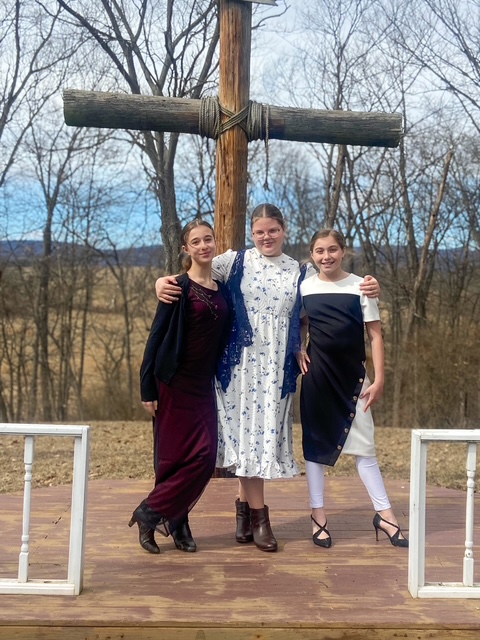
Last Sunday, I prayed with three young women. Our pastor instructed us to pray over one another a blessing of some sort for their future lives. I had been sitting behind the three young women in church, watching them interact with one another. Laughing, worshipping, and praying, I saw them connected in a way only tween/teen girls can be. They giggle at the same things, pretend disdain at adults’ attempts at humor, share heartbreaks and challenges with one another, and love each other fiercely. They are on the brink of womanhood, with so many dreams, goals, and ideas. When I came up to them, I didn’t have anything profound to say that spoke to their future. Instead, I felt led to bless their friendship and ask God to help them be hospitable whenever new tweens/teens entered the group. I prayed that God would help them enlarge their circles despite their strong connections. After a group hug, I felt as blessed as I hoped my prayer would be for them.
When I became a Christian, I was one of the outsiders coming into a group of friends that shared a history. They all attended a small Christian school while I attended public school. They could all sing beautifully and even had matching outfits for a vocal ensemble they were competing in. When I sang, it was less than harmonious. Yet, despite their connections, they were able to invite me to be a part of their group. I never felt like an outsider. They celebrated my wins and helped shape the woman I am today. Today, I am still in a relationship with two of these women, our friendship spanning almost 40 years.
This past Sunday was International Women’s Day. It was affirming to see women across different industries celebrating other women in their industry. Reese Witherspoon paid tribute to other actresses, Ina Garten honored Julia Child and Martha Stewart, along with other women who “were fabulous chefs and food writers.” Other women praised their moms, aunts, and teachers who made an impact on their lives.
In this post, I wish I could list all the women who inspire me. From my aunts to my sisters, to my oldest friends, to my daughter and daughter-in-law, to my newest friends, to my co-workers, to my volunteers, to all the young women in my life—you are all amazing! I hope to always be your biggest cheerleader, to sit by your side when life is hard, and to advocate for you when life seems unfair. Thank you for being amazing women, and let’s continue to make this world a better place for all women!
“And the streets of the city shall be of boys and girls playing in its streets.” Zechariah 8:5
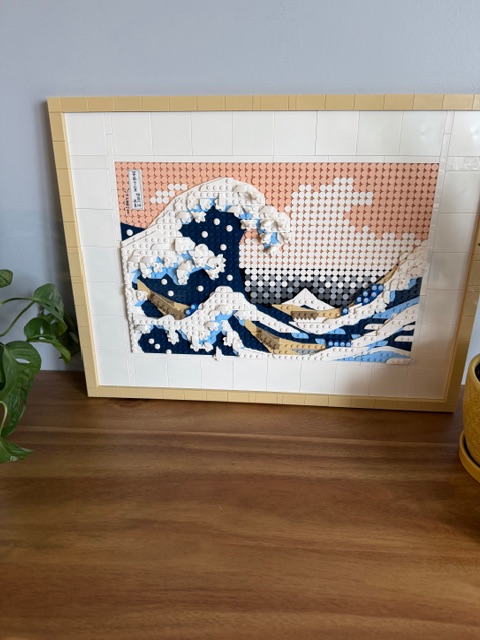
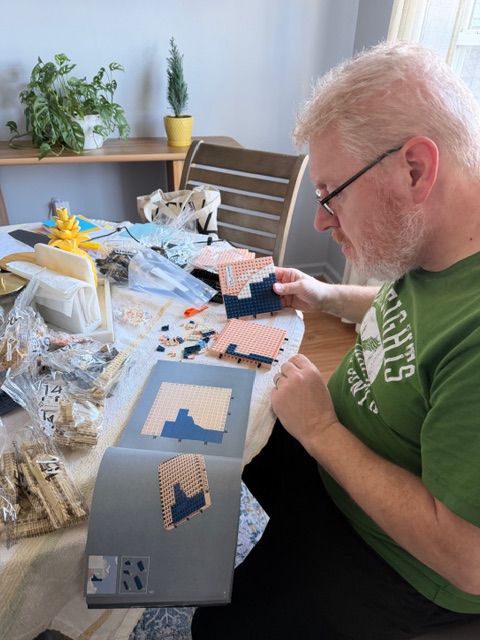
Four weekends ago, my husband played for hours. No, he was not playing the piano. No, he was not playing on his phone. And no, he was not playing with our grandchildren. All these things would have been perfectly acceptable. Instead, he was playing with Legos, a gift he had received for his birthday from our daughter and son-in-law. And for multiple hours across two days, Terry built the art piece The Great Wave by Hokusai.
Too often, as an adult, I viewed playing as strictly for children. I understood the importance of play for children, how it helps them develop their social skills, increases their creative muscles, builds strong neural connections, and helps make sense of the world. I invested in toys that fostered open-ended play and was careful not to overcommit my children to outside events. Simply, I let them play for hours uninterrupted.
As an adult, I forgot how to play, if I ever even knew how. I bought into the idea that as a Christian American, I needed to be constantly productive. I cleaned my house, prepared Sunday School lessons, read books that would help me grow as a Christian, and then started all over the next day. By the time I hit my mid-forties, I was exhausted. I had lost my joy, and I was measuring everyone else on their productivity. I did not know how to live differently.
Meanwhile, my daughter, Maggie, was in nursing school. Throughout the semester, she was extremely focused, studying and watching videos on the subjects she had covered in class. When spring break came along, Maggie decided to put the books down briefly and play. Over the course of two days, she baked and frosted a cake to look like a log with fondant mushrooms. The cake turned out amazing and I asked her why she made it. Her response was simple, “Just for fun!” It allowed her to express her creativity and provided a much-needed break from a semester of intense learning. She did not make the cake for an occasion, but simply for her own pleasure. It was a whimsical art piece in the form of a cake. It was play.
This awakened a desire in me to be more playful. I no longer saw her baking as a waste of ingredients and time. Instead, I saw how it brought joy to Maggie’s life. I started by dabbling with sketching flowers, bees, and artichokes with colored pencils. I cooked elaborate ethnic dishes with new spices, filling my home with exotic scents from around the world. I explored the idea of writing by both blogging and journaling. I was becoming more playful.
Research has indicated that playing as an adult is just as beneficial as it is for a child. Playing releases endorphins, reduces cortisol levels, and fosters relaxation. It improves cognitive flexibility and memory. Many play activities strengthen bonds between family and friends. Just like sleep and good nutrition, play is something we should prioritize in our lives.
Still, I struggled with playing, feeling like I was a bit of an outcast and still too judgmental. I was not a conventionally playful person: I don’t enjoy practical jokes, rarely get punchlines, find the Three Stooges stressful, and still thought video games were a waste of time. I did enjoy whimsy—driving an hour to explore a new indie bookstore or a pastry shop that featured canelé. I could sit for hours listening to people tell their stories. Yet I felt like I was still missing something, lacking the fundamental gene to be truly playful.
The National Institute of Play, a nonprofit organization that “recognizes, supports, and promotes the science of play” helped clarify my internal quandary. On their website, they had a link to a quiz to assess your “play personality.” This is “the style or mode we feel most comfortable being playful.” Just the concept of different play personalities freed me. It allowed me to celebrate who I was without trying to fit into the traditional modes of how others played. It was okay for me to not have a favorite Stooge. It also helped me see how my judgment of different forms of plays was just as harmful as how I viewed myself. People do find video games fun because their play personality is competitive, while others find attending car shows fun because their play personalities are wired to be collectors. Before taking the quiz, I knew instantly that I was not the joker or the kinesthetic play personality. I also knew I was not likely to be the competitor or the collector, but I was not sure if I was the director, explorer, creator/artist, or the storyteller. After answering a few questions, my play style leaned towards a storyteller. That seemed to fit since I readily indulge in books and podcasts.
The greater truth is less about my play personality, but more about the idea that play looks different for everyone. I have friends who love to go into our town’s cat café and pet cats for hours. This is their form of play. For me, cats pouncing on their cat gyms would be stressful and cause an allergic reaction. These same friends may not enjoy listening to our local bookstore owner’s pontifications about the history of our local library. Some people enjoy pranks with big stuffed dogs, others love to play board games, while still others enjoy digging in the dirt, creating flower beds that bloom all season.
I believe play is important to God. He created the world in six days and designed a day for us to rest. He designed lambs to frolic in the fields, otters to splash in rivers, and birds to have elaborate mating dances. Jesus’ first miracle was to turn water into wine, to ensure that the wedding was a success. Play is important, and I will continue to prioritize play in my life. I will no longer judge others by how I play but will celebrate their own version of play. Productivity is important, but productivity without play is living life as an automaton.
“They are like trees planted along a riverbank, with roots that reach deep into the water.” Jeremiah 17:8
Terry and I drove by our old house and were devastated when we saw the maple tree we love had been massacred. Yes, this is a slight exaggeration; we were devastated because our maple tree had been trimmed to fit the stereotypical tree shape most HOAs dictate. Gone were all the branches that countless children had dared to climb. Gone were the low-hanging branches that we ducked under while we mowed the lawn. Gone was the canopy that provided backyard shade on hot days. Yes, the tree was still there, and I am sure it will fill out beautifully next year. But right now, it is half the tree it used to be, and I mourn the memory of the maple tree that was.
My husband loves trees and shares this passion with me. His absolute delight is contagious, and I, too, have fallen in love with these majestic monuments of nature. They provide many benefits for us: cleaner air, cooler temperatures, better stormwater management, improved health by reducing stress, and the creation of habitats for wildlife. I have done a deep dive on trees with books like The Hidden Lives of Trees, Reforesting Faith, and the most recent, Tree Collectors. These authors have helped me see how trees are communal, distinct, and important to God.
But more than reading about trees, I love taking walks among trees. Whether it is a park where a weeping willow is swaying in the wind, or down a city street where Ginkgos have been planted. I love to explore the woods where I walk on needles and smell the scent of pine trees. Like a child, I stop to pick up leaves, run my fingers across the bark, and gaze up to look at the crowns of oaks, birches, and elms.
“For God has not given us a spirit of fear, but of power, love, and a sound mind.” 2 Timothy 1:7
Seven weeks ago, we spent a beautiful time in picturesque Charleston, South Carolina. Rainbow Row and its cobblestone alleys felt like I was entering a new world where elves and pixies danced among the ivy- and moss-covered stones. The southern live oaks dripping with Spanish moss helped my tense shoulders relax and my whole body lean into the low country vibe. The Pineapple Fountain reminded me to remain open and hospitable despite some of the anxiety I had felt in the past few months. And the sunset cruise on the harbor reminded me of the goodness and faithfulness of God.
My lack of writing was an indicator that my life had reached a point where I had lost perspective. My inability to open my gratitude journal demonstrated that I was feeling hopeless. The utter exhaustion I felt from the time I rose till the time I lay my head on my pillow reminded me that something was not right. And when words failed to be released from my lips to God in prayer, sitting in silence, just feeling His presence was a sign that things needed to change.
One of the changes I made was starting a new Substack account last week, a place for me to share my thoughts. It was also a new place for me to be inspired, to create, to receive beauty and truth, and to re-focus. I still have no expectations about my writing. I just know that when I stop, I lean too much into the busyness of life and forget to reflect on the goodness of God. Writing helps me turn the chaos and despair I may be feeling into peace and hope.
Last week, I posted the first of a series of writings I am calling Musings. Musing is defined as a period of reflection and thought. Although some of the pieces I am writing are related to current events, these musings that have been marinating in my brain for the past few years. They reflect the tension I feel between who I was and who I am becoming. I am still a Christian, I still find my identity in Christ, but I am trying to navigate the chaos around me while staying centered on Jesus. This finds me in a different place than I was 10 years ago, 5 years ago, or even a year ago.
I would love to hear feedback about these pieces. I am in no way trying to tell anyone what to believe or think. Instead, I hope you feel I am taking you on a journey where I explore that tension I feel. Tension is not bad; it is at the heart of every good story, spurs new inventions, challenges us to research, creates music, and defines art. Tension is only bad when we stay focused on what should be and what is not. I hope my exploration helps you see how I am breathing during this tension, becoming the woman God has called me to be.
“When I look at your heavens, the work of your fingers, the moon and the stars, which you have set in place, what is man that you are mindful of him, and the son of man that you care for him?” Psalm 8:3-4
In the 1970’s, having a copy of the World Book Encyclopedias was as important as having a 45-inch flat screen TV today. Despite earning below the poverty line, my mother made monthly payments for us to have those treasures of knowledge, and the Childcraft books that came with it. These beige embossed vinyl books captured my imagination. I would peruse the first volume, pouring over the nursery rhymes making my way through longer poems flanked by delightful artwork. I explored the other volumes, but always came back to the poetry volume reciting Simple Simon Met A Pieman and envisioning magical forests while reading The Sugarplum Tree by Eugene Field. Something about poets’ distinct words conjured up images for me that seemed otherworldly compared to the harsh reality of life. My love for Volume 1 was imprinted with the oils of my fingers, making the embossed covers look worn and beloved.
I stopped reading poetry around age nine. I don’t know what stopped me from delighting in words. It is possible life just became too hard. I didn’t have the time to slow down and let the poets romance me because I was too busy keeping secrets. It could be that in English classes we poured over structure and rhyming schemes, making poetry seem mechanical. It may have been that the areas where poetry touches, feelings and nature, were not familiar or restorative to me. All I know is, for many years, I stopped engaging in my childhood friend, poetry.
Later, with my children, I explored poetry while home educating them. Charlotte Mason, one of my major educational influences, remarked that “poetry could cultivate the seeing eye, the hearing ear, the generous heart.” We read a free verse picture book titled Daring Dog and Captain Cat where family pets had nighttime adventures. As I read the book aloud and found the rhythm, I delighted in the images the author painted with words, like “kitchen pans banging breakfast songs.” Yet, I held poetry at a distance, still believing that my lack of intelligence or imagination prevented us from forming a relationship.
Ann Voskamp, and her poetic prose best seller One Thousand Gifts: A Dare To Live Fully Right Now slowly enticed me back to poetry. Her descriptions of soap suds dancing in the air, and the colors of sunrise captured my senses. I, too, began to write down things I was grateful for, paying attention to how the steaming cup of coffee warmed my hand and soul. I too, listened to the songs of birds chirping and the smell of lilacs wafting across my patio. And, like Ann, “when I’m always looking for the next glimpse of glory, I slow and enter.” This created the soil where my love and appreciation for poetry could grow and thrive.
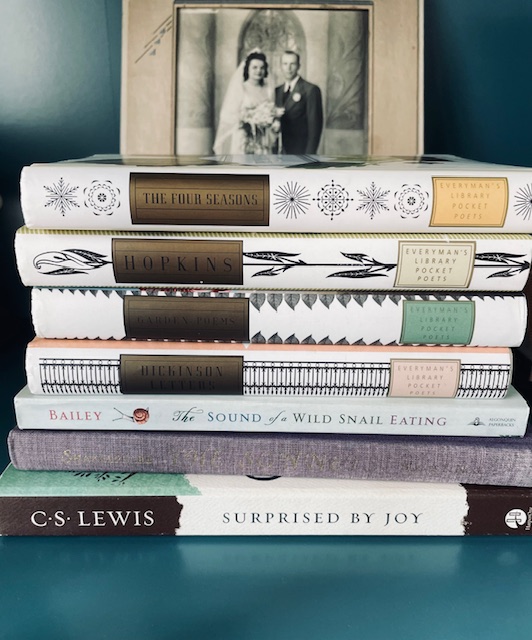
Later, when I was experiencing a lot of life transitions, I was encouraged by authors like Joy and Sarah Clarkson to start reading poetry once again. I picked an anthology, The Four Seasons Poems, edited by J.D. McClatchy in spring of 2018. This compact book, from a series called Everyman’s Library Pocket Poets, stayed at my bedside for a year. Regularly, I would read a poem aloud, listening to how the words danced across my lips, savoring the images the poets created. Sometimes, I could smell the plowed spring earth ready to bear seeds, feel the soft summer wind brush my hair across my face, hear the crickets play their fiddles in fall, and see the giant snowflakes flutter to the ground. As I did this, I found myself paying more attention to the world around me and feeling more appreciative of God, the creator of all things beautiful.
This small book opened up a new world. I began to crave poetry and found both old and modern poets I loved. Christine Rossetti, Wendell Berry, Mary Oliver and Maggie Smith soon became treasured friends. I encouraged my husband to join me, and soon we were reading poems aloud to each other in the evening. I started to open my imagination to answer Mary Oliver’s question in The Summer Day “Tell me, what is it you plan to do with your one wild and precious life?” I started to think harder about where I lived and how I can create community because of Wendell Berry’s insights. I contemplated how I can contribute to making this world beautiful by reading Maggie Smith’s Good Bones. Each poet helped me adjust to the transitions in my life and see that I had a full life ahead of me.
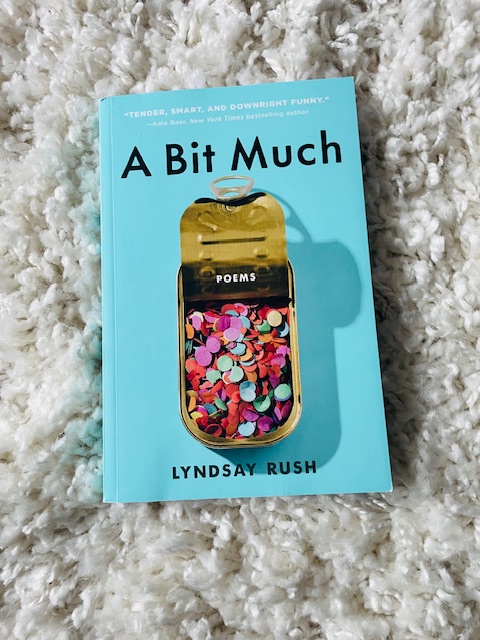
I also saw how poetry can address justice, body positivity, and other issues our world faces today. Amanda Gorman called for “unity, collaboration, and togetherness” as she recited her poem The Hill We Climb at the 2021 Biden inauguration. With her bright yellow coat, she stood elegantly and resolute capturing the hearts of Americans. Kwame Alexander connects young African American men to the importance of family by using sports analogies in his visual poems. Lindsay Rush addresses the stereotypes and stigma women feel in her book of poetry A Bit Much.
My husband tried tiramisu years ago and was disappointed. After two attempts, he concluded that he didn’t like this famous Italian dessert. We then heard others drool and rave about our friend Nate’s famous tiramisu. Everyone requests this dessert from him, and some unashamedly eat it before the main meal at church dinners. After a couple of years hearing about all the fuss and gentle prodding from me, Terry decided to give it a try. His first bite into this rum, espresso, creamy mascarpone concoction opened his eyes to this Italian treasure. The reality is he did like tiramisu, he just needed to find the right recipe for his taste buds.
I have heard from many people resolute about their distaste of poetry for much the same reasons I had vocalized in the past. But like Terry’s experience with tiramisu, it may take some trial and error for you to find the right poet or poem to speak to you. As a Christian, we should challenge ourselves to read poetry because it is a writing technique God used in the Bible. He knew the power of imagery and expressing emotions speaks to the heart of all people. Audre Lorde says “poetry is not a luxury. It is the vital necessity of our existence.”
Here are a few ideas on how to engage in a poetic relationship. Start in Psalms, and although we lose some of the rhythm due to translation, read a few aloud. Pay attention to the imagery and emotions being expressed, and how vulnerable the writer was being. Then, look at some anthologies, like a poem about seasons or gardens, or even a poem a day. Read the poem aloud following the punctuation, it may feel awkward the first few times, but eventually you will feel the heart of the poem. If it describes plants or places or animals you are unfamiliar with, look those images up. I had no idea what a snowdrop looked like until we explored Winterthur Gardens. Now, all the late winter/early spring poems about the snowdrop flower make sense. If reading a book of poetry seems to be daunting, explore some poetry podcasts that read a poem aloud such as Slowdown or Daily Poem. Finally, if one poem does not speak to you, leave it behind. But if it does, take the time to savor the words and images. Maybe even annotate the poem by underling the lines that jump out at you. Also, explore some modern poets like the ones I mentioned in this blog post. Keep trying, because one day you will find a poem that speaks to you.
It is National Poetry Month, so give a poem a try. I promise you will like it!
“Give her of the fruit of her hands, and let her works praise her in the gates.” Proverbs 31:31 ESV
For our first Pennsylvania Thanksgiving, both my sisters and my in-laws made the trek from Wisconsin, Nebraska, and Illinois to celebrate with us. We had our traditional turkey feast and squeezed in an early Christmas with everyone as well. To keep the season festive, I made everyone’s favorite Christmas treats: Hershey Kiss Cookies, Peanut Butter Balls, Haystacks, Thumbprints and Carrot Cookies. My sister’s boyfriend came with her, and I assumed he would find a cookie amongst our favorites that he would like. When I noticed that Jamin was passing on the cookies, he politely shared that he didn’t like nuts, peanut butter, or carrots in cookies. I felt bad and promised the next holiday we had together, I would bake his favorite cookie or treat. I asked what he liked, half expecting him to announce sugar or gingerbread cookies. His eyes lit up and he exclaimed, “Cornflake Wreaths!” He explained that he and his mother had a tradition of making these treats, and he emphasized the importance of the red-hot candies. Terry snickered in the background, because he had been asking for years to add these same treats to the holiday baking list. I half-heartedly agreed but kept putting them at the bottom of the list.
So, next Christmas, I finally decided to make Cornflake Wreaths for Terry. I looked up the recipe and immediately presumed there was a mistake: 1 tsp. of green food coloring? Surely, that was a misprint, since food coloring is typically measured by drops. I adjusted the food coloring, added a few extra drops, then attempted to form the wreaths. When it was all said and done, my blob-shaped wreaths were the shade of a sick Grinch. I snapped a picture and sent it to Jamin asking what I did wrong. He informed me that buttered hands were necessary to shape the wreaths. He also said a lot of green food coloring was necessary to get the right shade. And when you think you have enough, add some extra.
There is a new poet, Lindsay Rush, known on Instagram as Mary Oliver’s drunken cousin, who wrote a poem that went viral and has since become my poetic life mantra. It is titled “She’s A Bit Much.” She takes a common insult made about women and turns it into a compliment. She compares the insulted women to confetti, sprinkles, and the bonus French fry at the bottom of the bag, someone we are to celebrate, and she ends with the line, “Aren’t we lucky she’s here.” Her poem points to a bigger truth: insults made about women, such as she is a bit much, too bossy, manipulative, too driven, not feminine enough, etc., are more about putting women into a box that minimizes their God-given attributes when they should be celebrated.
As I child, I was labeled as bossy by some adults in my circle. I had budding leaderships skills, and needed adult guidance to help develop those skills in a healthy manner. Yes, some children with leadership skills can develop into narcissistic dictators, but most children just need adults to help them recognize that being a leader is not just giving orders but inviting others along to accomplish a goal for the greater good. It is interesting that boys are rarely described as bossy; words like charismatic or having leadership potential are used instead.
I have also been accused, in some circles, of being “too much” and have had conversations with other women who have also been unjustly accused of this as well. Introverted, mild mannered Christian women are held up as the more palatable and less offensive role models. According to the Bible, we are all expected to be humble, gracious, and gentle. Those character traits are not just limited to the female gender. But somehow, we associate those traits with quiet females. I think I can be “too much” in some people’s eyes but still exhibit the fruits of humility, graciousness, and gentleness in my life. It is just how those fruits are manifested that might be different than some of my introverted friends.
The point is, we label women with negative traits that we rarely use to describe men, and somehow, we think that it is okay. Although I don’t like being called bossy or “too much”, I find myself putting other women into a box with the label “brassy.” These so-called “brassy” women boldly state their opinions or ask for what they need from others without qualifications. We all need to learn a level of hospitality and be careful that we are asking and not demanding. Being bold and direct are not bad traits, and I must be careful that I am not labeling a bold woman as brassy when I don’t apply the same standard to men.
Like most consumers, I can be drawn in by certain labels. Terms like “sustainable,” “supports local farmers,” and “produced in small batches” are like catnip to me. I also look for labels in a bookstore and rush to the poetry, memoirs, and literary fiction sections, avoiding the fantasy and science fiction shelves. These labels help me pursue what I am looking for. But when we broadly label women negatively, we impose limits on what we think they can and should achieve, which can sometimes become self-imposed limits.
One of the most controversial women today, Meghan, the Duchess of Sussex, addressed these labels or archetypes on a podcast she did in 2022. She understands firsthand how labels can destroy when the media and trolls describe her as a “gold-digger,” “fake,” “family destroyer” and far worse. She interviewed some women, including Serena Williams, Paris Hilton, and Mariah Carey, exploring the origins and consequences of being labeled ambitious, a bimbo, or a diva. These women shared how they have let go of the negativity and, in some cases, changed the definition to a positive one. One thing from her podcast that stuck with me is when Serena Williams talked about negativity in relation to a woman being described as ambitious. Serena explained how for a long time that label hadn’t impacted her until she met her husband. But then people started describing her ambition in a negative light. “So, since I’ve felt the negativity behind it (referring to ambition), it’s really hard to un-feel it. I can’t unsee it, either, in the millions of girls and women who make themselves smaller, so much smaller—on a regular basis.”
Serena articulated something that I believe most women have felt in their lifetime, and I have no doubt that all the young women I care about have also felt it. When we are labeled as too much, bossy, brassy, and not feminine enough, we often find ourselves becoming smaller, shrinking our influence, agency, ambition, drive, and talents. This often leads us to imposter syndrome where we think we don’t measure up. We then start to second guess our instincts and minimize the character traits that reflect our creator.
Years ago, my husband had a meeting with some people and the subject of me came up. I had been feeling for a while that I was doing something wrong and felt like I was being pushed out of what I deemed the inner circle. Terry directly asked if there was an issue with me. The people in the meeting immediately said no, but one person qualified that sometimes, “Sherry can be too much.” They continued, implying that I can swoop in and get a job done, almost making the “too much” more palatable. But clearly, no one in the room but my husband believed this was a good trait.
Later, when I heard that I was “too much”, I instantly felt swallowed by shame. Hadn’t I written prayers time and time again in my journal asking God to help me be meek and mild? Hadn’t I come to this same group, bearing my soul in one of the worst moments in my life, and pursuing God with humility? Hadn’t I become smaller, hiding my natural extroverted inclinations to fit in with this group? Apparently, despite my best efforts, I was still “too much.” At that point, I was still desperately trying to fit in, so instead of affirming that my “too much” was enough for God, I did the opposite. I became smaller by being less talkative, less present, less involved, and less joyful.
There is one woman in the Bible who did not shrink in a time of need. Esther and her people were facing total annihilation. At first, when confronted by her cousin Mordecai to address the king, Esther started to shrink. Yes, she was the queen, but she still had to submit to the king. Boldly approaching his throne without being called for might lead to her own death. But Mordecai challenged her with these words found in Esther 4:14, “For if you keep silent at this time, relief and deliverance will rise for the Jews from another place, but you and your father’s house will perish. And who knows whether you have not come to the kingdom for such a time as this.” Esther thought about what he said, and replied with a plan, ending with “and if I perish, I perish.”
Esther decided to go big and be who she was called to be, realizing that shrinking will lead to certain death, but the unknown gave her agency, allowing her to call the shots. By being who God called her to be, she was able to command the king’s attention and save her people and herself. I wonder how many of us women have shrunk in times we were needed because of what others have said about us, and how that leads to us slowly dying inside, never fully living the life we are called into.
In the circle that thought I was “too much”, I was slowly dying and becoming less of who I am. But I am no longer in that circle and have found a safe place to be all that God has called me to be. Yes, I still have character traits that must be balanced and smoothed out. But God’s guidance will help me fully be the woman He created.
I need to talk more about these issues with my friends. When I hear a woman being labeled, I should challenge the speaker with grace, trying to expose how these labels constrict, damage, and restrict women. I also need to address my own complicity in the problem, making sure I don’t fall into the trap of labeling others. I can encourage young women to be exactly who God made them, growing in true inward holiness. This will help #AccelerateAction in removing gender biases.
Sometimes, we need extra food coloring to make things right. Sometimes we need to turn insults into something positive like Lindsay Rush does in her poetry. But we always need women to operate exactly as they were designed; not labeled in a way that brings death but brings life.
“I praise you, for I am fearfully and wonderfully. Wonderful are your works; my soul knows it very well. My frame was not hidden from you, when I was being made in secret, intricately woven in the depths of the earth.” Psalm 139:14-15
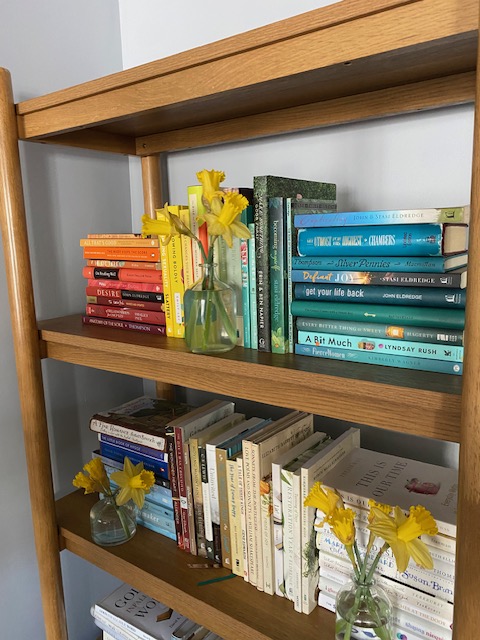
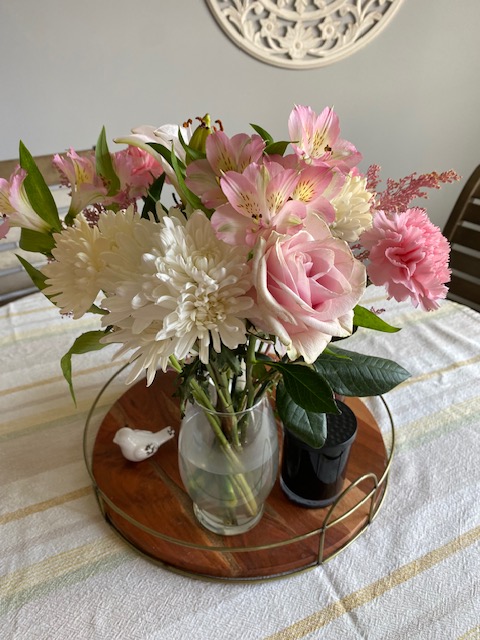
I can smell spring in the air, the faintest scent of dirt exhaling after its long winter slumber, while birds sing their morning songs. The air is still cool, but the sun and the wind whisper warm breezes, hugging my body. Even my music playlists are changing, from the mellow rhythms of yacht music to the upbeat melodies of Cole Poter and Frank Sinatra. To commemorate spring and offset my curmudgeon attitude due to daylight savings time, I bought myself some grocery store flowers. It started when a small bundle of daffodils smiled at me from their bucket. Then I saw another bouquet, full of light pink and white flowers that physically embodied the sounds of robins chirping. Initially, I was going to bundle both bouquets together. I later decided to spread the joy in four separate vases, creating expectant hopes of spring around my home.
The kinds of flowers a person is drawn to are a unique fingerprint of their personality. My mother-in-law loved impatiens, geraniums, and pansies, flowers that grew abundantly, giving her a lot of blooms for her budget. My mother loves ordinary carnations because they last a long time, allowing her to savor the blooms. My daughter’s love for ranunculus helped determine that she would have a spring wedding, so that her bouquet would drip with the delicate pink and yellow blooms. I love daisies because, as Meg Ryan’s character asked in You Got Mail,“Don’t you think daisies are the friendliest flower?”
It is interesting that God designed flowers to be unique. Some have massive heads with lots of tiny individual flowers like hydrangeas, some have intricate patterns like dahlias, and some are just little cups of joy like buttercups. There are even different varieties amongst the same species. Soon, pockets of daffodils will fill fields with sunshine, but if you look closely, you will see some with bright yellow heads, while others are the color of butter. Some will have curvy petals, while others will be fringed with lace. I am delighted our God, in His master artistry, took the time to create flowers unique and individualistic.
In the past few years, I have been on a journey to better health. I have had some setbacks in the last two years, gaining back a lot of the weight I had lost. But I am choosing not to focus just on numbers but on being more active, gaining strength, and becoming more flexible. I am also choosing not to be ashamed of the body I am living in and have bought clothes that fit me well and make me feel comfortable. But as much as I am working towards not being ashamed, I have still let other people around me make comments that demeaned me and others about the size of our bodies. I let the comments slip by, wishing now I had been courageous enough to address how these comments harm women.
One of the comments had to do with a local theater production an acquaintance saw. He noted that the production was good but commented that the female lead seemed too “big for the role.” He felt her size made her less believable as a love interest, although she could sing and dance “well enough.” I listened in disbelief. I am sure that, even in local productions, there were several women trying out for this role. I am also sure that some of the women would have fit his idea of what the lead should look like. But this woman was chosen above every other option because she was the most talented for this role. Additionally, I am curious how “big” this woman really was? Were his perceptions of “big” defined by his narrow view of how a woman should look?
The second comment was made directly to me about me. A different acquaintance of mine looked at the back cover of my book and asked if I dug out my “yearbook photo” for my picture. He didn’t comment on the fact that publishing a book is a major accomplishment. He didn’t remark on how brave I was for addressing a difficult subject or how well my daughter had designed the cover. His only response was pointing out rather unsubtly that I had gained weight. Again, I was stunned by his remarks and started to justify my choice of picture and even casually remarked that I recognized I had gained weight. Meanwhile, he quickly put the book down and started rambling about his upcoming adventure. I left that conversation demeaned.
It is stunning to me that in 2025, despite all the work that has been done in this area, women are still being judged by our size, appearance, and age. We celebrate women such as Andie McDowell who decided to go grey naturally, and Pamela Anderson who decide to walk the red-carpet sans makeup. Yet, Millie Bobbie Brown, a 21-year-old actress, was trolled by critics as “aging badly.” Keely Shaye Bronsan, the wife of actor Pierce Bronsan, is often pictured with before and after pictures, pointing out her weight gain. And if a celebrity has recently lost weight, the assumption is made that she used Ozempic.
I remember writing the author’s biography for my book. As Terry was helping me with the correct wording about where I lived, he added the words “Sherry currently lives in south-central Pennsylvania.” I reacted viscerally to that statement and stated rather emphatically, “I don’t want to take up that much space in my author’s biography. Where I live is not the most interesting thing about me!” I feel the same about my appearance and weight loss/gain; that is not the most interesting thing about me. How I love and care for my family, what I write about, my job as a volunteer coordinator, my passions, and, most importantly, my faith are far more interesting than whether I choose to dye my graying hair, or whether the numbers on the scale have increased or decreased. I do enjoy wearing a nice outfit and taking the time to care for my skin and hair, so I feel confident in accomplishing the things I want to in my world. I do want to move towards a healthier lifestyle so I can live a long and active life. But I don’t want to be defined by my age or my size anymore. And I will no longer tolerate comments made by others that demean me or the women around me.
Ilona Maher is one of the most body-positive role models for women. Maher won a bronze with her American Rugby team at the Paris Olympics this past summer. One of the comments on her social media speculated that she had a BMI of 30. Maher pushed back in a viral TikTok video, confirming she had a BMI of 29.3. She went on to say that the BMI was designed to represent males and was not an accurate representation of what a healthy female athlete’s body looks like. She also stated her weight boldly, remarking that she was not meant to live in a small body. Finally, she stated to the naysayer, “I am going to the Olympics, and you are not!”
If God designed flowers so uniquely, why can’t we accept that women live in different sized bodies, have different facial features, and have different shapes? Why are little girls in middle school still struggling with eating disorders and cutting due to bullying about how they look? Why is “You look fat!” the worst thing you can say to a woman or a girl? And why do we still think appearance, no matter the age, is the most interesting thing about a woman? I am sick of hearing people’s first remarks about a girl or a woman being “She is so pretty,” and then extolling her character, talents, and skills only as secondary considerations. When people remark about a young man, they lead with his character, skills and talents, and rarely address his looks. Will this ever change?
It can only change if I admit how I contribute to the problem. I can work on changing my own language and make sure my comments about women and girls address the character, skills, and talents they offer our world. When I am faced with demeaning comments about women related to their appearances, I can challenge the offender with kindness and curiosity, hoping to make them aware of how their comments demean women. Finally, I can keep addressing the subject with women in my community, hoping that little by little, we can move the conversation forward and #Accelerateaction in conversations about gender bias.
One thing I know for certain is that God made hydrangeas, tulips, and bluebells to be different. And if He was so careful to design flowers differently, I have no doubt that He designed humans to look differently as well, and I believe He looks at His creation and declares it good. It is my responsibility to live well in the body I have been given!


 By Sherry Collins