“The way of a fool is a right in his own eyes, but a wise man listens to advice.” Proverbs 12:15
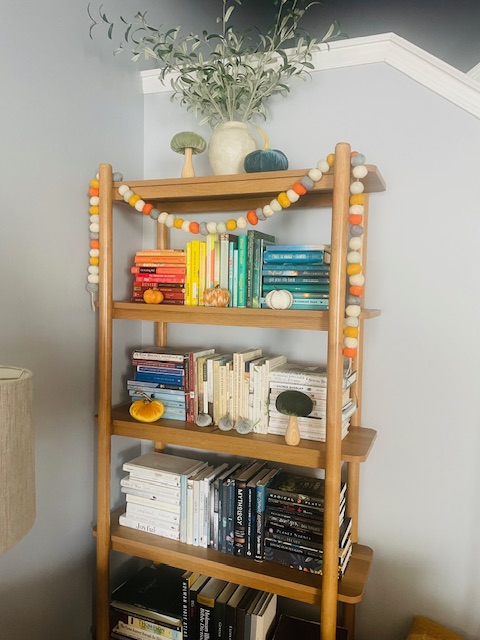
It is finally cooling down, and you can see the leaves getting tired and worn out, ready to shed their verdant color and expose the red, yellow, and brown of Autumn. Squirrels scurry on the streets, desperately trying to grab every nut and seed they can find before winter. Pumpkin décor scatters my bookcases, the spicy apple butter scent has already permeated my home, and I just made my first pot of chili. And, yes, I have had more than my share of hot and cold pumpkin spice drinks. This has been and continues to be my favorite time of the year.
Fall always feels like a time of transition—a time to get cozy and embrace hygge living. You can learn more about my love for hygge in an earlierpost. This fall, more than ever, I look forward to lighting candles, cozying up under a throw, and listening to my cousin Johanna’s classical spooky playlist. It is a welcome change after a summer filled with swirling noise, making everything feel murky and confusing.
But practicing hygge this season would not be enough. I had known for a while; it might do me some good to start counseling—to follow the advice I had given to so many recently. But sometimes it is easier to give advice than to follow it. Almost two months ago, I took the plunge and went back into therapy. I needed some help processing the aftermath of publishing my book. I also needed some help reconciling the things I had been taught about faith with what Jesus taught, as some of it felt incongruent. So, I found a licensed counselor who could help me reorient myself and clear up the murkiness I was feeling.
I am too early in the process to fully disclose what I am learning about myself and about God. I can say that I still believe God is good. I can also say that thirty-six years ago I had a life-changing experience that filled me with peace and joy when I asked God to fill the empty space in my life. But beyond that, I am still figuring out how to hold Jesus in one hand and the obstacles of life in another.
Transitions are hard, whether you ask for them or they come unexpectedly. This whole blog experience was because I was facing transitions. I had no idea that in this process, I would be expanding my views on God and finding a fuller message of the gospel. But in that process, I have learned some unpleasant things about myself, things I need to work on. One of those things is that I can be extremely passionate when I make a change or discovery, and that enthusiasm or passion can make others feel judged. I am also learning to give myself more grace, articulate to others where I am at, and fill my life with gratifying things.
It’s Autumn, and I don’t have a bucket list of things I want to accomplish. I just want to keep my heart open to whatever God has planned for me. I want to work on the things that I can control and leave the rest in His hands. I also want more pumpkin spice!
“A fool gives full vent to his spirit, but a wise man quietly holds back.” Proverbs 29:11
I have always wanted to time-travel to the 1960s and be a flower child. I imagined listening to the Beatles and Jimmy Hendrix on 45s. My closet would be radiating hippy vibes with peasant blouses and platform shoes. As a college student, I would participate in civil rights protests, while remaining drug free. I know that is a bit unrealistic given that most college students during that time experimented with LSD and mushrooms, but I would still be me, a bit of a rule follower. I wanted to live in a time when it felt like important things were happening and I was making a difference.
In romanticizing that era, I forget that in a space of 5 years, 4 major political figures were assassinated: President John F. Kennedy, Malcom X, Robert Kennedy, and Martin Luther King, Jr. Despite the peace signs and mellow commune living, I am sure that all people, mushrooms or not, experienced anxiety, grief and turmoil over these deaths. They didn’t have up to date information on the manhunt for the shooters. Images of the actual assassinations were grainy, taken with cameras far less superior than most iPhones. Often, they had to wait until their “regularly scheduled program” was interrupted to get the latest updates.
In the last 5 years, we have also faced political violence resulting in 3 political assassinations. These acts of violence include the plot to kidnap Michigan Governor Gretchen Witmer, the January 6 violence at the US Capitol, Nancy Pelosi’s husband attacked in her home, 2 assassination attempts on President Donald Trump, a firebomb thrown at PA Governor Josh Shapiro’s residence, 4 shootings of Minnesota lawmakers and their spouses in their homes, resulting in 2 deaths, and the assassination of Charlie Kirk. Add the attempt on Justice Brett Kavanaugh and the shooting at the CDC, and these acts of violence feel unprecedented in my lifetime.
Some things have changed since the 60s: Swifties replaced Beatlemania, neutrals replaced the bright patterns (except in my wardrobe), and retro sneakers replaced platform shoes. While fashion and music have changed, how we respond to political violence has not changed. We still turn some victims into martyrs while villainizing others. Conspiracy theories float around and become the leading narratives. People call for protests, speech to be censored, and more stringent laws to protect those they believe are innocent.
I could fulfill my past flower child dreams by making signs and marching in my city square or state capital, protesting on behalf of those I feel are being oppressed. I have been given the opportunity to join some protests in recent months by some of my friends. I could also write a click bait comment online, waiting for likes and dislikes to hit, based on my algorithms. But protesting and tweets don’t feel like the best approach for me at this moment. Instead, I am learning to pause, think, and reflect before I speak and act. My family and friends could attest that this approach doesn’t come naturally to me. I am far more comfortable speaking than being silent. I readily look for solutions and ways to apply them. This rhythm of pause, think, and reflect is a learning process that I continue to develop in my life.
In my time of reflection, I am trying to balance my news intake by hearing both sides. It helps me to see all victims of political violence as real individuals with families who love them, pets they cared for, and people who believed in them. Erika Kirk’s answer to her 3-year old’s questions as to where her daddy, “He’s on a work trip with Jesus so he can afford your blueberry budget,” was absolutely heart wrenching. Equally as devastating was the statement made by Sophie and Colin Hortman, children of Minnesota Rep. Melissa Hortman and her husband Mark, who were shot in their home. They encouraged others to honor their parents’ memory by doing “something, whether big or small, to make our community a little better for someone else.” I also had the unique perspective of viewing an alleged criminal’s family differently. When images of the alleged Minnesota shooter flashed on my screen, I recognized this person as someone I had been briefly acquainted with while in a homeschool group with his wife and family in the mid 2000’s. This sweet woman loved God, invested herself in her children, and gave to her community. I can’t imagine her grief, and I pray daily for this family.
This balance of news also helps me see there is political violence on both sides. David French wrote an op-ed piece for the New York Times titled “There Are Monsters in Your Midst, Too” that articulates how I have been feeling. He shared a conversation he had with National Review colleague, Michael Brenden Dougherty about political blindness. Dougherty said when we see a problem on our opponent’s side, we believe that is emblematic, but when our allies do something, that is exceptional. This resonated with me; how often do I label those I struggle with and say that their mistake is indicative of their personality, and that this shortcoming makes them a flawed human being? But when someone I love does the same thing, overall, I emphasize that they are good people who made a small mistake. I even let this confirmation bias inform how I view myself. It is so much easier to see a flaw in another person, judging their motives and actions. But when this same flaw shows up in me, I protest when my motives and actions are judged.
I found out that a young man who was formerly in my circle of influence recently did something violent that ended with multiple deaths. I didn’t know him well and hadn’t seen him in the last year or so. What I did know was that this young man seemed lonely. As much as many of us tried to include him in our circle, it wasn’t enough to make any lasting change. Soon, he left our circle and moved on. I can also say that what I knew of this young man was that he was not evil; but at the same time, I can hold the acts he committed as evil and destructive.
I am asking myself some hard questions based on what I know of him and what I suspect of most people who commit these acts of violence. Do I enable political extremism by engagement online and in person, labeling people and putting them into groups? Do I engage in conversations with curiosity or try to prove my point? Do I call out political violence no matter what the source? Do I amplify political extremism when political violence occurs, or do I move towards unity and reconciliation? Do I treat all people as if they are created in the image of God? Finally, do I open my home with hospitality, inviting those who feel alienated or lost to enter, creating a space of refuge?
In the case of the young man I knew, it was not an act of political violence. But it was still violence that may have been prevented. I grieve for the young man I knew and his family, along with the victims and their families. I can no longer sit on the sidelines and say that violence “affects them.” It affects all of us, no matter what side of the fence we are on. And if we continue in “us vs them” conversations, if we only lower flags half-mast to honor people we support, if we move to limit the free speech of those we disagree with, if we label the other side as extreme, then violence will continue. But if we pause and reflect, maybe we can work to create a community where we can invite those who feel alienated to be in a place where they feel welcomed and loved. Just maybe, we can stop some from becoming potential monsters.
“For God has not given us a spirit of fear, but of power, love, and a sound mind.” 2 Timothy 1:7
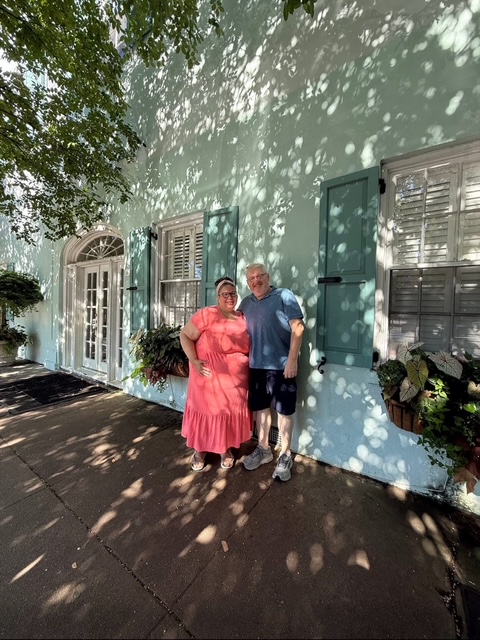
Seven weeks ago, we spent a beautiful time in picturesque Charleston, South Carolina. Rainbow Row and its cobblestone alleys felt like I was entering a new world where elves and pixies danced among the ivy- and moss-covered stones. The southern live oaks dripping with Spanish moss helped my tense shoulders relax and my whole body lean into the low country vibe. The Pineapple Fountain reminded me to remain open and hospitable despite some of the anxiety I had felt in the past few months. And the sunset cruise on the harbor reminded me of the goodness and faithfulness of God.
My lack of writing was an indicator that my life had reached a point where I had lost perspective. My inability to open my gratitude journal demonstrated that I was feeling hopeless. The utter exhaustion I felt from the time I rose till the time I lay my head on my pillow reminded me that something was not right. And when words failed to be released from my lips to God in prayer, sitting in silence, just feeling His presence was a sign that things needed to change.
One of the changes I made was starting a new Substack account last week, a place for me to share my thoughts. It was also a new place for me to be inspired, to create, to receive beauty and truth, and to re-focus. I still have no expectations about my writing. I just know that when I stop, I lean too much into the busyness of life and forget to reflect on the goodness of God. Writing helps me turn the chaos and despair I may be feeling into peace and hope.
Last week, I posted the first of a series of writings I am calling Musings. Musing is defined as a period of reflection and thought. Although some of the pieces I am writing are related to current events, these musings that have been marinating in my brain for the past few years. They reflect the tension I feel between who I was and who I am becoming. I am still a Christian, I still find my identity in Christ, but I am trying to navigate the chaos around me while staying centered on Jesus. This finds me in a different place than I was 10 years ago, 5 years ago, or even a year ago.
I would love to hear feedback about these pieces. I am in no way trying to tell anyone what to believe or think. Instead, I hope you feel I am taking you on a journey where I explore that tension I feel. Tension is not bad; it is at the heart of every good story, spurs new inventions, challenges us to research, creates music, and defines art. Tension is only bad when we stay focused on what should be and what is not. I hope my exploration helps you see how I am breathing during this tension, becoming the woman God has called me to be.
“For everything there is a season, a time for every activity under heaven.” Ecclesiastes 3:1
A few months ago, I made Erin French’s Butter Cake. Erin, a self-taught chef, has created a culinary experience in the sleepy town of Freedom, Maine. Late spring, she opens her restaurant on the weekend to lucky individuals who travel from around the world to her tables. She serves different courses highlighting local produce in an artful way that leaves the diners feeling connected, loved, and cared for. One of her favorite desserts is a simple butter cake, which she slices and adds fresh fruit and whipped cream. Despite butter being the main ingredient, and soaked with a butter glaze, the cake is surprisingly light and ethereal. It left you satisfied with a hint of wanting just one more bite.
It’s been an eventful year; I entered the workforce after being a home educator and childcare provider at home for 26 years. This resulted in a long commute for work for both Terry and me. This prompted a move to Carlisle, and in the process, Terry found out his company was closing. He took a new position which now makes our commute less than 7 minutes. Besides all the driving we did for work, we made 6 trips to Rhode Island, and 3 trips to Wisconsin. We both had some pressing health issues that resulted in new medication for me and a biopsy for Terry. Amid this chaos, I finished writing, editing (with Terry’s help), and published my memoir, Reclaimed & Restored. The biggest highlight of the year was welcoming our newest granddaughter.
The word weight is a loaded term. It conjures up images of heaviness, judgment, and burdens for me. As a woman, I have been judged by the flashing numbers on my scale, how I prioritize my responsibilities, and whether I am making meaningful contributions to my family, church, and world. This results in a weight that is unseen, but that yokes me together with feelings of failure, a constant need to be productive, and never being enough. And the weight of this pressure extinguishes my creativity and crushes my dreams.
We both recognized as soon as I took this position, that life would need to change. For most of our marriage, I took responsibility for meal planning and preparation, cleaned and maintained our home, organized our schedule, and managed our finances. But even working only three days a week (which often ended up being 4-5 days a week), I could no longer manage the load I carried before. Even more importantly, I didn’t want to. I was tired of being solely responsible for cleaning the house, knowing when certain projects like de-scaling the coffee pot needed to be done. I was done with making dinner every evening. I was tired of being defined solely by what I did at home.
To be fair, Terry has always been a great partner in our marriage. He always helped with chores on weekends and cleaned up after dinner. He picks up after himself, and to his credit, I have only had to pick up his dirty socks once in our almost 29 years of marriage (we won’t discuss the amount of bobby pins or hair ties that he picks up). We both had idealized traditional roles and didn’t recognize how the weight of these roles hindered both of us. By taking this new position, I turned our worlds upside down. Even though we both needed to change we didn’t know how to communicate with one another about what changes needed to happen which led to resentment in me and Terry feeling inadequate.
I quickly learned that me responding to his inquiries about what needs to be done with “You’re an adult, figure it out” wasn’t helpful or kind. But I also didn’t like treating him like a child with a honey-do list. We both needed to get past the resentment and feelings of inadequacy. After a few heated discussions, we sat down and talked reasonably about how our idealized traditional roles left little time for me to explore creative endeavors or pursue other interests. I was not only maintaining the house, but also home educating our children and doing full-time childcare as well. This seemed reasonable when he was going to school part time and working full-time. But when that changed for him, my load didn’t lessen. I want to reiterate, Terry was not lazy, he helped any time I asked or when he saw me doing something. My resentment came with the weight of the responsibility and the lack of initiative.
This is common in a lot of marriages, regardless of the women’s working status. My generation entered the workforce and struggled with the mental weight of managing the home as well. Often, women were expected to do most of the meal planning, clean the house and adjust their work schedules when their kids were sick. Sitcoms picked up on this discrepancy, often making men look like buffoons or idiots. Many in the evangelical Christian circles pushed against these stereotypes. They felt like it made men seem insignificant and worthless. Yet, if you go back a few generations, TV shows like Leave it to Beaver,I Love Lucy and the Geroge Burns and Gracie Allen Show made their leading ladies look unintelligent, silly, or ditzy. Yet, I have yet to see these same Evangelical Christians address how these stereotypes denigrate women. We are all created in God’s image and although humor is an important outlet, it should never be sanctioned when it supports stereotypes in way that is destructive.
After long conversations, Terry and I are working at creating a new normal. We both have some clear responsibilities in the house. I no longer cook every meal completely on my own. We share responsibilities depending on each other’s schedules. We are flexible to pick up the slack when the other person has some extra responsibilities at work. It feels like a true partnership, where I no longer carry the mental load of running the household.
I heard recently something that has challenged my beliefs about marriage. On the Bare Marriage podcast, author Sheila Wray Gregorie and her husband discussed that when the premise that marriage is hard is accepted, people tend to accept the disappointments and struggles as normal and their burden to bear. Instead, they suggest if we view marriage as a good thing and beneficial for both parties, we are more willing to address the hard things and work together to find a solution. We don’t carry resentment because we address things that seem unfair. I thought about this in my own situation. For years, I accepted the mental load as my burden to carry. I never addressed how it made me feel. I know if I had addressed this earlier, Terry would have been responsive and willing to adjust. Instead, I accepted the status quo and chose to endure the burden.
We think of butter as being a heavy ingredient, like it is in French food, where the rich sauces are tasty but leave you feeling a bit sluggish. Erin French took this same ingredient and created a cake, brushed with butter, and made it light. Maybe I need to look at all things in my life and learn to make things lighter, including the weights that burden me.
“Wisdom is with age the aged and understanding in length of days.” Job 12:12
At 53 years old, I wish I could tell my 17-year-old self the following:
God is a good God. You don’t have to strive to win His approval; you just need to be in relationship with Him, because He loves you.
Enjoy the college cafeteria, because after figuring out what to cook for more than 11,000 dinners, the decision about what you want for dinner is not so glamorous.
There will be good times and challenging times, but remember, each season is just a season.
Wear sunscreen and reapply it often.
Stop buying so much stuff! Eventually most of it ends up being donated, at your yard sale, or, even worse, in the landfill!
There is no book that tells you what to expect during menopause, but I hope that by the time your daughter reaches this stage, a book will have finally been published; written, of course, by a woman.
Relationships matter, so spend more time cultivating them.
Choose where you spend your time carefully: outdoors, being creative, and giving back to your community.
Remember the three R’s: read, read more, and read more often.
No relationship is ever meant to be your all: not your spouse, your children, and not your friends. Only God is meant to fulfill you.
Marriage can be hard, but it also can be a lot of fun. Make sure you laugh often, chill together, forgive continuously, and have adventures.
Celebrate the big moments and the small victories.
Life is extraordinarily ordinary and that is okay.
Sleep for 7 to 9 hours; the rest is good for both your mental and physical health.
Some of the movies, fashion choices, and music you loved at 17 didn’t stand the test of time –who cares, look at those memories as good, (Yes, I had pictures of Knight Rider David Hasselhoff on my wall along with Tom Wopat form Dukes of Hazard, and Andrew Macarthy from Pretty in Pink)
Fruit is nature’s candy when it is in season. Buy it then and indulge it.
Lots of people including yourself will have negative opinions about your body, stop listening to those voices, Express kindness to your body.
Kindness costs nothing, be generous with it and express it to everyone.
“He is like a tree planted by streams of water that yields its fruit in season, and its leaf does not wither. In all that he does, he prospers.” Psalm 1:3 ESV
A new cookie recipe captured my family’s heart. It wasn’t the decadent brown butter chocolate chip cookie that made every other chocolate chip subpar. It wasn’t Dorie Greenspan’s World Peace cookie, which is the perfect blend of buttery, salty, chocolatey goodness. It was an ordinary cookie that is often overlooked at church potlucks: the oatmeal raisin cookie. I have used a friend’s recipe for years which she got from a Walt Disney cookbook, and it is delicious. I included that cookie on Christmas platters, thinking that maybe it would tip the scales slightly from sugar overload to a health food store vibe. This new recipe, from one of my favorite bakers, Zoe Francois, turned that oatmeal raisin cookie upside down. She starts by browning the butter and then adds her secret weapon. While the butter is still sizzling in the pot with its nutty fragrance filling the air, you add cinnamon, and for 15 seconds, you let it bloom. This simple step allows the cinnamon to intensify in flavor and permeate the cookie, adding a subtle richness that elevates the recipe. They were so popular, the next day my daughter asked for the recipe.
Right now, everything is blooming in central PA. For about three weeks, the trees that lined my street displayed white blossoms, making our ride home feel like a majestic welcome. Daffodils have come and gone, and now tulips are reigning in our neighborhood. The yellow, red, and orange cups open as the sun rises, reminding me God’s mercies are new every day. This burst of blooms brightens my day after a long gray winter. Despite the havoc the pollen is creating in my red, itchy eyes, I am still delighted spring has arrived.
Spring always feels like possibilities: new life, new beginnings, and new growth. Despite my delight, the sluggishness of winter still clings to my body and mind. This may be due to the trifecta of circumstances in my life: an RA flare, menopausal insomnia and Vitamin D deficiency. Add in my usual seasonal depression, it’s been a hard time. Each day I wake up exhausted and fake my usual perkiness in both my work and personal life. By the end of the day, I stop pretending, and slump into my hibernation mode. But even with pretending, it is evident in my lack of writing. I find it easier to scroll on Instagram looking for inspiration than to put my fingers to the keyboard. It is evident by the dark circles under my droopy eyelids. It is evident when I am more content to stay home on weekends than leave my house.
I recognize that some of what I am feeling is due to some health issues beyond my control. I have started a new medicine for my RA, which should make a difference in six more weeks. I am also taking a prescription dose of Vitamin D, which should also make a difference. I recognize that depression can be a serious issue that needs intervention from a physician and/or a therapist. I am not at that point, but I do need to make some changes that help create some natural serotonin and dopamine in my life.
Due to the severity of my RA flare, any additional exercise beyond my normal daily activity seemed impossible in the past year. Getting out of bed in the morning was a major accomplishment with achy and swollen joints taking up all my physical energy. I am starting to see some differences with the medicine regime I am on, and I am planning to join the YMCA soon. I think swimming will be good for my joints and some mild weight training will help build strength. Terry and I both miss our regular walks, and plan on incorporating that back into our lives as well, finding new parks and trails to explore. Just moving alone should help increase my dopamine.
We recently enjoyed two lectures by an area bookstore owner on the history of our local library. After dinner, I mustered up enough energy to go to the lectures despite the enticements my cozy couch whispered to me. After each lecture, I felt energized, conversing about the Bosler family, stained glass, and artist Edward Burne-Jones. This reminded me that it is important to explore. Micro adventures to area gardens, bookstores, and museums will inspire and breathe life into me, dialing up my serotonin levels.
Beyond medicine, exercise, and micro adventures, I need to prioritize creativity in my life. For me, that comes in several different forms, including cooking and writing. On a recent podcast, Aimee Nezhukumatathil, author of Bite by Bite, remarked that we have “26 letters to make magic with” and speculated about the infinite number of spices we can use to make a dish. Scrolling on Instagram, no matter how curated my feed is, has become a habit that leaves me depleted and exhausted. I know this, I have written about this in the past. But when you are not feeling well, it is too easy to stay checked out instead of living. I have at my fingertips, the ability to write essays or books that inspire or encourage others. I have in my spice cabinet the ability to create meals that expose Terry and I to new cultures and cuisines.
There is scientific research that demonstrates how creativity affects your mental status. Often, when engaging in creative pursuits, you enter a “flow state” where you lose track of time while doing something you enjoy. This happens to all sorts of creatives, and when in this flow state, you reach a level of calmness that reduces stress. At the same time, it energizes you, increasing your capacity throughout the day. It also helps you process your emotions and increases your empathy. Therapists are starting to use more dance, music, and art therapy to help people with depression and post-traumatic stress. Finally, by being creative, you increase your brain’s plasticity. This will help you process information better in the future, building more connections across your brain.
My husband has been a witness to my struggles the past year. He has seen me wince in pain when I struggle to find a comfortable position in bed. He has seen me sitting in the car while he runs in to get something at my former happy place, Target. He has seen me mask my tiredness by pretending to be ok, when I am not. Additionally, he has picked up the slack: cooking, running errands, and cleaning.
Terry also knows what fulfills me. And in his own gentle way, he reminded me a few weeks ago by sending me a Substack screen shot. It came from Joshua Luke Smith, reminding himself of the importance of writing. I will not quote it all, but it included these lines: “I am a writer, and this week, I will write. I will type, until what is within me exists beyond me. I will not make excuses about time or talent.” He followed that with another quote from Kyle Worley, “The writer has to love the world enough to ignore it so that they might illuminate it.” These simple quotes reminded me of the importance of creating. They pushed me forward into setting aside more time to write.
Right now, flowers are blooming due to the warmth of the sun. Heat applied to the cinnamon bloomed the spicy flavor to permeate the cookie. Terry’s gentle prodding was the heat to nudge me into blooming again as a writer.
We are all creatives, and as creatives, we sometimes have slumps or challenging seasons. But just as spring is an indicator of new life, let this piece remind you to go create. Whether it is picking up your camera to get the perfect shot, finding your paint brush to paint a landscape, strumming your guitar, crocheting a blanket, or writing a poem, spend time finding something creative to do. Soon, your creativity will permeate goodness throughout your life.
“When I look at your heavens, the work of your fingers, the moon and the stars, which you have set in place, what is man that you are mindful of him, and the son of man that you care for him?” Psalm 8:3-4
In the 1970’s, having a copy of the World Book Encyclopedias was as important as having a 45-inch flat screen TV today. Despite earning below the poverty line, my mother made monthly payments for us to have those treasures of knowledge, and the Childcraft books that came with it. These beige embossed vinyl books captured my imagination. I would peruse the first volume, pouring over the nursery rhymes making my way through longer poems flanked by delightful artwork. I explored the other volumes, but always came back to the poetry volume reciting Simple Simon Met A Pieman and envisioning magical forests while reading The Sugarplum Tree by Eugene Field. Something about poets’ distinct words conjured up images for me that seemed otherworldly compared to the harsh reality of life. My love for Volume 1 was imprinted with the oils of my fingers, making the embossed covers look worn and beloved.
I stopped reading poetry around age nine. I don’t know what stopped me from delighting in words. It is possible life just became too hard. I didn’t have the time to slow down and let the poets romance me because I was too busy keeping secrets. It could be that in English classes we poured over structure and rhyming schemes, making poetry seem mechanical. It may have been that the areas where poetry touches, feelings and nature, were not familiar or restorative to me. All I know is, for many years, I stopped engaging in my childhood friend, poetry.
Later, with my children, I explored poetry while home educating them. Charlotte Mason, one of my major educational influences, remarked that “poetry could cultivate the seeing eye, the hearing ear, the generous heart.” We read a free verse picture book titled Daring Dog and Captain Cat where family pets had nighttime adventures. As I read the book aloud and found the rhythm, I delighted in the images the author painted with words, like “kitchen pans banging breakfast songs.” Yet, I held poetry at a distance, still believing that my lack of intelligence or imagination prevented us from forming a relationship.
Ann Voskamp, and her poetic prose best seller One Thousand Gifts: A Dare To Live Fully Right Now slowly enticed me back to poetry. Her descriptions of soap suds dancing in the air, and the colors of sunrise captured my senses. I, too, began to write down things I was grateful for, paying attention to how the steaming cup of coffee warmed my hand and soul. I too, listened to the songs of birds chirping and the smell of lilacs wafting across my patio. And, like Ann, “when I’m always looking for the next glimpse of glory, I slow and enter.” This created the soil where my love and appreciation for poetry could grow and thrive.
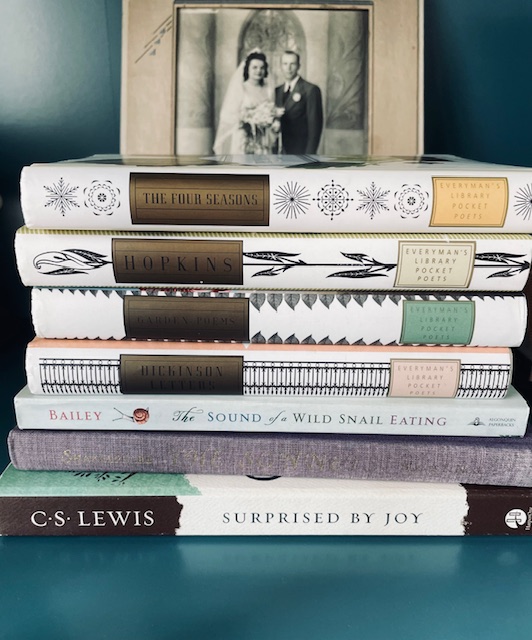
Later, when I was experiencing a lot of life transitions, I was encouraged by authors like Joy and Sarah Clarkson to start reading poetry once again. I picked an anthology, The Four Seasons Poems, edited by J.D. McClatchy in spring of 2018. This compact book, from a series called Everyman’s Library Pocket Poets, stayed at my bedside for a year. Regularly, I would read a poem aloud, listening to how the words danced across my lips, savoring the images the poets created. Sometimes, I could smell the plowed spring earth ready to bear seeds, feel the soft summer wind brush my hair across my face, hear the crickets play their fiddles in fall, and see the giant snowflakes flutter to the ground. As I did this, I found myself paying more attention to the world around me and feeling more appreciative of God, the creator of all things beautiful.
This small book opened up a new world. I began to crave poetry and found both old and modern poets I loved. Christine Rossetti, Wendell Berry, Mary Oliver and Maggie Smith soon became treasured friends. I encouraged my husband to join me, and soon we were reading poems aloud to each other in the evening. I started to open my imagination to answer Mary Oliver’s question in The Summer Day “Tell me, what is it you plan to do with your one wild and precious life?” I started to think harder about where I lived and how I can create community because of Wendell Berry’s insights. I contemplated how I can contribute to making this world beautiful by reading Maggie Smith’s Good Bones. Each poet helped me adjust to the transitions in my life and see that I had a full life ahead of me.
I also saw how poetry can address justice, body positivity, and other issues our world faces today. Amanda Gorman called for “unity, collaboration, and togetherness” as she recited her poem The Hill We Climb at the 2021 Biden inauguration. With her bright yellow coat, she stood elegantly and resolute capturing the hearts of Americans. Kwame Alexander connects young African American men to the importance of family by using sports analogies in his visual poems. Lindsay Rush addresses the stereotypes and stigma women feel in her book of poetry A Bit Much.
My husband tried tiramisu years ago and was disappointed. After two attempts, he concluded that he didn’t like this famous Italian dessert. We then heard others drool and rave about our friend Nate’s famous tiramisu. Everyone requests this dessert from him, and some unashamedly eat it before the main meal at church dinners. After a couple of years hearing about all the fuss and gentle prodding from me, Terry decided to give it a try. His first bite into this rum, espresso, creamy mascarpone concoction opened his eyes to this Italian treasure. The reality is he did like tiramisu, he just needed to find the right recipe for his taste buds.
I have heard from many people resolute about their distaste of poetry for much the same reasons I had vocalized in the past. But like Terry’s experience with tiramisu, it may take some trial and error for you to find the right poet or poem to speak to you. As a Christian, we should challenge ourselves to read poetry because it is a writing technique God used in the Bible. He knew the power of imagery and expressing emotions speaks to the heart of all people. Audre Lorde says “poetry is not a luxury. It is the vital necessity of our existence.”
Here are a few ideas on how to engage in a poetic relationship. Start in Psalms, and although we lose some of the rhythm due to translation, read a few aloud. Pay attention to the imagery and emotions being expressed, and how vulnerable the writer was being. Then, look at some anthologies, like a poem about seasons or gardens, or even a poem a day. Read the poem aloud following the punctuation, it may feel awkward the first few times, but eventually you will feel the heart of the poem. If it describes plants or places or animals you are unfamiliar with, look those images up. I had no idea what a snowdrop looked like until we explored Winterthur Gardens. Now, all the late winter/early spring poems about the snowdrop flower make sense. If reading a book of poetry seems to be daunting, explore some poetry podcasts that read a poem aloud such as Slowdown or Daily Poem. Finally, if one poem does not speak to you, leave it behind. But if it does, take the time to savor the words and images. Maybe even annotate the poem by underling the lines that jump out at you. Also, explore some modern poets like the ones I mentioned in this blog post. Keep trying, because one day you will find a poem that speaks to you.
It is National Poetry Month, so give a poem a try. I promise you will like it!
“Learn to do good; seek justice, correct oppression; bring justice to the fatherless, plead the widow’s cause.” Isaiah 1:17
As I write the epilogue, we are deep into the editing process. Thoughts race through my mind. Did I miss something? Should I have written certain chapters with more vulnerability? Did I address all the areas I hoped to cover? And the list continues. But my husband keeps reminding me that I need to close the book. And he’s right. This book was never meant to be an exhaustive window into my healing process, because it is fluid, and I continue to grow. Nor was this book meant to be a comprehensive overview of all the therapeutic models that have helped me and could help other victims. Just as the home remodeling shows edit hours and hours of footage down to a 44-minute show, I also must edit all the heart, soul, and mind material that I have dealt with in my healing process. I can’t cover everything, and some things are still so raw and vulnerable that I am not ready to share them with the world.
I therefore close with a thought that Rachael Denhollander, a victim of sexual assault, shared in her victim impact statement at the sentencing hearing of Olympic Gymnastics doctor, Larry Nassar. She asked the judge, “So what is a little girl worth?”1 This later became the title of her own memoir about sexual assault. It is a simple question but one with many layers to it. And it’s a question I ask you, my readers: What is a little girl worth?
I know the answer is not found in the voices of perpetrators who crush victims. It is not found in people who lack insight and knowledge of how to handle trauma. It is only found in the gospel. As Christians, we can and should be a support system that has confronted and dealt with our own misconceptions about sexual assault and has created a safe place for victims to heal.
I ask you, again: What is a little girl, a little boy, a woman, or a man worth? Are you willing to arm yourself with knowledge and material that will help educate and inform you on the effects of trauma? Are you willing to let experts like Rachael Denhollander, Dan Allender, and Chanel Miller educate you on the harm this kind of trauma did in their lives and the lives of others? Only one of these is a licensed therapist. Their expertise is not based on the letters after their names, it’s based on their own experiences with sexual assault. All too often, victims are further dismissed for being a sexual assault advocate. Rachael Denhollander said in her impact statement, “Once it became known that I too had experienced sexual assault, people close to me used it as an excuse to brush off my concerns when I advocated for others who had been abused, saying I was just obsessed because of what I had gone through.”2 I also have experienced this dismissal. But who better to understand and advocate for a victim’s rights than a person who has experienced it herself?
So once again, I ask you: What is the person sitting next to you in church worth? What is the person in your small group worth? What is your sister worth? What is your neighbor worth? If they are valuable and made in the image of God, will you invest some time to unpack sexual assault in more depth? I have included in this epilogue a list of books and podcasts that have helped shape me and correct my own misconceptions about sexual assault, rape, and harassment. Not all these are written by Christians, but truth is truth, no matter the source. Take some time to read a few of these books, or, if you prefer, download them as audiobooks. Listen to a few of the podcasts. It will help inform your compassion and empathy.
List of Resources
Books:The Wounded Heart: Hope For Adult Victims of Childhood Sexual Abuse: Dr. Dan B. Allender; What is a Girl Worth?: My Story of Breaking the Silence and Exposing the Truth about Larry Nassar and USA Gymnastics: Rachael Denhollander; What My Bones Know: A Memoir of Healing from Complex Trauma: Stephanie Foo; Rid of My Disgrace: Hope and Healing for Victims of Sexual Assault: Justin S. Holcomb and Lindsey A. Holcomb; She Said: Breaking the Sexual Harassment Story that Helped Ignite a Movement: Jodi Kantor and Megan Twohey; The Body Keeps the Score: Brain, Mind, and Body in the Healing of Trauma: Dr. Bessel van der Kolk; Know My Name: Chanel Miller; All My Knotted-Up life: A Memoir: Beth Moore
Podcasts:The Healing Trauma Podcast: Monique Koven; Java with Juli: Dr. Juli Slattery; The Place We Find Ourselves: Adam Young; The Allender Center Podcast: Dan Allender and Rachael Clinton Chen
“Do nothing from selfish ambition or conceit, but in humility count others more significant than yourselves.” Philippians 2:3
Recently, an acquaintance asked a question in a judgmental tone that upset me, “Now that you are working, are you finally going to get a second car?” I instantly felt like I had to explain my choices and justify the decisions my husband and I have made. Instead, I remembered some of the work I have done, and that not everyone deserves an explanation, especially when they have already formed their own opinion. I replied “no” and moved the conversation in a different direction.
For many, our almost 29 years of marriage may seem like we are in the dark ages, with our choice to have only one vehicle. For most of the time, Terry has worked within 5 to 10 minutes from our home. This made it convenient when I had appointments or home school activities. I would just take him to work in the morning and continue my day. I also lived close to parks and the library, putting a lot of miles on my stroller odometer. Money was tight, and keeping up a second car was not something that fit into our budget.
For the past 10 years, other than during the pandemic interruption, my husband has commuted 45-60 minutes to work. This made appointments a little bit challenging, but again we found ways to work around those obstacles. I was providing childcare for a family, who had an extra vehicle which I used for taking their kids to appointments and school. They generously allowed me to use it for my own appointments as well. I lived close to my family doctor and chose to walk to her office on a few occasions. Also, my children were driving and had purchased their own cars, so occasionally they helped with a few errands.
The one-car family idea became a little more challenging when I took a part-time job, and for 9 months, I drove more than I had driven in the past 5 years. We knew all the miles we were putting on our car were not sustainable, so we moved closer to my work. Two months later, Terry accepted a new position making both of our commutes 5-6 minutes in the same direction from our home. We have decided that the cost of a second car is not important to our lives, using the extra money for travel and day excursions.
I know that Women’s History month is over, but I want to end this series on how we can support all women in their choices concerning their marital status, if or when they are going to have children, whether they choose to stay home or work while raising children, and how they decide to educate their children. All of these have elicited some strong opinions in the church and have caused women to go both on the offense and on the defense. Within all these areas, we even micro-judge whether they breastfeed, what they feed their family, and what they let their children watch.
Years ago, while in college, I made some arrogant statements over time to a dear friend about the importance of higher education and being career oriented. With her usual grace, she wrote a letter to me, sharing with me how my opinions had demeaned her choice to be a stay-at-home mom, and that there was room for both of us to have our goals without tearing each other down. I instantly felt bad and apologized. Ironically, I didn’t learn my lesson when I made the decision to stay home with my kids and home-educate. I soon found myself on the other side of the table, judging working moms. This view was reinforced by my insulated circle of friends and acquaintances, all of us reading books by home education leaders and listening to Christian talk-radio shows (this was before podcasts were a thing).
Recently, I had a few people hang up on me as I was making phone calls for donations to a local nonprofit. The first time, I was offended but quickly remembered I have done the same to various other organizations trying to raise funds. I cushioned the hang up by saying I was not interested and ended the call before the person had a chance to respond. Now, being on the other side of the call, I realized even a cushioned hang-up felt rude.
Author Tyler Merrit says in his book I Take My Coffee Black, “proximity breeds empathy. And with empathy, humanity has a fighting chance.” My sister, Cheryl, entered college slightly later than her peers. She finished her bachelor’s degree and went on to complete her master’s degree. She later found a great job at a major university. She then decided to pursue her law degree, while getting married, followed by having two children. After having her children, she continued working full-time while finishing her law degree. I saw how hard she worked towards achieving her goals. I also knew how much she loved her children and wanted what was best for them. She wanted them to have healthy, whole lives supported by a loving mother. Her goals in parenting were not different from mine. What was different was the application, and that didn’t make either of our approaches better than the other.
Just like me, she sacrificed her finances and personal time to meet the needs of her growing family. I chose to have one car; she chose to spend money on an excellent daycare for her children. I made some sacrifices with my professional goals, while she limited her opportunities so she could be fully present in the evening with her kids. We both stayed home with our sick kids, giving them the extra cuddles they needed. We both took our children to the library, created family traditions, and researched the best ways to raise our children.
I saw how hard my sister worked, and continues to work, as a mom while still excelling in her chosen career. Being close to her gave me insight into working moms. Just like stay-at-home moms, they love their children passionately. Their reasons for working are to help provide for their family, achieve some professional goals, and some may have no other option as single parents. No matter what their reason is, this doesn’t make them less of a mother. It just means they work differently than stay-at-home moms.
I remember going to camp where competition between cabins was fierce. We created chants about our cabin name, often belittling the different cabins, hoping to win the coveted Best Cabin award at the end of the week. This was fine for a one-week experience as a middle-schooler. The stakes are higher when we continue as adults to put ourselves into camps of our different choices in marriage, children, work, and education. We automatically create an “us vs. them” culture which leads to belittling attitudes and judgements. But Paul reminds us there is a different way to operate. He states in Galatians 3:28, “There is neither Jew nor Greek, there is neither slave no free, there is no male and female, for you are all one in Christ Jesus.” Paul was teaching a principle that our differences don’t separate us from Christ, and in turn, shouldn’t separate us from each other.
Sienna Miller, who welcomed a new baby at age 41, addressed the ageism question in Hollywood. She pointed out that she gets a lot of negative feedback on how “old” she was to be having a baby. She also pointed out that stars like Robert De Niro and Al Pacino, who welcomed children at 79 at 83 respectively, were celebrated instead of questioned on their geriatric age. Though these arguments plague Hollywood, can’t we of the Christian faith do better? Let’s cheer on mothers who embrace motherhood at older ages. Let’s support those who choose to remain single by embracing them into the greater family of God. Let’s champion those mothers who choose to use formula. Let’s recognize that all parents want the best education for their children, and that they have a right to delegate that to private or public schools.
Again, like all the other topics I have discussed in the last three blogs, this can only happen when I personally identify the ways I have judged other women in the past and choose to be supportive in the future. I have some amazing friends who parent passionately and have made different choices than I did. I have some amazing friends that are single, who support the kingdom in so many tangible ways and their choices should be validated. It’s time to embrace the differences so we can chant the hashtag of International Women’s Day, let’s #AccelerateAction, by recognizing that these differences make us a more effective body of Christ. This proximity to differences will increase our empathy, and in turn, our witness.
We have one car, and we are content with our choice. I chose to raise my family the way God called us to as a family unit, which resulted in me staying home, home educating, and a limited income. Our way was right for our family, but not for everyone. In the future, I want to champion my friends and families who make different choices than me.
“Judge not, that you be not judged.” Matthew 7:1 ESV
During my junior year of college, I had a full schedule. Along with being promoted to a new role as a Program Assistant and other extracurricular activities, I had the toughest class of my psychology major: a research and methods course. Often when I moved around my small campus, my head was down, thinking about the list of things I still needed to accomplish before the day ended. At the end of the school year, I met a freshman with whom I would be working in a summer program for underprivileged high school students. We quickly became friends, and she introduced me to a new, up-and-coming store: Bath & Body Works. Later that summer, she shared how she had tried to make my acquaintance before and, after being ignored a few times, she thought I was pretentious. I was taken aback by this assessment, and it was the first time I realized that I didn’t always appear warm and friendly. I quickly apologized, remembering how often my head was down and my list was long. Unfortunately, at the time, I was not mature enough to recognize that I needed to find healthier ways to deal with my stress and to avoid alienating people.
Since then, I have learned that when I am busy, I tend to have a Jekyll and Hyde transformation, shifting from the warm, friendly Sherry to busy, task-oriented Sherry. Even how I move about my world is different. I go from engaging in conversation with total strangers and inviting people into my home for peanut butter and jelly sandwiches (this was when my children were little) to being laser focused on what needs to be done and barking orders at others. This Mr. Hyde conversion is not my best side, and the various members of my immediate family have often been the ones who faced the brunt of this ugliness. And if you meet me at this time, you might not be enticed enough by the peanut butter jelly sandwiches to come over and visit with me.
Despite being busy with a newborn, I remember the1998 Bill Clinton and Monica Lewinsky scandal blowing up across the different broadcast and cable news networks. Before social media platforms existed, we still managed to be inundated with images of the infamous blue dress and clips of her phone conversations with a so-called friend. Next, we watched as President Clinton denied any sexual relationship, later apologized, and then faced impeachment. For years afterwards, every comedian and talk show host had a joke about Monica Lewinsky, criticizing her body, intelligence, and character. I laughed at some of the jokes and formed my own opinions of her.
But in 1998, we had no common language for the concepts of power differential, body shaming, or trauma. We didn’t understand that critical thinking is not yet fully developed in young adults, resulting in one intern’s naïve idea of love turning into the biggest mistake of her life. Today, I listened to Lewinsky tell her own story on her new podcast, Reclaiming by Monica Lewinsky. My views of Monica Lewinsky had been shifting for the last few years, and I knew I had misjudged her. But it was devastating hearing how hard it has been for her to move forward in her life, find a career, or even be in a healthy relationship because of a mistake she made when her impulse control was not yet fully developed. What was even harder to face was my culpability in her demise. I, along with the rest of the public, had misjudged and mischaracterized her.
This Saturday is International Women’s Day, a day with its roots in women protesting to receive better pay and improved working conditions. It started in the United States and moved across Europe as more women protested poor working conditions, wage gaps, and the inability to vote. In 1975, it was recognized by the United Nations as a day to support gender equality. The theme this year is #AccelerateAction, engaging in concrete ways to improve gender equality. There are still nations like Iran and Afghanistan where girls can’t receive education beyond elementary school, women are not allowed to own businesses, and women can’t leave their homes to have lunch with a friend. I can’t do much about those problems, except bring awareness of those human rights violations, support organizations that are trying to make a change, and vote in ways that address these issues. But I can do one thing that is noted on the International Women’s Day website: I can “call out stereotypes, challenge discrimination, question bias, celebrate women’s success…and share our knowledge and encouragement with others.” But to do this well, I need to recognize my own biases and the ways I need to change to address these issues.
Over the next three weeks, in honor of International Women’s Day, I am going to address issues of body image/body shaming, labeling, and judging women’s paths in life. I have touched on these areas in the past, but I am hoping to examine them from a fresh perspective with some personal anecdotes, pop cultural references, and Biblical principles. I also want to highlight why I, as a Christian, should and can do better about these issues. I hope you will join me in this series and hear how I am evolving.
I am so glad my friend in college laid aside her preconceived notions about me to become my friend. Her friendship, as brief as it was, enriched my life beyond fruity smelling lotions. I know how it feels to be misjudged, and I need to remind myself not to make judgments of others based on my own limited information about that person. My participation in shaming Monica Lewinsky certainly didn’t embody Christian principles and exacerbated her future struggles. But I know better now, and I want to continue to accelerate action to help move the dial forward in treating all women with equality.






 By Sherry Collins