Page 15 of 29

Soggy Cereal Dreams

“And he said to her, “Daughter, thy faith has made thee whole; go in peace” Mark 5:34

It was early morning of my eighth-grade year when I crept out of bed, got dressed, and went downstairs. I quickly fixed a bowl of Corn Pops and sat on the lumpy brown couch. It was rather quiet for a house of six people, with the faint heavy breathing of my stepfather, passed out in an alcoholic stupor and my mother sleeping soundly next to him in their bedroom. I turned on the television, frantically turning the volume down to barely audible but loud enough for me to hear CNN broadcast their half-hour news. As I listened, eating quickly to avoid soggy Corn Pops, I thought about my future. Someday, I would be in a foreign country reporting about a natural disaster or humanitarian aid in war-torn country. Someday, my name would be a byline. Someday, I would be important!

I bounded off to school that day, dreams of being a reporter still in the back of my mind as I met with my counselor to set up my freshman schedule. I was excited, anticipating all the new things I would be learning when I saw what I believed to be a misprint: Freshman English. I mumbled something to my counselor like, “Shouldn’t this read Accelerated English?” I had low Bs in my English class, but still believed that my teacher would recommend me for the advanced English class. My counselor told me to follow up with my teacher. Later that day, I asked my teacher why she hadn’t recommended me for that class. Her words, “Sherry, your writing is not good enough, you lack fundamentals and clarity.” I was stunned, feeling like I had just swallowed a lifetime’s supply of soggy Corn Pops, seeing my dreams of journalism crumble before me.

I did eventually get into an accelerated class as a sophomore in high school, but the sting of the words echoed throughout my life. I quickly changed career goals, believing that I was not cut out for journalism. I felt like an imposter all the way through college, even though I graduated with honors, believing that my writing never measured up. I even stopped journaling for years, fearful that, if I died unexpectedly, others would laugh at my choppy sentences and mixed metaphors. I let the impact of one teacher’s words follow me for decades!

There was some truth about my teacher’s conclusions. My fundamentals were lacking. It’s hard to pay attention to grammar, sentence structure, and spelling when your goal in reading is to find the happy ending. I believe the trauma I was feeling at home hindered me from seeing and understanding the beauty of words, and how a correctly chosen word paints a picture. Yes, I was a reader, but reading was a form of escape from hide all the ugly words being spoken over me.

 Decades later, I sat at my computer with a need to put my thoughts and voice to paper, or rather, cyberspace. I doubted anyone would want to read my words, confident that it would not come out in clear, well-formed sentences. I wasn’t sure I could paint a picture with words that would resonate with someone or touch their heart. Regardless, I felt a need to put my words out there in the form of a blog. I told myself, and really believed, that this writing might only before me and, if so, that was enough.

 Vulnerability is not always about sharing your story. Sometimes, it’s about taking a risk, believing your future can be different than what an eighth-grade teacher did or did not recommend. To be fair, I think she had to draw a line, and, at the time, I didn’t meet the standard. I could argue that maybe, if she had been more compassionate with me and given me some pointers on how to improve my writing, I could have been inspired. But she didn’t, and I gave power to her words for a large portion of my life.

Recently, a friend of mine reminded me of the bravery the woman with the issue of blood. This was a woman who had spent all her money on doctors looking for a cure, to no avail. Additionally, according to Jewish law, she could be punished for being out in a crowd with her blood disorder because she was “unclean”. Yet, she risked her reputation and her future in one moment of brave vulnerability. She had heard the stories about this man called Jesus who had healed others. He was in her city, on her street, and she thought that if she could only touch the hem of his garment, she might be healed. I can imagine her in her weakened state, maybe stepping outside for the first time in years. The bright sun glaring in her eyes as she moved towards the crowd. I can imagine her cautious steps as she was jostled in the crowd. Suddenly, there he was, she could see him walking by, and in one desperate motion with every ounce of remaining energy, she reached out and touched the hem of his garment, believing she would be whole.

 Jesus responded to this woman by asking who had touched him. The Bible records that he felt virtue flow out of him towards the woman. The Greek word for virtue is “dynamis”, where we get the word dynamite from. The implication was something powerful flowed to the woman, and he told her that her faith had made her whole. Her act of faith, her brave vulnerability, had made her whole. It changed her life, and made her a vibrant, active member of her community. We don’t know the rest of the story, but I can imagine that this woman told others about the goodness of Jesus. She likely reached out to others, sharing with them about her desperate moment and how Jesus responded to her faith.

 I am starting my fourth year of blogging this fall. I believe that some of my posts have touched others’ lives. I have found a place where I can clearly paint pictures of the work God is doing in me. I can share how He is making me whole. I can share ideas and thoughts that God has given me. And it started with me being vulnerably brave.

 Readers, some of you I know and some of you I don’t. Some of you might be in the middle of your life like I am, and others might be starting out in adulthood. But wherever you are, be vulnerable. Brené Brown said in a TED talk, “Vulnerability is the birthplace of innovation, creativity and change.” Our world, individually and collectively, will only be a better place when we are vulnerably brave!

Invasion of the Flies

“Confess your faults one to another, and pray one for another, that ye may be healed. The effectual fervent prayer of a righteous man availeth much.” James 5:16

It was late, we were on our way home after a thirteen-hour day of working and serving. We quietly talked, reminiscing about two famous people who had died that day. Both of us were looking forward to climbing into bed, reading a few chapters, and falling asleep. As Terry unlocked our front door, I glanced to the right, seeing flies darting across the front window. On closer inspection, and to my horror, I realized they were on the inside! We came in and, upon investigation, found over a dozen flies had taken up residence not only that window, but four more windows in my house! These flies were strange, they didn’t fly away as we started swatting. They were in a drunken stupor, and I caught a few with only a piece of paper towel. Within ten minutes, we had annihilated all the flies we could find. We still have no idea how they got in, or why they ignored the bowl of nectarines I had on the table. It was surreal! This mini invasion was fought off, and we still managed to squeeze in a few chapters before falling asleep.

When I woke up this morning, I thought maybe it had been a dream, only to find a few more flies we had missed buzzing around. I am hoping we are now in a fly-free zone. I had intentions of posting a different blog, but as I was praying this morning, I felt like God asked me to share this story. Honestly, I have never wanted to write about houseflies, especially an invasion of my home. Most of you have never met me and might conclude that I’m not a good housekeeper. Others might think, “I would never tell anyone about finding bugs in my cream of wheat as I poured it into the boiling water for my kid’s breakfast.” And still others might think, “I would never talk about hearing a mouse in my garage.” Again, all of these are true stories that have happened to me. And I am sharing them with the potential for others to read and judge my housekeeping skills.

But pests are a natural part of life. Even the best housekeeper living in a brand-new house will occasionally find an unwanted creature in their home. Yet, the pictures of the creatures rarely make Instagram or find their way into Facebook updates. Pests, junk drawers, overflowing closets, and recipe flops don’t quite paint the type of picture we want others to see or know. Yet, at one time or another, all of us have had to face these issues.

As much as we keep our battles with pests quiet, we keep the personal battles we face even more private. We rarely talk about the serious troubles we have had in our marriages, or the times we have been frustrated over our toddler’s spilled milk. We never share about the times others made us feel less than or the times we failed in our professional lives. We don’t discuss our financial struggles or post comments about the vacations we couldn’t plan. We don’t talk about the endings of friendships or the struggles with addictions we face. And for those of us who are Christians, we certainly don’t talk about our faith struggles or ways we have been hurt in a faith-based community. Additionally, we don’t talk about the ways we have failed others by saying spiteful or inconsiderate things.

I wonder, is it easier to keep these things private?  Cliches like “don’t air your dirty laundry in public” or “keep that within the family” have been part of the American lexicon for years. It has even affected how we deal with those in the public eye. I remember naively thinking that Bill Clinton was the first president to have illicit relationships in the White House, but after reading biographies about all past presidents, I learned he wasn’t the first. The difference is that the press no longer decided to hide this information from the American public.

In recent years, thinkers like Brene’ Brown and Curt Thompson have talked about the importance of vulnerability and transparency for us and within groups. Both in their books and their podcasts, they report that vulnerability leads to healing, growth, and connection. Psychologists and doctors are reporting that these private stories where we feel shame, trauma, or loneliness lead to all sorts of psychological and medical issues. It also affects future relationships including our marriages and parenting. It even affects how we relate to God!

 Although the hashtag vulnerability is trendy, the Bible records the importance of vulnerability. Jesus never shied away from addressing hard issues in people’s lives. He addressed Martha’s priorities when she questioned her sister’s unwillingness to help. He addressed Peter’s heart after Peter had denied him at the cross. He addressed the Samaritan woman’s marriage status when asking for water. In all these situations, Jesus never addressed issues to shame or condemn people. Instead, He used their vulnerability to bring them into a deeper relationship with him. Martha now knew what was important, Peter preached salvation on the day of the Pentecost, and the Samaritan woman spread the news of Jesus.

 In the next few blogs, I am going to be vulnerable about some areas in life. I am still praying about what areas to share. I do know I will cover some vulnerability about my faith journey. I hope to share with my readers places where my lack of vulnerability has caused harm to myself and others, and where my vulnerability has led to healing. I am not doing this to get a sympathetic response from my readers, instead I hope it encourages you to grow and heal.

Finally, back to the mini invasion of flies. As I was writing this today, what I thought was a fly-free zone was incorrect. I am still finding these lethargic flies around my house. I will continue to fight them, but I also need to find out how these flies are getting in. Maybe by being transparent, my readers can give me insight, because I truly believe vulnerability leads to answers!

Freezers, Old Towels, and Relief

“Do not lay up for yourselves treasures on earth, where moth and rust destroy and where thieves break in and steal, but lay up for yourselves treasures in heaven.” Matthew 6:19-20 ESV

It was early morning and I needed chicken thighs for tonight’s dinner. After taking a slug of coffee for strength, I put on my shoes and entered my garage. I stared at the 14.5 cubic feet chest freezer, taking a deep breath as I slowly lifted the lid, reaching my hand into the abyss. I shuffled through my frozen produce, bags of blanched corn, peas, and beans. I pushed aside beets and peppers along with blueberries and strawberries. I dug around my batches of homemade spaghetti sauce and apple sauce, but still no chicken thighs. I slid aside the baskets that held my jars of jams, bags of nuts, and Christmas baking chocolate, to reach the depths of the freezer. I silently thanked God that it wasn’t Christmas, where I would have to shift the containers of cookies and candy made in advance, pulled out for gifts and holiday celebrations. Finally, I found the chicken thighs along with a few bags of unidentifiable leftovers, a loose frozen cranberry, and a few crumbs. I wondered how breadcrumbs end up in the bottom of the freezer. I grabbed my chicken thighs, shifted things around haphazardly, and closed the lid.

For eight years, I repeatedly engaged in this search and rescue pattern to find the items I needed for dinner. Occasionally, I would call one of my unsuspecting teenagers downstairs and say, “Can you help me organize the freezer?” They reluctantly agreed realizing it was more of demand than a request. We would pull everything out, throw out the UFOs (unidentified frozen objects), and scrape some of the ice off, organizing the food in categories of vegetables, meats, fruits, and bread. And then, a few weeks later, the freezer would turn once again into a chaotic abyss!

For eight years, our freezer served us well, the storage for summer abundance in preparation for winter meals. After Maggie’s wedding, we decided that this freezer was too big for only two people. We no longer buy frozen waffles in bulk or eat twenty bags of frozen corn in a year! Terry took a few pictures, we listed it on Facebook Market Place, and it sold within an hour of being listed.

We still haven’t found a new place to move into yet, but I am currently de-cluttering my home in preparation of moving. A friend recommended a book called “The Joy of Less” by Francine Jay. As a self-proclaimed minimalist, she asks some hard questions like, “How many paper clips do you really need?” She then outlines some principles and shows you a path toward ridding your home of all the extras. I believe her approach is similar to the wildly popular “KonMari” method. As I read the book, I find myself feeling anxious and relieved at the same time.

The anxious feelings indicate that maybe I am too attached my stuff. Terry and I went through our coffee mug collection, eliminating the ones we didn’t love due to size, shape or design. I was so excited when we eliminated ten coffee mugs. Feeling proud, I had Terry count how many coffee mugs we had left. He reported he had four, but I still had sixteen! I delight in having a different mug every morning, but maybe sixteen is still a bit excessive. Once again, I am going to pull out my mugs and make some tough decisions.

We all have our “things”, things we believe we can’t live without. Mine might be coffee mugs, serving dishes, and cake plates. My husband’s “things” are office supplies, including his collection of binder clips. Yet, if we take those things aside, I still find we have a pan for Danish pancakes, a broken laptop we haven’t discarded, outdoor Christmas lights we never used, and grapefruit spoons that crowd my utensil drawer. This stuff takes up space in my house that either gets moved around when looking for something else or finds itself on a shelf collecting dust.

Why do I hold on to things I don’t want, need, or use? Let’s take the Danish pancake pan. I bought it over twelve years ago, envisioning making stuffed round pancakes, the name of which I can’t pronounce. I did make one batch, stuffing them with pumpkin butter. They were so much work that, honestly, I don’t even remember how they tasted. Yet, I have held on to the pan because I spent money on it, and occasionally see Bobby Flay making a stuffed pancake on his brunch show and I feel inspired. But after my fleeting fancy, the pan remains in the back of my cabinet, unused and unwanted. Yes, I spent money on it and maybe it was a bit foolish. But the reality, is that I can’t return the pan, and it consumes mental energy and space that should be freed up. So, I am moving the pan to my rummage sale pile, and hopefully it will find a home with someone who wants to make ebelskivers!

The other pile of stuff that I hang onto is the rainy-day pile. A few years ago, Terry and I started to replace our fifteen-year-old bath towels. The new plush bath towels soon were the chosen ones, pushing aside the old, frayed towels. Eventually, I had enough new towels for everyday use, but I still didn’t throw out the old ones. I replay messages in my brain from well-meaning people: old towels are good for cleaning up grease spots and paint spills. First, my husband never changes his own oil or messes around with our car, therefore we have never had grease spills. And as far as paint goes, my husband is a careful painter, and we have never had huge globs of spilled paint. Thus, the old towels need to go, along with any broken appliances and old bedding that hasn’t been used in years.

As I work through my anxiety, I start to feel relieved. Less stuff means less to clean or clean around. It means less to move and store. It also frees me up from needless spending. If I live a more minimalist lifestyle, I am less likely to purchase a book on a whim, instead checking it out at my local library for free. I am less likely to buy another shirt on a clearance, without thinking about what I am willing to give up. And I can’t honestly think of a single small kitchen appliance I still need to get except a spice grinder. It frees my budget up for travel and experiences, which, in this stage of life, are more important to me.

Finally, de-cluttering reminds me that I can’t carry this stuff with me when I am gone. I want to keep the things that are useful, that bring me joy, and help me connect with other people. I think my home is already a comfortable space for family and friends, but I want to keep it uncluttered so that it remains a welcoming place.

Francine Jay sums up a thought in her book that I want to carry with me for all future decisions. She says, “Once we’re warm, safe, and fed, we shouldn’t feel compelled to browse a shopping mall or surf the Internet to find more things to buy. Instead, we could devote that time and energy to other more fulfilling pursuits-such as those of a spiritual, civic, philosophical, artistic, or cultural nature.” When I follow those pursuits, I create memories which cost nothing and don’t require dusting. And so I continue, going room by room, and choosing carefully what I really need!

Starry Night and Year 26

“Let me hear in the morning of your steadfast love, for in you I trust. Make me know the way I should go, for to you I lift up my soul.” Psalms 143:8

“If I could handwrite this in a beautiful script or paint a picture of our silhouette as we age with these words, I would. Instead, I am quoting Ann Voskamp, “There’s an old love that sees with a kind of holy double vision — that remembers a young lover in all their seeming infallibility and sees your aged lover in all their beautiful humanity.” That’s what I see in you and in us!” I wrote a few more words, hit send, and the message, bouncing off few satellite towers, reached my husband’s office. I sat pondering Ann Voskamp’s words in her latest book “Waymaker” and how they impacted my marriage. Hope flooded my soul as I recognized that we were safe in God’s loving arms.

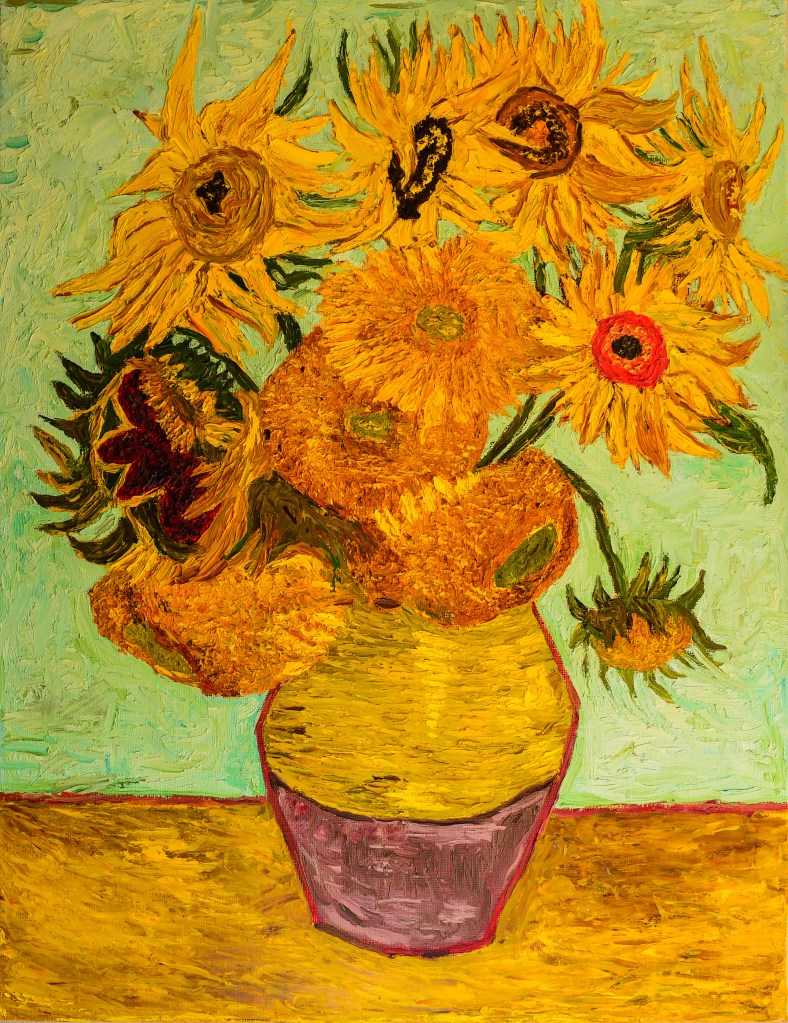
Sunflowers by Vincent Van Gogh, Shutterstck

Terry and I celebrated our 26th Anniversary on Saturday. We went to the Van Gogh immersive exhibit in Washington DC with Indian food for lunch. Walking through the exhibit we learned that Van Gogh saw colors differently than the average person. Some have attributed this to a medication’s side effects, others believe it might have been a rare form of color blindness, and still others believe it was his understanding of color theory mixed with his genius creativity. Whatever the case, Van Gogh’s life was complicated with psychotic episodes, bouts of deep depression, and stays in the psychiatric ward. Despite these major setbacks, Van Gogh manage to paint some of the most vivid, masterful paintings of all time. His series of Sunflower paintings are arguably some of most recognizable art pieces in the world. The juxtaposition of the bright sunflowers in a vase with the ending of his life by suicide seems hard to understand. It is hard to hold all the brightness of the sunflowers with the darkness that was engulfing Van Gogh internally.

As he painted Starry Night, Van Gogh said, “I often think that the night is more alive and more richly colored than the day.” It’s easy to look at darkness and see no color. But if you let your eyes get acclimated to the darkness, shades of dark blues, greys and greens start to stand out. The flicker of any light source illuminates shadows with depth and complexity. Darkness no longer seems scary or flat. But what is even more amazing is when you see the dark fading away, and the morning sun slowly rises, painting the sky in hues of pink, orange, red, and violet. The dark night juxtaposed against the morning sky makes everything magical and full of possibilities.

Starry Night by Vincent Van Gogh, Shutterstock

All marriages hit points where the bright glow of infatuation wears off. Marriage is two imperfect people with their own pasts and woundings trying to live together and create something new. Sometimes bright colors turn into an ordinary day where you are busy working, getting the dishes done, and crawling into bed, exhausted from child rearing and daily responsibilities. Sometimes marriage hits points of darkness where you can’t grope your way through, and don’t even recognize your hand before your face. These are the times when things seem hopeless.

Four years ago, Terry and I were in a place of darkness. We were still committed to marriage, but both felt hopeless and defeated. It was a place where we allowed our own past wounds to dictate our responses towards each other and towards God. We were tired of trying to fix each other and felt even more hopeless in being able to change our own behavior. The only place we could turn to was God.  It was in the darkness that we had created where God did miracles.

The Bible records miracles during all different times of the day and night. Our God is always available. But it is interesting to note the different miracles that happen in those early morning hours. It was in the early morning hours that God delivered Moses and the Hebrews at the Red Sea. It was in the morning Jesus walked on water during the storm. It was in the early morning hours that the broken body of Jesus left an empty tomb, whole and restored to life. These moments were precipitated by what seemed like impossible situations, and then God sweeps in with parted seas, walking towards his disciples, and resurrection! He leads people towards deliverance, safety, and hope.

Shutterstock

I can look back and cherish our wedding day. Terry’s smile beaming at me as I walked down the aisle made me believe anything was possible. I can look back at the ordinary days of marriage when we were raising children with a smile, despite some mistakes we made. I can look back at the evening hours where we started to drift, where we got into a cycle of hurting each other with our words and deeds, and still smile because we had some real moments of happiness. And I can look back at the dark moments, grateful for God stepping in, healing us individually, and bringing us back together.

But right now, I feel Terry and I have entered a new morning in our marriage. We are still healing, moving towards wholeness. But right now, the morning light is illuminating a future that is full of mercy and goodness. And I see Terry’s great smile looking back at me, loving me completely in all my aged humanity, and I now know anything is possible!

Brain Fizz

“So teach us to number our days, that we may apply our hearts unto wisdom.” Psalm 90:12

The sun was starting to rise in the sky as I popped in my Air Pods to listen to a podcast. As I was listening, I skirted around my kitchen, completing some daily tasks. I found the podcast so profound that I could hardly contain what I had learned. As Terry entered the kitchen, I took out my Air Pods and bubbled off some thoughts I had based on what I had heard in the past hour. After a few minutes of nonstop talking, I realized I had overwhelmed my slow-waking husband. I stopped and said, “I’m done.” Terry responded to a few of my thoughts, ending with “I think I’ve used up all my words for the day.”

Childhood summers in the early eighties were hot with window fans providing scant relief. Lunch menus included Wonder bread peanut butter and jelly sandwiches congealed in a gummy mush to the roof of your mouth, adding to the already sticky atmosphere. The drink of choice was often the sugary fake fruity Kool-Aid we made in a plastic red-orange Tupperware pitcher. Occasionally, my mom would splurge on assorted flavors of bottled Springtime Soda. My siblings would argue over who got the orange or the grape sodas, but I was always drawn to the cream soda. The vanilla fizzy drink was a welcome change from Kool-Aid. Drinking water in the eighties was unheard of, only when you were desperate, and the Kool-Aid canister was empty. I was the generation that grew up on MTV, jelly sandals, Scratch-n-Sniff stickers, and a growing consumption of soda. As my siblings and I entered our teens, soda quickly replaced Kool-Aid as our drink of choice.

As an adult, I no longer drink Kool-Aid and have the occasional soda in the form of ginger ale. I prefer coffee in all forms and tend to drink too much of that. I am trying to increase my water consumption and have found sparkling water a good transition. I like water, but the cucumber melon or black cherry sparkling water feels a little more exciting than plain old tap water. I love the little bit of flavor and the look of the carbonation bubbles as they dance in my glass. It somehow feels special.

In a recent podcast, I heard a woman share that her son had learned a new concept in a book. He was excited about what he had learned and said, “it made my brain fizz.” In my mind, I pictured a cartoon image of a boy with thought bubbles inside and outside his head, exploding with new ideas. The picture made such an impression on me, I thought about brain fizz for the next day.

Like the son, I, too, enjoy “ideas that make my brain fizz.” I have always loved learning, but when I started college, the concept of becoming a lifelong learner was starting to resonate with me. It led me to working in a residence hall that incorporated what was learned in a Freshman Seminar class to the living environment. It continued in my home education journey where I became curious along with my children about the natural world, history, and the arts. And as a middle-aged adult, it shows in the variety of podcasts, books, and documentaries I consume. In past week, I have learned that our bodies have brown fat, that keyhole composting is a good way to get rid of citrus scraps, and that Peru used to have sixty different varieties of potatoes. I am also currently doing research on childhood trauma and reading a poetry collection by Amanda Gorman that is opening my world to the power of chosen words.

I believe that keeping your brain active is an important part of aging well. Research has shown that, for both men and women, curiosity helps maintain the health of our central nervous system. It also increases longevity. Although diets, such as the Mediterranean diet and eating more fruits and vegetables, can aid in the ability to be more curious, I believe it’s more than a particular diet and steady consumption of kale and asparagus.

As we age, it’s common for us to get more sedentary, both physically and mentally. We are encouraged to take short walks to help us physically, but I think we can find ways to exercise our minds to increase the fizz in our brains. For me, it looks like reading a wide variety of materials including literary fiction, poetry, the natural world, history, and memoirs. It also includes me listening to different points of views, hearing the stories of others, and pondering big questions. It involves me searching scripture for both meaning and historical/cultural context. It also involves me learning new skills or crafts. I find the more I explore my world, the more I want to explore. It becomes contagious like the dancing carbonation bubbles in my fizzy water.

In preparing for this blog, I found this interesting article, “What We Need to Cultivate Our Curiosity”, on the Aging-Well Project. The article is not only adding new books to my TBR list but is also encouraging me to turn off my GPS when I explore new areas. One day this week, I plan to explore the downtown Carlisle on foot, with no agenda in mind.

Walt Disney said, “We keep moving forward, opening new doors, and doing new things, because we’re curious and curiosity keeps leading us down new paths.” As I age, I want to keep moving forward physically, mentally, and spiritually. I believe cultivating curiosity will keep my brain fizzing and affect all three of those areas, leading me to new places that I can’t imagine.

Chasing Fireflies

“Delight yourself also in the Lord, and He shall give you the desires of your heart.” Psalm 37:4

“Their yard has more fireflies than ours, please Auntie, can we go across the street to capture some?” my nephew pleaded, holding his bug-catching basket. Between the sultry Nebraska heat and my bare feet, I could think of several reasons why this wasn’t a good idea. But he pleaded again with his huge dark brown eyes, and I said yes. We walked across the street, my bare feet not hurting as much as I expected on the hot asphalt. The neighbor’s yard sparkled with dancing lights across the manicured lawn. The lush grass enveloped my feet like a plush rug as we crept around the yard looking for fireflies.  A few minutes later, we chanced upon a one resting on some foliage. We captured it and placed it in his net. He skipped across the street, delighted to show his parents.

Fireflies, or lightning bugs, are a part of summer magic, finding their way into folk lore, photographs, paintings and even songs. A few years ago, the artist, Owl City, immortalized fireflies by penning the words to a catchy tune, “Because I’d get a thousand hugs from ten thousand lightning bugs as they tried to teach me how to dance.” That song always makes me smile with the desire to run across a meadow lit by moonlight and fireflies. These luminescent insects even capture the hearts of those of us who find ordinary houseflies disgusting. They simply are delightful!

Delight is defined as “a high degree of gratification or pleasure or joy.” It is heard when a child squeals at the sight of bunny. It is experienced when a husband and wife are dancing to Frank Sinatra, even though the wife has two left feet. It is tasted when you bite into the first sweet nectarine of the season as juice drips down your chin. It smells like newborn babies, fresh and clean like a perfect day. Delight is a feeling we can experience daily if we make consistent choices to look, embrace, or seek it. But all too often, I look towards my obstacles, embrace habits that provide false comforts, and find ways to fill emptiness that don’t delight. These choices often leave me unfulfilled and uninspired.

Right now, I face one major obstacle: we haven’t found a place to live in Carlisle. Currently, our lives are centered forty minutes north of where we live. My husband has a one-hour commute to work, and we are active in our church, which is in Carlisle. Moving to Carlisle would cut down on my husband’s commute, give us an opportunity to connect with the community in which we worship, and free up our time for ministry. In times past, I would be inpatient, maybe settle for a less desirable location, or be in a state of constant frustration. But Terry and I have decided to be still and seek God. For me, this time of being still doesn’t mean I don’t look for a place to live, but I don’t obsess over it. It also means I don’t pray for God to open doors, instead I am spending time learning more about the character of God and deepening my relationship with Him. It looks like listening to worship music as I clean house, spending time in His word, sharing with my husband my passions and dreams, and laying them before the feet of Jesus. It also looks like examining my motives, remaining humble and allowing Him to purify my heart.

Ann Voskamp , in her eloquent poetic prose, lays out the concept of the “Red Sea Road” in her latest book, Waymaker. She says, “I have no imagination for the ways of God. In my mind, there had been no island of new possibilities, no dry land of change, no way through to something other than what I’d already known.” She responds to this place of despair by saying, “Jesus knows turns you never heard of, makes roads you wouldn’t have dreamed of, makes miracles exactly where you never would have imagined.” In this crazy housing market, with rental prices creeping up, it seems like an obstacle that neither of us can see past. But we know a God who can!

Last night, Terry and I were driving the forty plus miles back to our home from an evening at church. Terry, exhausted, quickly agreed to my offer to drive home, while he sat back and relaxed. I turned on a podcast, listening to a woman talk about her passion for the people of Chinatown, New York City, where she has spent the last two years sharing their stories. Her desire was to bring to light the plight of this community and how the pandemic had shattered the livelihoods of so many people in the food industry. I thought about my passion for storytelling, my desire to listen well to others, and hear about their stories. These stories might be about their passions or where brokenness touches their lives. I want to be a safe place of refuge for those who feel marginalized in my community. I want to share with others our story and the work Jesus has done in our lives, providing people with hope. As I was thinking these thoughts, I glanced to side of the road. I saw fireflies dancing among the trees on the shoulder. I softly shared with Terry, delight in my voice, “Look, there are fireflies.”

In Psalm 37, David says, “Trust in the Lord, and do good, dwell in the land, and feed on His faithfulness. Delight yourself also in the Lord, and He shall give you the desires of your heart.” Trusting, continuing to do good, dwelling in the home the Lord has already provided, feeding on His faithfulness, and delighting in the character and nature of God is the place where I am abiding in now. It feels secure, safe, and full of wonder. And I know that, in the future, I will be able testify how gave us the desires of our heart! Meanwhile, I will keep looking for fireflies.

Rest

“And on the seventh day God ended His work which He had done, and He rested on the seventh day from all His work which He had done.” Genesis 2:2

I am sitting in my egg chair listening to the sounds of summer. The humming of the central air unit is a constant, while I hear five different birds chirping summer music in the background. Occasionally, I hear the rustling of leaves as a soft warm breeze floats by, keeping the sultry heat manageable. The buzzing of bees and flies also flits in and out as I close my eyes. I open my eyes to see a rare dragon fly whizz by, heading to another spot where she can sip sweet nectar. I look over at my blackberry bush and see a hint of red, a sign that I need to wrap the bush in a net to harvest the blackberries before the birds do.

Four weeks ago, summer sounds were replaced with buzzing chaos: hundreds of limes rolled to be juiced, fifteen heads of garlic peeled to be minced, and twenty-four blocks of cheese unwrapped to be grated. Wedding preparations were in full force while friends and family were helping me to prepare food for the wedding. The activity that was happening in my kitchen seemed mild compared to the activity swirling in my mind: did we have enough food, what about the serving dishes, had Terry polished his shoes, and what about the guacamole? This swirling was in constant motion, feeling like I had entered the land of “Heffalumps and Woozles” where psychedelic limes and avocados were chasing me.

The wedding was beautiful, and I had enough food and serving dishes. Terry was so dashing in his suit that we didn’t care about his unpolished shoes. And I did forget about the guacamole, but a new friend came to the rescue and fixed it while I remained clueless about my mistake, soaking up my daughter getting ready for her big entrance into married life.

The aftermath of the wedding was still a little chaotic, but I no longer had activity swirling in my mind. I soaked up a Sunday afternoon with friends and family that had come a long way to celebrate. I enjoyed two more weeks with my son and his family, watching my grandson play his guitar while looking for a substitute tuner. I then flew to Nebraska to spend a week with my niece and nephew, swimming, drawing, playing games, and reading countless books.

Last Monday was the start of a new week. I made an ambitious list of goals to accomplish.  But I was still wrestling with exhaustion. I fell asleep early, barely sneaking in a chapter of a book that I am loving. I managed to workout early at the gym a few days but chose to sleep in some of the days as well. I find myself in the egg chair with either a book in hand or my computer, occasionally drifting off for short naps. And now a week later, my list is less than half done.

Day 7 Rest

And, surprisingly, I am totally okay with that. I’m okay that I am spending my holiday accomplishing a few things, but mostly resting, reading, and relaxing. A few weeks ago, I wrote about activities I can do to bring some restoration in my life. But many of those activities involve “doing”: paddling in a kayak, hiking a trail, exploring a new town. Today would have been a perfect day to hike, but I honestly couldn’t scrounge up the energy to go. And that’s okay. After an intense, busy season, both physically and emotionally, I need the extra rest to refuel.

Last Christmas, Maggie found a small turquoise juicer on clearance. She thought it was cute and would help make juicing lemons and limes easier on my arthritic hands, with the bonus of being helpful with wedding prep. We ran this juicer nonstop for a few hours, juicing about eighty limes. And then it stopped. The appliance didn’t make any funny noises or smells indicating its demise. It looked as cute as ever, but no longer functioned. This little juicer was never meant to replace a commercial juicer, it was for the small home cook who occasionally need some lime juice.

In my exhausted state, I am reminded, that I am human. I am not meant to run at top speed for long stretches, crossing things off my massive to-do list. I was created in the image of God who, after a busy week of creation, chose to model a principle for His prized creation: He chose to rest. Not because God was tired, because He has boundless energy. Not because he needed to take a break, because he is all powerful. Not because he needed to escape, because He is omnipresent. Jen Wilkin says in “None Like Him”, “The God of the Bible is infinite-immeasurable, unquantifiable, uncontainable, unbound, utterly without limit. We cannot take the full measure of him no matter how hard we may try.” She continues later saying, “Our limits teach us the fear of the Lord. They are reminders that keep us from falsely believing that we can be like God.”

God modeled rest so that we would learn we are not God, and sometimes we need rest. This past week I rested. It gave me space to listen to God, to empty my head of psychedelic limes, and to remind me where my energy comes from. It comes from a God who is abundant in His gifts. And I am thankful.

Distortion to Health and Wholeness

“Behold, I will bring it health and healing: I will heal them and reveal to them the abundance of peace and truth.” Jeremiah 33:6

After recording what I ate at my daughter’s wedding shower, including the cupcake, this message popped up on my screen from the food tracking program I had just joined. “Life is hard. Go easy on yourself. Slip-ups can feel like the end of the world. They’re not. Take a breath, listen to a 5-Min Coaching session.” What was meant to be a word of encouragement frustrated me. Although it wasn’t their intention, I felt shamed for making a conscious decision to enjoy my daughter’s shower by making sensible choices. I had one cupcake, and a Panini sandwich. I was aware that this would put me over the suggested calorie intake. But an application only sees what you record, not your thought process.

Once again, I am having to address a small weight gain. The weight gain was enough to make my clothes uncomfortable and for me to notice the difference. It was a tough winter, and I found myself creeping back into old habits, using food as a comfort. I knew I needed to address it and my old methods of tracking didn’t seem to be enough. I needed another form of accountability, so I joined a weight loss program I had used before, hoping a different system would inspire me to be more faithful.

This latest program has me asking some deeper questions: what is healthy eating? and how do we change our habits to eat healthy? As I am counting according to this new program’s system, I am finding myself frustrated. It does personalize it to your lifestyle, so currently eggs, avocados, quinoa, and chickpeas are not counted. But nuts, which are a good source of protein and fat, are penalized. Just ¼ cup of sea salt assorted nuts cost me almost 1/3 of my suggested daily intake of food. I find myself “cheating” by not being as diligent according to the program’s rules. And why do I see this as cheating?

I found this picture a few years ago, and I feel that my position and expression indicate some of the trauma that I was experiencing. It is about this time that I started gaining weight, moving towards obesity.

Like most sensible weight loss programs, they use some scientific research for their program, and are trying to help you become more self-aware of what you are putting in your mouth. Over the course of the winter, I had forgotten that my beloved pistachio lattes with oat milks are a huge percentage of my suggested daily intake of food. The program is doing its job, reminding me that I need to be more conscious of what I eat. But it doesn’t answer the deeper questions.

I noticed something with my almost 2-year-old grandson. He loves to eat, and mealtimes are one of his favorite parts of the day. It is not enough for him to be sitting at the table by himself, he likes to be with his family and interact with them at the table. He also likes a variety of things: fruits, eggs, vegetables, and whole grains. But when he is done, he is done! He tells his parents “aught” which is his way of saying “all done”. He eats enough to fuel himself up and then is done with mealtime and ready to move.

Do I know when I am done? Do I eat a variety of things, and turn down things I don’t enjoy? Do I focus on the company or on my food? What has interrupted my God-given internal sense of knowing when enough is enough? And how often, when I am done with a meal, do I feel like taking a nap instead of moving? And is it possible to get back to that same place where my grandson resides?

All weight-loss programs are businesses at their core. They are businesses with the goal of helping people get to a healthier version of themselves with the additional goal of making a profit. I don’t believe they are trying to take advantage of people and I believe that the programs can help you get started on your journey to being healthy. But I don’t think any single program is the answer.

I just started reading “It Was Me All Along”, a memoir by Andie Mitchell. It is about a woman who decided to lose weight and find happiness in her twenties. I am in the early chapters but one thing she said resonated with me so far. She said, “That whenever I start to feel even one inkling of boredom, doubt, anxiety, or anger, food would soothe me.” Food has habitually covered all my emotions over the course fifty years. I may have started out with a healthy relationship with food, but my pictures from two years old and beyond mirror the distortion I had with food along with the distorted life I was living. Trying to address that distortion and have a healthy relationship with food was a journey I started four years ago. But habits are hardwired and take lots of consistent and deliberate actions to change. And sometimes I just get tired, angry, and anxious, and use pistachio lattes to soothe the difficult emotions.

And sometimes I get it right, like I did at my daughter’s shower in April, and external sources, even if it’s an automated response, shame me into thinking I did it wrong. This post has taken me since April to write. I thought maybe I would come up with a solution to share, or an epiphany of thoughts. Instead, I am still in the same place I was earlier, still trying to grapple with the answers to the questions I asked earlier.

Maybe I am not in the exact same place. I am no longer mindlessly using pistachio lattes to soothe me. I could joke and say I have switched to iced lattes since it is summer. And although that is my drink of choice right now, I am consciously choosing when to have that drink and when to set it aside. And as far as that weight loss program, at the end of July, I will cancel my contract and continue with the program that seems sensible to me.

Finally, I recently showed my niece and nephew a picture of me when I was at my heaviest, neither of them recognized me. I also don’t recognize the young girl in the photo in this post. It is so easy for me to look at the scale or clothes that don’t fit as well as they used to and become discouraged. But numbers and sizes don’t show the transformation that God has been doing in me both internally and in my journey to healthier living. What has been distorted in the past, God is making whole, where I can enjoy a cupcake without shame, eat for nourishment, and move towards freedom.

50: Back and Ahead

“But grow in the grace and knowledge of our Lord and Savior, Jesus Christ.” 2 Peter 3:18

Confetti shot out as I walked through the front door, while my friends and family shouted out “Happy Birthday!!” I turned fifty with flowers in every room, and glittery streamers, disco balls, and balloons hanging all over my house. My husband, daughter, and friends planned an incredible brunch with a pancake charcuterie board, while new friends and old friends celebrated big. It was truly a magical day where I felt celebrated and loved.

Fifty years is a milestone. I see many of my former classmates celebrating it in different ways. Some have posted a countdown until retirement, others are taking big trips, and some are celebrating quietly. It’s a bit sobering to realize that I have lived half a century and probably over half my life. Looking back, it’s easy to see mistakes I have made and challenges I am still facing. At the same time, its also exciting to see what the future holds. In so many ways, I feel like I have this new lease on life, with all kinds of possibilities at my fingertips.

The past few years, I have looked back at some mistakes I have made in parenting, in my marriage, and in finances. I can’t go back and fix all the situations or change direction at the crossroads, but I can learn from those mistakes and work to do better in the future. I also have seen places where I haven’t shown as much grace as I should have in situations. This is another area where I can be intentional. In the last few years, I have been shown grace in some tough situations in my life. It has helped me to move beyond the guilt and shame, and into a place of humility and growth. I intend to show grace to others, so that they can move past their own guilt and shame.

I was too busy celebrating and we forgot to take pictures of me celebrating.

Last December, sitting at my uncle’s funeral, my sisters and I had the same realization. We were not only grieving the uncle we had lost, but we were also grieving the loss of a father we never had. Forty-eight years ago, as a two-year-old, I entered a season of trauma that lasted till I was sixteen. Although I have overcome much of the effects of the sexual abuse, I still face the impact and losses in some areas of my life. Some of that impact includes internal messages that shape how I see God, the world around me, and myself. It also shapes how I respond to others. I have been doing a lot of hard work to uncover those internal messages and rewrite the script with truth. My trauma was not my fault, but I don’t want to finish out the last quarter or more of my life still believing the scripts of that trauma.

Part of the trauma resulted in me using food to cover my shame from the abuse. I have worked hard to lose approximately 170 pounds. I feel the best I have ever in my adult life, wearing sizes I never thought were possible, and I have added years onto my life. Yet, I still have the results of carrying that amount of weight with saggy skin that clearly marks my years of obesity. I believe I could lose maybe twenty more pounds, but the rest can only be taken off by surgery to remove excess skin. Someday, I hope to have the surgery, but, for right now, I must learn to be content where I am, saggy skin and all.

It would be easy to keep looking back and focus on the what ifs. A dear person in my life, who has since passed away, stopped living her life after retirement. She enjoyed time with her family, but often spent days pondering that if she had done things differently, would her family have turned out stronger and healthier. She stopped learning, setting goals, and dreaming. I think healthy reflection is important, but I have no desire to stop learning, setting goals, and dreaming big, and these three factors will determine the future quality of my life.

For me, learning has always been important. I want to continue to explore my world not only through books and podcasts, but through having conversations with others and hearing their stories. My husband and I are looking to start a new blog in September with emphasis on interviewing small business owners and hearing the stories of where their passions come from. I also want to finish my book and maybe write more in the future. Writing can only happen through learning and reading.

As far as goals and dreams are concerned, there are places I want to travel, hikes I want to take, and experiences I want to live. I want to focus on creating memories with my ever-growing family. I want to bake a tasty sourdough bread, paint a picture of flowers, and try embroidery. I want to contribute to my faith community in ways that God is speaking to my heart. I want to work with my husband in ministering to others by creating a home that is welcoming and supportive of others in our community.

Finally, I feel the most confident I have ever felt in my life. This confidence is not rooted in my abilities, talents, or personality. There are better writers, more inspiring Mimi’s, and more driven women than I. Instead, this confidence is rooted in who I am in Christ. I believe that my God is good, is good to me, and has a plan for my life. My responsibility is to get closer to Him, hear His voice, and walk in the path He has laid out for me. I believe that He knows the desires of my heart and I am confident that, as I walk in His path, He will unfold plans that I can’t imagine.

For some, turning fifty can be depressing. For me, it feels like I am starting a new chapter in life. I can’t wait to see what the next several decades are like!

Rest, Play, and Summer

So I said, “Oh, that I had wings like a dove! I would fly away and be at rest.” Psalm 55:6

“Sometimes you have to be really busy in order to enjoy the relaxation of fishing” was my son’s answer to the question of what made fishing enjoyable. As a young boy, Ethan had tried fishing with his friends on a few occasions. Terry was more than willing to take his son fishing but had no love for the sport himself. Ethan never caught anything and quickly lost interest. But an overnight camping trip with his in-laws on Memorial Day changed his perspective. He enjoyed fishing and hopes to continue in the future.

The saying, “take time to stop and smell the roses”, as well as Ethan’s answer, speaks to a truth that we all deal with at times. Sometimes there are seasons of being busy where we don’t take time to relax. And then we pause for a minute during this busy season and find simple hobbies relaxing and refreshing. But all too often I find myself resorting to activities or habits that are not life-giving or restorative.

I recently received a message on my Goodreads app that I am behind schedule in my reading challenge. It was a little jarring to see that I had only read 12 books this year. This spring was jam packed with wedding preparations. By the time I got to bed, I claimed I had only enough energy to scroll a few minutes on my phone. Holding a book seemed difficult and cumbersome. Yet, some of what I was scrolling through was only raising my blood pressure, not relaxing me. I found myself getting caught up in the drama of the #churchtoo crisis. This is a legitimate issue to be concerned about and it should be addressed, but in a season where I was already exhausted, it was not bringing peace into my life. Looking back, a few pages of poetry or a chapter of a book would have been more life-giving.

The other observation I made during my busy season was that I didn’t spend enough time taking walks outside, even short ones. Spring passed by in a whirl. I hadn’t been to the park to see the trees fill out, or daffodils bloom in my neighborhood. Before I realized it, my peonies were already blooming, and weeds were popping up in my flower bed. Again, I was legitimately busy, but I am sure I could have found thirty minutes to get out for some fresh air. Maybe they wouldn’t have been the power-walks I normally take where I break a sweat, but they could have been short walks that restored.

Not everything I did during this busy season was negative. I did take some time to be with friends both on the phone and in person. I made a conscious decision to listen to my body and often chose sleep over exercise. I listened to story-telling podcasts like “The Storied Recipe” and “River Café Table 4” that inspired and encouraged me. And I chose to eat healthy food that nourished my body.

Photo credit to Shutterstock

Busy seasons are still just seasons, they should never become a way of life. But in those seasons, I need to pay attention to what is life-giving and what is not. A simple walk or reading a few pages in a book are better than scrolling on my phone. And when I make mistakes, like I did this past season, I need to be honest with myself and make some changes, so these life-draining habits do not become a way of life.

I recently listened to Annie F. Downs interview John Eldridge on her “That Sounds Fun” podcast concerning his new book “Resilient”. He discussed how summer is a good time to be purposeful in planning restorative activities. The days are longer, the weather is warmer, and life seems to slow down a bit in summer. He encouraged people to plan purposeful activities that encourage you to play and bring restoration.

My summer is just starting, and I have roughly ten weeks to take in the joys of summer. I plan on trying kayaking for the first time along with hiking some new trails. I also plan to read some great fiction, and visit some new farmer’s markets and towns in PA. I also want to take walks, soak in the sun, and experiment with new recipes using seasonal vegetables. I am going to be intentional in spending time with my husband, creating new rhythms in this season of life. And I am going to follow the advice of John Lubbock, English parliament member and philanthropists, “Rest is not idleness and to lie sometimes on the grass under trees on a summer’s day, listening to the murmur of the water or watching the clouds float across the sky, is by no means waste of time.”